
Last verified: March 2026
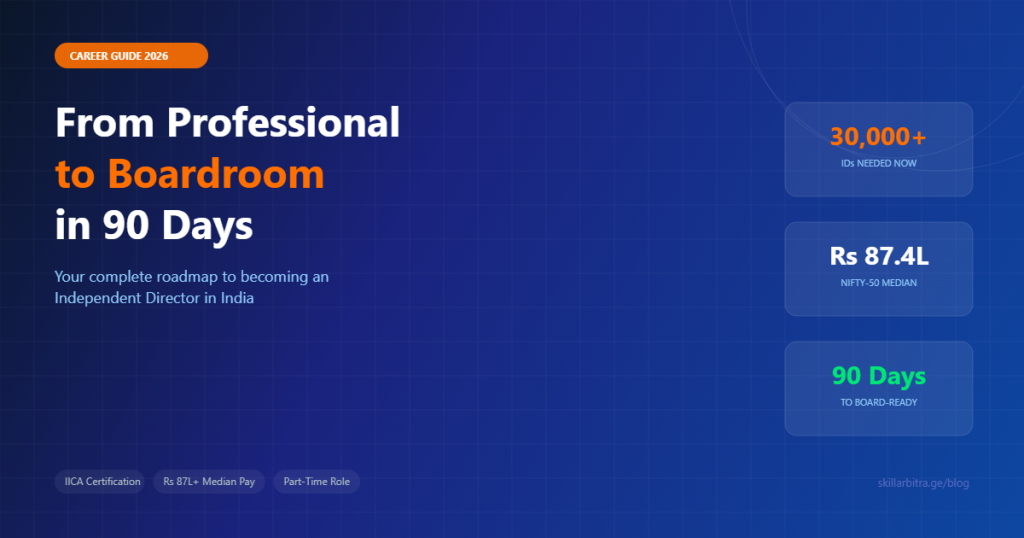
The independent director career path is one of the most rewarding professional pivots available in India today. If you are a senior professional with 15 or more years of experience in any field, you already possess the functional expertise that company boards actively seek. With over 30,000 board positions to fill right now and median compensation at Nifty-50 companies reaching Rs 87.4 lakh in FY24, this is not a distant aspiration reserved for retired bureaucrats. It is a concrete, achievable transition you can complete in 90 days.
This guide gives you the exact roadmap. Not theory, not legal jargon, but a week-by-week action plan built on Section 149(6) of the Companies Act 2013, SEBI LODR Regulations, and the practical realities of how board appointments actually happen in India.
Table of Contents
- Who Is an Independent Director and Why This Career Path Matters
- Eligibility: Do You Qualify Under Section 149(6)?
- Your 90-Day Roadmap: From Professional to Board-Ready
- What You Will Actually Earn
- Four Career-Specific Playbooks
- Inside the Boardroom
- Tenure, Liability and Risk
- Tenure Rules: 5+5 Years and Cooling-Off
- Section 149(12): Your Liability Shield
- When the Shield Fails: Satyam and IL&FS
- Practical Risk Mitigation: Four Steps
- Frequently Asked Questions
Who Is an Independent Director and Why This Career Path Matters
Legal Definition Under Section 149(6)
Section 149(6) of the Companies Act 2013 defines an independent director as a person of integrity who possesses relevant expertise and experience, and who has no material relationship with the company that could compromise their objectivity. The statute does not require you to be retired, does not require previous board experience, and does not prescribe a minimum educational qualification. What it requires is integrity, expertise, and independence from the company you serve on.
The definition is deliberately broad. Parliament intended the Nomination and Remuneration Committee and the board to exercise judgement on what constitutes relevant expertise for their specific company. A technology company may need cybersecurity expertise while a pharmaceutical company may need regulatory affairs knowledge. Your professional track record is what matters, not a specific degree. This means that a career path as an independent director is open to virtually any senior professional who can demonstrate domain expertise and has no conflicts of interest with the company in question.
The Demand: Over 30,000 Positions to Fill
The opportunity is structural, not speculative. Every listed company in India must reserve at least one-third of its board for independent directors under Section 149(4) of the Companies Act. SEBI LODR Regulation 17(1)(b) pushes this to 50% when the chairperson is a promoter or related to a promoter, which describes the majority of Indian listed companies. Beyond listed companies, Rule 4 of the Companies (Appointment and Qualification of Directors) Rules 2014 extends the mandate to unlisted public companies crossing Rs 10 crore in paid-up capital, Rs 100 crore in turnover, or Rs 50 crore in aggregate outstanding loans. These companies must have at least two independent directors.
With thousands of companies crossing these thresholds every year as the Indian economy grows, the supply-demand gap keeps widening. By some industry estimates, India needs over 30,000 independent directors right now. The sectors most actively seeking board talent include banking and financial services (risk management, compliance, and audit expertise), information technology (cybersecurity governance, data privacy, and digital transformation), pharmaceuticals (regulatory affairs and clinical governance), manufacturing (supply chain, ESG compliance, and operational excellence), and startups approaching IPO (corporate governance setup and SEBI compliance readiness).
SEBI LODR Regulation 17(1)(a) adds another dimension: the top 1,000 listed entities by market capitalisation must have at least one woman independent director. This requirement was initially mandated for the top 500 entities from April 1, 2019, and extended to the top 1,000 from April 1, 2020, further expanding the pool of available positions.
Why Mid-Career Professionals Have the Edge
One misconception that frequently appears on professional forums is the belief that you need “connections” or “political influence” to land a board seat. The reality is different. Section 178(3) of the Companies Act requires every listed company’s Nomination and Remuneration Committee to evaluate the balance of skills on the board and identify gaps. This is a skills-based process, not a relationship-based one. Companies are legally obligated to look for specific expertise they lack on their board.
What makes this independent director career path particularly attractive for mid-career professionals is the combination of three factors that no other career pivot offers simultaneously. First, the compensation is substantial — the median at Nifty-50 companies is Rs 87.4 lakh. Second, the commitment is part-time — typically 16 to 20 days per year per board. Third, you can hold multiple positions — Section 165 allows up to 20 directorships. You do not need to leave your current career. You add board income on top of it.
The Compensation Reality: Rs 87.4 Lakh Median at Nifty-50
According to the Exec-Rem Advisors study reported by Business Standard in August 2024, the median total compensation for independent directors at Nifty-50 companies reached Rs 87.4 lakh per year in FY24, representing a 106% increase since FY19. Mid-cap listed companies in the BSE 500 typically pay between Rs 15 and 25 lakh per year, small-cap listed companies offer Rs 5 to 10 lakh, and unlisted public companies, which represent the entry-level tier, generally pay between Rs 2 and 5 lakh annually.
The compensation structure has two components. Sitting fees are capped at Rs 1,00,000 per meeting of the Board or committee thereof under Rule 4 of the Companies (Appointment and Remuneration of Managerial Personnel) Rules 2014. This is a single uniform cap applying to all meetings. Commission on net profits is capped at 1% if the company has a Managing Director or Whole-Time Director, or 3% if it does not, under Section 197(1). The total managerial remuneration must not exceed 11% of net profits. Stock options are explicitly prohibited under Section 197(7A) to preserve independence.
The challenge most professionals face at this stage is not eligibility but visibility. They qualify on paper but are invisible to the NRCs looking for them. The 90-day roadmap in this guide solves that problem.
Eligibility: Do You Qualify Under Section 149(6)?
The Six Statutory Conditions
Before you invest time in this independent director career path, you need to confirm that you clear the eligibility bar. Section 149(6) sets out six specific conditions, and you must satisfy all of them simultaneously. There is no room for “substantial compliance” — courts and regulators have consistently held that the test is strict.
First, you must be a person of integrity who possesses relevant expertise and experience. The Act deliberately does not define “integrity” or prescribe minimum qualifications, leaving this determination to the NRC and the board. Second, you must not be a promoter of the company or its holding, subsidiary, or associate company, and must not be related to the promoters or directors. “Related” is defined broadly under Section 2(77) and includes spouse, father, mother, son, daughter, son’s wife, and daughter’s husband.
Third, you must have no pecuniary relationship with the company beyond director remuneration for the current and two preceding financial years, with the only exception being transactions not exceeding 10% of your total income. Fourth, neither you nor your relatives should have been a Key Managerial Personnel or employee of the company in the three financial years immediately preceding the year of appointment. Fifth, you must not be a partner or employee of the company’s statutory auditor, internal auditor, cost auditor, or company secretary in practice, and must not have been one in the preceding three financial years. Sixth, you and your relatives together must not hold securities exceeding Rs 50 lakh or 2% of the paid-up share capital, whichever is lower, and must not hold 2% or more of the total voting power.

Common Disqualification Traps
Another frequently overlooked disqualification arises from clause (c), the pecuniary relationship test. Professionals who serve as consultants to a company often assume their consulting fees are distinct from the director relationship, but any pecuniary relationship beyond director remuneration that exceeds 10% of total income during the relevant period triggers disqualification. The lookback covers the current and two preceding financial years, meaning a consulting engagement that ended eighteen months ago can still prevent an independent directorship today.
The Practical Eligibility Test
If you are a working professional in a completely unrelated industry, you almost certainly qualify. The restrictions are designed to prevent conflicts of interest, not to keep professionals out. The practical test is simple: if you have no financial relationship with the company, are not related to its promoters, have never worked for it or its auditors, and do not hold significant shares, you are eligible. For a deeper look at the role itself, see our guide on the work of an independent director.
Your 90-Day Roadmap: From Professional to Board-Ready
Week 1-2: DIN and Databank Registration
Every director in India needs a Director Identification Number. Apply through Form DIR-3 on the MCA portal at mca.gov.in. You will need your PAN card, Aadhaar card, a passport-size photograph, proof of residence, and a Digital Signature Certificate. Processing takes approximately one working day once a complete application is submitted. The fee is Rs 500.
Your second step is registering on the IICA Independent Directors Databank. This is mandatory under Rule 6 of the Companies (Appointment and Qualification of Directors) Rules 2014. Visit the official portal at independentdirectorsdatabank.in and complete your registration. You must first register on the MCA portal, then create your databank profile. Our IICA certification guide covers the registration process in detail.
The registration fees are structured in three tiers, all inclusive of 18% GST. The one-year plan costs Rs 5,000 plus GST, totalling Rs 5,900. The five-year plan costs Rs 15,000 plus GST, totalling Rs 17,700, which works out to Rs 3,540 per year. The lifetime plan costs Rs 25,000 plus GST, totalling Rs 29,500, and represents the best value. At Rs 29,500 as a one-time payment, the lifetime plan pays for itself with a single board meeting sitting fee.
Week 3-6: Passing the OPSAT
Unless you are exempt, you must pass the Online Proficiency Self-Assessment Test within two years of databank registration. The two-year deadline was extended from the original one-year period by the Fifth Amendment Rules 2020 (G.S.R. 774(E), dated December 18, 2020). The passing score was simultaneously reduced from 60% to 50% by the same amendment.
The test consists of 50 multiple-choice questions carrying 100 marks in total, with two marks per question. You have 75 minutes to complete it, with no negative marking for incorrect answers. There are two daily time slots at 2:00 PM and 8:00 PM, and you can attempt the test unlimited times with a mandatory one-day gap between attempts. Results are immediate, with an e-certificate generated upon passing.
The syllabus is divided equally between Board Essentials (25 questions covering Companies Act 2013 sections 149 through 188, SEBI LODR Regulations, and SEBI Prohibition of Insider Trading Regulations) and Board Practice (25 questions covering financial literacy, corporate governance principles, ethics, and case studies).
Rule 6(4) exempts two categories from the OPSAT. Advocates, Chartered Accountants, Cost Accountants, and Company Secretaries who have been in practice for at least 10 years are exempt. Additionally, individuals who have served as director or KMP for at least 3 years in qualifying companies are exempt, with this threshold having been reduced from 10 years by the Fifth Amendment Rules 2020.
Week 7-10: Building Your Board-Ready Profile
Passing the test makes you eligible. Getting appointed requires visibility. The gap between eligibility and appointment is where most professionals stall, and closing it requires understanding how Nomination and Remuneration Committees actually search for candidates.
When companies search the Independent Directors Databank, they filter by industry expertise, functional skills, geographic availability, board experience, and professional qualifications. Your profile must be complete, specific, and keyword-rich. The difference between a bad profile and a good one is specificity. A bad profile reads: “Senior professional with 20 years of experience in various industries.” A good profile reads: “22 years in corporate treasury and risk management across automotive and chemical manufacturing. Specialise in forex exposure hedging (USD/EUR/JPY), working capital optimisation, and bank covenant compliance. Managed treasury operations for a BSE-500 company with Rs 3,000 crore turnover. Audit Committee and Risk Management Committee ready.” The good version tells an NRC exactly what skill gap you fill and mentions specific committee readiness.
Section 178(3) of the Companies Act requires the NRC to evaluate the balance of skills, knowledge, and experience on the board before recommending a new appointment. This means every board maintains a skills matrix with identified gaps. Position yourself as the solution to a specific gap. Technology professionals should emphasise cybersecurity governance and digital transformation oversight. Chartered Accountants should emphasise audit committee expertise and financial reporting oversight. Lawyers should emphasise regulatory compliance and legal risk management. HR professionals should emphasise compensation committee expertise and ESG social metrics.
Board appointments do not happen through job portals. They happen through NRC recommendations (get known to committee members through industry associations and professional bodies), board advisory firms (register with firms like EMA Partners, Heidrick and Struggles, and Egon Zehnder), industry associations (CII, FICCI, and ASSOCHAM host governance forums), IICA events (networking programmes specifically for databank registrants), and professional referrals (existing independent directors who are often asked to recommend candidates).
Week 11-12: Targeting Your First Appointment
Your first independent directorship will likely not be at a Nifty-50 company. The realistic starting tier is unlisted public companies crossing the Rs 10 crore paid-up capital threshold (they are newly required to appoint two independent directors and are actively looking), small-cap listed companies (lower competition, easier access), and companies in your industry where your expertise is directly relevant.
The appointment process follows a statutory sequence. The NRC identifies a skills gap on the board under Section 178(3). They search the IICA databank and their networks for suitable candidates. The board passes a resolution recommending your appointment. Shareholders approve at the Annual General Meeting by ordinary resolution for the first term. The company issues a formal letter of appointment as per Schedule IV of the Companies Act. Form DIR-12 is filed with the Registrar of Companies within 30 days. For listed companies, disclosure to the stock exchange must happen within 24 hours under SEBI LODR Regulation 30.
The independent director career path has one notorious hurdle at this stage: how do you get appointed when you have zero board experience? The answer is to reframe “no board experience” as a feature rather than a limitation. What you bring is what boards call “functional expertise.” You have 15 to 20 years of operational knowledge in a specific domain. Schedule IV of the Companies Act says independent directors should bring “independent judgement” on issues of strategy, performance, risk management, resources, and standards of conduct. That is exactly what your domain expertise provides.
Start where competition is lowest. Unlisted public companies crossing the Rs 10 crore threshold are actively looking with no established board networks. Section 8 companies (non-profits registered under the Companies Act) need independent directors for governance credibility. Subsidiary companies of listed entities offer easier entry points than parent companies. Companies in your professional network may need independent directors and would prefer someone they know from a professional context.
What You Will Actually Earn: The Complete Compensation Framework
Sitting Fees and Commission Structure
Independent director compensation in India has two primary components, and understanding both is essential before committing to this career path.
Sitting fees are capped at Rs 1,00,000 per meeting of the Board or committee thereof under Rule 4 of the Companies (Appointment and Remuneration of Managerial Personnel) Rules 2014. This is a single uniform cap applying to all meetings, whether board meetings or committee meetings. Most Nifty-50 companies pay close to this cap. If you serve on the Audit Committee, the NRC, and the Stakeholders Relationship Committee alongside quarterly board meetings, a single company can generate Rs 16 to 20 lakh per year in sitting fees alone.
Commission on net profits adds substantially to the total. Section 197(1) allows up to 1% of net profits if the company has a Managing Director or Whole-Time Director, or up to 3% if it does not. The total managerial remuneration across all directors and managers must not exceed 11% of net profits. Stock options are explicitly prohibited under Section 197(7A) to preserve independence from equity-linked incentives.
Income Math: Building a Board Portfolio
The portfolio effect is where the arithmetic becomes compelling. A single small-cap listed board position, with four board meetings and eight to ten committee meetings per year, generates between Rs 4 and 7 lakh annually. A single mid-cap listed position with five to six board meetings and twelve to sixteen committee meetings yields Rs 13 to 22 lakh per year. Three mid-cap listed positions generate Rs 39 to 66 lakh. A mixed portfolio of two mid-cap and two small-cap positions delivers Rs 34 to 58 lakh. At five boards across different tiers, your total reaches Rs 55 lakh to Rs 1 crore, with a time commitment of roughly 70 to 100 days per year, or about 25 to 30% of your working time. That is a part-time commitment delivering full-time senior executive income.
Section 165 of the Companies Act allows up to 20 directorships overall with a maximum of 10 in public companies. SEBI LODR Regulation 17A limits this to 7 listed company directorships, or 3 if you also serve as a whole-time director in any listed company.
The Real Time Commitment Month by Month
Every guide says “four to six meetings per year” and leaves it at that. The reality is more nuanced. For an independent director sitting on one listed company board with Audit Committee and NRC membership, the calendar looks like this.
January brings the Q3 board meeting and Audit Committee review of quarterly results, requiring approximately two days. February has an NRC meeting focused on performance review and succession planning, taking one day. March is reserved for the separate meeting of independent directors mandated by Schedule IV, which takes half a day. April is the busiest month of the first half, with the Q4 and annual board meeting combined with the Audit Committee’s review of annual results, requiring three days. May follows with the NRC annual remuneration review, taking one day. June and July bring the Q1 board meeting and AGM preparation, requiring two to three days. August and September are the heaviest period of the year, with the Annual General Meeting, pre-AGM board meeting, and shareholder queries consuming three to four days. October has the Q2 board meeting and Audit Committee, taking two days. November and December are the lightest months, with strategy sessions and risk reviews taking one to two days.
The total for a single board is 16 to 20 days per year. The heaviest months are April and August-September. Most meetings happen in the city where the company is headquartered, though post-COVID many companies offer video conferencing for committee meetings.
Tax Treatment of Independent Director Income
The tax treatment adds another layer of attractiveness. Independent director fees are taxed as “Income from Business or Profession” under Section 28 of the Income Tax Act, not as salary. TDS is deducted at 10% under Section 194J (not Section 192, which applies to salary). If your total fees exceed Rs 20 lakh per year, you must register for GST. GST at 18% applies under the Reverse Charge Mechanism, meaning the company paying you deposits the GST.
Four Career-Specific Playbooks
Chartered Accountants and Finance Professionals
CAs have the strongest natural advantage in the independent director career path. SEBI LODR Regulation 18 mandates that at least two-thirds of Audit Committee members must be independent directors, all members must be financially literate (defined as the ability to read a balance sheet, profit and loss statement, and cash flow statement), and at least one member must have accounting or financial management expertise. If you are a CA, you are the most sought-after profile for Audit Committees.
Your playbook involves emphasising your ability to read financial statements, identify red flags in auditor reports, and evaluate internal controls. If you have forensic accounting or fraud investigation experience, that is a rare and particularly valuable skill for boards in the post-Satyam and post-IL&FS era. Target companies in sectors you have audited or consulted for, where your industry knowledge gives you an immediate advantage. CAs with 10 or more years of practice are exempt from the OPSAT under Rule 6(4).
Lawyers and Legal Professionals
Every board needs someone who can spot regulatory risk before it becomes a crisis. With SEBI continuing to tighten disclosure norms, insider trading regulations, and related party transaction rules, legal expertise on the board has never been more critical. Your target committees are the Stakeholders Relationship Committee (Regulation 20), the Risk Management Committee, and any ad-hoc committee dealing with litigation or regulatory matters.
If you specialise in corporate law, mergers and acquisitions, or securities law, you fill a high-demand gap. Advocates with 10 or more years of practice are exempt from the OPSAT. Target companies facing regulatory transitions, including BNSS implementation, new data protection law compliance under the DPDP Act 2023, and ESG reporting mandates.
IT and Technology Professionals
Technology professionals are filling the fastest-growing skill gap on Indian boards. SEBI’s 2024 Cybersecurity and Cyber Resilience Framework (CSCRF) for regulated entities made technology risk a board-level agenda item, yet most boards have zero members with deep technology expertise. Board composition studies show that fewer than 8% of independent directors across the BSE 500 have a primary background in technology.
Frame your experience around governance rather than coding. “Data governance framework design” is a boardroom skill. “Python development” is not. Highlight experience with IT audits, SOC 2 compliance, the Digital Personal Data Protection Act 2023, and business continuity planning. You will need to pass the OPSAT since there is no exemption for IT professionals. Target BFSI companies (mandatory cybersecurity committee), pharma (data integrity), and any company with significant digital operations.
HR, Marketing, and Operations Professionals
ESG (Environmental, Social, Governance) reporting is now mandatory for the top 1,000 listed companies under SEBI’s BRSR framework. The “S” in ESG, covering employee welfare, diversity metrics, and supply chain labour practices, is where HR and operations professionals bring irreplaceable expertise. Your target committees include the NRC (compensation design, succession planning), the CSR Committee, and the Stakeholders Relationship Committee.
If you have POSH Act compliance experience, emphasise it since every company with 10 or more employees needs a POSH policy, and boards need oversight. Supply chain professionals should target manufacturing companies with ESG reporting obligations. Marketing professionals should target consumer-facing companies where brand governance and stakeholder communication matter.
Inside the Boardroom: What the Job Actually Looks Like
A Day in the Life of an Independent Director
Most people imagine a board meeting as a conference room full of suits nodding along to a PowerPoint presentation. The reality is more demanding, more intellectually stimulating, and more consequential than that.
Three days before the meeting, you receive the board pack. This is typically 200 to 400 pages of documents including the agenda, minutes of the last meeting, quarterly financial statements, management discussion and analysis, compliance certificates, related party transaction approvals, committee reports, and any special items for board approval. Your job is to read every page. This is not optional. Section 166(2) of the Companies Act requires you to act with due and reasonable care, skill, and diligence. If something goes wrong and you claim you did not read the papers, that defence will not hold under Section 149(12).
On the morning of the meeting, arrive 30 minutes early. Use this time to speak informally with the company secretary and the CFO. This is when you learn what is not in the board papers: the tone, the concerns, the things management is worried about but has not flagged formally. Experienced independent directors learn more in these hallway conversations than in the formal meeting.
During the meeting itself, which typically runs three to five hours, the Company Secretary presents the agenda, the CEO gives a business update, and the CFO walks through the financials. Then the real work begins. Your role is to ask the questions that management does not want to answer. “Why did receivables spike 40% this quarter?” “What is the succession plan if the CEO leaves?” “Why are we approving this related party transaction at above-market rates?” This is where you earn your sitting fee.
After the meeting, sign the attendance register and follow up on any action items assigned to you. If you dissented on any resolution, ensure your dissent is recorded in the minutes under Section 118. This is your primary liability shield under Section 149(12).
IICA Databank Profile That Gets You Found
Your IICA databank profile is your board-ready resume. When companies look for independent directors, the NRC or the company secretary searches the databank using specific filters. Optimising your profile for these filters is the difference between being found and being invisible.
NRCs filter by industry (select every industry where you have meaningful experience, not just your current one), functional expertise (be specific since “finance” is too broad while “internal audit and risk management” is searchable and differentiated), geographic availability (companies prefer directors who can physically attend meetings, so select multiple cities if you are willing to travel), and professional qualifications (list every relevant qualification since CA, CS, CMA, LLB, MBA, CFA, and CISA are all keyword filters).
The Cold-Start Problem: Getting Your First Board Seat
Companies are legally obligated to look beyond the usual suspects. Section 178(3) requires the NRC to formulate criteria for determining qualifications, positive attributes, and independence. SEBI LODR Schedule II Part D further specifies that the NRC must identify qualified persons. The law pushes companies toward skills-based selection, not relationship-based selection.
Start where the competition is lowest. Unlisted public companies crossing the Rs 10 crore threshold are newly required to appoint two independent directors under Rule 4 and are actively looking, with no established board networks. Section 8 companies (non-profits) often need independent directors for governance credibility. Subsidiary companies of listed entities offer easier entry points. Companies in your professional network may need independent directors and would prefer someone they know from a professional context.
Your First 30 Days After Appointment
The first month sets the tone for your entire tenure. In the first three days, sign the letter of appointment per Schedule IV format, file Form DIR-2 (consent to act as director) and Form DIR-8 (declaration of non-disqualification under Section 164) with the company, submit Form MBP-1 (disclosure of interest in other entities under Section 184, which is an internal board disclosure and not filed with the ROC), and confirm your DIN is active on the MCA portal.
During days four through ten, request and read the last four quarters of board papers, Audit Committee minutes, and annual reports. Study the company’s related party transactions register. Review the vigil mechanism and whistleblower policy under Section 177(9) and (10). Understand the company’s insider trading code and identify your trading window restrictions. Ask the CFO for a briefing on the financial position, cash flow, and any ongoing litigation.
In the second and third weeks, schedule one-on-one meetings with the Company Secretary, the statutory auditor (ask about audit observations and management responsiveness), fellow independent directors (understand board dynamics), and the internal auditor (your early warning system).
In the fourth week, prepare for your first board meeting by reading the board papers cover to cover and preparing at least three to five substantive questions. Do not try to prove your worth by challenging everything in your first meeting. Observe, listen, and ask clarifying questions. Set up your compliance calendar for the year.
Tenure, Liability and Risk: What Protects You and What Does Not
Tenure Rules: 5+5 Years and Cooling-Off
Section 149(10) allows a maximum first term of up to five consecutive years. Reappointment for a second term requires a special resolution passed by shareholders, also under Section 149(10). After completing two consecutive terms totalling a maximum of ten years, Section 149(11) mandates a three-year cooling-off period during which the person must not be appointed in or associated with the company in any capacity, directly or indirectly. Section 149(13) provides that independent directors are not subject to retirement by rotation under Section 152(6), giving them tenure security.
On multiple boards, Section 165 allows up to 20 directorships overall with a maximum of 10 in public companies. For listed companies, SEBI LODR Regulation 17A limits this to 7 independent directorships, reducing to 3 if you also serve as a whole-time director in any listed entity.
Section 149(12): Your Liability Shield
Section 149(12) is a non-obstante provision that limits liability to acts of omission or commission that occurred with the director’s knowledge, are attributable through board processes, involved the director’s consent or connivance, or occurred because the director failed to act diligently.
This creates a four-limb test. If you can demonstrate that you attended meetings diligently, read board papers, asked the right questions, recorded your dissent when necessary, and acted in good faith, the law protects you from liability for management decisions you were not involved in.
A former member of a regulatory enforcement team has shared an important observation about how Section 149(12) operates in practice. The provision creates a rebuttable presumption of non-liability, but the burden shifts to the director to demonstrate diligence when enforcement proceedings are initiated. Directors who maintain a personal file of all board papers, notes, questions raised, and dissent recorded have a significantly stronger defence than those who rely solely on company-maintained minutes.
Your general duties as a director are codified in Section 166 — act in good faith, exercise due care, avoid conflicts of interest. Section 149(8) mandates compliance with Schedule IV, which is the Code for Independent Directors.
When the Shield Fails: Satyam and IL&FS Lessons
Section 149(12) protects you when management commits fraud without your knowledge and you attended meetings diligently with no red flags in the board papers, when the company suffers losses from a decision you voted against and your dissent is recorded in the minutes, and when regulatory violations by operational teams were never escalated to the board through formal processes.
Section 149(12) does not protect you when you approved a related party transaction without questioning its arm’s-length pricing, when you signed off on financial statements containing material misstatements you should have spotted, when you failed to attend meetings consistently (because low attendance equals lack of diligence), or when you knew about a problem but chose silence, since silence when you should have spoken constitutes connivance.
The Satyam scandal (2009), involving Rs 7,000 crore of falsified accounts, exposed the failure of independent directors to question non-existent cash reserves. The IL&FS crisis (2018) saw the NCLT suspend the entire board, with Audit Committee independent directors specifically implicated for being aware that loans were being granted to already-defaulting borrowers. In December 2025, IL&FS initiated proceedings to recover Rs 187 crore in excess remuneration from former directors. The lesson from both: passive attendance is not due diligence, and committee-level knowledge pierces the Section 149(12) shield.
Practical Risk Mitigation: Four Steps
First, confirm that the company provides Directors and Officers (D&O) liability insurance before accepting an appointment, and verify the coverage amount and scope. Second, whenever you disagree with a board decision, ensure your dissent is recorded in the minutes under Section 118, which is your single most important legal safeguard. Third, if you discover governance issues that management refuses to address, resign under Section 168 of the Companies Act and optionally file Form DIR-11 with the ROC stating your reasons (this filing became optional after the 2018 amendment but is strongly recommended for your legal record, while the company is required to file DIR-12 within 30 days). Fourth, maintain a personal file with copies of every board paper, every meeting minute, and every email where you raised concerns.
Disclaimer: This article is for informational and educational purposes only and does not constitute legal advice. Laws, rules, and procedures are subject to change. For advice specific to your situation, consult a qualified legal professional. Information is current as of March 2026.
Frequently Asked Questions
How long does it take to become an independent director?
With focused effort, you can complete all formalities within 60 to 90 days. DIN application takes one working day, IICA databank registration is immediate, and the OPSAT can be attempted as soon as you feel prepared. The actual board appointment depends on networking and opportunity, which can take an additional 3 to 12 months.
Do I need to quit my current job?
No. Independent directorships are part-time roles. Most boards meet four to six times per year, with additional committee meetings. The total time commitment per board is 16 to 20 days per year.
What is the minimum qualification required?
The Companies Act does not prescribe a minimum educational qualification. Section 149(6) requires integrity, relevant expertise, and experience. Your professional track record matters more than degrees.
How much does the entire process cost?
DIN application costs Rs 500. Databank registration ranges from Rs 5,900 to Rs 29,500 depending on the plan. The OPSAT is included in the databank registration fee. Total investment is under Rs 30,000 for lifetime access.
Can I become an independent director if I am under 40?
Yes. There is no minimum age requirement under the Companies Act. SEBI LODR Regulation 16(1)(b) requires a minimum age of 21 for listed companies. If you are 75 or above, the company must pass a special resolution under SEBI LODR Regulation 17(1A).
What happens if I fail the OPSAT?
Nothing. Unlimited retakes with a one-day gap. No penalty. Two years from databank registration to pass.
Can a practising CA become an independent director?
Yes, provided you are not the auditor of that specific company. Section 149(6)(iv) restricts only the company’s own auditor.
What is the difference between an independent director and a non-executive director?
All independent directors are non-executive directors, but not all non-executive directors are independent. An independent director must meet the specific criteria under Section 149(6), including no material relationship with the company, its promoters, or management.
Is previous board experience mandatory?
No. Companies seek fresh perspectives from professionals with functional expertise.
How are independent directors different from nominee directors?
Nominee directors are appointed by specific shareholders to represent their interests. Independent directors represent all shareholders and bring objective oversight.
Can NRIs become independent directors in India?
Yes. Foreign nationals must obtain a DIN, register on the IICA databank using passport. Land-border country nationals need MHA security clearance (June 2022 notification).
What committees must an independent director serve on?
Under SEBI LODR: at least two-thirds of the Audit Committee must be independent directors (Regulation 18), the NRC chairperson must be an independent director (Regulation 19), and the Stakeholders Relationship Committee must include at least one independent director (Regulation 20).
Can an independent director be removed before completing their term?
Under Section 169: ordinary resolution with special notice. For listed companies, SEBI LODR Regulation 25(2A) requires a special resolution for stronger protection.
Is the IICA databank registration mandatory?
Yes. Rule 6 mandates it for every independent director.
What is the tax treatment of independent director income?
Taxed as “Income from Business or Profession” under Section 28. TDS at 10% under Section 194J. GST at 18% under Reverse Charge Mechanism if fees exceed Rs 20 lakh per year.
Can a government employee become an independent director?
Government employees in active service generally cannot due to conduct rules. Retired officers from commerce, finance, or industry ministries are highly sought after and exempt from OPSAT under Rule 6(4) with 3 or more years qualifying experience.
Become an Independent Director!





 Allow notifications