
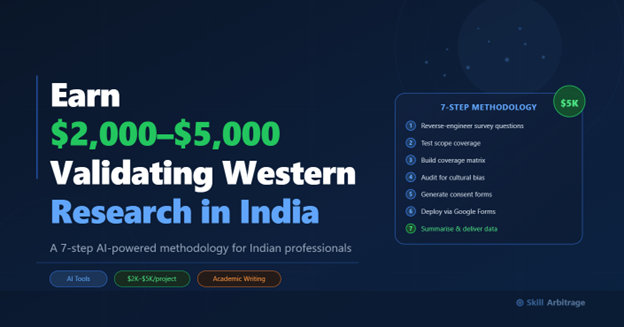

Every year, hundreds of landmark studies get published by researchers at Harvard, Oxford, PEW, and top EU universities and almost none of them have ever been tested in India. That’s not an oversight. It’s an opportunity.
Table of Contents
What Does It Mean to Validate Research in India?
When researchers publish a study, their findings are only as reliable as the population they tested. Most major academic studies draw respondents from “17 advanced economies” think the US, UK, Germany, Australia. India, with its 1.4 billion people spread across dozens of languages, religions, and socioeconomic classes, is almost never included.
Validating research in India means designing and executing a new data-collection exercise from scratch surveys, interviews, or observation studies to test whether the original findings hold in an Indian context. You don’t reproduce the original study. You build a culturally adapted version of it.
A Real-World Example: The PEW ‘What Makes Life Meaningful’ Study
PEW Research Centre published a landmark study asking respondents from 17 advanced countries what makes life meaningful. Their top findings: career success, financial security, personal achievement, and individual freedom.
Now ask the same question in India. As author-surgeon Atul Gawande observed in Being Mortal, Indians often prioritize dying surrounded by family and community over material milestones. Would an Indian respondent choose:
- Scenario A: ₹15 lakhs/year in Bangalore but visiting parents twice a year, OR
- Scenario B: ₹6 lakhs/year in hometown while caring for aging parents daily?
The answer to that question could challenge decades of Western research on human motivation and life satisfaction. That’s why researchers will pay $2,000–5,000 to find out.
Who Pays You to Validate Research in India and How Much?
The market for cross-cultural research validation is larger than most people realize. Your potential clients include:
- The original research teams (e.g., senior PEW researchers like Laura Silver or Patrick van Kessel) who want follow-up data
- University professors studying cultural psychology, sociology, or behavioral economics
- Corporate researchers at multinationals expanding to Indian markets
- Think tanks and policy institutes analyzing global social trends
Comprehensive survey studies typically pay $2,000–5,000 and take 3–4 weeks to complete for 100–500 responses. The time investment is 15–20 hours of actual work. And 60% of clients come back for regional follow-up studies.
How to Find Foreign Researchers Who Need You to Validate Research in India
You don’t need an academic network to get started. Here’s exactly how to find researchers who would pay for India-validated data:
- Search Google Scholar for papers in your domain. Look for studies done exclusively in Western countries (US, UK, EU, Australia).
- Check the ‘Cited by’ section of prominent papers to find hundreds of related researchers working on the same topic.
- Go to university faculty pages in departments like psychology, sociology, economics, public health, or law.
- Search LinkedIn for “research professor + [your subject]” and look at their published work.
- Use search strings like “life satisfaction cross-cultural study”, “cultural values US vs Asia”, or “[topic] India data gap”.
Key Takeaway: You don’t need to cold-pitch blindly. You’re approaching researchers whose published work already signals exactly what data they need.
The Exact 7-Step AI-Powered Methodology to Validate Research in India
Here’s the step-by-step process to go from a foreign research paper to a deliverable Indian validation study using AI to do the heavy lifting.
Step 1: Reverse-Engineer Survey Questions from the Research Hypothesis
Academic papers are built around hypotheses. Your job is to translate those hypotheses into practical survey questions that can be answered by real Indian respondents.
Use Claude.ai (or any capable AI tool) with this prompt sequence:
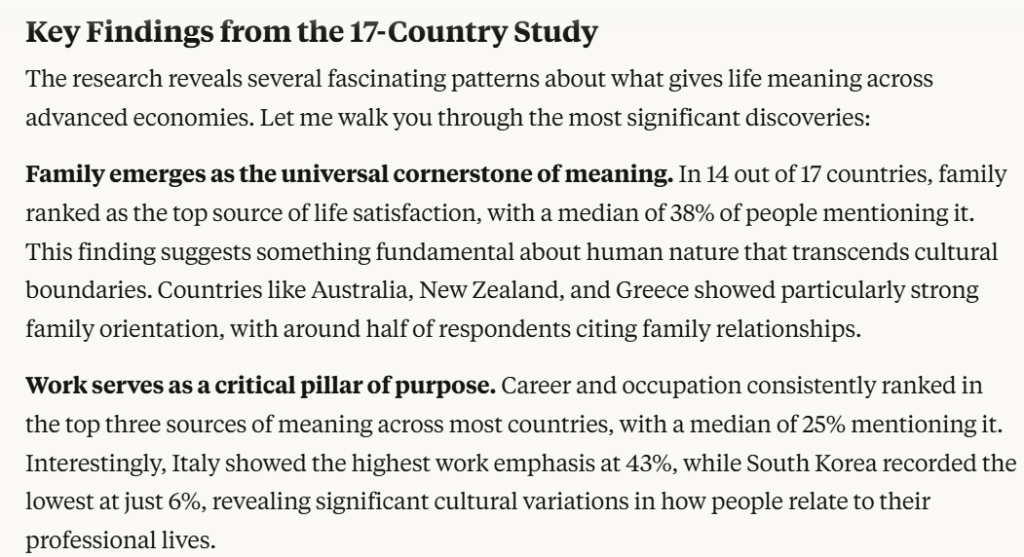
Prompt 1: This is a research (paper) of the PEW Research Centre. It was done on respondents from 17 advanced countries. The research is now to be tested in India. I want you to do two things for me:
- Find out the key findings of the study
- Contextualise them as hypotheses for testing in India
Claude did it for me in less than 10 seconds
Now, to get the third thing (reverse engineering) done, I will give my next prompt:

I want you to reverse-engineer survey questions from the research hypotheses (in the Indian context). I am used to interpreting hypotheses, but I am not skilled at turning research questions into practical, answerable items. That is where I need your guidance. Give me at least 5 survey questions to validate each hypothesis
Check out this document to find out what Claude generated for me: https://drive.google.com/file/d/1A1vfJiurTX_4xdXuWqCRNlTzEbrU4zvb/view?usp=sharing
Step 2: Test Scope Coverage
Scope coverage means ensuring your survey questions capture every dimension of what you’re measuring—not just the obvious ones. Think of it like mapping an unknown continent: you want to discover all major geographical features, not just the ones visible from where you land.
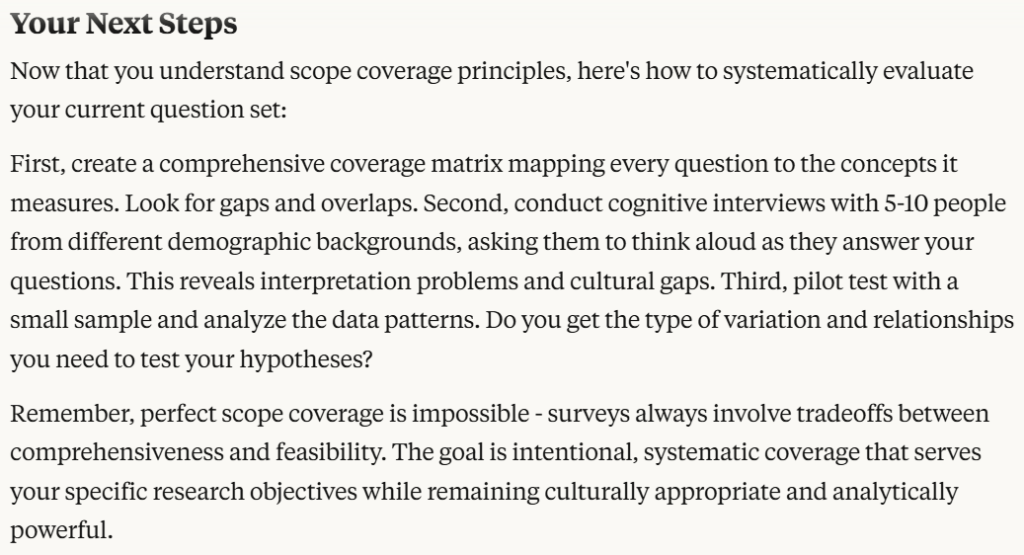
I used AI for this and told Claude that I want to test scope coverage and sought its guidance.
Claude not only gave me a detailed answer but also suggested what I should do next, giving me ideas for my next prompt.
Step 3: Create a Coverage Matrix
A coverage matrix is your survey blueprint mapping every question to the concept it measures. Just as an architect wouldn’t begin construction without confirming the bathrooms are on the floor plan, you shouldn’t deploy a survey without confirming every hypothesis is covered.
Prompt: Can you please create a comprehensive coverage matrix mapping every question to the concepts it measures?
Check out the coverage matrix here:
https://drive.google.com/file/d/1A8NHhX1-gLr-v0eoy34J-_QzXpFtDEff/view?usp=sharing
Towards the end of the coverage matrix which Claude generated for me, you can see a section called “strategic recommendations”. That is supposed to be read thoroughly.
I agreed with all the suggestions and asked Claude: Please apply the strategic recommendations and give me a revised version of the questionnaire after having incorporated the recommendations
Check the chat with Claude here (Step 1 to 3): https://claude.ai/share/2194ebf6-1997-43a4-91cc-c06f404a2f9f
Then I asked Claude to merge the revisions with the existing list of questions.
This is the final list of questions I have with me now: https://drive.google.com/file/d/17S6TdCPriUDSnLEmGKQ4w_fFukX60S4E/view?usp=sharing
What can you do next?
- You can use AI to simplify the language. The current language of the questionnaire can be too academic for large segments of your target population. You can try giving a prompt like: “Simplify this academic phrasing so a 10th grade student can understand”
- You can use AI to translate the questionnaire into multiple regional languages – Hindi, Bangla, Gujarati, Marathi, Tamil, Malayalam, Telegu, etc.
Step 4: Audit for Bias Before You Launch
This is one of the most overlooked steps and one of the most important. Questions that work in Western surveys often contain leading phrasing, double-barreled structures, or culturally loaded assumptions that will skew your Indian data.
Prompt: I want you to flag any leading or culturally biased phrasing and suggest neutral alternatives to these questions
Claude identified nine problem areas in my questionnaire in this context and shared this recommendation:
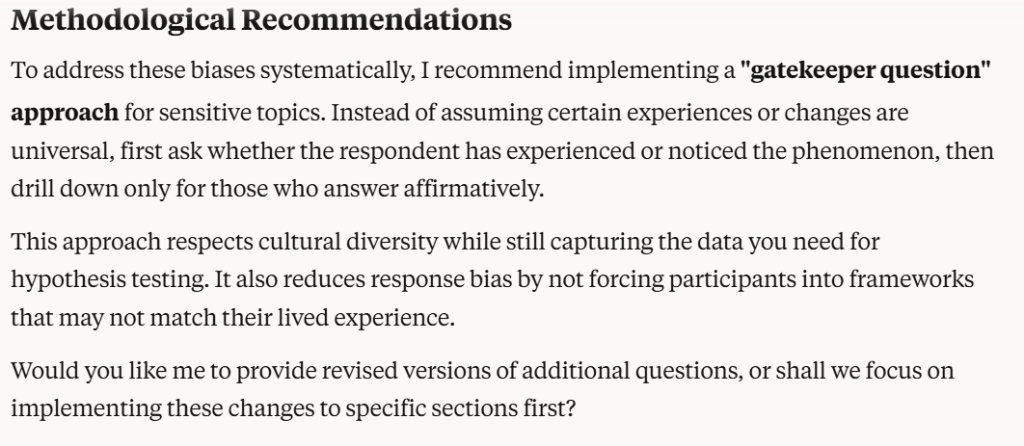
I asked Claude to implement the recommendations and give me a revised version of the entire questionnaire.
Step 5: Getting Consent
You cannot use respondent data ethically without proper informed consent. Consent requires that respondents clearly understand every question which means you first need to simplify complex academic language.
Prompt:
I want you to do two things:
- Scan the entire questionnaire and see if there are any technical or possibly complex words/phrases. If yes, I want you to break them down in layperson language – like explaining to a school student. Also, there should be no room for ambiguity and/or vagueness.
- Generate sample ethically sound consent statements – adding paragraphs wherever appropriate. Help refine tone, language, disclaimers (anonymity, data use, opt-out rights). And the language should be simple so that there no doubt in the minds of the respondents
Check out the output Claude generated after this:
https://drive.google.com/file/d/1gVdaTbZF0-h2AG164IpPoaBj58lfoKUk/view?usp=sharing
It created a separate consent form , which I can send along with the questionnaire. Check out here: https://drive.google.com/file/d/1uM3vvLobB0S4KPkA5Ntyeu7XiZ_Uf7cZ/view?usp=sharing
Step 6: Deliver the Survey via Google Forms or Typeform
Once your questionnaire is clean, audited, and consented, build it in Google Forms or Typeform. Both are free, mobile-friendly, and easy for respondents to complete on their phones.
Set up your forms guide:
https://drive.google.com/file/d/1ud17mHyiJ1MCmjAHShSxK58At5XDFmop/view?usp=sharing
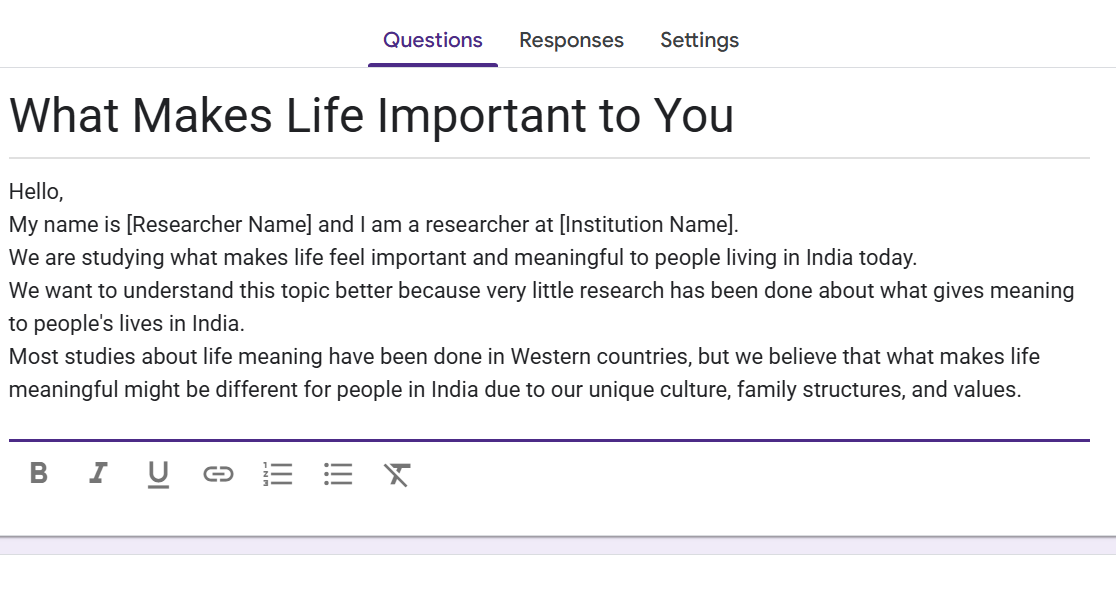
Once it is ready, you can send the questionnaire to your target groups by any ways you think fit like Email, LinkedIn, Social Media (both DM and groups), WhatsApp and Telegram groups, Online forums and/or Direct networks etc.
Here is the survey form on Google Forms –https://docs.google.com/forms/d/e/1FAIpQLSeqfnxrunxs4S68zcjEOKehSlPTd7LtBrhYE2xIwKmpwMUXXw/viewform?usp=sharing&ouid=104275941349093515798
Once done, wait (and give yourself a deadline)
Step 7: Summarise the Data
Once you have received X number of responses, you need to extract them.
How to do it?
- Go to “Responses” tab in Google Forms
- Click on the Google Sheets icon to export as spreadsheet
- Review completion rate, drop-offs, and recheck open-ended responses manually
- If needed, duplicate the form and send a fresh batch for the same study.
Now you need to process the data.
Use AI for the heavy lifting of data conversion and initial pattern detection, then apply your human judgment for interpretation and quality control.
Here is a step by step guide:
https://drive.google.com/file/d/1DSCZ1uE43KLj1kZWtaOSeatltttNjBf4/view?usp=sharing





 Allow notifications
I never realized how much foreign researchers are missing out on not validating their studies in India. With such a massive population and unique societal factors, it seems like a crucial step to ensure their findings are globally relevant. This guide really lays out a great roadmap for anyone looking to enter this niche market.