
Imagine working for a Silicon Valley startup or a New York fintech, drawing US-grade dollars, while sitting in your home in Pune or Hyderabad. A year ago, that sounded like a pipe dream for most Indian professionals. Today, thanks to Trump’s H-1B policy and its punishing $100,000 annual fee, it is fast becoming the default.
Table of Contents
The Trump H-1B Policy Move That Changed Everything
On 19 September 2025, the Trump administration imposed a $100,000 annual fee per H-1B worker. For most US firms, that single line item priced the H-1B programme out of the market.
Why this hits Indian professionals hardest: Over 72% of H-1B beneficiaries in recent years have been Indian nationals. In FY 2024, India accounted for around 71% of all H-1B approvals. So when the H-1B becomes too expensive to use, India is the country whose talent pipeline gets disrupted first.
But here is the part most people miss. The H-1B fee applies only to physical workers on US soil. Not to services, contractors, or remote employees. The moment that distinction sank in, US companies started rewriting their hiring strategies. And almost every rewrite ends up pointing to India.
How the H-1B Fee Triggered a Remote Contractor Hiring Boom
Platform data reveals this shift is both material and accelerating rapidly. Leading freelance marketplaces like Upwork have documented double-digit increases in remote global hiring appetite from U.S. companies.
Corporate willingness to hire abroad has risen sharply since the H-1B fee announcement. In fact, US companies are now three times more willing to hire remote workers internationally compared to before the pandemic. (Source)
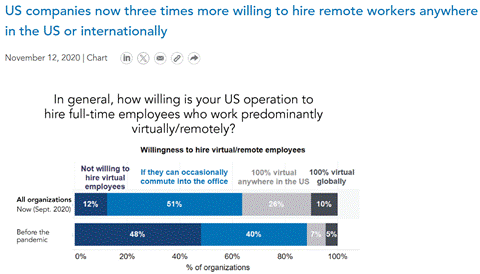
Instead of waiting months for H-1B approvals and paying $100,000 fees, businesses can engage skilled Indian professionals within weeks through contractor agreements. The speed and cost-effectiveness mean many companies are treating remote hiring not as a temporary fix, but as a permanent strategy shift.
Annual pay for an operations professional is around INR 2-3 LPA in India, versus USD 66,000+ in the United States. For companies, the math is simple: hire an entire team remotely for the cost of a single H-1B fee.
The contractor market isn’t just growing; it’s becoming the primary pathway for accessing US company opportunities without visa complications.
This contractor boom sounds like pure upside, but every major economic shift has trade-offs. Here’s the one challenge India faces, and why it’s actually creating even more opportunity.
The H-1B Shock Is Pushing MNCs to Scale India GCCs
It’s not just freelancing and remote contractor roles that are growing. Large multinationals are responding to H-1B restrictions by scaling up their India-based teams permanently.
India has long been a destination for outsourcing, but recently, American firms are going beyond hiring third-party contractors; they are setting up their own subsidiaries and “global capability centers” (GCCs) in Indian cities.
The scale is huge. The GCC market in India was worth about $64.6 billion in 2024 and is expected to reach $99-105 billion by 2030. That represents enormous growth in the scale of work U.S. companies are shifting to India.
Recent data shows this trend accelerating dramatically. GCC leasing in India has rebounded strongly, with nearly 100 million sq. ft. absorbed since 2021. GCCs now command 40% of office demand in 2025, and leasing activity is set to almost double 2021 levels. (Source)
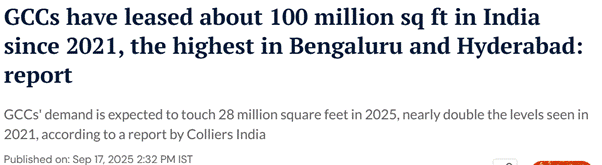
India is already home to some of the global marquee brands, with their GCC operations in India. This includes companies such as JPMorgan Chase, Walmart, and Target in Bengaluru, while Hyderabad also hosts companies such as McDonald’s, Heineken, and Vanguard Group.
Why does this matter for remote professionals? These MNC expansions create a parallel track of opportunities. While you build your freelance or contractor career, GCC roles offer another path, often with more stability, benefits, and structured growth.

What the H-1B Slowdown Means for India’s Remittance Economy
India’s economy has grown significantly dependent on remittances from overseas workers, particularly those in the U.S. on H-1B visas. India received roughly $120-$138 billion in global remittances recently (World Bank/RBI estimates for 2023–24).
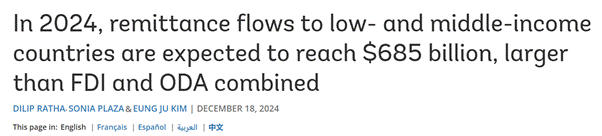
In 2024, remittance flows to low and middle-income countries reached $685 billion, larger than FDI and ODA combined, highlighting how crucial these financial flows are for emerging economies. (Source)
With fewer H-1B arrivals and renewals due to prohibitive costs, India faces a single-digit percentage hit to these dollar inflows compared to baseline projections. This represents a material but not critical impact.
While some families may need to adjust expectations around H-1B worker remittances, this short-term challenge is being more than offset by the surge in remote work opportunities and higher-value projects being relocated to India.
The reduction in traditional H-1B remittances is creating pressure to find alternative dollar-earning opportunities, exactly what remote work with US companies provides.
Why SMEs Are Dodging the H-1B Fee Through Remote Hiring
While corporate giants can establish entire overseas campuses, small and mid-sized enterprises (SMEs) lack the scale to open their own foreign offices. Yet, SMEs too have felt the pinch of H-1B-induced cost increases and are seeking relief.
For many of them, the answer is to hire remote workers overseas, effectively tapping into the same benefits of cost and H-1B-free services that big firms enjoy.
The benefits are clear. Saving six figures on a single hire frees up cash to invest in product development, marketing, or new staff.
Cost isn’t the only factor; skills availability also drives SMEs to look abroad. Certain skills are in short supply or very expensive in the U.S., but an entrepreneur might find abundant talent in India ready to work remotely. (Source)

By broadening their hiring beyond local candidates, SMEs gain access to a diverse global talent pool. This remote approach allows smaller companies to punch above their weight; they can build distributed teams with capabilities that rival much larger firms.
The trend of SMEs embracing global remote work is evident in the growth of facilitating services.
For example, an international HR platform (Deel) reported helping 35,000+ companies hire and pay workers in over 150 countries.
Many of those companies are likely startups and mid-sized firms taking advantage of the ease of global hiring.
Additionally, outsourcing providers and freelance marketplaces (like Upwork or Fiverr) have reported increasing usage by small businesses seeking overseas talent.
New Compliance Hurdles in the Post H-1B Hiring World
Here’s what you need to know to successfully navigate this new landscape. The shift toward remote hiring has created new pathways, but they come with different rules than traditional employment.
A rapid rise in “legal/structural” workarounds is creating new friction points that both companies and Indian professionals need to understand.
The main compliance challenges include:
Employer of Record (EOR) and Professional Employer Organization (PEO) hiring: Companies increasingly use third-party services to technically “employ” Indian workers, adding layers of complexity and cost.
Contractorization complexity: Converting what would have been employee relationships into contractor agreements requires careful legal structuring to avoid misclassification issues.
Third-country posting arrangements: Some firms explore creative visa solutions through other countries, adding immigration complexity.
Tax and regulatory frictions: Each workaround introduces new tax implications and compliance requirements that raise the effective cost of hiring.
What this means for you as an Indian professional:
- You need to understand different engagement models (contractor vs. EOR vs. direct hire).
- Be prepared for more complex payment and tax arrangements.
- Navigate varying contract terms and legal frameworks.
- Potentially work with intermediary platforms or agencies.
Despite these frictions, the cost savings compared to $100,000 H-1B fees still make these arrangements highly attractive for U.S. companies. Understanding these models early gives you a competitive advantage.
Platform and immigration analysts are documenting this migration to contractor/EOR models post-visa shocks. While these solutions aren’t seamless replacements for direct employment, they’re creating new pathways that didn’t exist before.
Why the H-1B Shake-Up Could Be Your Biggest Career Opportunity
These trends add up to a massive opening for Indian professionals in operations and support roles. The functions that keep businesses running, customer support, IT helpdesk, operations coordination, project management, and process optimization, are exactly what US companies are now hiring remotely at scale.
What makes Indian ops & support talent so valuable:
Deep Talent Pool: India offers millions of English-speaking professionals with proven experience supporting global clients across tech, customer service, and back-office functions.
Compelling Economics: Instead of spending $100K on visa fees alone, companies can build entire remote teams for that amount. The ROI has never been clearer.
Round-the-Clock Operations: The 9-12 hour time difference with the US means Indian contractors can keep work moving overnight, enabling true 24/7 coverage.
World-Class Infrastructure: With cloud tools, modern CRMs, and collaboration platforms, a remote professional in Hyderabad can deliver the same output as one sitting in Houston.
How to Position Yourself in the Post H-1B Economy
With US companies actively seeking remote talent, here’s how to make sure you’re ready:
Upskill and Showcase Relevant Experience: Get familiar with industry-standard tools and document your experience. A strong portfolio tells US hiring managers you can deliver from anywhere.
Master U.S. Business Culture: Working for a U.S. company requires strong communication skills and cultural awareness. Be proactive in communication; keeping teams updated becomes crucial.
Target MNC GCCs and Corporate Roles: Research which companies are expanding their India operations. Apply directly to GCC positions at major multinationals; these roles often offer better stability, benefits, and growth paths.
Position Yourself as the Solution: In interviews, don’t just talk about what you can do. Show them why hiring you remotely saves them $100K in fees, and you’re the right person to prove the model works.
H-1B Crisis to Career Opportunity: The Bottom Line
The H-1B was never the only door. It was just the one most Indian professionals could see. The Trump H-1B policy has not closed careers. It has redirected them.
US companies still need Indian talent. They still want Indian operations professionals, customer support specialists, project managers, and analysts. They just cannot afford to fly them to Houston anymore. They need to hire them in Hyderabad.
For the right professional, this is the biggest dollar-earning window in a decade. The companies are ready. The infrastructure is ready. The only question is whether you are.





 Allow notifications