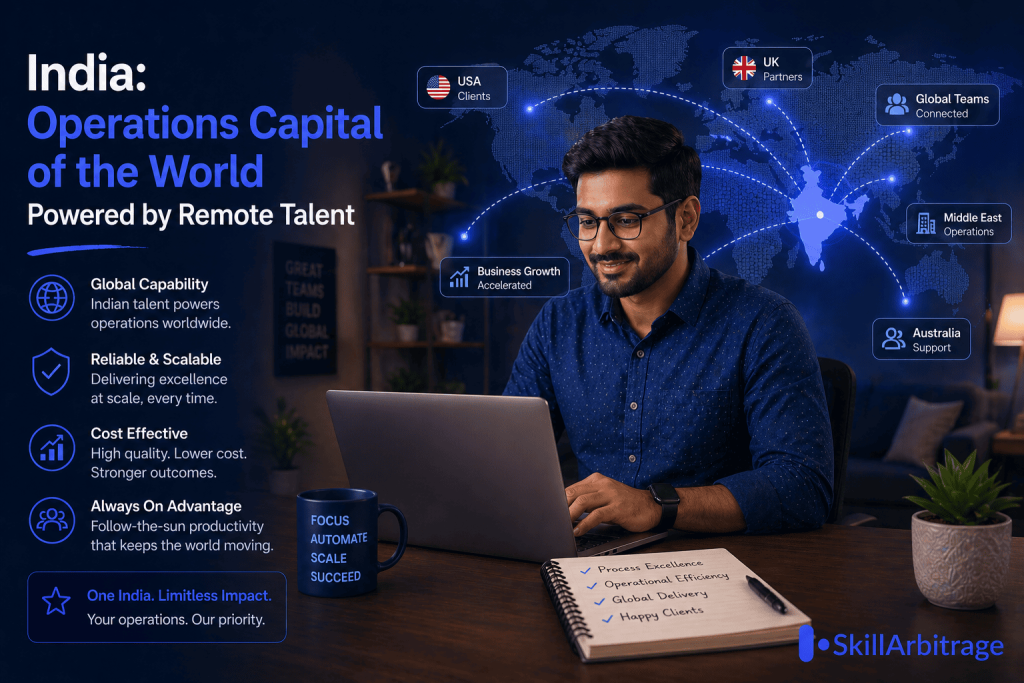

A virtual assistant in Indore is billing a US startup $25 an hour. A customer experience lead in Bhubaneswar is running operations for a SaaS firm in San Francisco. A bookkeeper in Surat is closing the books for three Australian agencies. None of them have left their hometown.
Table of Contents
From IT Hub to Operations Capital: India’s Next Export Story
You probably remember the 1990s and 2000s, when India became the world’s software hub. Companies abroad needed code, and they outsourced it to Infosys, TCS, and Wipro. India today earns more foreign currency from tech services than the country spends on oil and gas imports.
But that wave was just the IT industry. After 2020, the same opportunity is now playing out in every other service that can be exported remotely. Virtual assistants, startup generalists, content creators, bookkeepers, HR professionals, social media managers, and at the heart of it all, operations and support professionals.
According to government projections, India’s services exports will grow to $618 billion by 2030, up from $80 billion in 2018. IT services are slowing down at the $250 billion mark. The next $300 billion-plus is coming from these other exportable services. That is the engine quietly turning India into the operations capital of the world.

Why Global Companies See India as Their Operations Capital
Operations is the backbone of any business. Sales gets the customer in. Operations and support keep the customer there. Without a strong retention engine, no amount of marketing spend saves a company.
Every business needs these two engines to work in sync –
- The revenue engine, which is sales, marketing, and customer acquisition.
- And the retention engine, which is the experience that ensures customers stay, succeed, and trust the product or service.
So why are global companies pointing their operations capital arrow at India? Three reasons.
Talent shortage in the West. Developed countries are short on STEM and skilled service workers. Hiring from India gives them access to a global talent pool that is large, English-speaking, and trained.
Time-zone fit for 24/7 operations. SaaS, cloud, IT management, and e-commerce companies need round-the-clock support. India’s timezone covers US business hours during Indian evenings and nights without needing extreme shifts.
Cost economics. A US support professional charges $30 to $40 per hour, sometimes more. An equally skilled Indian professional delivers the same work at a fraction of the cost. For SMEs operating on tight budgets, the ROI is immediate.
Until recently, only MNCs could capture this advantage through GCCs and BPO contracts. SMEs, which make up over 95% of businesses in the US, were locked out. The pandemic blew that lock open.
The Pandemic That Turned India into the Remote Operations Capital
Before 2020, working for a US client almost always required a US visa. Remote work for foreign employers was rare. Most managers did not believe serious work could be done from home.
The pandemic forced everyone remote at the same time. Silicon Valley, US SMEs, agencies, services firms. There was no choice.
What employers discovered surprised them. They could tap a much larger and better talent pool by hiring globally. Productivity went up. Profitability went up. And the genie did not go back into the bottle.
Today, 16% of global businesses operate fully remotely. Advanced economies in the US and Europe are projected to cross 50% remote in the coming years. Around 73% of the US workforce is expected to take on freelance work this year.
If a US employer is happy to work remotely with a US worker, why not with you in India for a fraction of the cost, as long as the output matches? That single question is what makes India the operations capital of the new remote economy.

GCCs Are Cementing India’s Operations Capital Status
The story is not just about freelancers and SMEs. It is also about the world’s largest companies setting up shop in India.
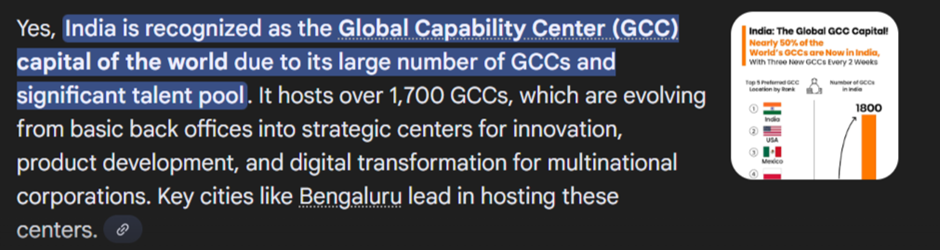
There are over 1,700 multinational corporations running Global Capability Centres (GCCs) in India today. At least 500 more MNCs are expected to launch GCCs by 2030. By that year, India is projected to host around 2,400 GCCs employing 4.5 million people. Even in 2025 alone, 4.5 lakh new GCC jobs are being created.
These centres are not back-office cost arbitrage anymore. They have evolved into hubs of digital innovation, AI deployment, and operational excellence. Bengaluru hosts JPMorgan, Walmart, Target. Hyderabad hosts McDonald’s, Heineken, Vanguard. And the next wave is moving beyond the metros.
Where the Next Wave of GCC Jobs Will Land
The new GCC map includes Pune, Jaipur, Coimbatore, Chandigarh, Indore, Bhubaneswar, Vadodara, Mysuru, Nagpur, and Lucknow. You no longer need to be in a metro to access these roles.
And guess which two functions sit at the top of every GCC’s hiring list? Operations and customer support. That is exactly why India is being called the GCC capital and the operations capital of the world in the same breath.
AI Is Accelerating India’s Rise as the Operations Capital
There is one more force pulling India into the operations capital seat: AI.
Indian companies have a track record of becoming the world’s go-to partner for new technology waves. SaaS gave us Zoho and Freshworks. Customer support outsourcing made India the global default in the 2000s. AI implementation is the next chapter, and Indian operations professionals are the natural fit for it.
The data confirms the demand. In Gartner’s 2023 survey, talent shortage was rated a top barrier to AI adoption alongside data and technical issues. IBM’s research found 42% of organisations felt they had inadequate generative AI expertise in-house. Western SMEs are looking for partners who can implement AI in real workflows, not just pitch slides.
The same way India became the customer support capital of the world in the 2000s, it is becoming the AI integration capital for support and operations in the 2020s.
The Indian operations professional who can wire AI into ticketing, CRM, scheduling, billing, and reporting workflows will be in extraordinary demand.
The Numbers Behind India’s Operations Capital Claim
The opportunity is not theoretical. It is already showing up in the numbers.
- 35 million small businesses in the US, 1.22 million in Canada, 5.5 million in the UK, all potential remote-hiring employers.
- More than 50 lakh new business applications filed in the US every year, compared to under 2 lakh companies incorporated in India in 2024 (MCA data).
- The World Economic Forum estimates global remote jobs will reach 92 million by 2030.
- Between 2025 and 2030, an estimated 4 to 5 million net new remote jobs are expected in support and operations alone.
- Contact centre outsourcing is projected to grow 9.8% annually through 2030.
The WEF specifically calls out lower-middle-income countries with surplus skilled, educated workers as the natural fillers for support roles in higher-income markets. That description fits India almost perfectly. That is the structural reason India is locking in its position as the operations capital of the world.
What India’s Operations Capital Era Means for Your Career
Five years from now, Indian ops and support professionals will not just serve the Indian market. They will serve a global one.
You will not need to relocate. You will not need to grind through BPO night shifts under a fluorescent tube light. You will not need a visa, a US job offer, or a recruiter. You will work directly with startups, SaaS companies, digital agencies, and services businesses across the US, UK, Canada, UAE, and Singapore.
Thousands of Indian support professionals from cities like Indore, Bhubaneswar, Lucknow, and Surat are already doing this. They are billing $15 to $30 per hour, which translates to ₹1.5 to ₹3 lakh per month. From home.
Now ask yourself the question every reader of this blog should ask: if you can earn 3x to 5x what you earn in a domestic ops role by working remotely for foreign clients, will you take the offer or leave it on the table?
The Death of Traditional Support Roles
There is a catch, and it is a big one.
You cannot do routine, manual, or admin work and expect to ride this wave. The TCS CEO recently said that traditional call centres will be obsolete within a year. The role of answering tickets and escalating issues is dying.
But a new role is being born in its place. The AI-powered ops specialist. The professional who prevents tickets from being created at all by automating workflows, deploying AI agents, and rebuilding processes around modern tools.
The same companies firing traditional support staff are hiring AI ops specialists. Same department. Different skills. Two to three times the salary.
This is the fork in the road for every Indian support professional today. Stay manual and get replaced. Get AI-powered and lead the operations capital era.
Operations Capital of the World: Your Move
The trajectory is clear. India is becoming the operations capital of the world. The pandemic opened the door for SMEs. GCCs are flooding into Tier-2 cities. AI is creating a brand-new role at the centre of every business. And global companies are betting on Indian talent to run their operations.
The professionals who lean in over the next 24 months will define the next decade of Indian remote work, the same way the IT outsourcing pioneers defined the last one. The professionals who wait will watch the wave from the shore.





 Allow notifications