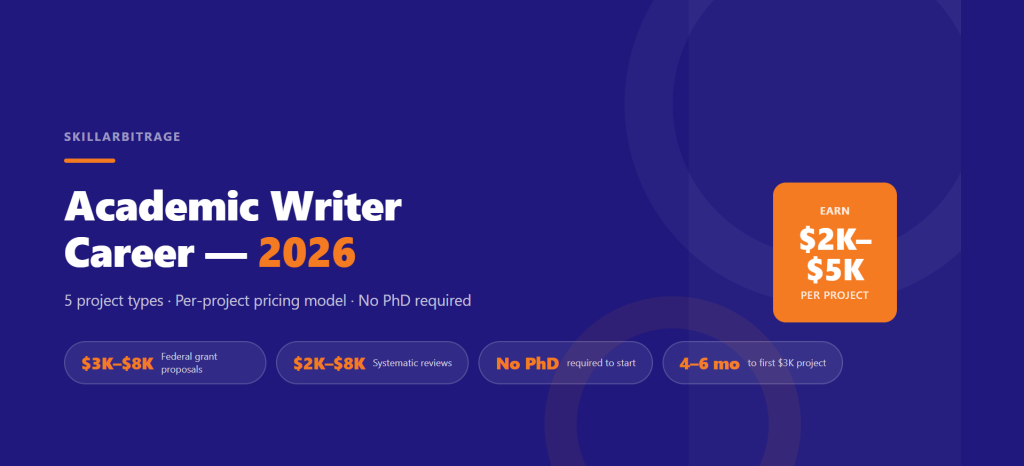

Academic writers who work on a per-project model — taking on grant proposals, systematic reviews, and medical journal manuscripts — routinely earn $2,000–$5,000 per engagement.
This is not an hourly freelance rate; it is the flat fee that researchers, universities, and pharmaceutical companies pay for a single, defined deliverable.
Two such projects per month produce $4,000–$10,000 in monthly income, without a client roster of dozens and without billing by the hour.
Most academic writers in India charge $10–$30 per hour — staying in the hourly model rather than pursuing an academic writer career per project. A parallel group of writers — working on the same research domains, serving the same international clients — earns $2,000–$5,000 for a single project.
The difference is not skill level. It is the type of project they take on and the model they use to price it. A writer charging $20 per hour for a systematic review that takes forty hours earns $800.
A writer charging a per-project flat fee for the same scope earns $2,500–$3,500 and finishes in the same amount of time.
This complete academic writer career per project guide covers the specific tier of work — the project types, the pricing model, and the client channels — that separates writers earning $400 per month from writers earning $4,000 per month.
It is about the specific tier of work — the project types, the pricing model, the client channels, and the positioning — that separates writers earning $400 per month from writers earning $4,000 per month from the same category of work.
From an academic writer based in Pune who shifted from hourly to per-project work after two years: “I was charging $18 per hour for literature reviews and earning about $900 a month. Then a client asked me to quote a flat fee for a full systematic review. I quoted $2,800 based on the scope, we agreed, and I finished it in six weeks. That one project earned more than three months of my previous work at the same skill level. I never went back to hourly after that. The per-project model changes not just the income — it changes how clients perceive you. A flat fee signals confidence in your own scope management. Hourly signals availability. Those attract very different clients.”
Per-Project vs. Hourly Academic Writing: Which Model Pays More?
The first decision in building an academic writer career per project is choosing the right pricing model.
The hourly model and the per-project model are not just different pricing structures — they produce fundamentally different client relationships, income ceilings, and types of work. Understanding the distinction before you decide which path to pursue is worth more than any rate chart.
In an hourly engagement, you are billing for your time. The client controls the scope and can expand it at any point by asking for more. You are available, you deliver incrementally, and your income is bounded by the number of hours in a week. Most academic writers starting out on platforms like Upwork operate this way, and it produces reliable but modest income. An academic writer charging $20–$30 per hour, working twenty to thirty billable hours per week, earns $1,600–$3,600 per month — before platform fees, at maximum effort, with no ceiling-raising mechanism. As hourly academic writing rates show, this is the typical entry-level income range.
In a per-project engagement, you are billing for a defined deliverable. The scope is fixed in writing at the start: a grant proposal for a specific funder, a systematic review following PRISMA 2020 guidelines, a full manuscript for a target journal.
The client knows exactly what they are receiving and when. You know exactly what you are committing to deliver.
Because the scope is defined, the price reflects the full value of the output — not the time it happens to take. A researcher who needs a sixty-page NIH grant application does not care whether it takes you twenty hours or sixty hours. They care whether it is submitted successfully. That alignment of incentives is why per-project fees are structurally higher than hourly rates for equivalent work.
The practical difference shows up clearly in one comparison. A systematic review that takes forty hours of skilled work earns $800–$1,200 at $20–$30 per hour. The same systematic review, scoped and priced as a deliverable, earns $2,000–$4,000 as a flat project fee.

The work is identical. The income is two to four times higher. The only thing that changed is the pricing model and the client’s perception of what they are buying.
| Factor | Hourly Model | Per-Project Model |
|---|---|---|
| Income ceiling | Bounded by hours available | Bounded by number of projects (scalable) |
| Scope control | Client can expand mid-engagement | Fixed scope agreed in writing upfront |
| Client perception | “Available resource” | “Expert delivering a defined outcome” |
| Income predictability | Variable — depends on hours approved | Predictable — deposit upfront, balance on delivery |
| Rate per hour (effective) | $20–$30 (stated) | $50–$100+ (implicit, based on project value) |
| Typical client type | Students, small researchers, Upwork generalists | University labs, pharma companies, NGOs, funded researchers |
The shift to an academic writer career per project does not require a credential upgrade or a new platform. It requires repositioning what you offer — from “I am available for academic writing tasks” to “I deliver [specific project type] for researchers in [specific domain].” That repositioning is the mechanism. Everything else follows from it.
From an academic writer with a background in public health who works primarily with university research teams: “The conversation that changed everything was when a faculty member at a US university asked me to quote for a grant proposal. I was used to quoting hourly, so I said ‘$25 per hour, probably 40–50 hours.’ They looked confused and said, ‘Can you just give me a project fee? We work with a budget, not time sheets.’ That was the moment I realised the hourly model was a signal — it was saying I was a freelancer renting time, not a professional delivering a result. Since I switched to per-project, the quality of the clients has changed completely.”
5 Academic Writing Project Types That Pay $2K–$5K Each
These five project types form the foundation of a profitable academic writer career per project.
Not all academic writing pays at the same level. The project types that reach the $2,000–$5,000 range share three characteristics: they require domain knowledge that not every writer has, they have a defined and verifiable deliverable, and the client faces a material consequence if the work is poor. Understanding which five types consistently produce these fees — and what each one requires — is the foundation of the per-project career. These are also the types that continue to grow with grant proposals and systematic reviews among the highest-demand academic writing segments in 2026.
Grant Proposals ($1,500–$8,000 per proposal)
Grant writing is the highest-ceiling academic writing category. A writer helping a researcher or organisation develop a compelling, technically sound proposal for external funding is providing a service with quantifiable return — the grant amount, which can range from $25,000 to several million dollars. Against that potential return, a $2,000–$5,000 professional fee is commercially rational from the client’s perspective.
The rate range is wide because grant types vary enormously. A proposal to a private US foundation for $50,000 in program funding takes twenty to thirty hours and typically commands $1,500–$3,000 as a flat project fee. A full NIH R01 research grant application — a sixty-page federal submission with specific aim pages, research strategy, budget justification, and human subjects review — takes forty to eighty hours of skilled work and commands $3,000–$8,000 or more. Indian funding body proposals (ICMR, DST, DBT) carry lower fees because the funder and client are both India-based, but they are a valuable portfolio-building category, with project fees typically ranging from ₹40,000–₹80,000.
The qualification that unlocks grant writing clients is not a degree in grant management. It is demonstrated familiarity with how funders think — what a logic model is, how a budget narrative works, what a specific aims page needs to accomplish in the first paragraph. Writers who can show a sample proposal, even a practice one developed for a fictional organisation, convert grant writing enquiries at significantly higher rates than those who describe their qualifications in general terms.
Systematic Reviews ($2,000–$8,000 per review)
A systematic review is a comprehensive, structured synthesis of the existing literature on a specific research question, conducted according to a defined and reproducible protocol. Researchers, medical teams, and health organisations commission systematic reviews when they need a rigorous evidence base — for clinical guideline development, policy decisions, or as the foundation for a new research proposal. The work has a defined methodology (PRISMA 2020 (prisma-statement.org) is the standard reporting framework), a defined structure (protocol, database search, screening, data extraction, synthesis), and a defined output (a publishable or submittable review document).
Freelancers charging per-project for systematic reviews command $2,000–$8,000 depending on the scope, with medical and clinical systematic reviews at the upper end of that range. The scope drivers are the number of databases searched, whether dual-reviewer screening is required, the complexity of the synthesis, and whether the output needs to meet publication standards for a specific journal. A protocol-only engagement (the pre-registration document, before the actual review begins) typically commands $800–$1,500 as a standalone project and is a natural entry point for writers building toward the full review price point.
Medical Journal Manuscript Ghostwriting ($3,000–$5,000 per manuscript)
Physicians, pharmacists, and medical researchers frequently have the data and the clinical knowledge but lack the time or the writing facility to transform their findings into a publication-ready manuscript. Medical ghostwriting — where the writer produces the full manuscript and the named authors revise and approve it — is an established, paid, and ethically debated but widely practised category of academic writing. The client is typically a clinician, a pharmaceutical company, or a research team; the output is a complete manuscript formatted for a target journal, including abstract, introduction, methods, results, discussion, and references.
Per-project rates for a full medical manuscript range from $3,000–$5,000. Partial engagements — abstract and introduction only, or introduction and discussion only — command $800–$1,500 and are a common entry point. The qualification that matters most in this category is familiarity with the ICMJE authorship guidelines, journal submission processes (submission portals, cover letters, journal-specific formatting), and the conventions of the relevant clinical or scientific specialty. Writers with backgrounds in medicine, pharmacy, public health, or life sciences have the clearest path into this category, but writers who have developed deep familiarity with a specific specialty through sustained academic writing work can also qualify.
Academic Book Proposals and Chapters ($1,500–$4,000)
University presses, academic publishers, and specialised non-fiction imprints commission proposals before contracting books. A book proposal is a forty-to-eighty-page document that includes a market analysis, competing titles assessment, chapter summaries, author credentials, and a sample chapter. Academics and researchers who have the ideas but not the writing bandwidth outsource the proposal development to professional writers. Per-project fees for a full book proposal range from $1,500–$3,500 depending on scope, with individual chapter ghostwriting commanding $1,000–$2,500 per chapter.
The client base for this category includes academics at research universities preparing their first monograph, senior practitioners writing books for specialist audiences, and non-fiction authors working with agents on academic-crossover titles. The platforms that connect writers with these clients include Reedsy (primarily for trade non-fiction but with academic crossover), direct outreach to academic publishing consultants, and referrals from the grant writing and manuscript category where the same research teams often need related writing support.
Policy Briefs and White Papers for Think Tanks and NGOs ($1,500–$4,000)
Think tanks, international development NGOs, and policy research organisations produce policy briefs and white papers as their primary output. These are fifteen-to-thirty-page documents that synthesise research on a specific policy question, present findings, and recommend actions to decision-makers. The writing is academic in standard — sourced, structured, evidence-based — but the output is designed for policymakers rather than journal reviewers. Organisations including the UN, World Bank, major international NGOs, and independent policy institutes hire freelance writers for this work, particularly for country-specific or regional research where the writer’s local knowledge adds value.
Per-project fees for policy briefs typically range from $1,500–$4,000 depending on research depth and length. Think tanks and NGOs have substantial demand for Indian academic writers specifically because of India’s significance across development, health, climate, and governance policy domains. A writer with a background in economics, public health, education, or environmental science who can demonstrate familiarity with policy writing conventions — executive summaries, recommendation framing, evidence citations in a policy rather than journal format — is well-positioned for this category.
| Project Type | Per-Project Rate Range | Typical Time Investment | Key Qualification Signal | Entry-Level Version |
|---|---|---|---|---|
| Grant Proposal (foundation) | $1,500–$3,000 | 20–35 hours | Sample proposal + funder familiarity | Practice proposal for real nonprofit |
| Grant Proposal (federal/NIH) | $3,000–$8,000 | 40–80 hours | NIH structure, specific aims writing | Specific aims section only ($600–$1,000) |
| Systematic Review (full) | $2,000–$8,000 | 40–80 hours | PRISMA familiarity, database search skills | Review protocol only ($800–$1,500) |
| Medical Manuscript (full) | $3,000–$5,000 | 30–60 hours | Journal submission process, ICMJE guidelines | Abstract + introduction ($800–$1,500) |
| Book Proposal (academic) | $1,500–$3,500 | 25–45 hours | University press proposal format | Chapter summary only ($300–$600 per chapter) |
| Policy Brief / White Paper | $1,500–$4,000 | 20–40 hours | Policy writing conventions, domain knowledge | Shorter brief (6–10 pages) ($800–$1,500) |
Qualifications You Need for High-Paying Academic Writing Projects
An academic writer career per project at the $2K–$5K level requires specific credentials.
The most common misconception about an academic writer career per project about a high-paying academic writer career per project is that it requires a PhD. It helps in specific cases — particularly for medical manuscripts and federal grant proposals where the client may ask for the writer’s credentials as part of their own submission compliance — but it is not the primary qualification that decides whether a client will hire you for a $3,000 project. The actual barrier is more specific and more achievable than a doctoral degree.
What High-Paying Clients Actually Evaluate
In an academic writer career per project, what clients at this level are evaluating, in practice, is whether you have done this type of work before and whether you understand the specific genre. A researcher commissioning a systematic review wants evidence that you know what PRISMA 2020 requires, that you can navigate PubMed and Embase, and that you have produced a review with a correctly constructed PRISMA flow diagram. A nonprofit commissioning a grant proposal wants to know that you understand logic models, can read a Request for Proposals (RFP) and identify what the funder is prioritising, and have developed at least one successful proposal. These are demonstrable skills, not credentials. They are built through a deliberate combination of structured learning and one or two portfolio projects.
Qualification Path for Each Project Type
The academic writer career per project qualification path for each of the five project types is specific. For grant writing, the fastest qualification is to develop a practice proposal for an organisation you know — a local NGO, a university department, a community initiative — and produce it to professional standard. One real, complete, well-structured grant proposal is more compelling evidence than a certification. For systematic reviews, completing the Cochrane Interactive Learning module on systematic reviews (free) and producing a protocol for a focused clinical question gives you the PRISMA familiarity to demonstrate competence. For medical manuscripts, extended exposure to one specialty’s published literature — reading twenty to thirty papers in your chosen field, understanding the results and discussion conventions — combined with a ghostwritten sample is the qualification signal clients respond to.
For an academic writer career per project, the point worth emphasising is that the entry-level versions of each project type — the specific aims section of a grant, the review protocol, the abstract and introduction of a manuscript — are not just lower-paid alternatives. They are the qualification-building engagements that produce the portfolio evidence you need for the full-price projects. A writer who has completed three systematic review protocols at $900 each has both earned $2,700 and built the evidence base that justifies quoting $3,000–$5,000 for the full review.
From an academic writer with a Master’s degree in biology who specialises in systematic reviews for clinical research teams: “I do not have a PhD. What I have is a portfolio of seven systematic review protocols and three completed reviews, a working knowledge of COVIDENCE and Rayyan, and a clear understanding of PRISMA 2020. When a client asks about my qualifications, I walk them through the portfolio before answering the degree question. By the time I tell them I have a Master’s, not a PhD, they have already decided they want to work with me. The portfolio does the credentialling. The degree is almost irrelevant once you have done the work.”
How to Price Academic Writing Projects: Per-Project Fee Guide
Pricing is where most professionals building an academic writer career per project make critical mistakes.
The most practical method for pricing an academic writer career per project for arriving at a per-project fee is to scope the work in hours, apply a baseline effective rate, add a revision buffer, and quote the resulting figure as a flat project fee — without disclosing the calculation to the client. The client is not buying hours; they are buying the deliverable. The per-project fee should reflect the value of the deliverable, not the time cost of producing it.
Baseline Per-Project Rates for Academic Writers
The baseline effective rate in an academic writer career per project for mid-career academic writers working in the per-project tier is $50–$80 per hour when the implied rate is back-calculated from project fees. This is significantly higher than the stated hourly rate most writers charge on platforms because it includes the premium for scoping, client management, revision cycles, and the expertise that makes a defined deliverable possible. A systematic review scoped at forty hours of active work, priced at $55 per implied hour, produces a project fee of $2,200. Adding a 20–25% revision buffer — because systematic reviews routinely require re-screening or methodology adjustments — produces a final quote of $2,640–$2,750. Rounding to $2,800 is a clean, professional presentation.
Payment Structure: Deposits and Milestones
The academic writer career per project payment structure for per-project academic writing should include a deposit — typically 40–50% upfront before any work begins — with the balance due on delivery of the completed draft. This is standard practice in professional services and not unusual or aggressive. Clients at this level expect a deposit structure. Writers who do not request one signal inexperience and are more likely to face non-payment disputes on completion. The deposit also aligns both parties: the client has invested financially, and the writer has confirmation of the client’s commitment before spending forty hours on a complex deliverable.
3 Common Pricing Mistakes to Avoid
Three academic writer career per project pricing mistakes are particularly common among writers transitioning from hourly to per-project. The first is underpricing the first project out of anxiety about losing the client. A quote of $800 for a scope that warrants $2,500 does not build trust — it signals uncertainty about the work’s value and attracts clients who will negotiate down from $800 in the future. The second mistake is not scoping revisions in the project agreement. “Unlimited revisions” is not a per-project term — it is an hourly term with a flat cap. A per-project agreement should specify what constitutes a revision (changes to existing content) versus a new scope (adding sections, changing the research question). The third mistake is quoting before the scope is clear. A per-project fee for a systematic review without knowing the target population, the number of databases required, and the expected output format is a guess. Take time to scope before quoting.
How Indian Academic Writers Are Landing $2K–$5K Clients
Client acquisition channels for an academic writer career per project differ from traditional freelancing platforms.
The academic writer career per project client acquisition channels for per-project academic writing are different from the channels that produce hourly gig work. Upwork is not the primary source for grant proposals and systematic reviews at the $2,000–$5,000 level — not because the clients are not on Upwork, but because clients commissioning this work tend to search outside marketplace platforms and through more specific channels where the writer’s domain expertise is visible before any pitch is made.
Kolabtree (kolabtree.com) is the platform most specifically designed for this category. It is a marketplace for scientific and academic freelancers — PhD holders, researchers, medical writers — who provide project-based expert services. Unlike Upwork, where clients often filter by price, Kolabtree clients filter by qualification and field. Indian academics with postgraduate degrees and demonstrable subject-matter expertise are well-represented on the platform and regularly receive systematic review, grant support, and manuscript writing enquiries. The profile on Kolabtree functions less like a freelancer listing and more like an academic CV — the degree, the publications (if any), and the specific services offered are the main selection criteria. An Indian writer with an MSc in public health offering systematic review services for clinical research questions, with two completed reviews in the portfolio, is competing with a very small number of writers in that specific intersection.
Direct Outreach to Research Faculty and PIs
In an academic writer career per project, direct outreach to research faculty and principal investigators (PIs) at universities is the second channel, and it tends to produce the highest-value and most recurring relationships. A PI running a funded research lab has ongoing writing needs — grant renewals, progress reports, manuscripts for multiple projects. Finding the research group through Google Scholar (searching for recent publications in your subject domain), reading two or three of their recent papers, and sending a targeted email explaining what you offer and attaching a relevant writing sample produces a response rate that no general platform listing can match. The email is not a cold solicitation — it is a contextually specific offer from someone who has clearly read and understood their work. Most writers never send this kind of outreach. That is why it works.
LinkedIn for Academic Writing Client Acquisition
For an academic writer career per project, LinkedIn is the third channel, and it works differently from the direct outreach model. The strategy is content-led rather than outreach-led: publishing short posts about systematic review methodology, explaining what a specific aims page needs to accomplish in the first paragraph, or summarising what a PRISMA flow diagram shows and why it matters. This creates a slow, compounding signal of domain expertise that generates inbound enquiries from researchers who encounter the content and recognise the knowledge behind it. Three to six months of consistent content produces a visible presence in a specific research niche, and that presence generates introductions and direct messages from researchers who need exactly the service the writer is positioning. As the broader academic writing income from international clients data shows, visibility in the right channels is the primary driver of higher-value client relationships.
The Structural Advantage for Indian Academic Writers
The academic writer career per project structural advantage Indian academic writers have in this tier is significant and underappreciated. The cost arbitrage — Indian writers charge 40–60% below the equivalent US or UK writer for comparable quality — is not the primary advantage. The primary advantage is the combination of postgraduate degree density, research familiarity, and English writing fluency that is far more common among Indian professionals than among equivalent salary-tier professionals in most other markets. A researcher at a US university who needs a systematic review completed for $2,800 is comparing that cost to a US-based medical writer quoting $5,000–$7,000 for the same scope. The Indian writer’s competitive position is not that they are cheaper — it is that they deliver comparable quality at a price point the researcher’s grant budget can accommodate.
From an academic writer with a background in epidemiology who landed their first $4,000 systematic review through Kolabtree: “I built my Kolabtree profile in detail — listed every tool I had used, every subject area I had written in, included two systematic review protocols from my Master’s thesis work as portfolio samples. Within three weeks of going live, I had an enquiry for a full review from a clinical research team in the US. They were not the cheapest-seeking clients I had encountered on Upwork. They were asking about methodology, my familiarity with COVIDENCE, which databases I would search. It was a professional evaluation, not a price negotiation. I quoted $3,800, they accepted, and that project led to two more from the same team. The platform attracts a completely different type of client.”
Building Your Academic Writing Income: From $2K to $5K Per Month
Scaling an academic writer career per project from $2K to $5K per month follows a predictable trajectory.
The academic writer career per project income trajectory in per-project academic writing does not scale through volume — taking on twenty small projects instead of two large ones. It scales through rate increases on the same project types as the portfolio grows, and through client retention, because per-project academic writing clients are fundamentally recurring clients. A research team that commissions a systematic review today will need a manuscript six months later and a grant renewal in twelve months. The per-project model, when combined with client relationship management, produces a recurring income structure that hourly platform work cannot replicate.
Months 1–3: Your First Per-Project Engagement
In the first three months of an academic writer career per project, the realistic goal is one per-project engagement at $1,000–$2,000. This is the entry-level version of the target project type — a grant proposal for a small foundation, a systematic review protocol, a section of a medical manuscript. The purpose of this engagement is not primarily the income but the portfolio credential it produces. The writer who has completed one real grant proposal, with a client reference, is in a fundamentally stronger position for the next grant proposal enquiry than the writer who has described their grant writing capability without evidence of it.
Months 3–6: Raising Your Rate
Between months three and six of an academic writer career per project, the second project typically arrives at a higher rate than the first — both because the portfolio now includes a real completed project and because the writer has the confidence to quote accurately rather than conservatively. The second project in the $1,500–$2,500 range, combined with residual income from the first client’s follow-on needs, produces monthly income in the $1,500–$3,000 range during this phase.
Year 1: Reaching $5K Per Month
By the end of year one in an academic writer career per project, a writer who has delivered three to five per-project engagements, maintained relationships with two or three research teams, and continued building their domain-specific presence has the conditions in place for $3,000–$5,000 per month. The arithmetic is straightforward: two projects per month at an average of $2,500 produces $5,000 per month. The challenge is not the arithmetic — it is building the client pipeline to consistently fill two project slots per month. That pipeline builds through a combination of the inbound channel (Kolabtree and LinkedIn presence) and the outbound channel (direct PI outreach), and it does not require working for every new client from scratch. Returning clients with new projects are the most time-efficient source of per-project income, because the scoping, relationship-building, and trust-establishing work has already been completed.
| Phase | Monthly Income Range | Typical Activity | Primary Growth Driver |
|---|---|---|---|
| Month 1–3 (Entry) | $500–$2,000 | First 1–2 engagements, portfolio-building versions | Landing first real project reference |
| Month 3–6 (Growth) | $1,500–$3,000 | 2–3 active projects, repeat client emerging | Rate increase + second client channel active |
| Month 6–12 (Specialist) | $2,500–$5,000 | 2–4 recurring clients, defined niche | Referrals from existing clients, inbound enquiries |
| Year 2+ (Established) | $4,000–$8,000+ | Selective clients, premium rates, retainer possibilities | Reputation in a specific research niche |
Mistakes That Keep Academic Writers Stuck at Hourly Rates
These mistakes prevent professionals from building a sustainable academic writer career per project.
The academic writer career per project transition from hourly to per-project academic writing fails in predictable ways. Understanding the specific failure patterns before attempting the transition saves significant time and reduces the risk of pricing the first per-project engagement incorrectly and having to choose between delivering a loss-making project or renegotiating with a new client.
Mistake 1: Positioning as a Generalist
The first and most consequential mistake is positioning as a generalist academic writer available for any type of work. “Experienced academic writer with expertise across multiple disciplines, available for essays, dissertations, literature reviews, research papers, and grant proposals” is a description that attracts low-value, price-competitive work from students and content mills. It attracts this work because it sounds identical to every other generalist academic writer and leaves the client with no reason to pay a premium. A per-project client commissioning a systematic review is not looking for a versatile writer — they are looking for someone who specifically understands systematic review methodology. The narrower the positioning, the smaller the pool of competitors and the higher the rate the specific expertise commands.
The second mistake is the absence of a sample in the specific project format. A writer who lists grant proposal writing as a service without a grant proposal sample in their portfolio is asking the client to take the qualification on faith. The client will not. Producing one well-crafted sample — a mock proposal for a realistic nonprofit organisation, with all the standard sections present and the funder guidelines followed — is a one-time investment of fifteen to twenty hours that unlocks every grant proposal enquiry that follows. The same logic applies to systematic reviews (one complete protocol or PRISMA-compliant review extract), medical manuscripts (one sample methods and results section in a relevant clinical specialty), and policy briefs (one complete brief on a real policy question). The sample is not optional at the per-project tier — it is the qualification.
The third mistake is using per-project pricing language with hourly client expectations. Writing “project fee: $2,500” in a proposal to a client who has previously worked on hourly terms without explaining what the project-based model means in practice is a recipe for friction. The per-project pitch to a new client should include a brief, direct explanation of what is included in the fee (the full scope, defined revisions, final deliverable in the agreed format), what is not included (additional research beyond the defined scope, reformatting for a different target), and the payment structure (deposit before start, balance on delivery). Clients who have previously paid by the hour are not averse to per-project fees — but they need the model explained once before they trust it.
Day-to-Day Life of an Academic Writer Earning $2K–$5K Per Project
Here is what a typical week looks like in a mature academic writer career per project.
The practical texture of a per-project academic writing career in India is substantially different from hourly platform work, in ways that suit the structure of most professional lives better than the constant availability that hourly client relationships demand. Understanding what the day-to-day actually looks like — not just the income ranges — is relevant to deciding whether this is the right career model.
An academic writer career per project, managing two to three active projects at a time works in focused, asynchronous bursts rather than continuous availability. A systematic review project has distinct phases — database search, deduplication, title and abstract screening, full-text review, data extraction, synthesis, write-up — each of which can be completed in concentrated blocks of two to four hours. A grant proposal has a research phase, a drafting phase, and a revision phase, typically spread across three to six weeks. The work is deep rather than constant, and the client communication is infrequent — a scoping call at the start, a check-in mid-project, a revision round near completion. This is not the hourly academic writer’s experience of daily client messages, task-by-task direction, and continuous availability expectations.
The time zone dynamic works strongly in the Indian academic writer’s favour at this tier. Researchers and grant managers in the US and UK are not expecting real-time responses — they are sending detailed briefs and expecting structured updates at project milestones. A grant writer in India can receive a briefing document at 9 PM IST (4:30 PM US East Coast), review it overnight, and respond with a detailed scope and questions by the following morning (US East Coast start of day). This creates a perception of rapid turnaround and high responsiveness that is structurally available to Indian professionals at no extra effort. It is one of the practical advantages that per-project academic writers in India consistently note as differentiating them from domestic US or UK competitors.
For professionals considering this path alongside a current job or other commitments, the academic writer career per project model is more compatible with part-time availability than hourly platform work. A single systematic review spread across six weeks, worked on for ten to fifteen hours per week, generates $2,500–$4,000 in additional income without requiring the constant availability that hourly platform work demands. The first year of per-project academic writing is frequently structured as a parallel track alongside existing employment — building the portfolio, establishing the channels, landing the first two to three projects before transitioning to it as a primary or significant income source.
From an academic writer who manages two to three per-project clients alongside a research analyst role: “I work on academic writing projects in the evenings and on weekends. Because the work is per-project, there is no expectation that I am available during business hours. My clients in the US send me briefing documents in their afternoon, I work on them in my evenings, and we have milestone check-ins every week or two. I am currently earning around $4,500 per month from two active systematic review projects and one grant proposal, working approximately fifteen hours per week on this alongside my full-time role. The per-project model is the only reason this is sustainable. Hourly work with the same hourly commitment would earn me $600 per month, not $4,500.”
Disclaimer: This article is for informational and educational purposes only and does not constitute financial, career, or legal advice. Income figures represent market ranges reported in publicly available sources and will vary based on individual experience, qualifications, client type, project complexity, and effort. Platform policies, market rates, and certification requirements are subject to change. For advice specific to your situation, consult a qualified professional. Information is current as of March 2026.
FAQs About Academic Writing Careers and Per-Project Earnings
Here are the most common questions about building an academic writer career per project in 2026.
How much do academic writers earn per project?
Academic writers working on per-project engagements earn $1,500–$8,000 per project depending on the type. Grant proposals for private foundations command $1,500–$3,000; federal grant applications range from $3,000–$8,000. Systematic reviews command $2,000–$8,000 depending on scope and medical complexity. Medical journal manuscripts are typically priced at $3,000–$5,000 for a full paper. Policy briefs and white papers for think tanks or NGOs range from $1,500–$4,000. These are flat project fees, not hourly rates.
Which academic writing project type pays the most?
Federal grant proposals — particularly NIH and NSF applications — have the highest ceiling of any per-project academic writing category, reaching $8,000–$10,000 for complex, multi-investigator proposals. At the mid-market level, medical journal manuscript ghostwriting ($3,000–$5,000) and full systematic reviews ($2,000–$8,000) have the highest typical per-project rates. The project type that pays the most per effective hour depends on the writer’s speed and subject-matter depth in a specific domain.
Do I need a PhD to get $2K–$5K per project?
No. A PhD helps in specific contexts — particularly for medical manuscripts and federal grant proposals where the client may be required to disclose the writer’s credentials — but the primary qualification for per-project academic writing clients is demonstrated experience with the specific project format. A writer with a Master’s degree, two completed systematic reviews in a defined clinical domain, and PRISMA familiarity is more competitive than a PhD who cannot show a relevant portfolio. The portfolio is the credential at this level.
How do I find my first academic writer career per project client?
Three channels produce per-project clients at the $2K+ level. Kolabtree is the most direct — it is a marketplace for academic and scientific freelancers where clients filter by qualification and domain rather than price, and profiles with postgraduate credentials and specific service offerings receive relevant enquiries. Direct outreach to principal investigators at research universities — via a short, targeted email referencing their specific published work and attaching a relevant portfolio sample — produces the highest-quality client relationships. LinkedIn content demonstrating domain expertise in a specific research niche generates inbound enquiries over a three-to-six-month horizon.
What is the academic writer career per project rate for a grant proposal?
Grant proposal rates vary by funder type and application complexity. Private foundation proposals (typically ten to thirty pages) command $1,500–$3,000 as a flat project fee. Federal applications — NIH, NSF, USDA — range from $3,000–$8,000 depending on the number of sections, whether a budget narrative is included, and the overall page length. Indian funding body proposals (ICMR, DST, DBT) typically command ₹40,000–₹80,000 per proposal. Partial engagements such as specific aims pages alone ($600–$1,000) or logic model development only ($400–$800) are common entry-level projects.
How much should I charge for a systematic review?
A full PRISMA-compliant systematic review — protocol, database search, screening, data extraction, synthesis, and write-up — should be priced at $2,000–$5,000 for most clinical or health sciences questions, and $4,000–$8,000 for reviews requiring dual-reviewer screening or meta-analysis. The pricing methodology is to scope the project in hours, apply a baseline implied rate of $55–$70 per hour, add a 20–25% revision buffer, and quote the total as a flat fee. Review protocols alone (pre-registration documents) are typically priced at $800–$1,500 as standalone engagements.
How long does a $3,000 academic writing project take?
A $3,000 per-project engagement typically involves thirty to fifty hours of active work, spread across three to six weeks depending on the project type and client response times. A systematic review protocol at $1,200 takes fifteen to twenty hours over two weeks. A grant proposal at $2,500 takes twenty-five to thirty-five hours over three to five weeks. A full medical manuscript at $3,500 takes thirty to fifty hours over four to six weeks. The calendar timeline is always longer than the active work hours because of client feedback cycles, revision rounds, and research dependency periods.
Can I do per-project academic writing part-time?
Yes. The per-project model is structurally better suited to part-time work than hourly academic writing precisely because it does not require constant availability. One systematic review project at $2,500–$3,500, worked on for ten to fifteen hours per week over four to six weeks, generates that income without requiring daily client availability. Most writers begin per-project academic writing alongside existing employment during the portfolio-building phase (months one through six), transitioning to it as a primary income source once two to three recurring clients are established.
Is medical writing the best route to $5K per month?
Medical writing — journal manuscripts, regulatory documents, clinical study reports — has the highest per-project ceiling of all academic writing categories. However, it also has the steepest qualification barrier: familiarity with medical terminology, journal submission processes, and clinical specialty conventions is non-negotiable. For writers with a life sciences or health background, medical writing is likely the fastest route to $5K per month. For writers from social sciences, economics, or humanities backgrounds, grant writing and systematic reviews have a lower qualification barrier and comparable income potential at scale.
How do I present a per-project fee to a client expecting hourly?
The framing is straightforward and should be stated directly rather than apologised for. Explain that you work on a per-project basis for defined deliverables, outline exactly what the project fee includes (the specific output, the revision rounds, the delivery format), and specify the deposit structure. Most clients who have worked on hourly terms before are not averse to per-project fees — they simply need the model explained once. The key is to present the per-project fee before any hourly discussion begins, so that the first number the client associates with the work is the project fee, not an hourly rate that they then mentally multiply.
What platforms are best for academic writer career per project work?
Kolabtree is the most purpose-built platform for per-project academic and scientific writing, connecting qualified researchers and writers with clients who filter by expertise rather than price. Upwork reaches a broader academic writing client base but defaults to hourly engagement norms — per-project clients exist there but require active positioning. ResearchGate’s researcher network is a valuable channel for direct faculty outreach rather than a formal platform. For medical writing specifically, platforms like Science Docs and the AMWA (American Medical Writers Association) job board are specialist channels that produce high-value per-project enquiries.
Is the academic writer career per project model sustainable long-term?
The per-project model has stronger long-term sustainability than hourly academic writing for one structural reason: per-project clients repeat. A research team that receives a strong grant proposal will come back for the renewal. A PI who receives a well-structured manuscript draft will return for the next paper. The per-project model builds a client base that generates recurring income from an expanding body of completed, referenced work — the opposite of the hourly platform dynamic, where each project is atomised and the writer starts each client relationship fresh. Writers who reach year two of per-project academic writing consistently report that the majority of their income comes from returning clients rather than new client acquisition.





 Allow notifications