
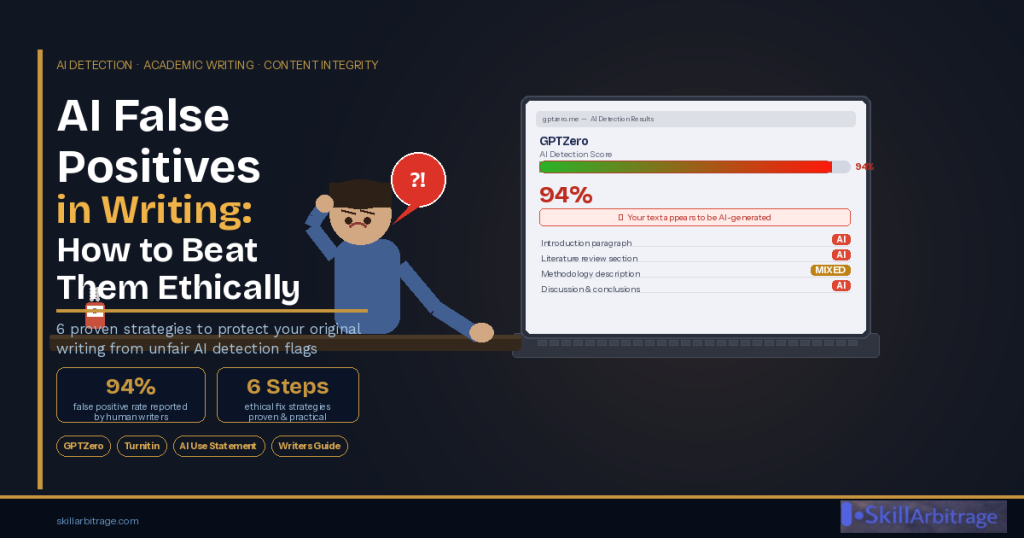

You spent hours researching. You wrote every sentence yourself. You submitted your work with confidence and then received a note saying it had been flagged as largely AI-generated. If this has happened to you, you are not alone, and you are not the problem.
Table of Contents
What Are AI False Positives in Writing and Why Are They Happening?
An AI false positive occurs when an AI detection tool classifies human written content as AI-generated. This is not a rare edge case it is a systematic problem built into how detection technology works.
Why is the problem happening?
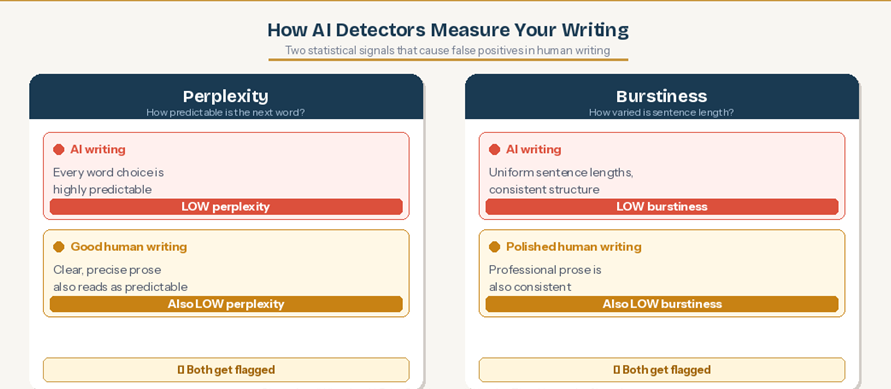
- Most detection tools (like GPTZero, Originality.ai, Turnitin’s AI detector) don’t really understand writing like humans do. Instead, they analyze two things:
First is perplexity – that is how predictable the next word is.
The other is burstiness – variation in sentence structure.
Human writing tends to be less predictable and more variable. But if your writing is clear, concise, and grammatically correct, if you have learned to write clearly and professionally, detectors may still misclassify it as AI-generated.
- Detection tools aren’t standardized or peer-reviewed for accuracy.
They often show overconfidence in their classification and there is often no clear rationale for false positives and, unlike plagiarism tools, they don’t show verifiable sources only a probability score. And there’s often no way to appeal the result, even when you know it’s wrong.
- As more people edit, study, and write with help from AI, a standardised way of writing is taking shape globally.
It’s marked by shorter sentences, cleaner structure, and minimal grammatical quirks – traits now wrongly associated with AI output. Ironically, the more we write like good writers, the more we risk being flagged!
The Standardisation Problem
There is a third, systemic cause that rarely gets discussed. As more people write with AI assistance, edit with AI, and learn writing through AI-aided feedback, a globally standardised writing style is emerging. It is characterised by shorter sentences, cleaner structure, and minimal grammatical irregularities.
These traits are now wrongly associated with AI output. The more you write like a skilled professional, the more you risk being flagged. The irony is sharp: improvement in writing quality is being penalised by tools designed to detect low-quality automation.
“Ironically, the more we write like good writers, the more we risk being flagged. The very traits that indicate mastery ,clarity, precision, consistency are being misread as machine output.”
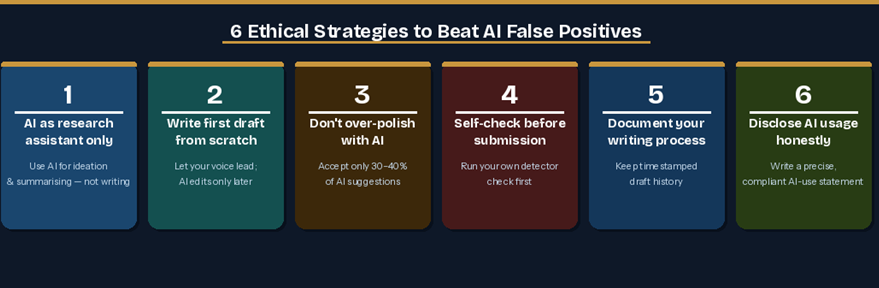
6 Ethical Strategies to Reduce AI False Positives in Your Writing
There is no single fix that works in every situation detection tools vary, journals vary, and writing contexts vary. But the following six strategies, applied consistently, will significantly reduce your risk of being wrongly flagged while keeping your writing fully original and compliant.
Strategy 1 — Use AI as a Research Assistant, Not a Ghostwriter
The clearest line between ethical and problematic AI use is this: AI should inform your thinking, not replace it. When using tools like ChatGPT or Claude, restrict their role to the research and ideation phase:
- Ask it to list recent studies or key findings in a domain
- Use it to explain a difficult concept in simpler terms before you write about it in your own words
- Ask it to suggest possible structures or subheadings
- Instruct it to identify contrasting viewpoints you should address
When it comes to actual writing, every sentence should come from your own analytical judgment and original phrasing. This single practice will drastically reduce the statistical similarity between your output and AI-generated text because your word choices, reasoning patterns, and sentence constructions will be genuinely yours.
Strategy 2 — Write the First Draft Entirely From Scratch
Write your first draft the way you naturally would using your own logic, tone, and sentence flow, without any AI involvement at all. Once that first version exists, you can use AI tools in a limited, supportive role:
- Identify logical gaps or coherence problems
- Suggest improvements to clarity in specific sentences
- Flag jargon or unnecessary wordiness
This approach keeps intellectual and creative ownership firmly with you. The structure, the argument, and the voice are established before any AI tool touches the work. AI then acts as an editor, not a co-author and the statistical fingerprint of your original draft carries through to the final version.
Strategy 3 — Do Not Over Polish Your Writing With AI
One of the most common causes of false positives is excessive use of AI editing tools Grammarly, QuillBot, ChatGPT, or Claude to rewrite and refine until the prose feels ‘perfect’. The result is often robotic sentence structure, low burstiness, and over-clean phrasing that reliably triggers detection tools.
When using any AI-based editing tool, apply a simple discipline:
- Accept only 30–40% of suggestions choose the ones that genuinely improve clarity without changing your voice
- Preserve your natural tone, rhythm, and phrasing even when alternatives are offered
- Deliberately vary your sentence lengths and transitions do not let a tool homogenise them
- Keep active voice, personal turns of phrase, and domain specific idioms these are your human fingerprints
The goal is not to produce the most polished possible prose. It is to produce writing that is clear, credible, and authentically yours. Some roughness is a feature, not a bug.
Strategy 4 — Check Your Own Work Before Submission
Before submitting to any journal or client, run your work through the same detection tool they are likely to use or a comparable one. GPTZero, Originality.ai, and Copyleaks all offer free or low-cost checks. This gives you advance warning of any passages that are likely to trigger a false positive.

If you find flagged sections:
- Rework those passages without compromising the substance — change sentence order, vary structure, add a direct quote or citation
- Increase sentence length variation in those sections
- Add a specific example, observation, or data point that grounds the prose in something genuinely concrete
This is not gaming the system. Detectors are imperfect tools. Checking your own work before submission is the same discipline as proofreading for grammar you are preventing a technical error from misrepresenting your work.
Strategy 5 — Document Your Writing Process
For high-stakes submissions journal papers, commissioned research, long-form editorial work keep a contemporaneous record of your process. This does not need to be elaborate. A shared Google Doc or Notion page with timestamped drafts, research notes, and any AI prompts you used (if any) is sufficient.
This documentation serves as proof of originality and intent if your work is ever questioned. Google Docs automatically preserves version history. Notion timestamps every edit. These records show that your work evolved through genuine drafting and revision a pattern that AI-generated content simply cannot replicate.
Strategy 6 — Disclose AI Usage Honestly and Precisely
If your journal, client, or institution requires an AI-use statement, write one. Do not avoid it and do not overstate your AI use in an attempt to appear compliant. The statement should be accurate: describing exactly what AI was used for, at what stage, and how you verified or replaced its output.
Being transparent about legitimate AI assistance earns trust and aligns you with the direction the publishing industry is moving. Nature, IEEE, Springer, Wiley, Taylor and Francis, and most other major publishers now require AI-use disclosure as standard. Writing a clear, honest statement is a professional skill that academic writers increasingly need to master.
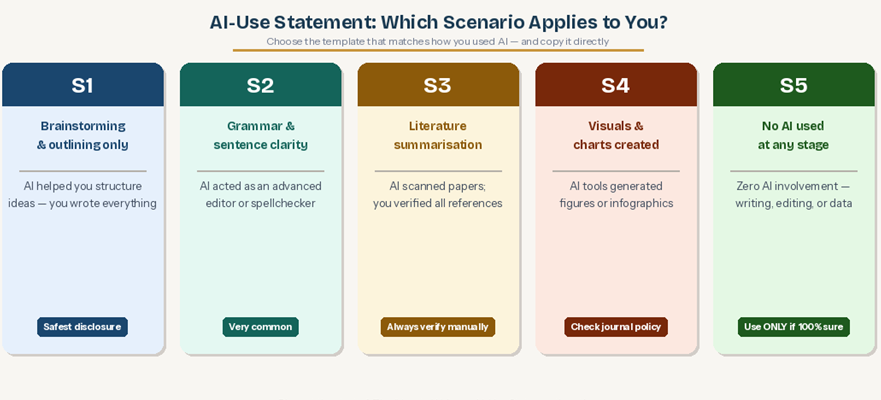
How to Write an AI-Use Statement — 5 Scenarios With Templates
AI-use statements are now a standard requirement across academic publishing. Here is a practical guide covering the most common scenarios you are likely to encounter.
Key Principles Before You Write
- Be specific — name the stage at which AI was used (ideation, summarisation, editing, etc.)
- Name the tool — ChatGPT, Grammarly, Scite.ai, Claude, or whichever tool you used
- Confirm human oversight — journals want to see that you maintained control over the final content and verified AI-produced material
- Align with the journal’s policy — if the journal provides prescribed language or a required format, use it
Scenario 1: AI Used Only for Brainstorming or Outlining
Template:
“AI tools (e.g., ChatGPT) were used only to generate initial outlines and to explore alternative ways of structuring the content. All writing, analysis, and editing were performed independently by the author.”
Use this when AI helped you think through structure but had no role in producing the actual text. This is the most conservative disclosure it signals AI-as-mind-map, not AI-as-writer.
Scenario 2: AI Used for Grammar or Sentence Clarity
Template:
“An AI-based writing assistant (such as Grammarly or ChatGPT) was used to suggest improvements for sentence clarity and grammar. All substantive writing, reasoning, and editing were carried out by the author.”
This covers the most common use case AI as an advanced editor or spellchecker. Declaring it protects you from any appearance of non-disclosure and positions AI as a tool rather than a contributor.
Scenario 3: AI Used to Summarise Research or Identify Citations
Template:
“AI tools were employed to summarise publicly available research papers and to identify relevant citations during the literature review stage. All summaries and references were manually verified by the author before inclusion.”
This is essential if you used Scite.ai, Elicit, Consensus, or ChatGPT to scan literature. The phrase ‘manually verified’ is important it tells the journal that you did not take AI summaries at face value.
Scenario 4: AI Used to Create Visuals or Charts
Template:
“Visual elements in this paper were developed with the assistance of AI-powered design tools. The content, interpretation, and final design decisions were made by the author.”
Some journals particularly in medicine and the social sciences have stricter policies on AI-generated visuals. If in doubt, check the journal’s specific guidance before using AI for figures or infographics.
Scenario 5: No AI Was Used at Any Stage
Template:
“No AI tools were used in the writing, editing, data analysis, or visual design stages of this work.”
Use this only when you are entirely certain. If AI played any role even rephrasing a sentence or checking a grammar point choose one of the above templates instead. A false ‘no AI’ declaration is far more damaging than an honest disclosure of minor use.
Here are some key tips when writing your AI-use statement
- Keep it specific. Mention what stage AI was used in — ideation, summarisation, editing, etc.
- Name the tool. Was it ChatGPT? Grammarly? Scite.ai? Mention it.
- Mention human review. Journals want to see that you maintained control over the final content.
- Align with the journal’s AI policy. If the journal has prescribed language (some do), use that.
The key point to communicate is that a detector score is a probability, not a verdict. You are not required to accept a tool’s classification as fact, and most editors will be responsive to a calm, evidence-based rebuttal.




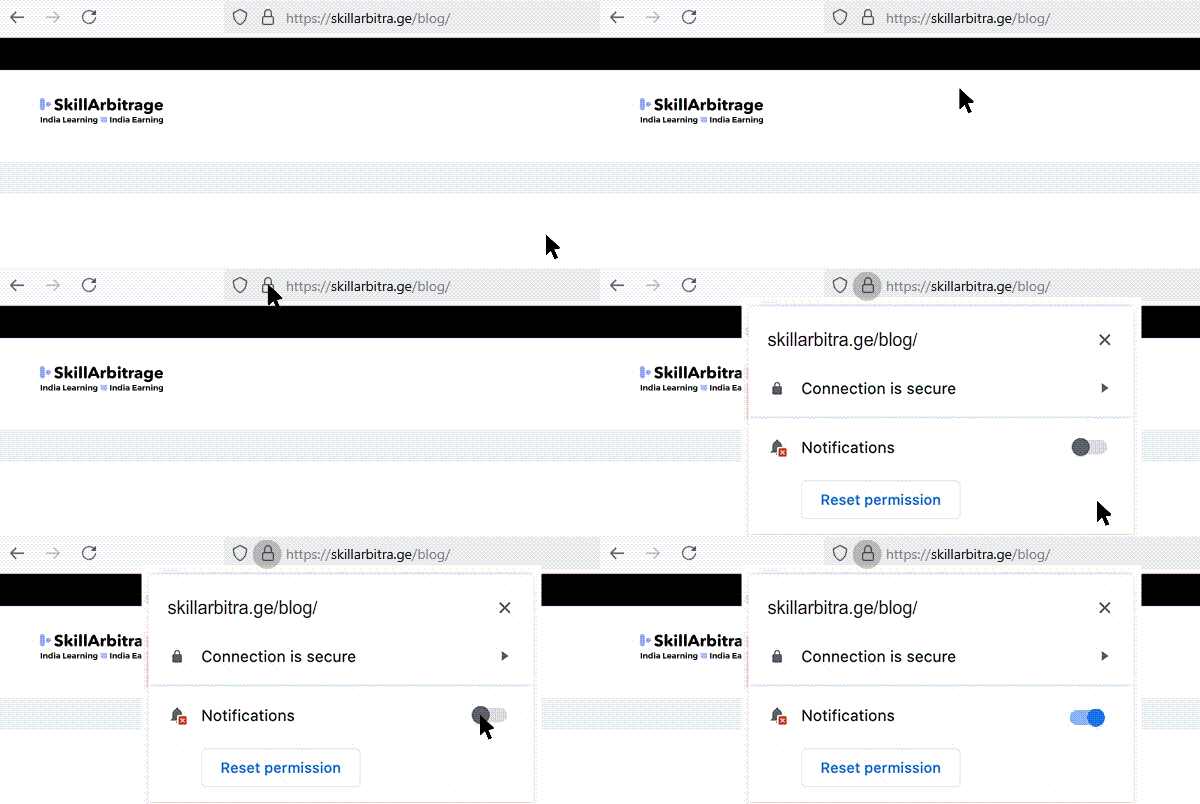
 Allow notifications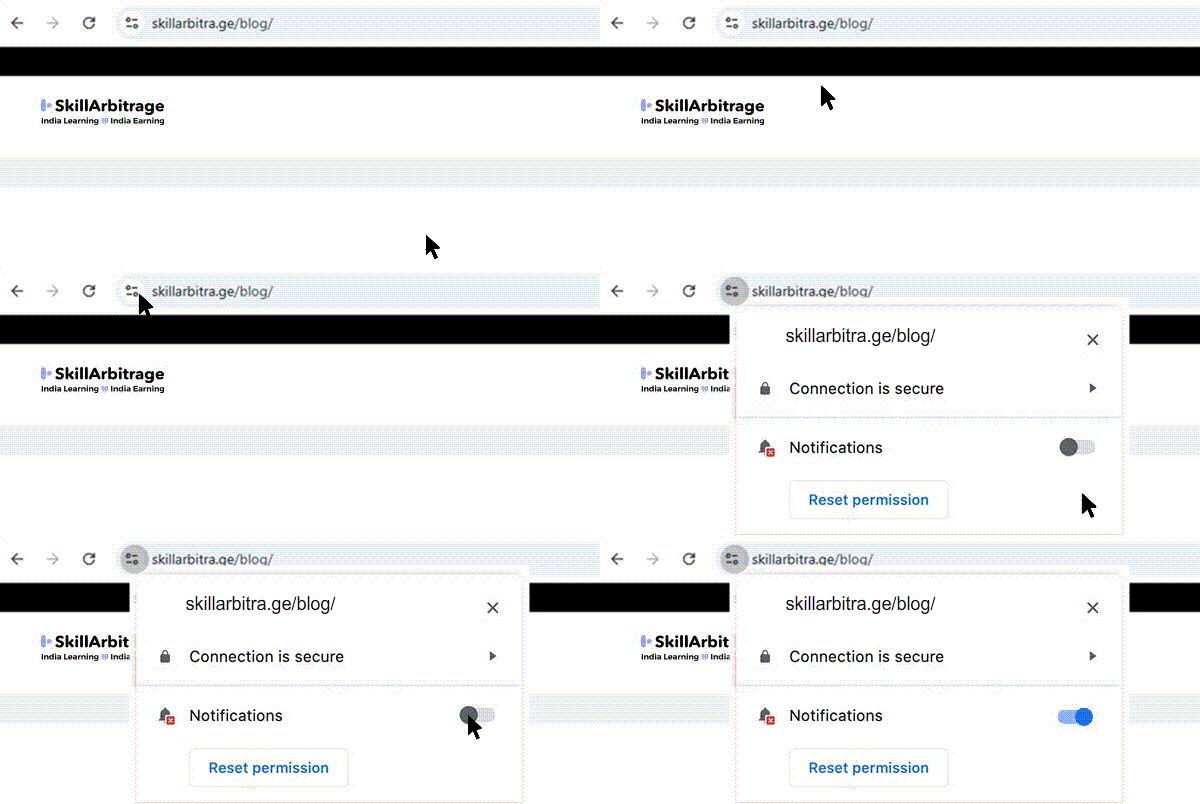
I’ve had AI detectors flag my writing even when everything was original, so it’s refreshing to see a guide that breaks down why false positives happen. The step-by-step strategies, especially documenting the writing process, feel practical and achievable without overcomplicating things. Being transparent about AI usage now seems like a straightforward way to protect both your work and your credibility.