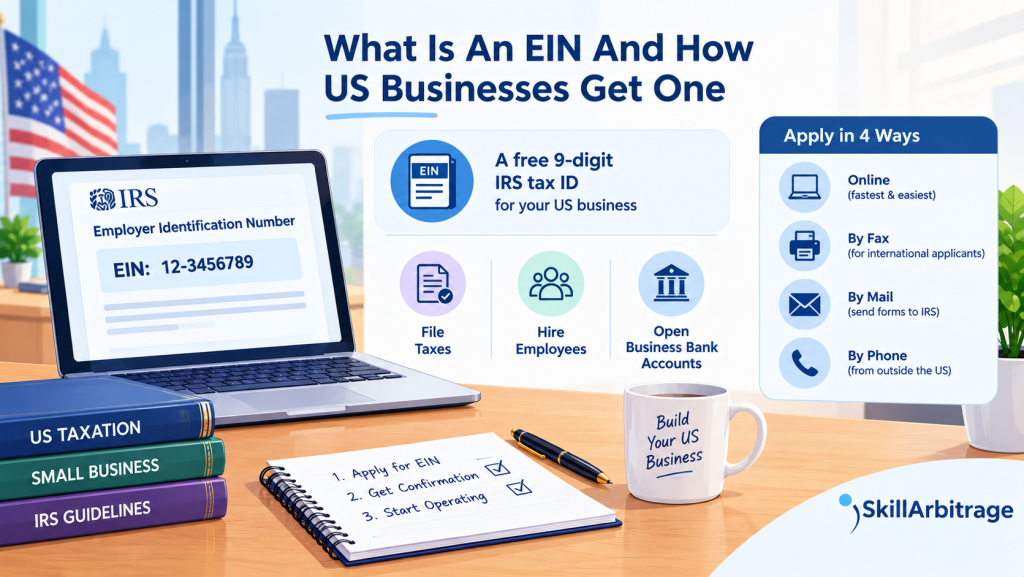

An EIN, or employer identification number, is a nine-digit federal tax ID in the format XX-XXXXXXX that the Internal Revenue Service (IRS) assigns to businesses, trusts, estates and other entities for tax filing and reporting. It costs nothing, and once assigned it stays with the entity permanently. US businesses get an EIN by submitting the information on Form SS-4 online, by fax or by mail, and applicants with no base in the United States can also get one by phone.
The same number goes by other names. The IRS also calls it a federal tax identification number, and banks and clients often write FEIN or simply “tax ID”. It appears on every federal return and payment the business makes, on payroll filings, on a business bank account application and on licence applications, and it is for business use only: the Instructions for Form SS-4 tell applicants not to use an EIN in place of a Social Security number (SSN) or an individual taxpayer identification number (ITIN). A business entity should hold only one.
Two practical points come before anything else. The IRS charges no fee for an EIN, and its application page warns against websites that do: “You never have to pay a fee for an EIN.” And the procedure has moved on: Form SS-4 and its instructions were revised in December 2025, the online application now opens on weekends, and the IRS’s own Publication 1635 (last revised in 2014) still circulates with the older hours and a fax number that doesn’t match the current instructions. Every figure below comes from the December 2025 revision and the live IRS and FinCEN pages.
Who needs an EIN
An EIN is required for any business that hires employees, operates as a corporation or partnership, or files employment, excise, or alcohol, tobacco and firearms returns. The IRS EIN page extends the list to anyone who withholds tax on income, other than wages, paid to a non-resident alien, and to partnerships, LLCs, corporations, tax-exempt organizations, estates, trusts, retirement plans and farmers’ cooperatives. The IRS’s internal manual states the principle in a single line: every business entity required to file a federal tax return must have or be assigned an EIN.
Having no employees doesn’t change that for most entity types. Form SS-4 says a partnership, corporation, nonprofit organization or farmers’ cooperative “must use an EIN for any tax-related purpose even if the entity doesn’t have employees.” The rules loosen only for the individual running an unincorporated business, and for the single-member LLC.
A sole proprietor needs an EIN only on specific triggers. Form SS-4 gives as examples establishing a qualified retirement plan or being required to file excise, employment, alcohol, tobacco or firearms returns, and hiring a first employee brings in employment returns. Outside those triggers, a sole proprietor can operate under their SSN, and Form W-9 lets a sole proprietor give a client either number. One EIN covers every business a sole proprietor runs, however many trade names they use (getting one voluntarily keeps the SSN off client paperwork, which is a practical reason rather than a legal one).
A single-member LLC is treated by default as a disregarded entity: the IRS ignores it for income tax and taxes its income on the owner’s return. For income tax it generally uses the owner’s SSN or EIN. It needs its own EIN once it has employees or an excise tax liability, because the IRS requires a disregarded entity to use its own name and EIN for employment and excise taxes. The IRS single-member LLC page says one with neither “does not need an EIN”, although it can still get one when a bank or a state tax law requires it.
A US single-member LLC wholly owned by a foreign person is the exception that matters most for founders outside the United States. For tax years beginning on or after January 1, 2017, the Instructions for Form 5472 treat such an LLC as a corporation for one limited purpose: although it has no income tax return to file, it may have to file a pro forma Form 1120 with Form 5472 attached when it has reportable transactions with a related party. A foreign-owned U.S. disregarded entity generally does not file Form 5472 when it has no reportable transactions. That filing needs an EIN. The penalty for failing to file Form 5472 when due is $25,000, and a substantially incomplete form counts as a failure to file.
The pro forma return doesn’t go to the usual IRS addresses. It is faxed to 855-887-7737 or mailed to Internal Revenue Service, 1973 Rulon White Blvd, M/S 6112, Attn: PIN Unit, Ogden, UT 84201, and it sits alongside the state-level filings a Delaware LLC run from India already carries, such as the annual state tax.
The three taxpayer numbers in play are easy to mix up. An SSN is issued by the Social Security Administration to individuals, on Form SS-5. An ITIN is a tax processing number the IRS issues on Form W-7 to certain resident and non-resident aliens, their spouses and dependents who can’t get an SSN. An EIN is issued by the IRS to entities, on Form SS-4, and (the point that matters most for founders abroad) a foreign individual applying for one does not need an ITIN first.
What about a foreign company with no operations in the United States? The IRS manual says foreign corporations and individuals not engaged in a US trade or business are not required to obtain an EIN, unless they have US-source income on which tax was not fully satisfied by withholding at source. A foreign person may still need one to comply with withholding rules, for example to complete a Form W-8 or claim treaty benefits, which Form SS-4 lists as its own reason to apply.
Preparing to apply for an EIN
Preparing to apply for an EIN comes down to four things: a legally formed entity, an eligible responsible party, the right entity type, and a business name the IRS system will accept. The online application checks the name and the responsible party’s taxpayer number in real time, so an error in either stops it on the spot.
Does the order of formation and application matter? The IRS tells anyone creating an LLC, partnership or corporation to register it with the state before applying for an EIN, and warns that an application made before the entity is formed “may be delayed”. Line 1 of Form SS-4 asks for the legal name exactly as it appears on the charter or other legal document, and a name that doesn’t yet exist on a state filing has nothing to match.
The responsible party is the person who ultimately owns or controls the entity, or who exercises ultimate effective control over it. The SS-4 instructions tie this to real control over the entity’s funds and assets. Unless the applicant is a government entity, the responsible party must be an individual, never another company, and that person’s SSN or ITIN goes on line 7b. For a trust it is the grantor, owner or trustor, and for a decedent’s estate the executor, administrator or other fiduciary.
Take a Delaware C corporation with two founders who each hold 50% and serve as its president and chief financial officer. Either founder meets the definition, since both own and control the company. The one named on line 7a enters their own SSN or ITIN on line 7b, or “foreign” if they have neither and can’t get one, and the formation service that filed the certificate of incorporation is not named anywhere.

The IRS doesn’t accept nominees. Its page on responsible parties and nominees defines a nominee as someone given limited authority to act for the entity during formation, with little or no control over its assets, and says nominees can’t apply for an EIN and shouldn’t be listed on Form SS-4. Some guides aimed at non-resident founders still suggest borrowing a US agent’s SSN to get through the online tool. That advice runs straight into the IRS rule that every application “must disclose the name and Taxpayer Identification Number” of the true principal officer, general partner, grantor, owner or trustor, and the international route described below makes it unnecessary anyway.
EIN issuance is limited to one per responsible party per day, whatever the method, a rule in force since May 21, 2012. A founder setting up three LLCs in the same week therefore needs three separate days. The IRS also asks applicants to use only one method per entity, since faxing an SS-4 and then calling or applying online for the same business can produce a duplicate EIN.
The entity type chosen on line 9a is not a tax election. An LLC that wants to be taxed as a corporation or S corporation makes that election separately, on Form 8832 or Form 2553. In the online application, single-member and multi-member LLCs must select “Limited Liability Company”, because selecting sole proprietor or partnership blocks the LLC suffix from being added to the name.
IRS systems accept only letters, numbers, hyphens and ampersands in a business name. Everything else is spelled out or dropped, and Publication 1635 gives the pattern: “Jones.com” is entered as “Jones Dot Com” or “Jones Com”, a slash becomes a hyphen, and an apostrophe is removed without leaving a space.
Whichever route is used, the application asks for the same information:
- the legal name exactly as on the state filing, plus any trade name
- a mailing address and, if different, a street address (which can’t be a P.O. box)
- the responsible party’s name and SSN or ITIN, or “foreign” where neither is available
- for an LLC, the number of members and whether it was organized in the United States
- the start date of the business and the closing month of its accounting year
- expected headcount over the next 12 months, and the date wages will first be paid
- the principal activity and the main products or services
How to get an EIN for a US Business
A US business gets an EIN by giving the IRS the information on Form SS-4 through one of four routes: online, by fax, by mail, or by phone. Online is limited to applicants in the United States or US territories, phone is limited to applicants outside them, and fax and mail are open to both. The IRS recommends applying electronically where possible, and online and phone are the two routes that return the number on the spot. Which of the four fits depends mainly on where the business is based.
Applying for an EIN online
Applying for an EIN online is open to an entity formed in the United States or a US territory with its principal place of business there, where the person applying is the responsible party or an authorized representative and has the responsible party’s SSN or ITIN. The application runs from the IRS get-an-EIN page during set hours, Eastern Time: Monday to Friday from 6 a.m. to 1 a.m. the next day, Saturday from 6 a.m. to 9 p.m., and Sunday from 6 p.m. to midnight. At least one leading competitor guide still prints the old weekday-only window of 7 a.m. to 10 p.m.
The session can’t be saved. It expires after 15 minutes of inactivity and has to be started again, so every field from the checklist above should be at hand before logging in. The system validates as it goes, including a match between the responsible party’s name and taxpayer number and a check for an existing EIN under the same business name in the same state. Applicants who pass receive the EIN at the end of the session and can use it at once to file a return or make a payment.
The confirmation notice, CP 575, can be viewed, printed and saved at the end of the session. Choosing to receive it online means no copy arrives by post, and the IRS says the original CP 575 “cannot be duplicated or recreated”, so the PDF should be saved before the browser is closed.
An application that fails validation ends with a fixed message beginning “We are unable to provide you with an EIN”, followed by a phone number (800-829-4933 in the US, 267-941-1099 from outside it) and a three-digit reference number. The IRS doesn’t publish what each reference number means. Its internal manual says only that numbers 101 and 115 are routed to a live assistor, while the rest lead to an automated message explaining how to correct the information and resubmit, or to apply by fax or mail instead. Explanations online that tie a particular code to a particular cause come from third-party sites, not the IRS, and since the online check compares the name with the taxpayer number and looks for an existing EIN under the same name in the same state, those are the first fields to recheck.
Applying by fax or mail
Fax and mail both use the paper Form SS-4, which downloads from irs.gov as a fillable PDF suitable for either. Under the IRS Fax-TIN program, a business in any of the 50 states or the District of Columbia faxes the completed, signed form to 855-641-6935 and generally receives its EIN by fax within four business days. The line runs 24 hours a day, seven days a week, and the form must carry a return fax number so the IRS can send the EIN back. The IRS notes that Fax-TIN numbers can change without notice, which makes a quick check of the current instructions worth doing before sending.
Mail is the slowest route. The instructions say to complete Form SS-4 at least four to five weeks before the EIN is needed, and the number arrives by post in approximately four weeks. A business in the 50 states or DC sends the form to Internal Revenue Service, Attn: EIN Operation, Cincinnati, OH 45999, and can check the status of a mailed application on 800-829-4933.
A paper application isn’t valid unsigned. The individual signs for a sole proprietorship; the president, vice president or another principal officer for a corporation; a responsible and duly authorized member or officer for a partnership or other unincorporated organization; and the fiduciary for a trust or estate. Foreign applicants may have any duly authorized person sign, a division manager for instance.
Applying from outside the US
An applicant with no legal residence, principal place of business, or principal office or agency in the United States or its territories can’t use the online application and applies by phone, fax or mail instead. A Delaware LLC run entirely from India, with a registered agent’s address as its only US presence, sits in this group.
The phone route is the fastest of them. International applicants call 267-941-1099 (not a toll-free number) between 6 a.m. and 11 p.m. Eastern Time, Monday to Friday. For a caller in India that window runs from 3:30 p.m. to 8:30 a.m. IST the next morning while the US is on daylight saving time, and from 4:30 p.m. to 9:30 a.m. IST between the first Sunday of November and the second Sunday of March.
The person on the call must be authorized to receive the EIN and to answer questions about Form SS-4. The IRS suggests completing the form before calling, writing the EIN given on the call in the upper right corner, then signing, dating and keeping it. If the assistor asks for it, the signed form (with any designee authorization) must be mailed or faxed within 24 hours to the address the assistor gives.
Fax and mail work from abroad too, through separate channels. An applicant with no legal residence or principal place of business in any state or DC faxes to 855-215-1627 from within the United States or 304-707-9471 from outside it, or mails to Internal Revenue Service, Attn: EIN International Operation, Cincinnati, OH 45999. Publication 1635 prints the outside-US fax number as 304-704-9471, and that figure should be ignored: the December 2025 instructions give 304-707-9471.
A foreign responsible party doesn’t need an SSN or ITIN to get an EIN. The SS-4 instructions say to enter “foreign” or N/A on line 7b if the responsible party doesn’t have and is ineligible to obtain an SSN or ITIN, and they add that an entry there is required.
For a Delaware single-member LLC owned by one individual resident in India who has no SSN or ITIN, the entries that differ from a domestic application are these: line 7b “Foreign”; line 8a “Yes”, line 8b “1” and line 8c “Yes”; line 9a “Other”, with “Foreign-owned U.S. disregarded entity-Form 5472” written in; line 10 “Other”, with “Foreign-owned U.S. disregarded entity filing Form 5472”; and line 11, the date the business began in the United States. The owner then calls 267-941-1099, or faxes the signed form to 304-707-9471.
Filling in Form SS-4
Form SS-4 has 18 numbered lines, followed by a third party designee block and a signature, and the instructions say to enter “N/A” on any line that doesn’t apply. Line 10, the reason for applying, is the exception: N/A isn’t accepted there. The lines fall into groups:
- Lines 1 to 3, names. Line 1 is the legal name exactly as on the charter or other legal document; a corporation includes its suffix, such as Inc. or Corp., and a sole proprietor enters their own name, with no abbreviations or nicknames, putting the business name on line 2 as the trade name. Line 3 is for an executor, trustee or “care of” name.
- Lines 4 to 6, addresses. Line 4 is the mailing address used on returns, line 5 the street address if different (never a P.O. box), and line 6 the county and state of the principal business. Foreign addresses give the city, province or state, postal code and the full country name, not an abbreviation.
- Lines 7a and 7b, responsible party. The individual’s name and SSN or ITIN, or “foreign” as described above.
- Lines 8a to 8c, LLC questions. Whether the entity is an LLC, how many members it has, and whether it was organized in the United States. Spouses owning an LLC in a community property state who treat it as disregarded may enter “1” as the member count.
- Lines 9a and 9b, entity type. One box only. A single-member LLC that stays disregarded checks “Other” and writes “disregarded entity”; a multi-member LLC taking the default partnership treatment checks “Partnership”; an LLC electing corporate or S corporation status checks “Corporation” and enters Form 1120 or 1120-S. Line 9b asks for the state or foreign country of incorporation.
- Line 10, reason for applying. One box: started a new business, hired employees, banking purpose, changed type of organization, purchased a going business, created a trust, created a pension plan, compliance with IRS withholding regulations, or other. Adding a location isn’t a reason to apply, and a business that already has an EIN doesn’t apply again because it has started hiring.
- Lines 11 and 12, dates. The date the business started or was acquired (for foreign applicants, the date it began or was acquired in the United States), and the closing month of the accounting year, which is December for a calendar year.
- Lines 13 to 15, employees. The highest number of employees expected in the next 12 months (0 if none, in which case line 14 is skipped), the Form 944 election, and the first date wages will be paid.
- Lines 16 to 18, activity and history. The principal activity from the listed categories, the principal line of merchandise or services, and whether the entity has ever applied for and received an EIN before, with the old number if so.
Line 14 decides which payroll return the business files. An employer expecting employment tax liability of $1,000 or less for a full calendar year can check the box to file Form 944 annually instead of Form 941 quarterly, and the instructions say that generally means total wages of $5,000 or less ($6,536 or less in a US territory). Leaving it unchecked means quarterly Form 941 filings. Once the box is checked, the business keeps filing Form 944 until the IRS tells it otherwise.
Line 17 needs a specific description, not a category, and an entry is required. The instructions give “General contractor for residential buildings” as their model; in the same style, a software company might enter “Subscription accounting software for small firms”, and a consultancy “Management consulting services to retail businesses”.
No US base: 855-215-1627 (from within the US) or 304-707-9471 (from outside it)
No US base: Attn: EIN International Operation, same city and ZIP

After you get an EIN
After the IRS assigns an EIN, most uses start immediately and a few wait up to two weeks. According to the IRS EIN page, the number can be used at once to open a bank account, apply for business licences and file a tax return by mail. The IRS says to allow up to two weeks before the number will pass its TIN Matching Program, before e-filing a return, and before making tax deposits and payments electronically.
The CP 575 notice is the IRS’s written confirmation of the number, and the IRS suggests keeping copies of it for opening bank accounts. It belongs in the permanent records, since the original can’t be reissued. Businesses with an IRS Business Tax Account can instead download a digital CP575, which the IRS says banks and other institutions accept as written confirmation and which substitutes for both the original notice and Letter 147C. But Business Tax Account isn’t yet available for LLCs that file as sole proprietors on Schedule C or Schedule F, access needs identity verification through the IRS’s third-party provider, and a foreign-owned disregarded LLC is not among the account types the IRS lists as eligible.
What if the number itself is lost? The IRS suggests checking the notice issued at application, asking the bank where the business account was opened, checking state or local licence records, and looking through past tax returns. If none of those turns it up, the Business and Specialty Tax Line on 800-829-4933 verifies the number after confirming the caller’s identity, Monday to Friday from 7 a.m. to 7 p.m. local time (Pacific time in Alaska and Hawaii). The IRS can then issue Letter 147C, “EIN Previously Assigned”, by fax or by mail, and a mailed letter takes 10 to 14 business days according to the IRS procedures manual.
The EIN also goes to the businesses that pay the entity. A US business gives its taxpayer number on Form W-9, which lets the payer file information returns such as the Form 1099 series. A single-member LLC that stays disregarded gives its owner’s SSN or EIN on the W-9, not the LLC’s own EIN. And a disregarded US entity with a foreign owner doesn’t use Form W-9 at all: the form’s own caution says it “must use the appropriate Form W-8.”
A business with employees, or with any other depository tax, pays electronically. Depository taxes, such as employment, excise and corporate income taxes, generally must be deposited electronically. Depending on the tax and taxpayer, electronic deposits can be made through EFTPS, the IRS Business Tax Account, or other permitted electronic payment methods” target=”_blank” rel=”noopener”>EFTPS, the Treasury’s free Electronic Federal Tax Payment System. Enrollment uses the EIN and can take up to five business days, so in practice it belongs straight after the EIN arrives rather than in the week the first deposit falls due. The federal payroll filings that follow are set out in the SkillArbitrage guide to US payroll rules.
The EIN is a federal number, and states run their own registrations for sales tax, income tax withholding and unemployment insurance. The IRS keeps a directory of state government websites covering doing business, taxation and employer registration in each state. Which registrations apply depends on where the business has employees and where it sells, which is the question sales tax nexus answers.
And what happens when the founder named as responsible party leaves, or the business moves? Changes to the mailing address, business location or responsible party are reported on Form 8822-B, and a change of responsible party must be reported within 60 days. None of these changes requires a new EIN.
When a business needs a new EIN
A business needs a new EIN when its ownership or legal structure changes, not when its name or address changes. The logic running through the IRS new-EIN guidance and Publication 5845 is that the number belongs to the entity: a new entity gets a new number, and a continuing entity keeps its own. The triggers by entity type:
- Sole proprietors need a new EIN on incorporating, on forming a partnership, on declaring bankruptcy, or on buying or inheriting an existing business that they run as a sole proprietorship. Changing name or location, or owning several businesses, doesn’t require one.
- Corporations need one on receiving a new charter from the secretary of state, on becoming a subsidiary of another corporation, on changing to a partnership or sole proprietorship, or when a merger creates a new corporation. A name or location change, bankruptcy, an S corporation election, a division of the corporation, or surviving a merger doesn’t.
- Partnerships need one on incorporating, when one partner takes over and runs the business as a sole proprietorship, or when the partnership ends and a new one begins. A name or location change, bankruptcy, or an ownership change that doesn’t end the partnership doesn’t.
- LLCs need one when an existing LLC ends and a new corporation or partnership is formed, and when a single-member LLC that has used its owner’s number has to file employment or excise taxes. A name or location change, an election to be taxed as a corporation or S corporation, or converting a partnership into an LLC taxed as a partnership doesn’t.
Estates and trusts carry their own list on the same IRS page. Form SS-4 adds one more point: a partnership that terminated because 50% or more of its interests were sold or exchanged within 12 months doesn’t apply for a new EIN on that ground.
A name change is handled under the existing EIN, but the method depends on the entity. A sole proprietor writes to the IRS at the address where returns are filed, signed by the owner or an authorized representative. A corporation marks the name-change box on its current-year return (page 1, line E, box 3 on Form 1120, or line H, box 2 on Form 1120-S), or writes in, signed by an officer, if that return is already filed; a partnership does the same on Form 1065, page 1, line G, box 3, with any letter signed by a partner. Publication 1635 adds that partnerships and corporations include a copy of the articles of amendment filed with the state.
An EIN can’t be cancelled, only deactivated. The IRS treats it as the entity’s permanent federal taxpayer ID, so closing a business means asking the IRS to close the account attached to the number. The request is a letter giving the entity’s legal name, EIN, address and reason for closing, with a copy of the EIN assignment notice if one is available. The IRS closing-your-account page lists two addresses for it, Internal Revenue Service, MS 6055, Kansas City, MO 64108, and Internal Revenue Service, MS 6273, Ogden, UT 84201, while an exempt organization eligible to deactivate writes to the EO Entity unit at the Ogden address or faxes the letter to 855-214-7520.
Outstanding filings come first. The IRS won’t deactivate an EIN while the business has returns due or taxes owed, so every outstanding return has to be filed and every balance paid before the account can close.
FAQs
What do the first two digits of an EIN mean?
The first two digits, called the EIN prefix, identify the IRS campus that assigned the number. The IRS manual makes an exception for EINs issued through the online application or through the Small Business Administration, whose prefixes are not set by the assigning campus. The format is always the same: two digits, a hyphen, then seven digits.
Can an accountant apply for an EIN for a client?
An accountant or other representative can apply as the third party designee named at the foot of Form SS-4, and the authorization is valid only once the taxpayer signs the form. The designee can answer the IRS’s questions and receive the EIN by the method used, but the authority ends as soon as the EIN is assigned, and the confirmation notice still goes to the taxpayer. If the designee’s address or phone number matches the taxpayer’s, the application has to go by mail or fax.
What goes on a tax return if the EIN hasn’t arrived yet?
The words “Applied For” and the date of application go in the space for the number, and the SS-4 instructions are explicit that an SSN must never be shown as an EIN on a return. If a tax deposit falls due first, the payment goes to the IRS service center for the filing area, by check payable to “United States Treasury”, showing the name as on Form SS-4, the address, the type of tax, the period and the application date.
Does a US LLC owned from India still file BOI with FinCEN?
FinCEN’s final rule of August 11, 2026, effective August 14, 2026, exempts every entity created in the United States from beneficial ownership information reporting, and that includes a Delaware or Wyoming LLC owned from India. The obligation now falls only on companies formed under foreign law that register to do business in a US state or tribal jurisdiction. The LLC’s EIN and any applicable Form 5472 filing requirements are unaffected.
References
- Employer identification number (EIN hub page). Internal Revenue Service. https://www.irs.gov/businesses/employer-identification-number
- Get an employer identification number. Internal Revenue Service. https://www.irs.gov/businesses/small-businesses-self-employed/get-an-employer-identification-number
- Instructions for Form SS-4 (Rev. December 2025). Internal Revenue Service. https://www.irs.gov/instructions/iss4
- Form SS-4, Application for Employer Identification Number (Rev. December 2025). Internal Revenue Service. https://www.irs.gov/pub/irs-pdf/fss4.pdf
- Publication 1635, Understanding Your EIN (Rev. 2-2014). Internal Revenue Service. https://www.irs.gov/pub/irs-pdf/p1635.pdf
- Responsible parties and nominees. Internal Revenue Service. https://www.irs.gov/businesses/small-businesses-self-employed/responsible-parties-and-nominees
- Single member limited liability companies. Internal Revenue Service. https://www.irs.gov/businesses/small-businesses-self-employed/single-member-limited-liability-companies
- Instructions for Form 5472 (Rev. December 2024). Internal Revenue Service. https://www.irs.gov/instructions/i5472
- Taxpayer identification numbers (TIN). Internal Revenue Service. https://www.irs.gov/tin/taxpayer-identification-numbers-tin
- Internal Revenue Manual 21.7.13, Assigning Employer Identification Numbers (EINs). Internal Revenue Service. https://www.irs.gov/irm/part21/irm_21-007-013r
- Internal Revenue Manual 21.7.1, Business Tax Returns and Non-Master File Accounts. Internal Revenue Service. https://www.irs.gov/irm/part21/irm_21-007-001r
- Understanding your CP575 notice. Internal Revenue Service. https://www.irs.gov/individuals/understanding-your-cp575-notice
- Business Tax Account. Internal Revenue Service. https://www.irs.gov/businesses/business-tax-account
- Telephone assistance contacts for business customers. Internal Revenue Service. https://www.irs.gov/businesses/telephone-assistance-contacts-for-business-customers
- Form W-9, Request for Taxpayer Identification Number and Certification (Rev. March 2024). Internal Revenue Service. https://www.irs.gov/pub/irs-pdf/fw9.pdf
- EFTPS: The Electronic Federal Tax Payment System. Internal Revenue Service. https://www.irs.gov/payments/eftps-the-electronic-federal-tax-payment-system
- State government websites. Internal Revenue Service. https://www.irs.gov/businesses/small-businesses-self-employed/state-government-websites
- About Form 8822-B, Change of Address or Responsible Party, Business. Internal Revenue Service. https://www.irs.gov/forms-pubs/about-form-8822-b
- When to get a new EIN. Internal Revenue Service. https://www.irs.gov/businesses/small-businesses-self-employed/when-to-get-a-new-ein
- Publication 5845, Do You Need a New EIN? (Rev. 7-2023). Internal Revenue Service. https://www.irs.gov/pub/irs-pdf/p5845.pdf
- Business name change. Internal Revenue Service. https://www.irs.gov/node/10373
- Canceling an EIN: closing your account. Internal Revenue Service. https://www.irs.gov/businesses/small-businesses-self-employed/canceling-an-ein-closing-your-account
- Beneficial Ownership Information Reporting. Financial Crimes Enforcement Network. https://www.fincen.gov/boi
Disclaimer
This article is for informational and educational purposes only and does not constitute tax, legal or financial advice. IRS procedures, phone numbers, fax numbers and addresses change, and their application depends on the facts of each business. Consult a qualified professional before acting on any tax or compliance decision described here.




 Allow notifications