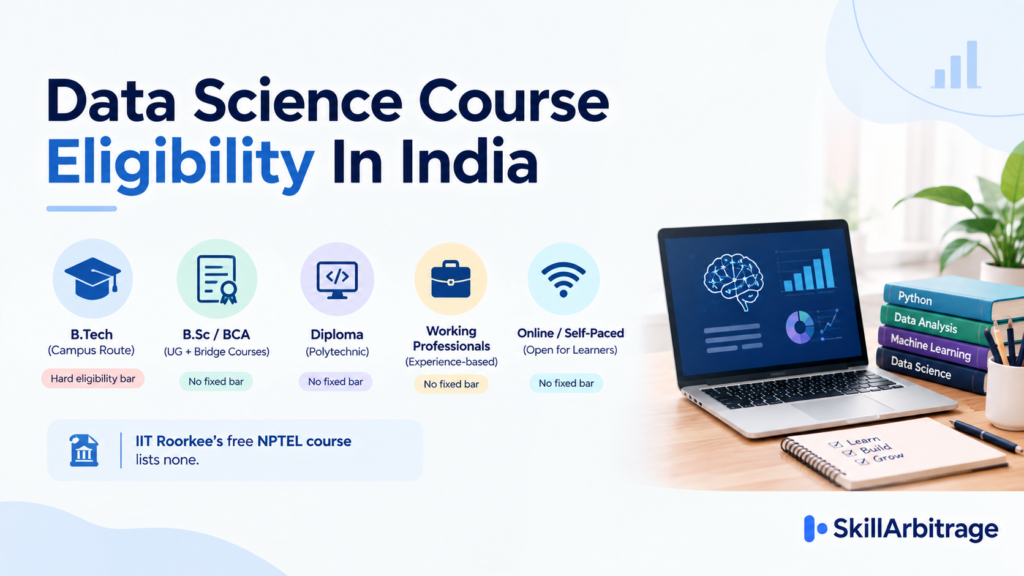

Data science course eligibility in India depends almost entirely on which route a student takes, and only one of the five routes carries a genuine academic bar. IIT Roorkee’s free data analytics course on NPTEL lists no prerequisite worth the name. IIT Madras admits students to a four-year BS in Data Science on a Class 12 pass alone, “irrespective of age or academic background”, with no entrance exam. An IIT Roorkee postgraduate certificate asks for a bachelor’s degree at 50% and states in writing that no coding or mathematics background is needed. The exception is the campus engineering degree, where the National Testing Agency requires Physics and Mathematics in Class 12 plus a 75% aggregate.
The figure that circulates on this question is 50% to 60% in Class 12. It appears across most of the pages that currently rank for it, and in Google’s own AI Overview, which puts the B.Tech requirement at “minimum 60%”. That number describes no institution a reader would actually name. Every Indian Institute of Technology admitting through the Joint Entrance Examination asks for 75%, or a place in the top 20 percentile of the candidate’s own board, relaxed to 65% for Scheduled Caste and Scheduled Tribe candidates.
The gap misdirects twice over. It overstates the bar on the four routes that are wide open, and understates it on the single route that is genuinely closed to most applicants.
Data science course eligibility in India, route by route
There is no single eligibility criterion for a data science course in India. There are five, and the distance between them is wide enough that one student can be simultaneously overqualified for one route and permanently shut out of another. Ranked by how hard they are to enter, they run: free courses on the government’s own platforms, paid short certificates, online degrees, executive and postgraduate certificates, and campus degrees.
Fees, duration and syllabus aren’t separate questions. They’re attributes of whichever route a student picks, and they move roughly in step with the bar.
Free courses on NPTEL and SWAYAM: no eligibility bar at all
The cheapest route into data science teaching at an Indian Institute of Technology has no admission process. IIT Roorkee’s Data Analytics with Python, run by its Department of Management Studies on the National Programme on Technology Enhanced Learning, states its prerequisite as basic knowledge of Python “but not necessary”, and names its intended audience as management, industrial engineering and computer science engineering students. It runs 12 weeks and carries three credits at undergraduate and postgraduate level.
Cost is the part the ranking pages leave out. According to IIT Roorkee’s own E-Learning Centre, “enrollment to the course and learning is free”, and the certification exam “is not free but has a nominal fee of Rs 1000”. Pass it and the certificate carries both the NPTEL and the IIT Roorkee logos.
The syllabus is not a soft introduction either. Across its twelve weeks the course moves from Python fundamentals through probability, sampling distributions and hypothesis testing, into one-way and two-way ANOVA, linear and multiple regression, maximum likelihood estimation and logistic regression, then ROC curves, the chi-square test, cluster analysis and classification and regression trees. That is a graduate statistics sequence, offered to anyone who registers.
Two companion courses from the same department extend it. Business analytics and data mining Modeling using R runs in two parts, 12 weeks and three credits each, and asks only for basic statistics knowledge.
Here’s the thing about this route: IIT Roorkee is one of the seven IITs that founded NPTEL alongside the Indian Institute of Science in 2003, which is why its free data science teaching sits on that platform rather than on its own admissions portal. Students searching for a free IIT Roorkee course and finding nothing are usually searching the wrong website.
Paid short certificates and bootcamps: a bar in name only
Paid certificates priced below a lakh sit a step above the free courses on cost and barely anywhere above them on eligibility. The data science certification run by the E&ICT Academy at IIT Roorkee through a training partner asks only for basic knowledge of Linux and any one programming language, and runs eleven months. Its fee is published by the partner rather than by the institute, and third-party listings put it near Rs 99,000.
What actually disqualifies students on this route isn’t the entry requirement. It’s the completion condition. That same programme requires 60% attendance at live sessions before it will issue a certificate, which means a working student who falls behind on weekend classes can pay in full and finish with nothing to show. Admission was never the filter. Attendance is.
The online degree route: Class 12, any stream, any age
The most permissive degree in Indian data science is also the most selective institution’s. IIT Madras states the eligibility for its BS in Data Science and Applications in one sentence: “Anyone who has passed Class 12 or equivalent can apply irrespective of age or academic background.” School students who have sat their Class 11 final exams may apply “irrespective of their group/stream/board”, and the page adds that “no additional eligibility other than the ones mentioned above is required”. The only academic expectation stated anywhere is that applicants studied Mathematics and English in Class 10.
There is no mandatory entrance exam. Applicants instead clear a Qualifier: four weeks of coursework across four foundational subjects, assessed by a four-hour in-person exam. Candidates already qualified to appear for that year’s JEE Advanced can skip it and join directly.
Fees are published per level rather than as a lump sum, which makes the route unusually easy to abandon cheaply. The Foundation level costs Rs 48,000, the two diplomas together Rs 81,000, and the full BS degree between Rs 3,86,000 and Rs 4,50,000 across 142 credits. Completion time runs up to eight years.

None of this existed before the regulator allowed it. Under the University Grants Commission’s 2020 regulations on open, distance and online programmes, institutions “accredited by NAAC with a score of 3.26 and above in the preceding two assessment cycles or institutions ranked in the top 100 in NIRF may offer full online programmes without seeking prior approval of the Commission”. The programme opened in June 2020 as, in the government’s words, the “first-of-its-kind” route that “makes it possible for students to study from IIT Madras without writing the hypercompetitive JEE”. A press release of 1 May 2024 put enrolment at more than 27,000 students, recorded more than 2,500 who had secured jobs or promotions, and noted that over 3,645 had taken up fee waivers and related support funded by corporate CSR, private donations and government scholarship schemes.
Executive and postgraduate certificates: a bachelor’s plus experience
Executive certificates are where eligibility finally starts to bite, and it bites on experience rather than marks. IIT Roorkee’s Continuing Education Centre runs two data science programmes whose entry requirements differ sharply from each other, which is worth knowing before either fee is paid.
The Post Graduate Certificate Programme in Applied Data Science & AI sets its bar at a “bachelor’s degree with minimum 50% marks” and adds, in the institute’s own words, that “no coding or mathematics background is needed”. It runs six to eight months online across five modules: conceptual and technical foundations, data mining and machine learning, analytics using natural language processing, time series and networks, data-driven web products, and data-driven business decisions. Its programme partner publishes the fee at Rs 1,50,000 plus GST, payable in two instalments.
Its sibling programme is stricter on all three counts. The Post Graduate Certificate Programme in Data Science, Machine Learning and Generative AI asks for a bachelor’s degree with minimum 50%, states a preference for candidates from engineering, technology, computer science, IT and mathematical sciences, and requires a minimum of one year’s experience, preferably in IT, software, technology or engineering. It runs eight months with live weekend classes, plus 30 hours of campus immersion and a 30-hour capstone, and admission is by application review. The joint brochure issued with its delivery partner puts the fee at Rs 1,99,000 exclusive of a Rs 1,000 non-refundable application fee, with 18% GST charged on top.
One detail deserves flagging, because it’s the opposite of how the comparison pages present it: neither IIT Roorkee course page states a fee at all. Both figures above come from partner material, so they are the partner’s published price rather than the institute’s. Fees on this route also move between batches, which is why a figure quoted on a third-party listing is worth checking against the current brochure before anyone commits.
The certificate itself carries conditions. On the eight-month programme, a candidate needs at least 50% overall and a minimum of 75% attendance to receive it. For a mid-career professional weighing this against the shorter AI and automation upskilling routes, the attendance requirement across eight months of weekends is usually the harder commitment to meet.
Campus degrees: the one route with a hard bar
This is the route the circulating 50% figure is meant to describe, and it’s the one place where a decision made at sixteen can close the door for good. For admission to the National Institutes of Technology, the Indian Institutes of Information Technology and other centrally funded technical institutions, the National Testing Agency requires candidates to have passed Class 12 with Physics and Mathematics as compulsory subjects, plus one of Chemistry, Biotechnology, Biology or a technical vocational subject. The marks requirement is 75% in Class 12 or a place in the top 20 percentile of the candidate’s board, relaxed to 65% for Scheduled Caste and Scheduled Tribe candidates.
The IITs sit a further step up, admitting to their B.Tech programmes in data science and artificial intelligence through JEE Advanced, which itself can only be attempted after clearing JEE Main.
So the stream gate is real, and it’s narrow. A commerce student who didn’t take Physics and Mathematics in Class 12 cannot enter this route at all, regardless of marks or aptitude. What that student can do is enter any of the other four, including an IIT degree, which is the fact the averaged 50-to-60% figure obscures.
The entry bar rises sharply only at the final rung, and cost does not follow it. The same institute teaches data science at nothing and at close to two lakh rupees, and it is the free route that asks for less.
Why data science course eligibility in India is not hiring eligibility
Clearing a course’s eligibility bar and clearing an employer’s are different problems, and the Indian job boards show how far apart they’ve drifted. On a Naukri search run on 5 October 2026, 686 data scientist postings were open to candidates with zero years of experience, and 567 of those accepted any graduate degree. The same search for data analyst roles returned 2,518 zero-experience postings, 2,183 of them open to any graduate. Those counts move daily, but the proportion holds: roughly five in six entry-level listings don’t specify a quantitative degree at all.
Read the senior postings and the picture inverts. A bank advertising for a senior data scientist against five to eight years of experience specifies a bachelor’s in computer science, statistics, mathematics, engineering or data science, with a postgraduate degree preferred.
That contrast is the useful finding. In Indian data science the degree requirement functions as a seniority gate rather than an entry gate. It rarely stops a commerce graduate getting hired; it stops them getting promoted past a band without going back for a qualification. Which makes the course decision a question of timing rather than permission, and the practical route in usually runs through a data analyst role or paid Power BI work rather than straight into a data scientist title.
What most people miss is that the widest door has the weakest signal attached to it. A course that filters nobody tells an employer nothing about who completed it, which is precisely the position of a free certificate with no prerequisite. Meanwhile the IIT Roorkee programme that does filter, on a bachelor’s degree plus a year’s experience, is priced for people who already hold the job the credential is supposed to win. The students with the most to prove get the credential that proves least.
There’s a second gate nobody schedules. Every route above admits commerce and arts graduates, but the mathematics arrives anyway, just later. IIT Roorkee’s own NPTEL course on essential mathematics for machine learning spends twelve weeks on matrix algebra, eigenvalues, singular value decomposition, principal component analysis and convex optimisation. That bar sits after admission rather than before it, so it shows up as mid-course attrition instead of rejection, and the skills that actually transfer are the applied ones a portfolio can demonstrate.
The hiring direction is worth watching too. Naukri’s JobSpeak index for June 2026 put artificial intelligence and machine learning roles at 25% year-on-year growth and fresher hiring at 8%, with the chief executive of the platform’s parent company noting in the same report that demand is shifting toward more senior and specialised talent.
Fair warning on the marketing that surrounds all of this. The Advertising Standards Council of India’s guidelines for educational institutions and platforms bar advertisements that lead the public to believe enrolment “will guarantee the student a rank, high marks, temporary or permanent job” without substantiation, require the disclaimer that past record is no guarantee of future prospects, and prohibit “100% Placement/Job assistance” claims outright. The eligibility line on a course page is a fact the provider has to stand behind. The placement claim beside it often isn’t.
The trade-off, then, runs in the opposite direction to the price list. The routes that cost nothing and admit everyone carry the least weight with an employer, while the ones that gate hardest are aimed at professionals who have already cleared the hiring bar by other means. A student choosing between them is really choosing when to spend the money, not whether they are allowed to.
FAQs
Is there an age limit for a data science course in India?
No upper age limit applies on any of the five routes. IIT Madras states that applicants to its BS in Data Science may apply “irrespective of age”, and NPTEL sets no age condition on enrolment or on the certification exam. The National Testing Agency is equally explicit that there is no age limit for JEE Main. What the campus route does impose is a recency window rather than an age bar: a candidate may appear in JEE Main in three consecutive years, counting the year they pass Class 12 and the two following it, so the constraint binds on how long ago school finished rather than on how old the applicant is. Individual institutions may set their own age conditions for admission.
Is an online data science degree UGC-recognised?
Recognition turns on the institution, not the delivery mode. The University Grants Commission’s 2020 regulations on open, distance and online programmes allow institutions “accredited by NAAC with a score of 3.26 and above in the preceding two assessment cycles or institutions ranked in the top 100 in NIRF” to offer full online programmes without seeking prior approval. A degree from an institution clearing that threshold carries the same standing as its on-campus equivalent. Worth checking separately is whether the specific programme is approved, since institutions outside that exempted category need the Commission’s clearance programme by programme.
Can a polytechnic diploma holder join a data science course?
A three-year AICTE-recognised diploma is accepted as a Class 12 equivalent by IIT Madras for its BS in Data Science, alongside qualifications recognised as equivalent to 10+2 by the Association of Indian Universities. The free NPTEL courses have no formal qualification requirement, so they’re open regardless. The routes that close are the ones requiring a bachelor’s degree, and the campus engineering route, which needs Physics and Mathematics at Class 12 level specifically.
Is three months enough to learn data science?
Published durations run considerably longer than three months on every institutional route. IIT Roorkee’s free NPTEL course covers one subject area, Python-based analytics, in 12 weeks. Its executive certificates run six to eight months, and the IIT Madras BS allows up to eight years for completion. Three months is roughly the length of a single NPTEL subject, which makes it a reasonable span for a first module and an unreasonable one for the field.
References
Free courses, IIT Roorkee and NPTEL
- Data Analytics with Python, NPTEL course 106107220, Department of Management Studies, IIT Roorkee. Prerequisites, intended audience, 12-week course plan, duration and credit value
- NPTEL, E-Learning Centre, IIT Roorkee. Free enrolment and learning, Rs 1,000 certification exam fee
- Business analytics and data mining Modeling using R, Parts I and II, NPTEL courses 110107092 and 110107095, Department of Management Studies, IIT Roorkee. Basic statistics prerequisite, 12 weeks and three credits each
- Essential Mathematics for Machine Learning, NPTEL course 111107137, IIT Roorkee. Twelve-week syllabus covering matrix algebra, eigenvalues, singular value decomposition, principal component analysis and convex optimisation
- About NPTEL, SWAYAM. Founding of NPTEL in 2003 by seven IITs, including Roorkee, with the Indian Institute of Science
Certificate and executive programmes
- Post Graduate Certificate Programme in Applied Data Science & AI, Continuing Education Centre, IIT Roorkee. Eligibility wording, six-to-eight-month duration, online mode, module list
- Post Graduate Certificate Programme in Data Science, Machine Learning and Generative AI, Continuing Education Centre, IIT Roorkee. Eligibility wording including the one-year experience requirement, eight-month duration, weekend schedule, admission by application review, 50% marks and 75% attendance certification condition
- Programme brochure issued jointly by IIT Roorkee and its delivery partner for the Post Graduate Certificate Programme in Data Science and Machine Learning. Total fee of Rs 1,99,000 exclusive of the Rs 1,000 application fee, 18% GST charged extra, instalment schedule, campus immersion and capstone hours
- Partner programme page for the IIT Roorkee Post Graduate Certificate in Applied Data Science & AI. Fee of Rs 1,50,000 plus GST and the two-instalment schedule
- Data science certification programme, E&ICT Academy, IIT Roorkee, via its training partner. Prerequisite of basic Linux and one programming language, eleven-month duration, 60% live-session attendance condition, fee as listed by third parties
Degree routes and regulation
- Admissions, BS in Data Science and Applications, IIT Madras. Eligibility wording, accepted Class 12 equivalents including AICTE-recognised diplomas, the Qualifier Process and the JEE Advanced entry route
- Academics, BS in Data Science and Applications, IIT Madras. Per-level fee table from Foundation at Rs 48,000 to the BS degree at Rs 3,86,000 to Rs 4,50,000, and completion time of up to eight years
- Engineering examination eligibility, National Testing Agency. Compulsory Physics and Mathematics subject combination plus one of Chemistry, Biotechnology, Biology or a technical vocational subject, and the 75% or top-20-percentile requirement, relaxed to 65% for Scheduled Caste and Scheduled Tribe candidates
- Frequently asked questions on JEE (Main), National Testing Agency. No age limit for candidates, and eligibility to appear in three consecutive years counting the year of passing Class 12
- University Grants Commission (Open and Distance Learning Programmes and Online Programmes) Regulations, 2020. NAAC score of 3.26 and above in the preceding two assessment cycles, or a place in the NIRF top 100, as the threshold for offering full online programmes without prior approval of the Commission
- “IIT Madras BS Data Science helps place 2,500 students with jobs & promotions”, 1 May 2024, Press Information Bureau, Government of India. Launch in June 2020 without JEE, enrolment of more than 27,000 students, more than 2,500 jobs and promotions, 850+ admissions to Masters and PhD programmes abroad, and more than 3,645 students on fee waivers and related support
Hiring data and advertising rules
- Data scientist and data analyst job searches filtered to zero years of experience, with education facet counts, Naukri. Snapshot taken 5 October 2026: 686 and 2,518 postings respectively, of which 567 and 2,183 accepted any graduate degree
- “Naukri JobSpeak: White-collar hiring grows 6% in June 2026”, published 3 July 2026, Naukri. Index at 3027 against 2854 a year earlier, artificial intelligence and machine learning roles at 25% year-on-year growth, fresher hiring at 8% in June and 9% for the April to June quarter, and the quoted comment from the managing director and chief executive of Info Edge (India) Limited on demand shifting toward senior and specialised talent
- Guidelines for Advertising of Educational Institutions, Programmes and Platforms, issued 2 March 2023 and amended 14 March 2023, Advertising Standards Council of India. Clause 3 on guaranteed-outcome claims and the required “past record is no guarantee of future prospects” disclaimer, and clause 4 prohibiting claims with a numerical value of 100% including “100% Placement/Job assistance”
This article is for informational and educational purposes only and does not constitute professional, career, financial or legal advice. Course fees, eligibility criteria, batch dates and examination fees change, and several of the fee figures above are published by programme partners rather than by the institutes themselves. Readers should verify current details on the official course page before paying any fee.




 Allow notifications