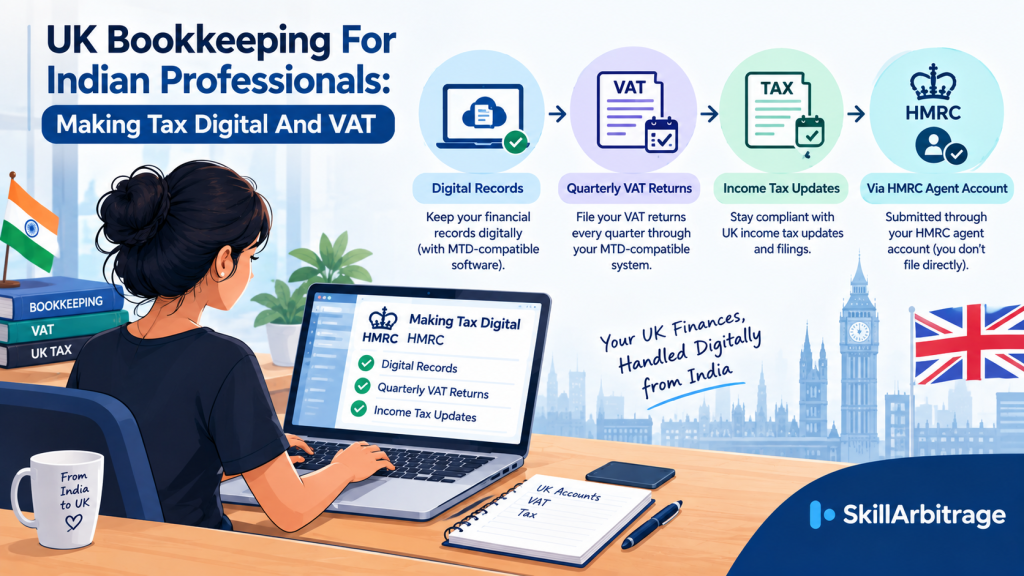

UK bookkeeping for Indian professionals now runs on Making Tax Digital. Every VAT-registered UK business must keep digital records and file its VAT returns through software under HMRC’s VAT Notice 700/22, and since 6 April 2026 sole traders and landlords with qualifying income over £50,000 must also send HMRC quarterly income tax updates. You can do this work from India, usually as a supporting agent inside a UK firm’s agent services account, or through your own account approved under HMRC’s route for agents based outside the UK.
A UK client usually hands you the digital records, the VAT return preparation and the quarterly income tax updates. The UK accountant tends to stay on as main agent and sign off the tax return, and HMRC’s own example of a supporting agent is a bookkeeper who completes quarterly updates. But pages selling outsourcing to UK practices rarely mention the UK GDPR data terms you’ll sign before you see a single ledger, or how your own invoice is taxed in both countries (UK VAT and Indian GST) and paid into India.
The workload is live and recurring: on 23 July 2026, ahead of the first quarterly deadline on 7 August, HMRC reminded “more than 864,000” sole traders and landlords that their first update was due. From September 2026 it starts signing up anyone who should be in the service but isn’t. The threshold then falls to £30,000 from April 2027 and £20,000 from April 2028. Four quarterly updates a year, due on 7 August, 7 November, 7 February and 7 May, replace one annual rush, and that steady, repeatable rhythm suits a team working from India.
Taking on UK bookkeeping clients from India
Taking on UK bookkeeping clients from India starts with scope: which parts of the work are yours, and which stay with the UK accountant. A client can have one main agent at a time and any number of supporting agents, which leaves room for you alongside the main agent.
The digital side isn’t new for VAT. Making Tax Digital for VAT applied from April 2019 to businesses with taxable turnover above £85,000, and to every VAT-registered business from 1 April 2022. Income tax followed on 6 April 2026. So agree in writing which pieces are yours (the brackets below are placeholders, and the wording is illustrative, not HMRC-prescribed):
We will keep your business records in [software] with digital links throughout, prepare your quarterly VAT return for your approval, and send your Making Tax Digital income tax updates as your supporting agent. [UK practice] remains your main agent and submits your tax return.
Data terms come next. India isn’t covered by UK adequacy regulations, and the ICO’s own worked example says a UK business using an organisation in India that only accesses data on UK systems is making a restricted transfer, with the UK business responsible for it. Expect to sign the International Data Transfer Agreement (IDTA), or the UK Addendum together with the EU clauses the UK Addendum attaches to, backed by the client’s transfer risk assessment. And add Article 28 processor terms, since a bookkeeper working on the client’s instructions is typically a processor.
UK practitioners on AccountingWEB keep asking whether clients must be told the work goes offshore. We’d recommend settling it in the engagement letter.
On the UK side of your invoice, bookkeeping for a UK business client is supplied where the customer belongs, so the client accounts for the VAT under the reverse charge, per HMRC’s VAT Notice 741A. If all your UK supplies are reverse-charged, you’re not entitled to register for UK VAT. Ask for the client’s VAT number, HMRC’s best evidence that the customer is in business (different rules apply to private individuals).
The India side is GST. Your work can be an export of services if it meets the five conditions in section 2(6) of the IGST Act, including payment in convertible foreign exchange, and the place of supply is the recipient’s location. Exports are zero-rated, so a registered supplier can bill without IGST under a Letter of Undertaking (LUT), filed each financial year in Form GST RFD-11. An export-only supplier with aggregate turnover up to Rs 20 lakh isn’t required to register, the same figure as the section 22 threshold.
Still on the number itself? See how to set the fee before the invoice goes out.
In practice, getting paid is mostly paperwork. Make sure the inward remittance is reported under RBI purpose code P1005, “accounting, auditing, book keeping and tax consulting services”, keep the FIRC or bank advice, and generate the eBRC on the DGFT portal from your bank’s inward remittance message.
Then watch the realisation clock. The 2015 Export Regulations set a nine-month period to realise export value. The 2026 Regulations, in force from 1 October 2026, set fifteen months from the invoice date for services (eighteen where invoiced or settled in INR), and services invoices up to Rs 10 lakh can have their EDPMS entry closed on your declaration. For an invoice raised before 1 October 2026, ask your bank which period applies.
The catch? Billing without an LUT, or a remittance landing under the wrong purpose code, leaves paperwork to unpick at year end, and your client won’t notice either mistake for you.
HMRC agent access from India
HMRC agent access from India comes one of two ways: you work inside a UK firm’s agent services account, or your firm applies for its own through HMRC’s approval route for agents based outside the UK. The agent services account is how tax advisers access HMRC’s online services. Which role do you hold in it? A supporting agent can send quarterly updates but can’t submit the tax return, finalise the tax position, view the tax calculation or set up a Direct Debit.

Registration changed in 2026. Anyone paid to interact with HMRC about someone else’s tax affairs, including sending returns, must register as a tax adviser, and HMRC says that includes businesses based outside the UK. The Finance Act 2026 prohibits unregistered advisers from interacting with HMRC, firms that held an agent services account before 18 August 2026 are treated as registered, and everyone else registers in phased windows under SI 2026/807. Compare where Australia draws its registration line for offshore bookkeepers.
Working under a UK firm’s agent services account
Working under a UK firm’s agent services account is the simpler route for an India-based bookkeeper, because the firm already holds the HMRC authorisations. Clients authorise the firm through the digital handshake: in the account the firm chooses “Ask a client to authorise you” and sends a link, which expires after 21 days. Access runs on agent services account sign-in details, not the ones you use for HMRC online services, and for VAT clients HMRC now handles sign-up itself.
Worth flagging: the final multi-factor authentication activation window runs from 28 September to 15 October 2026, per Agent Update 147. Send a covering email with the link along these lines (brackets are placeholders):
[UK practice] will send you a link from HMRC so you can authorise us as your agent for Making Tax Digital. Please open it and approve it within 21 days, because the link stops working after that. Our team in India prepares your quarterly figures under that authorisation, and we never need your own HMRC sign-in details.
Fair warning: whether offshore staff working inside the firm’s account need their own tax-adviser registration isn’t settled in HMRC’s guidance. Confirm it with the firm against HMRC’s test (do you interact with HMRC about someone else’s tax affairs, and get paid for it?). And diarise day 21, since a lapsed link holds up the first update.
Applying for your own agent services account
Applying for your own agent services account from India starts with HMRC approval, which a business based outside the UK must get before it can create the account. You’re eligible if your firm complies with anti-money laundering (AML) supervision “or similar regulations in your country” and the applicant is a director or senior officer. The evidence pack is proof of trading address (within 3 months), AML supervision proof if your country requires it (within 12 months), and proof of tax registration (within 12 months). If no AML body is required locally, upload a document explaining why, translate anything not in English, and expect a decision within 28 days.
Registration adds its own conditions: AML supervision evidence, no outstanding returns or unpaid tax, no relevant unspent convictions, and not being insolvent. Overseas firms send notarised, translated evidence only when HMRC asks.
Frankly, the real question is AML. HMRC’s accountancy service provider guidance treats professional bookkeeping as an accountancy service, and the UK Money Laundering Regulations apply to business carried on in the UK. But how an India-based firm with no UK business evidences AML supervision isn’t explained in HMRC’s guidance, so check with HMRC or a supervisory body before you apply. AAT, ACCA and ICB are among the supervisory bodies HMRC lists, and AML supervision of accountancy service providers is set to move to the FCA, subject to legislation, with no start date yet.
Making Tax Digital records for UK bookkeeping
Making Tax Digital records for UK bookkeeping are digital records kept in software, joined to the return by digital links all the way to HMRC. For VAT, section 3.3 of VAT Notice 700/22 sets the contents. You hold the business name, principal place of business, VAT number and any VAT schemes used. Then, for each supply made, the tax point, the net value and the VAT rate; for each supply received, the tax point, the value and the input tax claimed.
Output values are split by standard, reduced, zero, exempt and outside-the-scope supplies. Several supplies at the same rate on one invoice can go in as a single entry (a real saving on a busy sales ledger). For income tax, each record needs an amount, a date and a category, kept separately for each business under the same digital-link rules.
So what counts as a digital link? It’s a transfer of data between software programs with no manual intervention. Linked spreadsheet cells count, as do CSV or XML import and export, emailing a spreadsheet so it can be imported, and API transfer. Cut and paste, copy and paste and retyping by hand don’t, although some calculations outside the software are allowed, for example a capital goods scheme adjustment.
Submission to HMRC always goes through an API. But a spreadsheet can still do the job, because bridging software connects it to HMRC when it can’t connect itself.
On a real client file, it looks like this: Your client’s till system exports the month’s sales as a CSV, and you import that file straight into the ledger: that’s a digital link. Typing the same monthly totals into a summary tab of your spreadsheet isn’t, even if the numbers match. The fix is to link the summary cells by formula to the imported data, or to import straight into the software.
If you inherit a spreadsheet file with a formula-driven summary tab, it’s acceptable, provided every cell traces back through formulas or imports to the source data. The break happens the moment someone pastes values over those formulas to “tidy up” the workbook, because that’s copy and paste in HMRC’s terms.
HMRC keeps a search service for recognised record-keeping and bridging software, and it doesn’t recommend any product, so check each client’s package against the list rather than assuming. The authority granted to that software to reach HMRC data lasts 18 months and can be withdrawn at any time. If Xero dominates at the firms you’re targeting, weigh up a Xero advisor certification from India. Keep VAT records for at least six years.
The practical reality is that spreadsheet-heavy offshore workflows have to be rebuilt around digital links or bridging software. Bottom line: the skill UK bookkeeping firms test for shifts from fast data entry to keeping an unbroken data trail. Take one client file this week and trace every VAT return box back to an imported record; any figure you can only reach by retyping is a broken link to fix.

Preparing the UK VAT return
Preparing the UK VAT return is usually a quarterly job, and both the return and the payment are due one calendar month and seven days after the period ends. And the payment has to reach HMRC by that date even when it falls on a weekend or bank holiday. A client paying by Direct Debit must set it up at least three working days before the return is submitted.
Check registration status before you touch the return. A business must register for VAT when taxable turnover for the last 12 months goes over £90,000, or is expected to in the next 30 days, and it can ask to deregister below £88,000. Both figures rose on 1 April 2024 from £85,000 and £83,000, so older client notes may quote stale numbers. The VAT rates are 20% standard, 5% reduced and 0% zero, with some supplies exempt.
Which scheme is the client on? In our view, that question changes your UK bookkeeping more than the rate does.
On the Flat Rate Scheme a business can join at £150,000 or less excluding VAT and must leave above £230,000 including VAT. It gets a 1% discount in its first year of registration, and pays 16.5% if it’s a limited cost business. Cash Accounting runs to £1.35 million to join and £1.6 million to leave, and it can’t be combined with Flat Rate. So if a handover file shows both, stop and ask the client which scheme HMRC actually has on record.
Annual Accounting means one return a year, due two months after the period ends, with advance payments through the year. Quarterly filers owing more than £2.3 million in 12 months make payments on account. Read the scheme off the client’s file first, then build the calendar around it.
Copy this quarter-end check into a client calendar: For a VAT quarter ending 30 September 2026, file and pay by 7 November 2026. If the client sold children’s meals or family attraction tickets, check that sales up to 1 September used the temporary 5% rate and sales from 2 September went back to 20%. That temporary rate ran from 25 June to 1 September 2026 under the government’s Great British Summer Savings measure, so tills and software set up for it needed resetting. A till still charging 5% in September understates output tax on every affected sale.
You can skip one step: HMRC now signs new VAT clients up for Making Tax Digital automatically. If you already file for Canadian clients, you’ll recognise the same input-credit logic under Canadian GST/HST: output tax on sales, input tax reclaimed on purchases, the difference paid or repaid.
Further out, the government has announced mandatory e-invoicing for B2B and B2G VAT invoices from 2029, with a roadmap due at Budget 2026. The detail comes with that roadmap, so check it before you move a client onto a new invoicing package.
Making Tax Digital for Income Tax updates
Making Tax Digital for Income Tax updates are quarterly summaries that sole traders and landlords with qualifying income over £50,000 have sent HMRC since 6 April 2026, due on 7 August, 7 November, 7 February and 7 May. Qualifying income is gross self-employment and property income before expenses, and PAYE pay, partnership profit shares, dividends and pensions don’t count. HMRC’s own example adds £25,000 of rent to £27,000 of self-employment income for £52,000, which puts that person in.
HMRC writes to people in scope, but a missing letter doesn’t remove the obligation. Once in, a client whose qualifying income stays below the threshold for 3 tax years in a row can choose to opt out.
Each update is cumulative, running from the start of the tax year to the end of the period, and a nil update still has to go. Updates are summaries, not tax returns, so no accounting adjustments are needed. You can send one up to 10 days before the period ends if no further transactions are expected.
Think of it this way: The update due 7 November 2026 covers 6 April to 5 October 2026, not only July to October. If your client chose calendar quarters instead, it covers 1 April to 30 September, with the same deadline.
Calendar quarters are chosen in the software before the first update, and once an update is sent they can’t be changed for that year. Settle that choice at onboarding, not in October. A smarter strategy for the deadlines themselves is to close each quarter’s figures within a fortnight of the period end, well ahead of the 7th.
At year end, HMRC now calls the filing the tax return. It goes through Making Tax Digital software by 31 January after the tax year, with the tax paid by the same date. As supporting agent you send the updates, and the main agent files that tax return.
Here’s the thing: a supporting agent can’t view the tax calculation, so don’t promise the client a tax estimate off the back of your updates. That figure comes from the main agent. The better approach is to agree a hand-off date each quarter, so the main agent reviews your cumulative figures before anyone quotes a number.
A few edges matter for clients with an India connection. For non-UK residents only UK property and self-employment income on the UK return counts, and anyone whose 2024 to 2025 tax return included the SA109 residence pages is automatically exempt until April 2027. Partnerships don’t need to use it yet. Joint landlords record only their share, under HMRC’s digital record-keeping direction.
UK agents on AccountingWEB have argued about the quarterly workload for a while. So what does this mean for you? It’s the four-times-a-year workload you’re being hired to absorb.
And the pool of clients keeps widening. HMRC starts signing up anyone still outside the service from September 2026, and the threshold falls to £30,000 from 6 April 2027 and £20,000 from 6 April 2028.
FAQs
What happens if a client misses a quarterly update in 2026-27?
HMRC charges no penalty for a missed quarterly update deadline in the 2026 to 2027 tax year, but you still have to send every update before the tax return can be filed, and a late tax return still gets points. From 2027-28 each missed deadline earns a point, four points cost £200, and each further miss costs another £200. Those points run separately from VAT points.
What does a late VAT return or payment cost?
Four late submission points cost a quarterly filer £200, plus £200 for each later late return. Late payment costs your client nothing up to day 15, then 3% of the VAT owed at day 15, another 3% of what’s still owed at day 30, and 10% a year from day 31. Late payment interest runs at Bank of England base rate plus 4%, which HMRC puts at 7.75% from 9 January 2026.
What if a UK client refuses to use Making Tax Digital software?
HMRC exempts a business only where digital tools aren’t practical, for reasons such as age, disability or location, or on insolvency or religious grounds, and never for extra cost, time or unfamiliarity with software. You can apply on the client’s behalf for VAT. For income tax, the digital-exclusion exemption also works by application, and HMRC aims to reply within 28 calendar days.
Does my invoice change if the UK client isn’t VAT-registered?
HMRC’s rule, in paragraph 5.7 of VAT Notice 741A, is that a UK business that isn’t VAT-registered and buys services from overseas must add their value to its own taxable supplies when checking whether it has to register. Without a VAT number, get other evidence that the client is in business, because without it the supply is treated as business-to-consumer, where different rules apply.
References
UK: HMRC guidance, Making Tax Digital for VAT and VAT basics
- VAT Notice 700/22: Making Tax Digital for VAT. HM Revenue and Customs
- Making Tax Digital for VAT is coming: are you ready? HM Revenue and Customs, 7 January 2022
- Making Tax Digital for VAT as an agent: step by step. HM Revenue and Customs
- Find software that’s compatible with Making Tax Digital for VAT. HM Revenue and Customs
- How to send VAT returns when exempt from Making Tax Digital for VAT. HM Revenue and Customs
- Record keeping for VAT (VAT Notice 700/21). HM Revenue and Customs
- VAT place of supply of services (VAT Notice 741A). HM Revenue and Customs
- Register for VAT. HM Revenue and Customs
- VAT thresholds. HM Revenue and Customs
- Increasing the VAT registration threshold. HM Treasury and HM Revenue and Customs policy paper, 2024
- VAT rates. HM Revenue and Customs
- VAT Returns: deadlines. HM Revenue and Customs
- Pay your VAT bill. HM Revenue and Customs
- VAT payments on account. HM Revenue and Customs
- Flat Rate Scheme. HM Revenue and Customs
- Cash Accounting Scheme. HM Revenue and Customs
- Annual Accounting Scheme. HM Revenue and Customs
- Penalty points and penalties if you submit your VAT Return late. HM Revenue and Customs
- How late payment penalties work if you pay VAT late. HM Revenue and Customs
- Late payment interest if you do not pay VAT or penalties on time. HM Revenue and Customs
- HMRC interest rates for late and early payments. HM Revenue and Customs
- Great British Summer Savings: VAT slashed to save families money on days out. HM Treasury and HM Revenue and Customs, 2026
- Agent Update: issue 147. HM Revenue and Customs, 2026
- Budget 2025: overview of tax legislation and rates (OOTLAR). HM Treasury and HM Revenue and Customs, 26 November 2025
UK: HMRC guidance, Making Tax Digital for Income Tax
- Making Tax Digital for Income Tax (collection). HM Revenue and Customs
- Find out if and when you need to use Making Tax Digital for Income Tax. HM Revenue and Customs
- Work out your qualifying income for Making Tax Digital for Income Tax. HM Revenue and Customs
- Send quarterly updates. HM Revenue and Customs
- Submit your tax return. HM Revenue and Customs
- Create digital records. HM Revenue and Customs
- Digital record-keeping direction for Making Tax Digital for Income Tax. HM Revenue and Customs
- Penalties for Making Tax Digital for Income Tax. HM Revenue and Customs
- Find out if you can get an exemption from Making Tax Digital for Income Tax. HM Revenue and Customs
- Apply for an exemption from Making Tax Digital for Income Tax. HM Revenue and Customs
- Choose the right software for Making Tax Digital for Income Tax. HM Revenue and Customs
- Choose agents for Making Tax Digital for Income Tax. HM Revenue and Customs
- Deadline approaches for first Making Tax Digital quarterly update. HM Revenue and Customs, 23 July 2026
UK: agent access, tax-adviser registration and AML
- Apply for an agent services account. HM Revenue and Customs
- Apply for an agent services account if you are not based in the UK. HM Revenue and Customs
- Check if and when you need to register as a tax adviser with HMRC. HM Revenue and Customs
- Check if you meet HMRC’s conditions to register as a tax adviser. HM Revenue and Customs
- How to use the digital handshake to get authorised as a tax agent. HM Revenue and Customs
- Money Laundering Regulations: accountancy service provider registration. HM Revenue and Customs
- Reform of the anti-money laundering and counter-terrorism financing supervision regime: consultation response. HM Treasury, 2025
UK: legislation
- Finance Act 2026 (c. 11). legislation.gov.uk
- SI 2026/807. legislation.gov.uk
- The Money Laundering, Terrorist Financing and Transfer of Funds (Information on the Payer) Regulations 2017, regulation 8. legislation.gov.uk
UK: data protection
- Is the restricted transfer covered by adequacy regulations? Information Commissioner’s Office
- International transfers: a guide. Information Commissioner’s Office
- What needs to be included in the contract? Information Commissioner’s Office
India: GST, FEMA and export documentation
- Integrated Goods and Services Tax Act, 2017, section 2. Central Board of Indirect Taxes and Customs
- Integrated Goods and Services Tax Act, 2017, section 13. Central Board of Indirect Taxes and Customs
- Integrated Goods and Services Tax Act, 2017, section 16. Central Board of Indirect Taxes and Customs
- Central Goods and Services Tax Act, 2017, section 22. Central Board of Indirect Taxes and Customs
- Notification No. 10/2017-Integrated Tax. Central Board of Indirect Taxes and Customs, 13 October 2017
- Furnishing of Letter of Undertaking (Form GST RFD-11). GST portal user guide
- Foreign Exchange Management (Export of Goods and Services) Regulations, 2015, as amended. Reserve Bank of India
- Foreign Exchange Management (Export and Import of Goods and Services) Regulations, 2026. Reserve Bank of India
- Purpose codes for reporting forex transactions. Reserve Bank of India
- FAQs on self-certification of eBRC. Directorate General of Foreign Trade
This article is for educational purposes only and does not constitute professional, financial, legal, or immigration advice. For guidance specific to your situation, consult a qualified professional.





 Allow notifications