
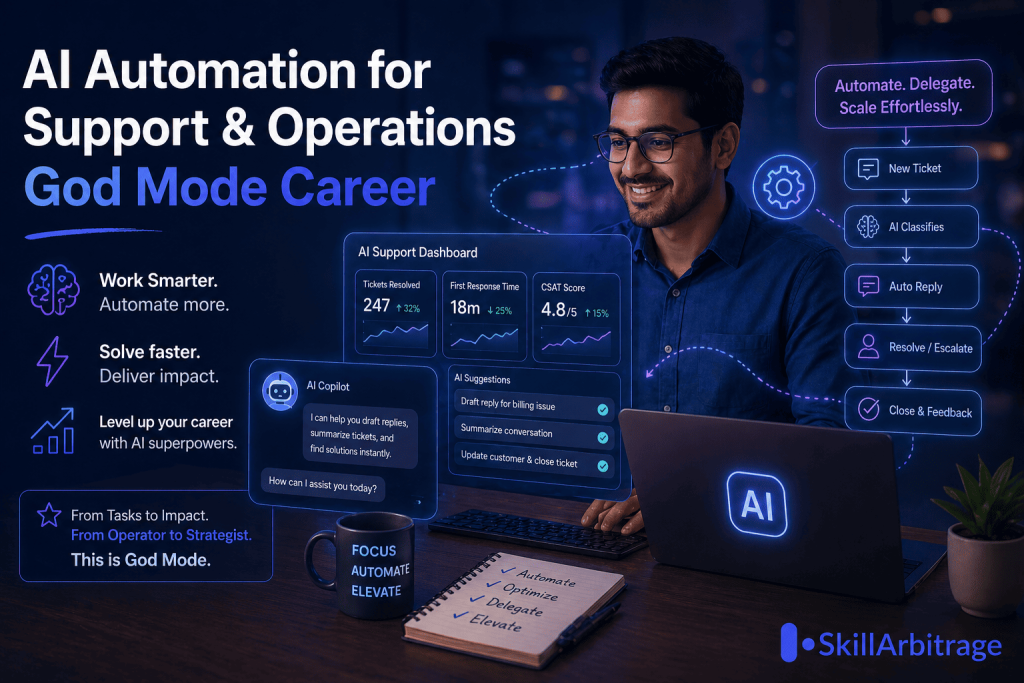

What if you could do the same support and operations job you do today, but with 10x the impact, half the workload, and triple the salary? That’s not a fantasy. That’s what AI automation does for support and ops professionals who learn to wield it.
Table of Contents
The Rohit Story: How AI Automation Changed Everything in 4 Weeks
Rohit was a Customer Support Executive at a SaaS company in Bangalore. Three years in. Hardworking. Stayed late most days. Stuck.
Every week was the same chaos: tickets piling up, angry customers, bad Google reviews, and refund requests shooting through the roof. His boss kept asking, “Why are customers leaving?” Rohit felt helpless.
Then he spent two weeks learning AI automation for support and operations. He rebuilt his company’s entire system:
- Created an AI chatbot that handled 70% of repeat customer queries.
- Automated refund and complaint tracking using Make.
- Built an onboarding flow that reduced churn by 35%.
- Set up real-time CSAT and NPS dashboards.
Four weeks later, support volume dropped 50%. Average response time fell from 14 hours to 3. CSAT jumped from 72% to 92%.
Last month, Rohit got promoted to Customer Experience Manager — ₹15 LPA plus a ₹1 lakh “operational excellence” bonus.
Same person. Same company. Same problems. Completely different capabilities. That’s what AI automation does.
What AI Automation Lets Support & Ops Pros Actually Do
Here are 20 things AI automation lets you do that 95% of support and ops professionals can’t. You don’t need all 20 even 5 to 7 done well make you unstoppable.
AI Automation for Customer Support
- Build chatbots and WhatsApp flows that handle 70–80% of repetitive queries automatically.
- Create AI-powered onboarding systems that guide customers step-by-step through your product.
- Set up voice bots that take customer calls 24/7 with no extra human agents.
- Build review management bots that collect and respond to Google and social media reviews.
- Create CSAT and NPS tracking systems that alert you instantly when customers are unhappy.
AI Automation for Operations and Workflows
- Map your team’s entire workflow — tickets, refunds, tasks — and automate manual steps using Make or n8n.
- Build real-time dashboards that track ticket load, revenue leakage, and agent performance.
- Automate daily reports and MIS updates straight to Slack or email.
- Identify recurring operational issues using predictive analytics.
- Use AI to design SOPs and training materials for new hires.
AI Automation for Customer Experience and Retention
- Analyze chat and call data to find patterns that cause customer frustration.
- Use sentiment analysis to detect refund or churn risk before it happens.
- Create automated win-back campaigns for dissatisfied customers.
- Personalize onboarding emails and WhatsApp flows for different customer segments.
- Build automated ticket routing systems that assign tasks based on agent skill and availability.
AI Automation for Strategic Ops and Leadership
- Conduct customer support audits and identify process inefficiencies.
- Create predictive dashboards that help CEOs prevent problems before they arise.
- Automate cross-team workflows between support, sales, and operations.
- Build self-service knowledge bases that reduce dependency on agents.
- Design performance dashboards that link metrics directly to revenue.
Why AI Automation Skills Pay 3x More
Once you can actually build automation systems instead of just operating within them, four big career doors open up.
Better Jobs and Better Pay (Even Globally)
SaaS startups, e-commerce brands, and agencies across the world are desperate for support and ops professionals who can build automation systems. They’re offering ₹15–25 LPA for people who can handle operations, analytics, and AI automation together.
This isn’t a stretch goal it’s the going market rate for proven AI automation skills.
Faster Promotions at Your Current Company
Your current company will see you completely differently. You stop being “the person who handles tickets” and become:
- The one who built the chatbot that cut workload 50%
- The one who designed the onboarding flow that improved retention
- The one who automated dashboards that saved your manager 10 hours a week
That person doesn’t get replaced. That person gets promoted.
International Remote Jobs Worth $2,000–$4,000 a Month
US and UK startups are actively hiring remote operations specialists who can implement AI automation, set up analytics, and manage customer success. When you apply with real automation projects:
- Your resume stands out instantly.
- You can demonstrate results they desperately need.
- You can comfortably command $2,000–$4,000 per month.
Freelance Income on the Side
Even if you keep your full-time job, AI automation skills open up serious side income:
- Offer chatbot and automation setup to startups and agencies.
- Deliver customer audit and reporting projects.
- Earn an extra ₹50,000–₹1,00,000 per month.
- Build a freelance client base that eventually becomes your full-time business.
How to Prove Your AI Automation Skills to Employers
Learning AI automation is only half the battle. The other half is proving you can actually use it. Because when you apply for a role, employers will ask:

- “Can you show me an example of an automation you’ve built?”
- “Have you ever set up a chatbot or dashboard that improved CSAT?”
If you can’t show it, they won’t believe it. That’s where most learners fail they study concepts but never build proof.
Step 1 — Build real projects you can showcase.
Don’t wait for a job to start building. Pick a small business, a friend’s startup, or even a hypothetical brand and build live projects:
- A customer support chatbot for a local business.
- A predictive analytics dashboard showing refund trends.
- A customer onboarding workflow for a SaaS product.
- An automated review management process for a D2C brand.
- A self-service helpdesk built on Notion or Intercom.
Host them on Google Drive, Notion, or your own website. Make them clickable and demo-able.
Step 2 — Showcase these in your CV and applications
Your resume shouldn’t say you do automation. It should show it. Replace generic bullet points with linked proof:
- Built a chatbot that reduced customer query volume by 70% → [Link to demo]
- Created a predictive analytics dashboard for churn prevention → [Link]
- Automated review management for a D2C brand → [Link]
Recruiters skim. Linked proof stops the skim.
Step 3 — Dominate Interviews
Most candidates answer interview questions with theory. You answer with receipts.
When the interviewer asks, “How do you improve customer satisfaction?”
- Other candidates say: “We send surveys and track feedback.”
- You say: “I built a chatbot and feedback loop for a SaaS brand that raised CSAT from 78% to 93% in four weeks. Want to see it?”
When they ask, “Can you handle analytics?”
- Other candidates say: “Yes, I’m good with Excel.”
- You say: “I built this dashboard for a logistics client. It tracks refunds, tickets, and sentiment live. Here’s the demo.”
The choice is simple, keep closing tickets manually, or learn AI automation and become the support and ops professional companies fight to hire.





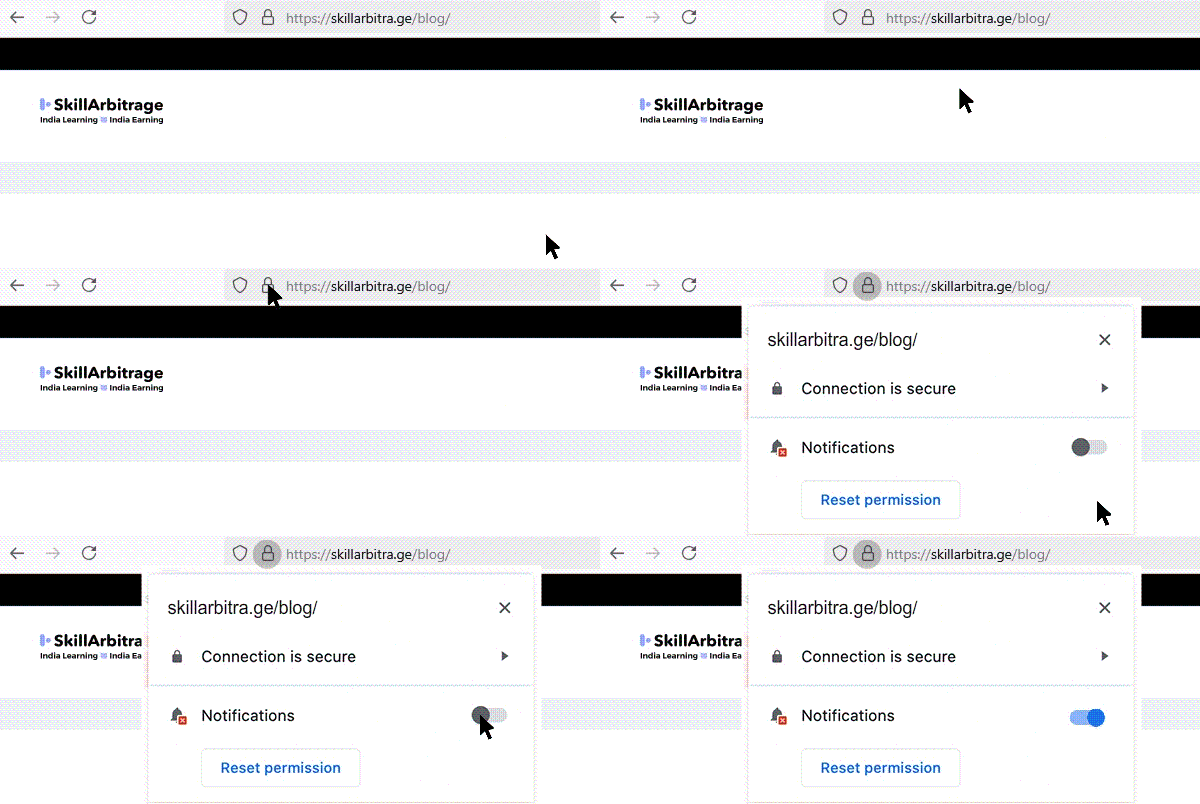
 Allow notifications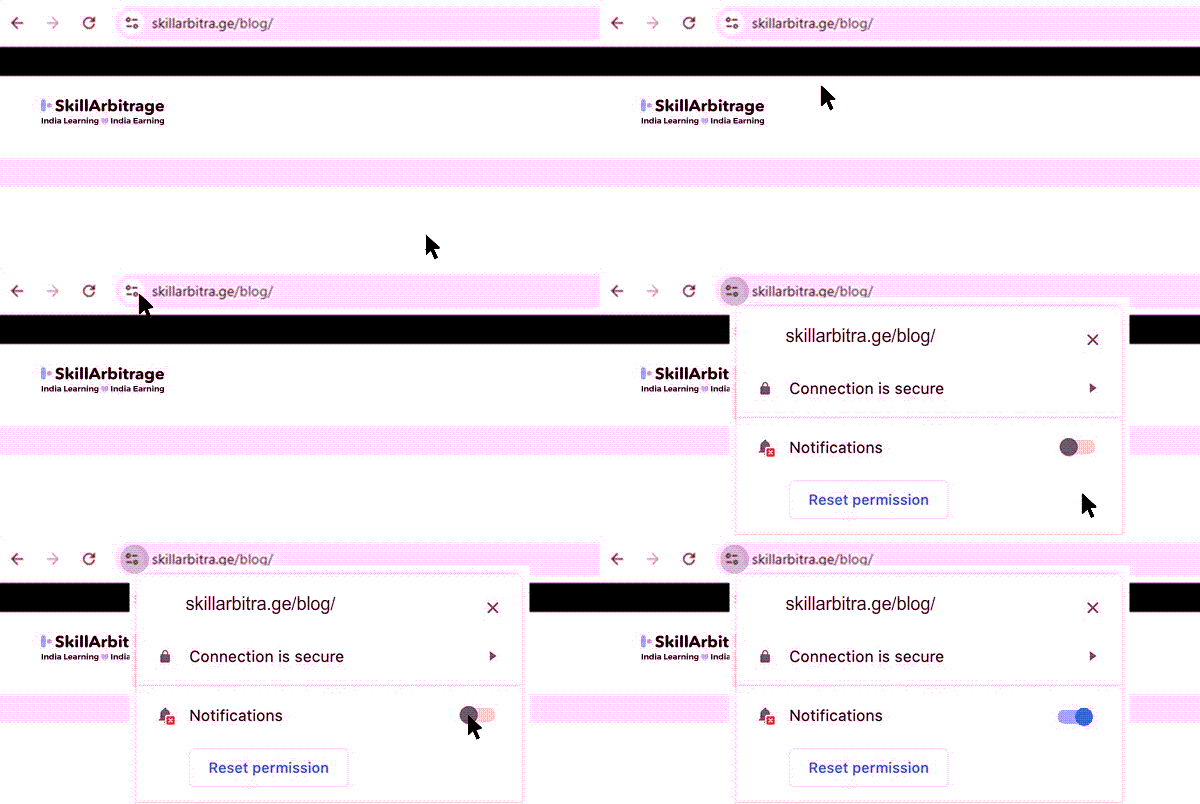
I love the insight about AI boosting impact while reducing workload. It makes me think about how teams can balance automation with maintaining that human touch for customers, which is often key to retention and satisfaction.
The Rohit story is a powerful reminder that AI automation isn’t just about replacing jobs—it’s about upgrading them. It’s inspiring to see how one person was able to transform a chaotic support role into a high-impact, efficient system with just a few weeks of learning. This kind of strategic upskilling could really be a game-changer for anyone stuck in repetitive ops roles.