
The world’s top companies spent $1.3 trillion on R&D in 2024. But here’s what none of them are talking about: they cannot find enough writers to communicate what they’ve built.
Corporate R&D departments, scientific labs, and deep tech startups are drowning in findings, data, and breakthroughs—but are short on one critical skill: writers who can turn complex technical knowledge into clear, compelling content. For Indian professionals with a science, engineering, or writing background, academic writing for R&D labs is one of the highest paying and fastest growing remote opportunities available today.
This guide breaks down exactly who’s hiring, what they need, why Indian writers have a natural edge, and how to land your first project.
Table of Contents
The $1.3 Trillion Opportunity in Academic Writing for R&D Labs
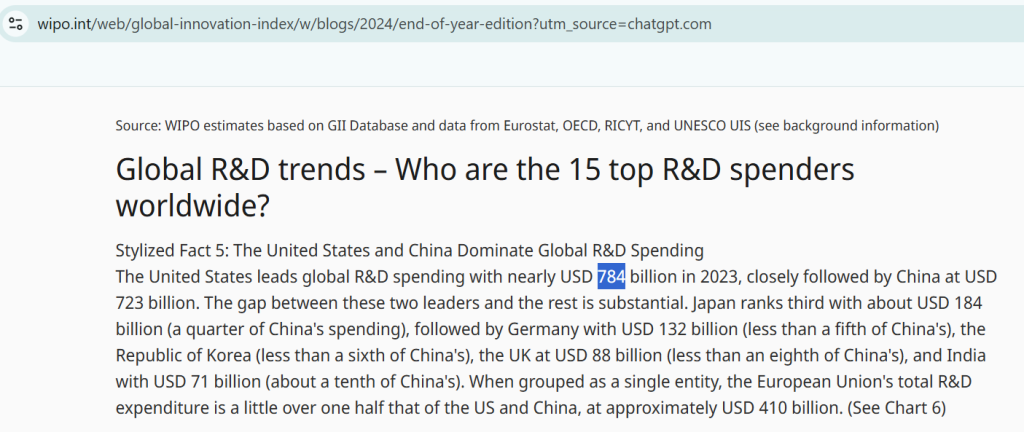
The numbers tell a clear story. The world’s top 2,500 R&D-spending firms invested $1.3 trillion in 2024—continuing growth even through global economic headwinds. In the US alone, corporations spent $722 billion on R&D in 2023, up from $692 billion the year before.
The global copywriting market—which includes technical and academic writing reached $27.96 billion in 2025 and is projected to grow to $42.83 billion by 2030. And unlike generic blog content, academic writing for R&D labs commands premium rates because it requires domain knowledge, research fluency, and scientific accuracy.
Key Stat: U.S. Bureau of Labor Statistics projects ~4,500 new technical writer openings every year through 2034. Companies cannot fill these roles fast enough internally that gap is your entry point.
Which Sectors Have the Highest Demand for R&D Writers?
Not all industries invest equally in research communication. These six sectors generate the most consistent demand for academic writing for R&D labs:
- Biotech & Pharmaceuticals — Clinical trial reports, regulatory submissions, journal articles, patient literature
- AI, Software & IT Companies — Technical whitepapers, algorithm documentation, research blogs, conference papers
- Semiconductors & Advanced Engineering — Product specs, technical manuals, patent support documents
- Aerospace, Defense & SpaceTech — Mission reports, compliance documents, grant proposals
- Quantum Computing & Cybersecurity — Research summaries, investor briefings, technical explainers
- Deep Tech Startups — Pitch decks, due diligence reports, science communication content

These sectors share a common problem: they are producing more research than they have the capacity to write up, publish, and communicate. That’s exactly the gap academic writers fill.
What Do R&D Labs Actually Need Academic Writers to Do?
Academic writing for R&D labs is far broader than most people realise. It’s not just about writing journal articles. Global R&D teams need writers across a wide range of deliverables:
- Technical whitepapers — In-depth documents explaining a technology, methodology, or research finding to a professional audience
- Scientific journal articles — Peer-review-ready manuscripts based on original research data supplied by the lab
- Product manuals, API docs & SOPs — Step-by-step documentation for internal teams and external users
- Investment & market reports — Research-backed reports for deep tech startups seeking funding or market entry
- Literature reviews — Comprehensive surveys of existing research to guide new R&D directions
- R&D summaries — Condensed versions of findings for internal circulation or client-facing updates
- Ghostwritten technical books & blogs — Long-form content for startup founders and researchers building a public profile
- Science communication copy — Marketing content that explains complex innovations to non-technical buyers
- Grant proposals — Funding applications for academic institutions and research labs
- Pitch decks & due diligence reports — Investor-facing documents for deep tech startups at Series A/B stage
You Don’t Need to Be a Scientist to Do This
This is the single biggest misconception about academic writing for R&D labs. You do not need a PhD or a lab background.
What you need is the ability to read technical material, understand the core argument, and communicate it clearly to the right audience whether that’s a peer reviewer, an investor, a regulator, or a product user. Research fluency, structured thinking, and strong writing are the real requirements.
Real-world example: Startups often lack in-house science communication talent entirely. A biotech founder who has spent five years developing a drug compound does not have time to write a 10,000 word whitepaper explaining it to hospital procurement teams. That is exactly the work a trained academic writer steps in to do.
Why Indian Writers Have a Competitive Edge in R&D Academic Writing
Indian professionals are uniquely positioned to win in the academic writing for R&D labs market for reasons that go beyond just cost.
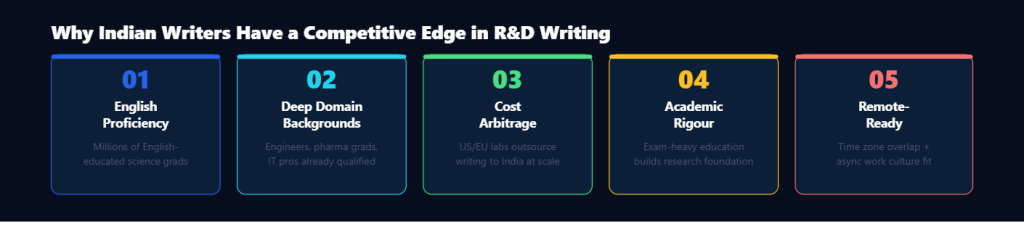
- English proficiency at scale — India produces millions of English-educated science and engineering graduates every year
- Deep domain backgrounds — Engineers, pharmacists, biotech graduates, and IT professionals already have the subject knowledge most Western writers lack
- Cost arbitrage — Many US and EU companies actively outsource documentation to offshore markets like India and the Philippines, with teams of 50–100 writers serving global clients
- Academic rigour — The Indian education system’s emphasis on exams, research papers, and technical writing gives graduates a natural foundation for this work
- Remote-ready — Time zone overlap with the EU and the growing normalisation of async work makes Indian writers practical partners for global R&D teams
The combination of technical background, English fluency, and cost competitiveness makes academic writing for R&D labs one of the most accessible high-earning paths available to Indian professionals today.
How Academic Writing for R&D Labs Differs from Regular Content Writing
If you’ve been doing SEO blogs, social media copy, or website content, you already have transferable skills but R&D academic writing operates by a different set of rules.
Regular Content Writing vs. R&D Academic Writing: A Comparison
Regular Content Writing:

- Goal: drive traffic, engagement, or brand awareness
- Tone: conversational, accessible, often informal
- Sources: general research, brand guidelines
- Typical rate: ₹500–1,500 per article
- Client: marketing teams, agencies, SMBs
Academic Writing for R&D Labs:
- Goal: communicate findings, support decisions, satisfy regulators or investors
- Tone: precise, structured, evidence-based
- Sources: primary research data, peer-reviewed literature, lab outputs
- Typical rate: $500–3,000+ per deliverable
- Client: research directors, CTOs, grant committees, pharma companies
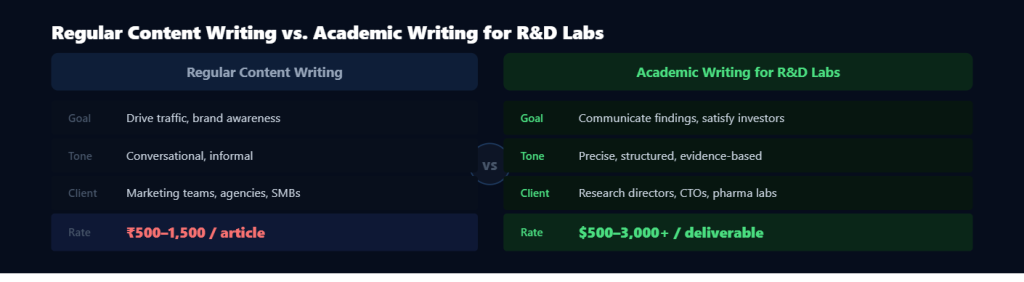
The bottom line: Most Indian content writers pitch to undergrad students or write generic blogs. Offering specialised research-backed writing unlocks higher rates, more credible international projects, and escape from the crowded low-paying gig pool.
How to Get Started with Academic Writing for R&D Labs
Breaking into academic writing for R&D labs does not require a complete career pivot. Here is a practical four-step entry path.
Step 1: Identify Your Domain Expertise
Your academic background or professional experience is your competitive moat. A mechanical engineer has an immediate advantage writing for aerospace or manufacturing R&D. A pharmacy graduate can serve biotech clients. An IT professional can write for AI and software labs.
Start by listing every technical domain you understand at a working level. That list is your initial niche. The narrower you go, the faster you can build credibility and win your first clients.
Step 2: Build a Portfolio of Research-Backed Writing Samples
You don’t need paid projects to build a portfolio. Here’s how to create credible samples from scratch:
- Pick a published research paper in your domain and write a plain-language summary of it (500–800 words)
- Write a mock whitepaper on a technology trend in your field (e.g., “How CRISPR is Changing Drug Development”)
- Ghostwrite a LinkedIn article as if you were a startup founder explaining their core technology
- Create a literature review summary on any topic you know well
Upload these to a simple portfolio page on Notion, LinkedIn, or a personal website. These samples demonstrate research fluency and writing quality exactly what R&D clients look for.
Step 3: Find and Pitch R&D Clients
The best channels to find academic writing for R&D labs opportunities:
- LinkedIn — Search for “R&D Director,” “Chief Scientific Officer,” or “Head of Research Communications” at companies in your niche. Connect and pitch directly.
- Google Scholar — Find researchers who publish frequently and reach out offering to help with science communication, summaries, or grant writing
- Upwork & Toptal — List yourself as a “technical writer” or “scientific writer” with domain-specific keywords in your profile
- ResearchGate — Academic networking platform where professors and lab directors actively post and engage
- Startup job boards — AngelList, YC companies, and deep tech accelerators regularly list writing and communications roles
Step 4: Price Your Services Correctly
One of the biggest mistakes Indian writers make when entering R&D academic writing is underpricing. These clients are not students with tight budgets they are funded labs, pharma companies, and venture-backed startups.
- Whitepaper (3,000–5,000 words): $800–2,500
- Journal article support (draft + editing): $500–1,500
- Literature review: $300–1,000
- Grant proposal: $1,000–3,000
- Monthly retainer (ongoing R&D content): $1,500–5,000/month
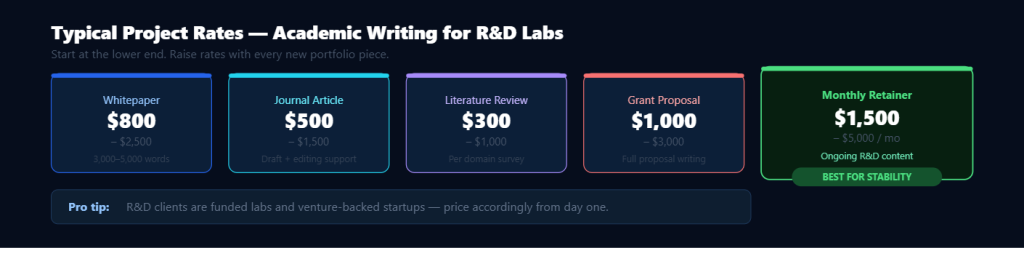
Start at the lower end while building your portfolio and testimonials, then raise rates with each successive project.




 Allow notifications