
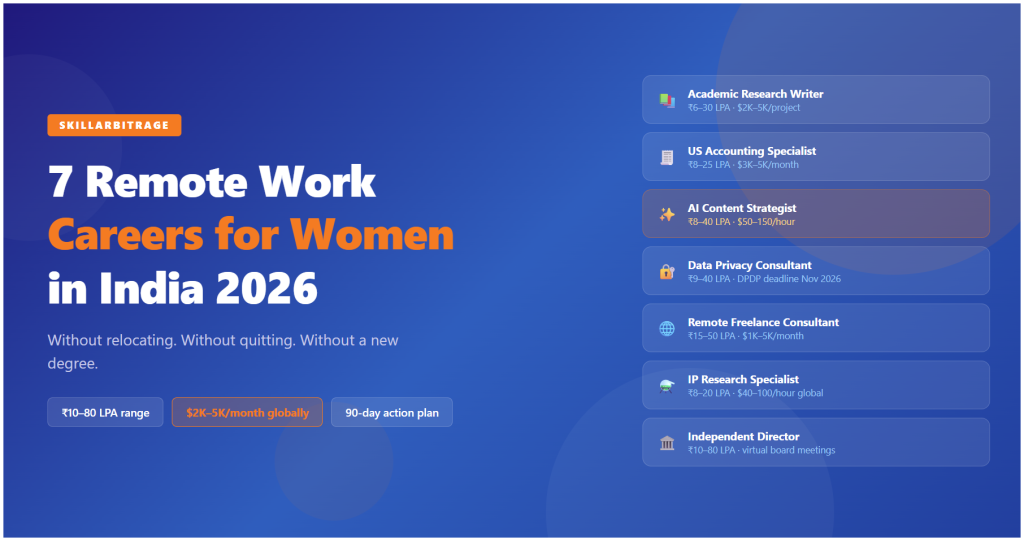

remote work for women India is no longer limited to data entry and virtual assistance.
When women in India type “remote work” into Google, they land on a job board offering ₹12,000 to ₹20,000 a month for data entry, customer support, or online teaching at a domestic edtech.
That disconnect is exactly what this article is about. The real opportunity in remote work for women India lies in specialised, high-value remote work for women India career paths. The real landscape of remote work for women India looks very different from what job boards show. According to the NITI Aayog, India’s digital workforce participation among women has been steadily rising since 2023.
There is a second tier of remote work that most career guides don’t show you. It’s not about finding a work-from-home job listing. It’s about building a career that earns global rates through remote work for women India opportunities while you stay exactly where you are — in your city, in your home, on your existing qualifications. SkillArbitrage offers structured programmes for each of these career paths.
India’s gig and freelance workforce is projected to reach 23.5 million by 2030, with project-based hiring already up 38% year-on-year according to the India Skills Report 2026. The professionals capturing the highest share of that growth aren’t the ones applying to job boards. They’re the ones who understand one thing: the same skills that earn ₹4–6 LPA in a domestic market earn ₹15–40 LPA — or $2,000–5,000 per month — when delivered to global clients.
That’s skill arbitrage. And these are the 7 careers where it works.
What Remote Work for Women Really Looks Like in 2026
The landscape of remote work for women India has transformed dramatically since 2023.
Most content about remote work for women India focuses on roles. Get a job as a virtual assistant. Teach English online. Do freelance content writing for domestic brands.
None of that is wrong. But it describes a ceiling, not a trajectory.
The real opportunity in 2026 isn’t a remote job. It’s a remote career — one built around expertise that global companies cannot easily hire locally at the same price point. A US accounting firm paying $150/hour for a local bookkeeper pays $15–25/hour for the same output from a trained professional in India. A European pharma company paying €500/day for a local IP research analyst pays €80–150/day for the same work done in Bangalore or Hyderabad.
That gap is not closing. It’s widening, because remote work infrastructure is now mature, payment platforms are accessible, and the skills gap in Western markets is growing faster than their domestic supply of trained professionals.
The 7 careers below each sit at the intersection of three factors: strong global demand, genuine skill arbitrage opportunity (not just lower rates — real income growth), and a clear skill path that does not require a new degree, relocation, or a decade of rebuilding your CV.

India Market (LPA)
Global Remote (LPA equivalent)
Academic Research Writing: A Remote Career for Postgraduates
Academic research writing is one of the strongest remote work for women India pathways for postgraduates.
If you have a postgraduate degree — in any discipline — you are sitting on an asset that the global research economy is actively looking for.
Academic research writing is not the same as blog writing or SEO content. It covers manuscript preparation for journals, research validation reports for global R&D labs, literature review writing for pharmaceutical trials, systematic review support for academic institutions, and grant proposal writing for international research bodies. These are specialised documents that require subject knowledge, academic English, and the ability to synthesise large bodies of research — skills that take years to build and that AI tools cannot fully replicate.
Global demand is structural. Universities, pharmaceutical companies, biotech firms, and corporate R&D labs in the US, UK, EU, and Australia are consistently short of research writers with strong domain knowledge. India produces more STEM and humanities postgraduates per year than almost any other country, but very few of them know this market exists.
What the work involves
Literature searches, academic manuscript drafting and editing, citation management (Mendeley, Zotero, EndNote), journal formatting, research reports for internal R&D teams, systematic review writing following PRISMA guidelines, and grant proposal sections.
Who this is for
Science, law, commerce, engineering, or humanities postgraduates. Anyone with research experience from a Master’s or PhD. Professionals from pharmaceutical, legal, or academic backgrounds transitioning to freelance work.
What you earn
Entry-level academic writers working with international clients earn ₹50,000–1,00,000 per month. Established writers with domain specialisation — particularly in pharma, law, or clinical research — earn ₹2,000–5,000 per individual research validation project, translating to ₹15–30 LPA annually at moderate volume. Senior research writers on retainer with global clients earn higher.
Platforms to find work
Upwork, Reedsy, academic outsourcing firms, specialist platforms like Research4Life, direct outreach to medical communications agencies, and contract research organisations (CROs).
“The biggest misconception I encounter is that academic writing is only for academics. Many of the strongest research writers I work with are law graduates or science professionals who moved into this path mid-career. What clients need is not a publication record — they need someone who understands the subject deeply enough to write about it with authority. That’s a completely transferable skill.”
— Senior Academic Research Consultant, Global Life Sciences Firm
US Accounting & Bookkeeping: Remote Finance Jobs from India
US accounting represents a high-demand remote work for women India opportunity in the finance sector.
The United States has more than 86,000 open accounting vacancies at any given time. The accountant shortage is not a cyclical problem — it’s structural, driven by an ageing professional workforce retiring faster than domestic colleges can replace them. US accounting firms, small businesses, and SMEs have responded by outsourcing their day-to-day bookkeeping and accounting functions to India-based professionals.
This is not offshore data processing. This is a career path that, at the senior end, pays $3,000–5,000 per month for work done entirely from India, with full visibility into client financials, strategic reporting, and advisory functions.
What the work involves
Transaction recording and reconciliation in QuickBooks Online or Xero, accounts payable and receivable management, payroll processing, monthly financial reports, tax preparation support (working alongside a US CPA), and year-end closing. Senior roles include management accounts, FP&A dashboards, and financial analysis.
Who this is for
Commerce graduates, B.Com/M.Com holders, CA students or dropouts, finance professionals looking to reorient toward international work. You do not need a US CPA qualification to start — it is an advantage for senior roles, but software proficiency and accounting fundamentals are sufficient for entry-level positions.
What you earn
Entry-level India-based bookkeepers working with US clients earn $400–800 per month. Mid-level professionals handling full accounts for multiple US clients earn $1,500–3,000 per month. Senior US accounting specialists — those handling reporting, compliance support, and financial analysis — earn $3,000–5,000 per month or more. Remote QuickBooks roles advertised on US platforms like ZipRecruiter pay $19–48 per hour at market rate.
Tools you need
QuickBooks Online (QBO), Xero, Bill.com, Gusto (payroll), and a working understanding of US Generally Accepted Accounting Principles (US GAAP) and IRS tax calendar basics.
“We have built an entire remote finance team in India over the past three years. The professionals who excel are not necessarily those with the most impressive domestic credentials — they’re the ones who have invested time understanding how US businesses are structured and what their clients actually worry about at month-end. The accounting knowledge is secondary to the business understanding.”
— Remote Finance Operations Lead, US Accounting Outsourcing Firm
AI Content Strategy & Prompt Engineering: The Fastest-Growing Remote Role
AI content strategy is the fastest-growing remote work for women India career path in 2026.
This is the newest career on the list, and it is moving the fastest.
As organisations adopt AI tools for content creation, marketing, and communications, they need professionals who can direct those tools — designing prompt systems, building content workflows, editing AI output for accuracy and brand voice, and managing the intersection between AI-generated drafts and human editorial judgement. This role runs on domain expertise and writing ability, not on coding or machine learning knowledge.
The market is not yet saturated. A significant portion of businesses adopting generative AI in 2025–2026 are doing so without a clear content strategy framework. Professionals who can build those frameworks — and who understand both the capabilities and the limitations of models like ChatGPT and Claude — are in genuine short supply.
What the work involves
Building prompt libraries for specific content types, designing AI-assisted editorial workflows, writing and editing AI-generated content for quality and accuracy, developing content strategy frameworks for marketing teams, training non-technical staff on AI tool usage, and auditing AI content for hallucinations and factual errors.
Who this is for
Marketing professionals, content writers, editors, journalists, HR communications leads, and anyone with a background in any domain who has developed strong writing skills. You don’t need to understand how large language models work — you need to understand how to give them good instructions and how to evaluate their output critically.
What you earn
Entry-level AI content strategists in India earn ₹8–12 LPA. Mid-level professionals with 2–3 years of AI tool experience earn ₹18–25 LPA. Senior roles at product companies and MNCs reach ₹25–40 LPA. Prompt engineers working remotely for US firms earn at the higher end — specialist roles have been listed at ₹40–60 LPA equivalent at senior levels. Freelance prompt engineers charge $50–150 per hour for project-based work.
Tools you need
ChatGPT, Claude, Gemini, Midjourney or DALL·E for visual content briefing, Notion or Airtable for workflow documentation, SEO tools (Ahrefs, SEMrush) for content strategists, and a portfolio of before/after examples demonstrating your editing and direction capability.
Data Privacy & DPDP Compliance: Remote Consulting After the 2023 Act
DPDP compliance consulting is an emerging remote work for women India niche with very low competition.
India’s Digital Personal Data Protection Act (DPDP Act) 2023 created a compliance deadline that is now approaching rapidly. Organisations classified as Significant Data Fiduciaries — the largest data-processing companies operating in India — are required to appoint a Data Protection Officer (DPO) based in India by November 2026. Beyond that deadline, full DPDP compliance requirements for all data fiduciaries come into force by May 2027.
This regulatory timeline is not theoretical. It is generating 8,000+ active job vacancies in data privacy roles on Indeed India right now, with the number growing as the deadline approaches. And it is not just large corporations — every business that processes personal data of Indian residents is affected, which in 2026 means virtually every company with a digital presence.
What the work involves
Data protection audits, privacy impact assessments (DPIA), consent management framework design, privacy policy drafting and review, training and awareness programmes for staff, DPDP compliance gap analysis, and for DPOs specifically — serving as the interface between the organisation, data subjects, and the Data Protection Board of India. Many professionals also serve international clients on GDPR and US privacy law compliance, making this a genuinely global practice.
Who this is for
Legal professionals (particularly those with compliance or corporate law backgrounds), IT professionals with security experience, HR professionals with data handling responsibilities, and compliance officers in banking, insurance, or healthcare. You do not need a technical background to become a DPO — you need to understand privacy law, risk assessment, and organisational processes.
What you earn
Entry-level data privacy professionals (0–3 years) earn ₹5–8 LPA. Mid-level specialists with 4–8 years earn ₹9–18 LPA. Senior DPOs and privacy consultants with 10+ years earn ₹20–40+ LPA. At large multinational companies and tech firms, senior DPO salaries go higher. For consultants managing multiple client retainers, income is not capped by a single salary grade.
Certifications that help
CIPP/E (Certified Information Privacy Professional — Europe), CIPM (Certified Information Privacy Manager), CDPSE (Certified Data Privacy Solutions Engineer), ISO 27001 Lead Implementer. These are globally recognised qualifications that matter to international clients beyond the Indian market.
“The professionals who are building real careers in data privacy right now are not waiting for the compliance deadline to pass — they’re positioning themselves ahead of it. In my experience, the biggest competitive advantage is being able to bridge the gap between legal language and technical implementation. Most lawyers don’t understand the tech. Most IT professionals don’t understand the law. The ones who can speak both languages are in extraordinary demand.”
— Senior Data Privacy Advisor, Technology Sector
Freelance Consulting: Turn Domain Expertise into Global Retainers
Freelance consulting converts domain expertise into one of the most lucrative remote work for women India models.
This is the most flexible of the 7 careers — and the one most overlooked, because it doesn’t map neatly to a job title.
Every professional with 5+ years of experience in any field has something that global companies will pay for: domain knowledge, industry contacts, process understanding, and the ability to navigate a specific market or function without months of onboarding. Remote consulting turns that existing expertise into a portable income stream.
The consulting model that works best for India-based professionals targeting international clients is the retainer model. Rather than one-off projects — which require constant business development — retainer arrangements pay a fixed monthly fee ($1,000–5,000+) for a defined scope of work: market entry research, partnership identification, client communication management, strategic advisory calls, or subject matter expertise on demand.
What the work involves
This varies by domain. Common freelance consulting tracks include: legal advisory for international clients, HR and talent strategy consulting, marketing strategy for businesses entering the Indian market, financial advisory and CFO-on-demand services, operational consulting for process improvement, and business development — sourcing, qualifying, and managing leads for international companies wanting to grow their India or Asia presence.
Who this is for
Any professional with 5+ years of experience in a defined domain who is willing to invest time building an international profile and client network. The key asset is not a credential — it is demonstrated expertise, communication skills, and the ability to deliver value on a call or in a document without needing to be physically present.
What you earn
Entry-level remote consultants on their first international retainer typically earn $500–1,500 per month alongside domestic work. Established consultants with 2–3 international client relationships earn $2,000–5,000 per month. Senior domain experts — ex-senior managers, ex-partners at firms, or professionals with rare niche expertise — earn more. In INR terms, established remote consultants earn ₹15–50 LPA; senior practitioners earn higher.
Platforms and channels
LinkedIn (the primary channel for international professional visibility), Upwork for project-based entry, Clarity.fm for advisory calls, direct networking through SA’s international client network, and referral networks built through professional communities and alumni groups.
IP Research & Patent Analysis: Remote Work for Science and Law Graduates
IP research and patent analysis offers a specialised remote work for women India career for STEM and law graduates.
Intellectual property research is one of the most globally mobile careers in the professional services world. A prior art search completed in Pune is just as valuable to a US pharma company as the same search completed in New York — and it costs a fraction of the price to source from India. This creates a large, sustained demand for India-based IP research professionals with scientific or legal training.
The work is done entirely remotely. There are 149 open remote IP and patent jobs on Glassdoor right now, across US, UK, and European clients, and the demand grows with every new patent filing cycle. The global patent filing volume hit a record 3.55 million applications in 2023 — the first time filings surpassed 3.5 million, according to WIPO — and continues to grow — each one requiring prior art searches, freedom-to-operate studies, and patent landscape analysis.
What the work involves
Prior art searching (finding existing patents and technical literature relevant to a new invention), patent landscape analysis (mapping the IP ecosystem in a technology area), freedom-to-operate (FTO) studies (assessing whether a product or process infringes existing patents), patent drafting support, IP portfolio management, and patent litigation support research. At a more senior level, patent prosecution and international filing coordination.
Who this is for
Engineering, science, and pharmacy graduates. Law graduates with an interest in IP. Professionals from pharma, biotech, electronics, software, or chemical industries. The Indian Patent Agent examination provides a strong foundation and professional recognition — but much of the freelance and consulting work does not require registration as a patent agent to begin.
What you earn
Entry-level IP research analysts earn ₹5–8 LPA domestically. Professionals working directly with international IP law firms and pharma companies earn ₹10–20 LPA. Senior IP specialists and those with patent agent certification earn ₹20–35 LPA. Freelance IP researchers charging international clients earn $40–100 per hour depending on technical complexity.
Databases you need to know
Espacenet (EPO), USPTO Patent Full-Text Database, Derwent Innovation, PatSnap, Google Patents, and WIPO PATENTSCOPE for international filings.
Independent Director: The Highest-Ceiling Remote Board Role
The independent director role is the highest-earning remote work for women India position on this list.
This is the most senior career on the list — and the one that represents the largest income jump relative to the commitment involved.
An independent director sits on the board of a company as a non-executive, independent voice. The role was already moving toward remote participation before 2020. Post-pandemic, virtual board meetings have become mainstream — most listed and unlisted companies now conduct board meetings and committee meetings via video conference as a matter of course. This means the role is genuinely location-independent in a way it was not a decade ago.
The income is in sitting fees and commissions. Under the Companies Act 2013, there is no ceiling on sitting fees paid to independent directors — listed companies pay ₹25,000 to ₹5,00,000 per meeting. A single board appointment might involve 4–8 board meetings per year plus committee meetings, generating ₹5–30 LPA from one directorship. Multiple directorships compound this. Senior independent directors with board experience and domain credibility across three to four companies earn ₹30–80 LPA purely in board compensation.
What the work involves
Attending board and committee meetings (in-person or virtual), reviewing board papers and providing strategic input, chairing audit, nomination, or CSR committees, ensuring corporate governance standards are met, providing independent scrutiny of management decisions, and representing the interests of minority shareholders.
Who this is for
Professionals with 10+ years of senior leadership experience in any domain — finance, law, HR, operations, technology, or industry expertise relevant to the company’s sector. Under the Companies Act 2013, any individual who is not connected to the company or its promoters, does not have a financial interest in the company, and holds the qualifications specified can be appointed as an independent director.
The certification requirement
All independent directors of listed companies must register on the IICA Independent Directors Databank and pass the online proficiency test — 50 multiple-choice questions, ₹5,000 fee, 50% pass mark, unlimited attempts. This is not an entry barrier — it is a relatively accessible qualification that most senior professionals pass with 4–6 weeks of focused preparation.
“The most common reason qualified professionals never pursue board roles is not eligibility — it’s visibility. Companies appoint independent directors through networks, not job boards. The investment that matters most is building a clear professional brand: what sectors you understand, what governance expertise you bring, and why your perspective is genuinely independent. Once the first appointment happens, referrals follow naturally.”
— Independent Director, Listed Manufacturing Company
Which Remote Career Matches Your Background?
Choosing the right remote work for women India career depends on your existing qualifications and experience.
The question is not which career pays the most — it’s which career has the shortest distance between where you are now and your first income from it. The cards below map professional backgrounds to the best-fit entry point.
Time to first income assumes active preparation, not passive study. It reflects the realistic timeline to the first paid project, retainer, or board appointment — not to full income replacement.
3 Skills Every Remote Career on This List Requires
Every remote work for women India career on this list shares three foundational skills.
Seven very different careers. Seven different domains, certifications, tools, and client types. But when you look at what actually determines success in each of them, three capabilities appear consistently.
Written Communication for Global Clients
Every career on this list requires you to produce written output that a global client will trust. For the academic writer, it’s research manuscripts. For the US accountant, it’s financial reports that a CFO in Chicago will read. For the data privacy consultant, it’s privacy impact assessments that will go to regulators. For the independent director, it’s board notes and committee reports.
Strong written communication — particularly in professional English, at the register required for a senior international audience — is the single most portable professional skill in 2026. It cannot be automated out of these roles, because clients trust the person behind the words, not just the words themselves.
Domain Expertise: Why Generalists Don’t Win
None of these careers reward generalists. The academic writer who earns ₹2K per project is the one with deep knowledge of clinical research methodology, not the one who can write about any topic. The IP researcher who charges $80/hour is the one who understands semiconductor patent claims, not the one who has learned to use Espacenet.
Your existing professional background — whatever it is — is the raw material of domain expertise. The skill is not in acquiring new domain knowledge from scratch. It is in making your existing knowledge visible, navigable, and valuable to international clients who don’t share your context.
Process Discipline: The Unsexy Differentiator
Remote careers self-select for professionals who can manage their own work without external structure. Deadlines are self-imposed. Quality checks are internal. Client communication is written, asynchronous, and high-stakes. The professionals who consistently earn at the top end of these income ranges are not necessarily the most knowledgeable — they are the ones who deliver reliably, communicate proactively, and manage client relationships as systems rather than as ad hoc interactions.
Process discipline is the unsexy differentiator that most career guides ignore. It is also the one that global clients cite most consistently when explaining why they continue to work with the same India-based professional for three, five, or ten years.
Your 90-Day Action Plan: From Career Selection to First Income
This 90-day plan maps out your transition into remote work for women India step by step.
The careers above are not theoretical. They are being built right now by professionals across India — from Tier-1 cities and from Tier-2 towns, by women returning after career breaks and by women who never stopped working but want to change the direction of their income.
The 90-day plan below is practical. Each phase has specific outputs, not just activities.
Days 1–30: Audit Your Skills and Choose One Career Path
Audit your existing assets. Before choosing a career path, map what you already have: domain knowledge (what field do you understand deeply?), credentials (what qualifications do you hold?), writing ability (at what level do you currently write professional documents?), and network (who do you already know in adjacent international contexts?).
Choose one career. Use the match table above. Do not try to pursue more than one path at the beginning — the professionals who build income fastest are the ones who go deep in one direction first. You can expand later.
Start the course. Every career on this list has a defined skill pathway. Use it. A structured programme cuts the time between “interested” and “capable of charging for it” from 12 months to 60–90 days.
Output by Day 30: One completed module or credential milestone. A written description of your professional offer (2–3 sentences: what you do, for whom, and what outcome you deliver).
Days 31–60: Build Your Portfolio and Professional Profile
Create your first portfolio piece. For academic writers: a sample literature review or research summary on a topic you know well. For US accountants: a sample management accounts pack in QBO format. For AI strategists: a before/after content transformation showing your editing and direction. For IP researchers: a sample prior art search report on a published patent. For data privacy consultants: a sample DPIA template and annotated DPDP Act compliance checklist.
Set up your professional profile. LinkedIn is the primary channel for every career on this list. Your profile needs three things: a headline that clearly states your professional offer (not your job title), a summary that explains your domain expertise and the outcome you deliver, and at least one portfolio piece visible to your network.
Output by Day 60: One portfolio piece. A completed LinkedIn profile optimised for your chosen career. Three to five prospective clients or platforms identified.
Days 61–90: Land Your First Paid Remote Project
Make your first outreach. For platform-based careers (academic writing, US accounting, IP research): apply to your first 5–10 projects on Upwork, PeoplePerHour, or a specialist platform. For consulting and data privacy roles: send 10 personalised LinkedIn connection requests to potential clients with a clear, non-salesy message about your expertise. For independent directors: identify 3–5 companies in your domain where you could genuinely add governance value and research the process for board nominations.
Charge for your first project. The instinct to work for free “to build a portfolio” is a trap. Your first client pays you, even if the rate is lower than your target. The relationship, the reference, and the confidence that comes from a paid engagement cannot be replicated by unpaid work.
Output by Day 90: One paid project completed, one retainer proposal sent, or one board nomination conversation started. This is your proof of concept. From here, you iterate.
These seven remote work for women India careers represent the most practical and profitable paths for remote work for women India in 2026. Each remote work for women India path has been selected based on real earning data, demand trends, and skill accessibility.
For structured training in any of these remote work for women India career paths, explore SkillArbitrage’s programmes designed specifically for Indian professionals targeting global clients.
FAQs About Remote Work Careers for Women in India
Here are the most common questions about remote work for women India opportunities, answered with current 2026 data.
Do I need to quit my job to start a remote career in one of these areas?
No. Most professionals start these careers alongside existing employment. Academic writing, IP research, and consulting work can begin as evening and weekend projects. US accounting clients typically need work done during Indian daytime hours (which aligns with US night-time accounting cycles). The transition to full-time remote income usually happens after 6–12 months of part-time work, when the income is consistent enough to de-risk the switch.
What if I have taken a career break?
A career break does not disqualify you from any of these paths. Academic research writing, data privacy consulting, and remote freelance consulting are particularly well-suited to professionals returning after breaks, because they are skill-based rather than tenure-based — clients care about what you know and what you can deliver, not the dates on your CV. What matters is currency: refreshing your knowledge of current tools, regulations, and market context during the skill-building phase.
Which career has the lowest entry barrier?
AI Content Strategist has the shortest ramp time for professionals with existing writing or marketing backgrounds — it is possible to have a first paid project within 30–45 days with active effort. Remote Freelance Consulting also has a short ramp for professionals with deep domain knowledge who invest in their LinkedIn profile and outreach. Academic Writing and US Accounting typically take 60–90 days to the first paid engagement.
Do I need to be fluent in English to work with global clients?
Professional written English is essential for every career on this list. Spoken fluency varies — academic writing and IP research are predominantly written-output roles. US accounting, data privacy consulting, and independent director roles involve more spoken communication in client or board meetings. If spoken fluency is a concern, written-output careers are the faster entry point while you build confidence.
What is the realistic income from a US accounting role in the first year?
In the first year, a professional completing a structured US accounting and bookkeeping programme can realistically earn $400–800 per month from one or two US clients, representing ₹4–8 LPA from that client stream alone. By year two, professionals managing three to five US client accounts earn $1,500–3,000 per month. These figures assume active client development, not passive job searching.
Is data privacy consulting only for lawyers?
No. Under the DPDP Act 2023, the DPO role requires knowledge of data protection law and organisational processes — it does not require a law degree. IT security professionals, HR managers, compliance officers from banking or insurance, and even operations managers with data handling responsibilities have successfully transitioned into data privacy careers. Legal training is an advantage for drafting and interpretation tasks but is not the only entry path.
Can I become an independent director with no board experience?
First-time board appointments typically require a strong professional track record (10+ years), domain expertise relevant to the company, and active networking in business and governance circles. The IICA online proficiency test is a necessary qualification — it does not, by itself, secure an appointment. Most first appointments come through professional networks, industry associations, or existing relationships with company promoters or governance advisors. Build the credential first; build the network in parallel.
What tools do AI content strategists need, and are they expensive?
The core tools — ChatGPT Plus, Claude Pro, Notion — cost under ₹5,000 per month combined. Most professional AI tool subscriptions have free tiers that are adequate for learning and early portfolio work. The more significant investment is time: learning to direct AI tools effectively, building a portfolio of before/after examples, and developing a point of view on AI content quality that clients value above the output of a simple prompt.
How do I find US accounting clients as an Indian professional?
The main channels are Upwork (large volume of US bookkeeping projects), direct outreach to US CPA firms that advertise India-based staff (many do openly), Belay, Paro, and similar US virtual staffing platforms, and referrals from India-based accounting professionals already working in this space. LinkedIn outreach to US small business owners and accounting firm partners is also effective at the mid-to-senior level.
Is academic writing legal and ethical?
Academic research writing as described in this article — manuscript preparation support, literature reviews for corporate R&D, research validation reports for pharmaceutical clients, grant proposal writing for institutional clients — is a legitimate and widely practiced professional service. This is distinct from contract essay writing or academic fraud services, which are not what is described here. The legitimate academic writing market serves professionals, researchers, and corporations, not students seeking to bypass academic assessment.
A Note on This Data
Salary ranges in this article are approximate and reflect publicly available market data from Glassdoor India, AmbitionBox, 6figr, PayScale, ZipRecruiter, Upwork, and industry-specific salary reports. Individual earnings vary based on experience, client type, specialisation, and the volume of work maintained. All salary figures represent ranges, not guarantees. The regulatory information about the DPDP Act and IICA Independent Director certification requirements is accurate as of March 2026 — verify deadlines and requirements directly with official sources (MeitY for DPDP, IICA for Independent Director requirements) before making career decisions based on them.




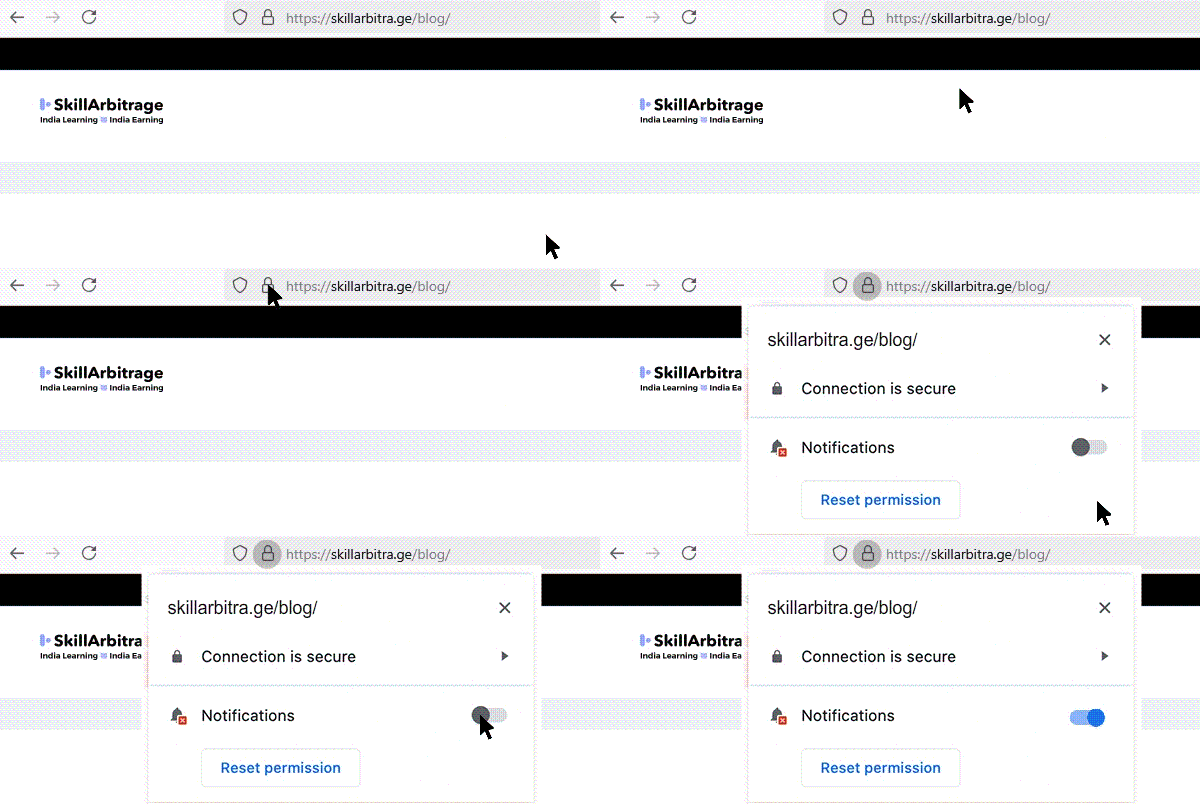
 Allow notifications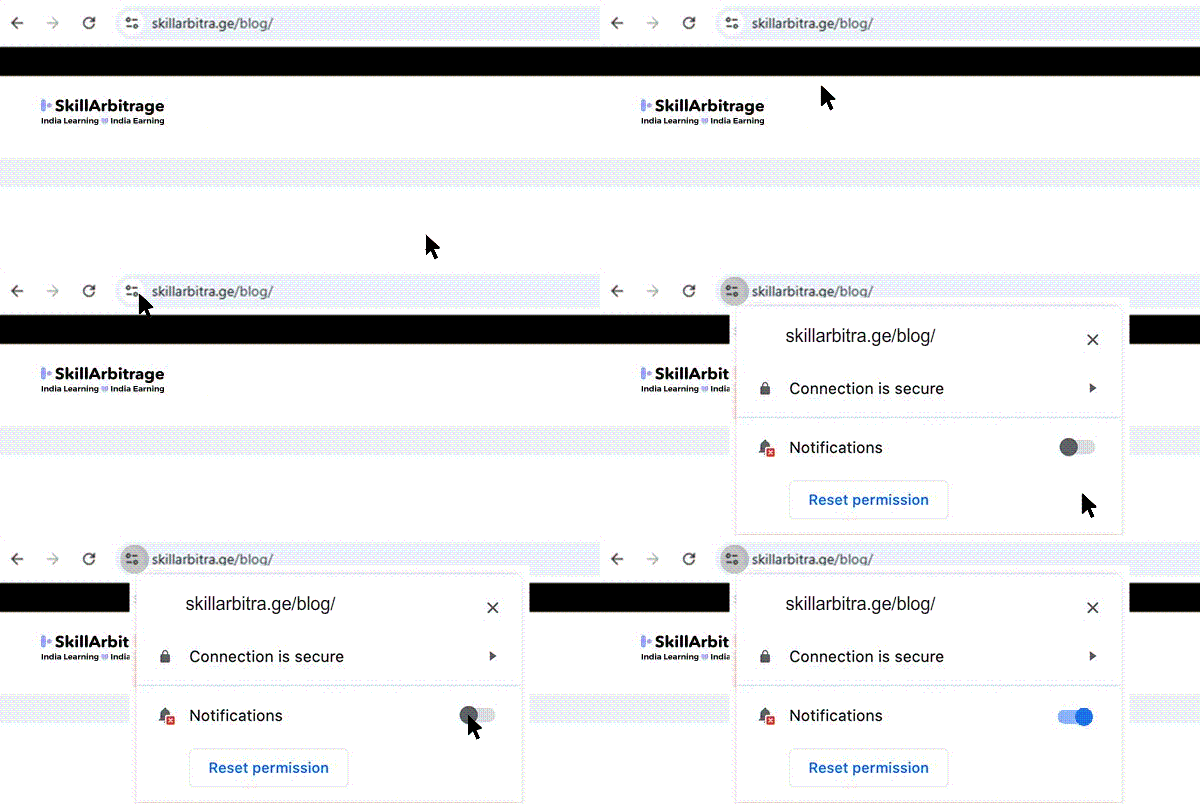
It’s fascinating to see how much more rewarding remote work can be when women focus on specialized skills instead of traditional entry-level roles. The idea of skill arbitrage really opens up opportunities to earn global rates while staying local, which seems like a smart long-term career move.