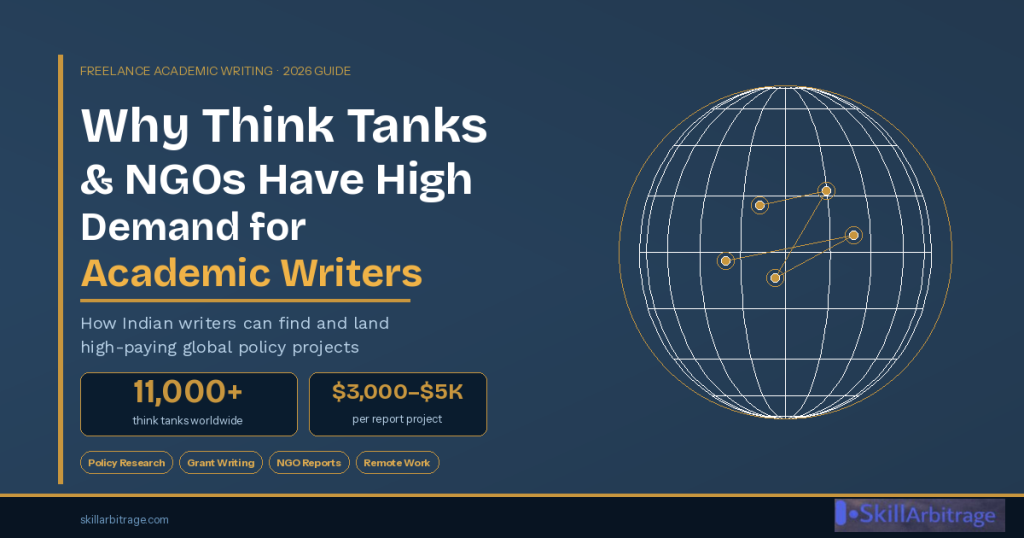

There are over 11,000 think tanks operating across the world and the vast majority of them are permanently short on writing capacity. These organisations produce policy papers, research reports, and issue briefs that shape government decisions, influence international policy, and drive public opinion. Yet most operate with small teams, limited budgets, and no dedicated writing staff.
Table of Contents
What Are Think Tanks and Why Do They Need Writers?
Think tanks, policy institutes, global NGOs, and research nonprofits are organisations that generate analysis to inform governments, businesses, and the public. They sit at the intersection of research and influence producing the evidence that policymakers rely on to make decisions on issues ranging from healthcare and climate to security and economic development.
According to research data, there are over 11,000 think tanks worldwide, ranging from small single issue advocacy groups to large international institutes like the Brookings Institution, ODI, and RAND Corporation. Many of the most active and impactful think tanks are small and that is precisely where the opportunity lies for freelance writers.

What Think Tanks Regularly Produce
- Policy papers and policy briefs
- Research reports and working papers
- Issue briefs and background notes
- Evaluation reports and impact assessments
- Grant proposals and project concept notes
- Case studies for advocacy and impact communication
- White papers for government or international agency audiences
All of these documents require strong research skills, clear academic writing, and the ability to translate complex evidence into readable, persuasive prose. These are exactly the skills that trained academic writers bring to the table.
Most of these think tanks need the following:
- Writing grant proposals and project concept notes.
- Periodic progress reports and donor-required fund-utilisation reports.
- Case studies for advocacy or impact communication.
- Policy papers summarising findings for government or international agencies.
- Designing and conducting surveys and field interviews.
- Literature reviews, annotated bibliographies, and evidence synthesis.
- Support to conduct field surveys, collect and organise the data, and draw insights.
- Assistance to compile their findings into reports – necessary for continued funding and subsequent projects.
- Turning raw findings into a structured, well-written research report.
Why Think Tanks and NGOs Outsource Writing Work
Think tank scholars and project managers are typically subject-matter experts economists, policy analysts, public health researchers, development practitioners. Their core value is their knowledge and their ability to design research and engage stakeholders. Writing and documentation is often a secondary task that competes with their primary responsibilities.
When output targets are high and for most think tanks, dozens of reports and briefs need to be published every year the in-house team simply cannot keep up. A shortage of writing capacity forces policy analysts to focus on drafting text rather than on research design or stakeholder engagement, which is an inefficient use of their expertise.
“Think tank scholars often need extra hands for research and writing tasks so they can meet their output goals without burning out.”
The Budget Reality
When budget cuts hit, think tanks are often the first to reduce permanent headcount. This does not reduce their output requirements it increases their reliance on freelancers and external contractors. Project managers responsible for delivering reports on tight deadlines, with limited in-house support, are highly motivated to find reliable outside writers.
Freelance academic writing projects for think tanks and NGOs are among the best-paying in the industry. Research reports for policy analysis typically pay between $3,000 and $5,000 per project, reflecting the intensive research and quality writing required. Grant proposals and evaluation reports command similar or higher rates.

The Project Manager Opportunity
Much of this outsourced work is managed by project managers who wear multiple hats. They have on-the-ground expertise and domain knowledge, but they often lack the time or academic writing skills to produce polished, publication-ready documents. They need external assistance not just for writing, but for research synthesis, data organisation, citation formatting, and editorial support.
This is the person you want to reach. They are not academics looking for peer-reviewed co-authors. They are practitioners looking for a reliable professional who can take their raw material and turn it into a finished deliverable.
What Work Can You Do for Think Tanks and NGOs?
The range of tasks that think tanks and NGOs outsource to freelance academic writers is broader than most people realise. Here is a comprehensive breakdown:
Literature Review and Background Research
- Identify and synthesise relevant academic papers, reports, and grey literature
- Track citation patterns to find seminal works in a given field
- Compile annotated bibliographies on specialised topics
- Map the evidence landscape and identify research gaps
Data Collection and Analysis
- Design and implement surveys with specific target populations
- Collect and analyse qualitative data from stakeholder interviews
- Conduct content analysis of organisational communications
- Perform discourse analysis of media coverage of policy issues
- Compile field data into structured, analysable formats
Writing and Editorial Support
- Draft initial sections of research reports and policy papers
- Develop case studies on specific interventions or policy contexts
- Create data visualisations and explanatory graphics
- Copy-edit and proofread draft documents for clarity and accuracy
- Format citations and references according to required style guides (APA, Chicago, Harvard)
Project and Administrative Support
- Write grant proposals and project concept notes
- Produce periodic progress reports and donor-required fund-utilisation reports
- Coordinate interview scheduling and stakeholder engagement logistics
- Track milestones and compile project documentation
Example: A global health NGO may publish a study on the impact of a healthcare intervention. An Indian academic writer could support the literature review, help design the survey instruments, assist with data analysis, and co-author the written report all remotely.
Why Indian Academic Writers Have a Significant Advantage
Indian researchers and writers are uniquely positioned to serve the global think tank and NGO sector. Here is why:
- Strong English writing skills combined with a deep understanding of development, public health, education, and governance contexts that are highly relevant to global policy research
- Familiarity with South Asian field research environments valuable to any think tank studying India, South Asia, or comparable developing-economy contexts
- Competitive rates relative to Western freelancers, making Indian writers attractive to organisations working with restricted budgets
- Time zone compatibility with European think tanks for late-day communication, and morning overlap with US-based organisations
- A large pool of postgraduate researchers and academics who have the methodological training to contribute meaningfully to policy research cycles
As an Indian academic writer, you are not just a cheap alternative you bring genuine research expertise and contextual knowledge that Western writers often cannot match on topics relevant to the Global South.
How to Find Think Tanks and NGOs Hiring Freelance Writers
Finding clients in this sector requires a targeted, research-driven approach. Unlike freelance platforms where clients post jobs, most think tank writing work is sourced through direct outreach and professional relationships.

Step 1: Identify Organisations in Your Niche
Start with think tanks and NGOs working in fields where you have knowledge or interest: social policy, economics, public health, education, climate, security, or development. Small, recently established think tanks are often the most receptive they have high output demands and the least in-house capacity.
- Search ‘think tanks [your country or region]’ on Google
- Browse directories like the University of Pennsylvania’s Global Go To Think Tank Index
- Search LinkedIn for ‘policy research’, ‘think tank’, ‘NGO research officer’
- Use Google Scholar to find recently published policy reports and trace the producing organisation
Step 2: Study Their Work
Before reaching out to anyone, read at least one recent report or publication from the organisation. Understand their focus areas, their writing style, and the types of projects they typically run. Identify who the project managers or research leads are these are the people you want to contact.
Step 3: Send a Targeted Outreach Message
Your first message to a think tank project manager should demonstrate that you understand their work and can add immediate value. Do not ask for work offer a specific form of assistance.
Sample outreach message to a think tank project manager:
Dear [Name],
I have been following your work in <area> and am very inspired by your mission. I am an Indian academic researcher myself in <field of work>, and happy to contribute my efforts to support your cause
I’d love to help you conceptualise new project/research proposals, for grants, identify and synthesize existing literature, conceptualise field surveys, collect and analyse data, assist you with interview scheduling, identify insights, create materials and case studies for advocacy, even assist you to prepare drafts of various reports so that you can save your time and focus on the success of your project.
I have assisted <abc> professor in their research earlier, and my contribution was acknowledged in a <LinkedIn testimonial/co-authorship or a paper>
Would you like to jump on a Zoom call to discuss this further?
Just hit yes, and we can take it forward.
Step 4: Build from Your First Project
Once you have completed one project for a think tank or NGO, you have a credible reference point for every subsequent pitch. Use the experience to reach out to academics working on related issues this is how you build a compounding track record in the sector.
Sample follow-up message to a professor after completing a think tank project:
Dear Professor <Last Name>
I am quite inspired by your work on <humanitarian issues>. I recently worked on <report> produced by <organisation>, as part of their research team. <mention if your name has been acknowledged>. I would love to support you in conducting any follow-on field surveys in India (or anywhere else), performing literature reviews, assisting you with manuscript preparations for your subsequent drafts, liaising with publishers, etc.
Please let me know if we could get on a call!
How to network with project managers at think tanks
- Find think tanks on the internet.
- Read their prior report and work.
- Find out who the key project managers are and what they work on.
- Then send this message:
Dear [Name],
I have been following your work in <area> and am very inspired by your mission. I am an Indian academic researcher myself in <field of work>, and happy to contribute my efforts to support your cause
I’d love to help you conceptualise new project/research proposals, for grants, identify and synthesize existing literature, conceptualise field surveys, collect and analyse data, assist you with interview scheduling, identify insights, create materials and case studies for advocacy, even assist you to prepare drafts of various reports so that you can save your time and focus on the success of your project.
I have assisted <abc> professor in their research earlier, and my contribution was acknowledged in a <LinkedIn testimonial/co-authorship or a paper>
Would you like to jump on a Zoom call to discuss this further?
Just hit yes, and we can take it forward.
The Long Game: Becoming a Grant Connector
Here is an advanced strategy that almost no freelance academic writer in India has exploited yet: becoming a connector between think tanks and grant funders.
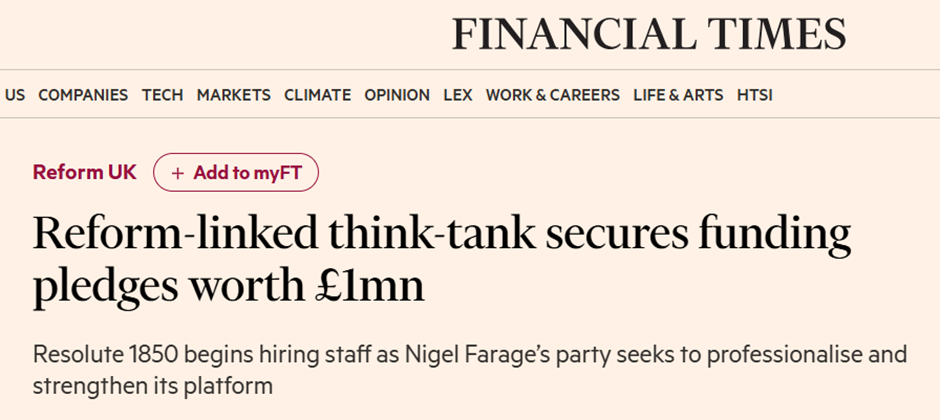
Think tanks source their funding from a range of providers: US government agencies, foreign governments, defence contractors, private sector donors including major technology companies, international organisations, and global foundations. Grant funding cycles are predictable, and most think tanks are perpetually looking for new funding sources.
Over time, as you work with more researchers, project managers, and think tanks, you will develop an understanding of which funders are active, what their priorities are, and which think tanks are well-positioned to apply for specific grants. This knowledge is extraordinarily valuable and almost no one is currently offering it systematically.
- Help think tanks identify relevant grant opportunities aligned with their research agenda
- Assist with proposal positioning to match funder priorities
- Make introductions between think tank leadership and grant programme officers
- Support the full proposal writing cycle from concept note to final submission
This capability connecting research organisations with the funders who need them is an almost uncontested space for an Indian academic writer willing to invest the time to build the right relationships. The value you can create for both sides is substantial, and the compensation reflects it.
How Much Can You Earn from Think Tank and NGO Writing Projects?
Earnings vary by project type, scope, and client, but the following ranges reflect typical market rates for this category of work
A single research report project pays what many Indian professionals earn in two to three months. With three to four such projects per year entirely achievable once you have built a small network you are looking at a substantial side income or a fully independent career.





 Allow notifications