
Every year, hundreds of landmark studies get published by researchers at Harvard, Oxford, PEW, and top EU universities and almost none of them have ever been tested in India. That’s not an oversight. It’s an opportunity.
Western researchers desperately want to know whether their findings hold true in India’s complex, multilingual, multi-class society. But they lack the local networks, cultural insight, and bandwidth to collect primary data here themselves. If you can bridge that gap, you can earn $2,000–5,000 per validation project working part-time, from home, using AI as your co-pilot. This guide shows you exactly how.
Table of Contents
What Does It Mean to Validate Research in India?
When researchers publish a study, their findings are only as reliable as the population they tested. Most major academic studies draw respondents from “17 advanced economies” think the US, UK, Germany, Australia. India, with its 1.4 billion people spread across dozens of languages, religions, and socioeconomic classes, is almost never included.
Validating research in India means designing and executing a new data-collection exercise from scratch surveys, interviews, or observation studies to test whether the original findings hold in an Indian context. You don’t reproduce the original study. You build a culturally adapted version of it.
A Real-World Example: The PEW ‘What Makes Life Meaningful’ Study
PEW Research Centre published a landmark study asking respondents from 17 advanced countries what makes life meaningful. Their top findings: career success, financial security, personal achievement, and individual freedom.
Now ask the same question in India. As author-surgeon Atul Gawande observed in Being Mortal, Indians often prioritize dying surrounded by family and community over material milestones. Would an Indian respondent choose:
- Scenario A: ₹15 lakhs/year in Bangalore but visiting parents twice a year, OR
- Scenario B: ₹6 lakhs/year in hometown while caring for aging parents daily?
The answer to that question could challenge decades of Western research on human motivation and life satisfaction. That’s why researchers will pay $2,000–5,000 to find out.
Who Pays You to Validate Research in India and How Much?
The market for cross-cultural research validation is larger than most people realize. Your potential clients include:
- The original research teams (e.g., senior PEW researchers like Laura Silver or Patrick van Kessel) who want follow-up data
- University professors studying cultural psychology, sociology, or behavioral economics
- Corporate researchers at multinationals expanding to Indian markets
- Think tanks and policy institutes analyzing global social trends
Comprehensive survey studies typically pay $2,000–5,000 and take 3–4 weeks to complete for 100–500 responses. The time investment is 15–20 hours of actual work. And 60% of clients come back for regional follow-up studies.
This Works for Any Field—Not Just Social Science
You don’t have to work in psychology or sociology to do this. The same model applies to:
- Economics: spending vs. saving patterns in Indian households
- Education: individual vs. family-driven learning goals
- Health: personal fitness vs. community wellness priorities
- Law and governance: compliance culture, institutional trust, dispute resolution preferences
Find researchers in your field of interest and approach them with a validation proposal tailored to their work.
How to Find Foreign Researchers Who Need You to Validate Research in India
You don’t need an academic network to get started. Here’s exactly how to find researchers who would pay for India-validated data:
- Search Google Scholar for papers in your domain. Look for studies done exclusively in Western countries (US, UK, EU, Australia).
- Check the ‘Cited by’ section of prominent papers to find hundreds of related researchers working on the same topic.
- Go to university faculty pages in departments like psychology, sociology, economics, public health, or law.
- Search LinkedIn for “research professor + [your subject]” and look at their published work.
- Use search strings like “life satisfaction cross-cultural study”, “cultural values US vs Asia”, or “[topic] India data gap”.
Key Takeaway: You don’t need to cold-pitch blindly. You’re approaching researchers whose published work already signals exactly what data they need.
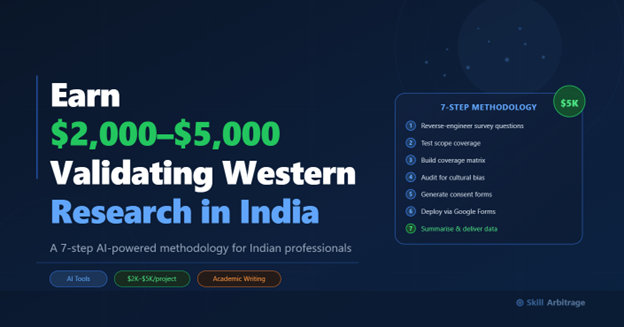
The Exact 7-Step AI-Powered Methodology to Validate Research in India
Here’s the step-by-step process to go from a foreign research paper to a deliverable Indian validation study using AI to do the heavy lifting.
Step 1: Reverse-Engineer Survey Questions from the Research Hypothesis
Academic papers are built around hypotheses. Your job is to translate those hypotheses into practical survey questions that can be answered by real Indian respondents.
Use Claude.ai (or any capable AI tool) with this prompt sequence:

- Prompt 1: “This is a research paper by [institution]. It was done on respondents from [countries]. The research is now to be tested in India. Find the key findings and contextualise them as hypotheses for testing in India.”
- Prompt 2: “Reverse-engineer survey questions from these hypotheses for the Indian context. Give me at least 5 survey questions to validate each hypothesis.”
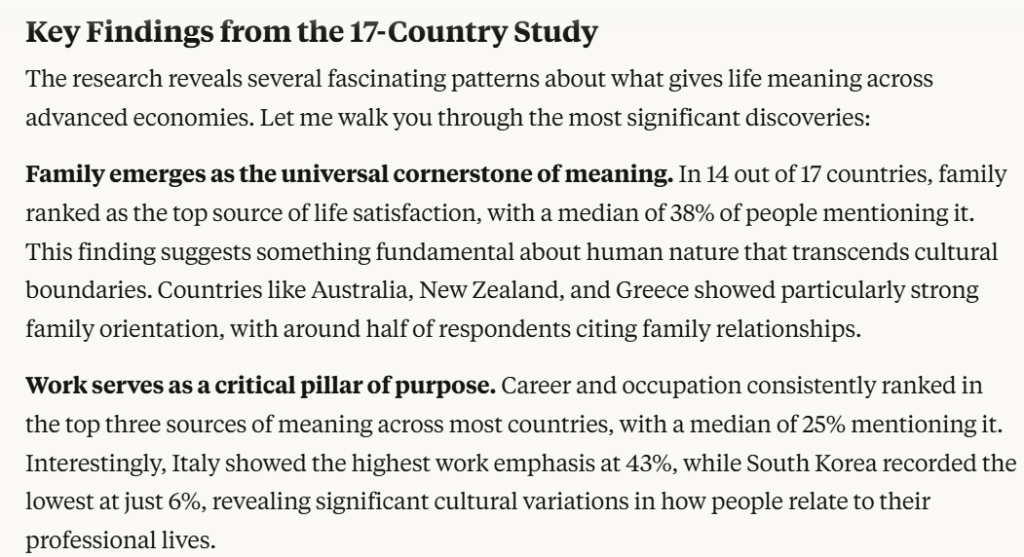
AI will do this in seconds. What would take you days of academic reading and drafting is done before your second cup of chai.
Step 2: Test Scope Coverage
Scope coverage means ensuring your survey questions capture every dimension of what you’re measuring—not just the obvious ones. Think of it like mapping an unknown continent: you want to discover all major geographical features, not just the ones visible from where you land.
Prompt AI: “I want to test scope coverage for this survey. Identify any major conceptual territories this questionnaire is missing and suggest questions to fill those gaps.”
A good AI will not just answer your question it will also suggest what your next prompt should be. Follow its lead.
Step 3: Create a Coverage Matrix
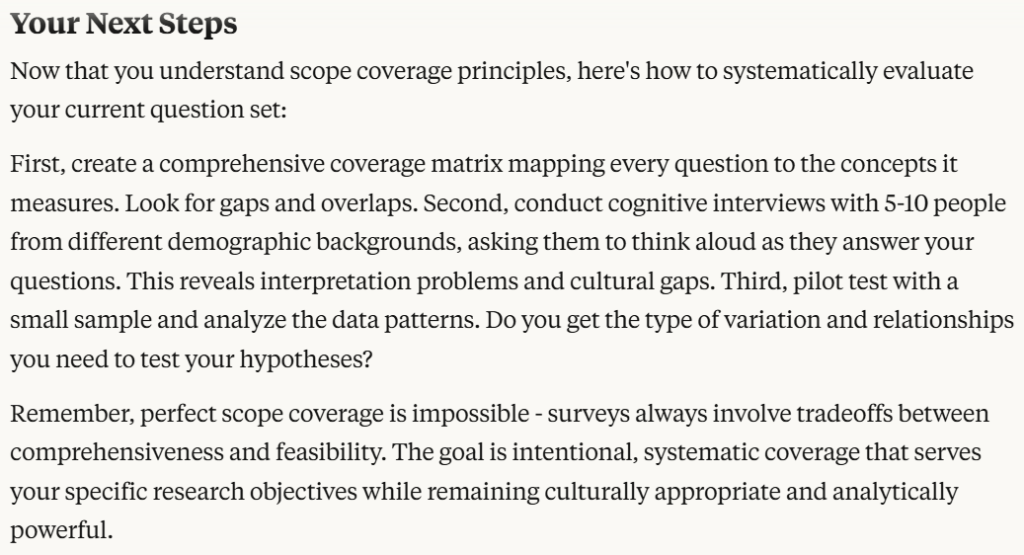
A coverage matrix is your survey blueprint mapping every question to the concept it measures. Just as an architect wouldn’t begin construction without confirming the bathrooms are on the floor plan, you shouldn’t deploy a survey without confirming every hypothesis is covered.
Prompt: “Create a comprehensive coverage matrix mapping every question to the concepts it measures.”
At the end of the matrix, look for the “Strategic Recommendations” section. Read it thoroughly and apply it before moving forward.
Step 4: Audit for Bias Before You Launch
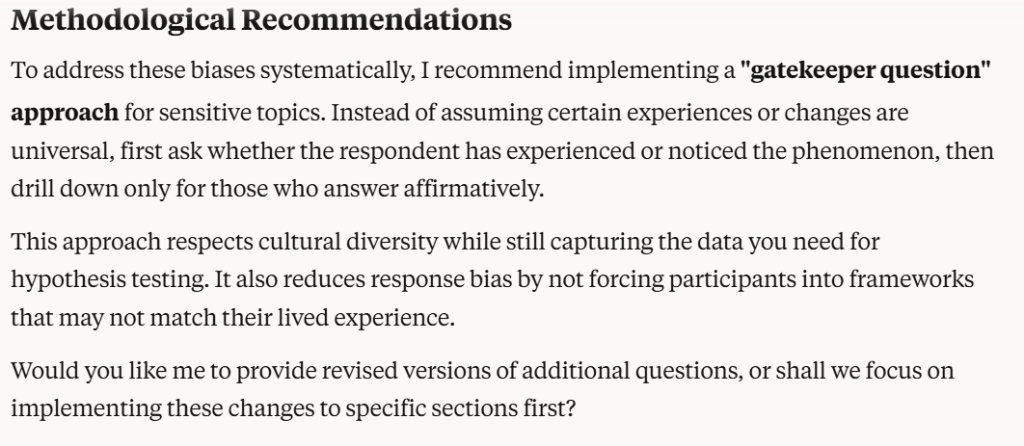
This is one of the most overlooked steps and one of the most important. Questions that work in Western surveys often contain leading phrasing, double-barreled structures, or culturally loaded assumptions that will skew your Indian data.
Prompt: “Flag any leading or culturally biased phrasing and suggest neutral alternatives to these questions.”
In one test run of the PEW study framework, AI flagged nine problem areas and provided neutral rewording for each. Use AI as your ethics and clarity proofreader.
Step 5: Generate Ethically Sound Consent Statements
You cannot use respondent data ethically without proper informed consent. Consent requires that respondents clearly understand every question which means you first need to simplify complex academic language.
Prompt: “Scan the questionnaire for technical or complex words and rewrite them in plain language. Then generate ethically sound consent statements with disclaimers on anonymity, data use, and opt-out rights.”
AI will produce both a simplified questionnaire and a standalone consent form you can send alongside your survey.
Bonus: Use AI to translate the questionnaire into Hindi, Bengali, Gujarati, Marathi, Tamil, Malayalam, or Telugu to reach India’s multilingual population accurately.
Step 6: Deliver the Survey via Google Forms or Typeform
Once your questionnaire is clean, audited, and consented, build it in Google Forms or Typeform. Both are free, mobile-friendly, and easy for respondents to complete on their phones.
Distribution channels to reach Indian respondents:
- LinkedIn (especially for professional or education-related topics)
- WhatsApp and Telegram groups (for community or cultural topics)
- Email lists and alumni networks
- Reddit India, Quora, and niche online forums
- Direct professional and personal networks
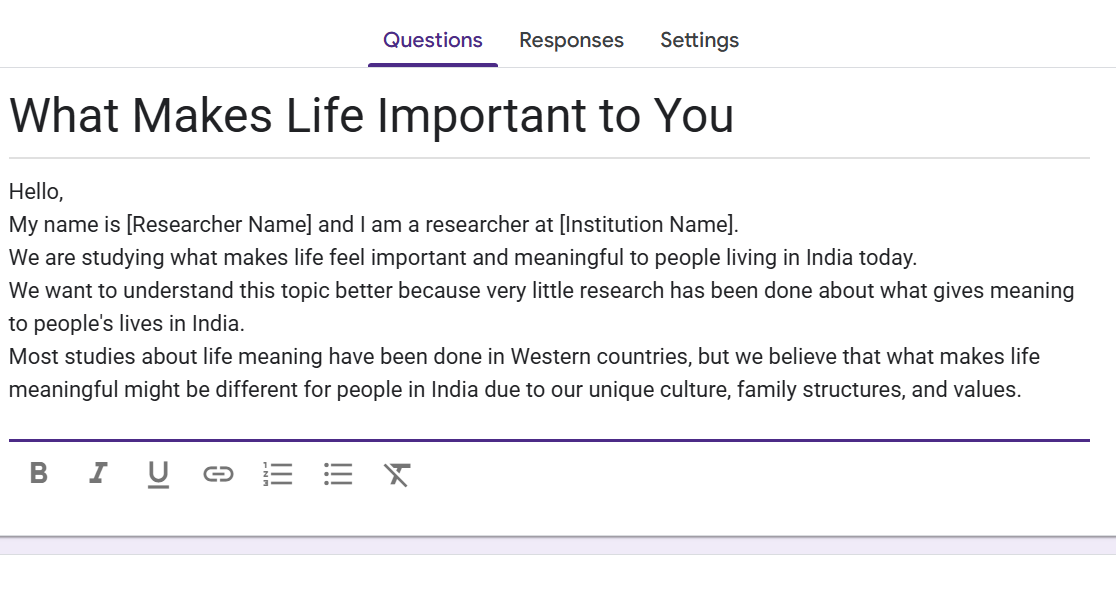
Note: Many field surveys can be conducted entirely online—you don’t need to interview people in person. This makes remote execution both viable and cost-effective.
Step 7: Summarise and Deliver the Data
Once you have your target number of responses (50, 100, 500—whatever you agreed with the client), export them from Google Forms as a spreadsheet and process the data.
Use AI for the heavy lifting:
- Initial pattern detection and trend identification
- Categorising open-ended responses by theme
- Drafting the summary report narrative
Apply your human judgment for interpretation, cultural context, and quality control. That combination AI speed plus your local insight is exactly what international clients are paying for.





 Allow notifications