
A company grants options to 340 employees in March. Eleven months later its board has to place a certificate before shareholders confirming the scheme was run exactly as the regulations and the shareholder resolution required, and somebody has to have kept the records that make that certificate true.
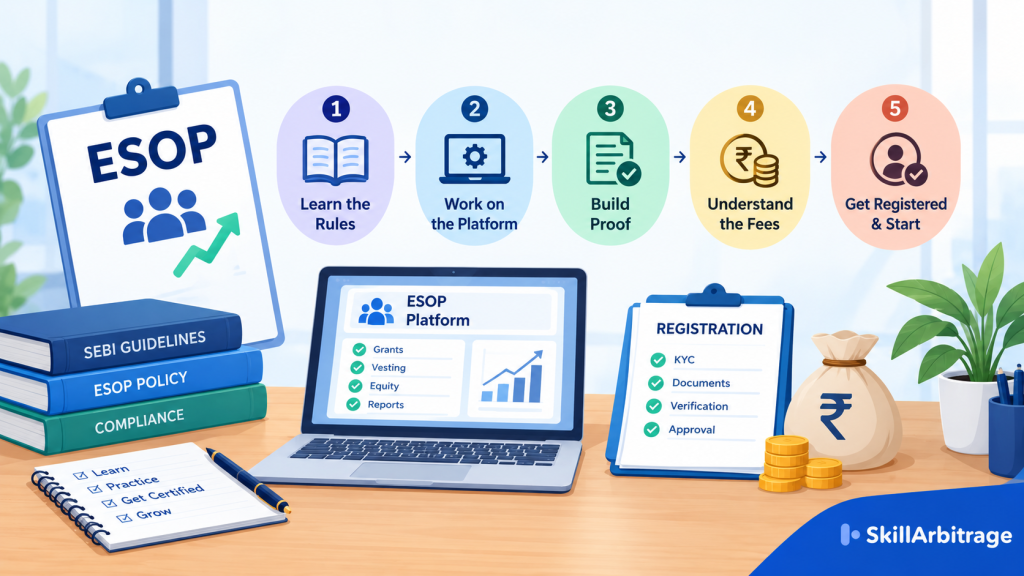
That somebody is the ESOP administrator, and you become one by learning a specific body of securities and company law, getting your hands on the software the grants actually live in, and then proving you can carry a grant from board approval through vesting to exercise without breaking either. No licence gates the work. What gates it is evidence that you have done it.
Nothing about the title is standardised either. The same work is advertised as stock plan administrator, equity compensation analyst and ESOP compliance executive depending on who is hiring, so a job search on the exact phrase will show you a fraction of what exists.
The route is unusually open for that reason. Company secretaries walk into it because the statutory register sits with them, finance people walk into it because the expense charge sits with them, and HR people walk into it because the employee questions land with them. None of those three starts with an advantage. The one who can reconcile a cap table on a Friday and explain a vesting cliff to a nervous employee on the Monday gets the role.
Fair warning before the stages: “ESOP” means two different things depending on which side of the world the plan sits, and choosing between them is the first decision, not a detail. An Indian option scheme and a US employee stock ownership plan share four letters and almost nothing else, including the law that governs them.
Pick the equity system you will administer
Start by deciding which of three equity systems you want to work inside, because the statutes, the software and even the job titles diverge sharply between them.
India: ESOS under the Companies Act and SEBI
An Indian unlisted company issuing options runs on Rule 12 of the Companies (Share Capital and Debentures) Rules, 2014, which requires the scheme to be approved by shareholders through a special resolution before a single option is offered. And that same rule carves promoters and any director holding more than ten per cent of the outstanding equity out of the definition of employee, with a five-year exemption for companies recognised as startups under the Department of Industrial Policy and Promotion notification of 17 February 2016.
Listed companies move to a second rulebook, the SEBI (Share Based Employee Benefits and Sweat Equity) Regulations, 2021. Regulation 5(1) puts a compensation committee in charge of “administration and superintendence of the schemes”, and where the scheme runs through a trust, that committee must delegate administration to the trust. If you want the wider company-side picture first, our explainer on what an ESOP plan is and how to implement one covers the design decisions that reach you as instructions.
The United States: the ESOP as a retirement plan
Here the same four letters mean something else entirely. A US Employee Stock Ownership Plan is a defined contribution retirement plan governed by retirement plan law, funded through a trust, and closer in machinery to a 401(k) than to an Indian option scheme. The National Center for Employee Ownership counts 6,609 ESOPs holding over $2 trillion for 15.1 million participants, of whom 10.9 million are active, on 2023 data drawn from Form 5500 filings.
Privately held US companies must obtain an annual appraisal from an independent outside firm hired by the plan’s trustee, and employees must vest at least 20% a year to full vesting within six years, or be 100% vested all at once after three. Work in this system and your year revolves around valuation season and participant statements rather than around grant letters.
Global stock plan administration
The third system is the one most Indian professionals actually enter. Listed multinationals and late-stage private companies issue options and restricted stock units across dozens of countries, and the people who run those programmes are called stock plan administrators rather than ESOP administrators. The equity itself is only half the job. The other half is reporting it, in the accounting currency, under the standard the parent company reports in.
So which one should you aim at? Pick by employer, not by preference: if your realistic next employer is an Indian listed company or a secretarial firm, learn the SEBI route, and if it is a global capability centre, learn the stock plan route.
Rules an ESOP administrator must know
An ESOP administrator is measured against the rulebook the plan sits under, so learn it at provision level rather than at summary level.
Take Rule 12 first, since India’s unlisted companies hold the bulk of the grants. The explanatory statement attached to the shareholder notice has to disclose thirteen specific items, including the appraisal process for deciding which employees qualify, the requirements and period of vesting, the exercise price or the formula for arriving at it, the lock-in period, the maximum options per employee and in aggregate, the method the company will use to value its options, and the conditions under which vested options lapse. Miss one and the resolution is defective before the scheme starts. In practice, though, this is the part that gets delegated to whoever drafted last year’s notice, which is how errors travel forward.
A separate shareholder resolution is needed in two situations that catch administrators out: grants to employees of a subsidiary or holding company, and grants to identified employees during any one year that equal or exceed one per cent of the issued capital at the time of grant. Both are easy to trip over in a group structure. The short answer on whether a general scheme approval covers them is no.

Then there are the two rules you will apply weekly. There must be a minimum period of one year between the grant of options and vesting, and the company must keep a Register of Employee Stock Options in Form No. SH.6, maintained at the registered office, with entries authenticated by the company secretary or another person the board authorises. Option holders get no dividend and no vote until shares are actually issued on exercise, which is the single most common question you will answer from employees.
Here’s what a register line looks like in practice: Grant ref ESOS-2025-0142, employee code 1182, date of grant 14 May 2025, options granted 4,800, exercise price Rs 27, vesting 25% on each of 14 May 2026, 2027, 2028 and 2029, exercise window 36 months from each vesting date, authenticated by the company secretary on 16 May 2025. Every column there exists because a rule asks for it.
On the listed side, four provisions of the SEBI regulations carry most of the operational weight. Regulation 18(1) sets the same one-year minimum vesting for an option scheme, and disapplies it on the death or permanent incapacity of an employee. Regulation 13 requires the board to place a certificate from the company’s secretarial auditors before shareholders at each annual general meeting confirming the scheme was implemented in accordance with the regulations and the shareholder resolution, and the regulations define that secretarial auditor as a company secretary in practice. Regulation 15 ties the accounting to the standards prescribed under section 133 of the Companies Act, 2013, and Regulation 5(4) requires the compensation committee to frame policies preventing the trust, the company or its employees from breaching the insider trading regulations.
That last one is the reason equity administration sits so close to the board. Our piece on AI in corporate governance covers how those committee obligations are being documented now.
One tax point matters enough to memorise, because employees ask about it constantly. ESOPs are taxable as perquisites at the time of exercise, and the Union Budget 2020-21 proposed deferring that tax payment for eligible startups by five years, or until the employee leaves the company, or until the shares are sold, whichever comes earliest. You won’t be giving tax advice. You will be the person who knows which event triggers what.
Three rulebooks, three job markets. The statutes and the software barely overlap. Three obligations recur in almost every Indian scheme, and each one generates a document you will be asked to produce. Load grants, build vesting schedules, process exercises and lapses, then reconcile back to the cap table before anything is signed. One recognised credential, reachable from India through online proctoring. Prove the interest cheaply first. Two published pay anchors, measuring two different things. Read the second as an indication, not a benchmark.
Get hands-on with the equity software
Nobody is hired into equity administration on rules alone, so get an actual platform under your hands early.
Grants live in dedicated systems now: Carta, Morgan Stanley at Work, J.P. Morgan Workplace Solutions (the business that was Global Shares), and in India, Qapita and similar platforms. Qapita states on its own site that it services more than 2,400 companies and 500,000 stakeholders across 60-plus countries, covering cap tables, plan administration, 409A valuations and financial reporting under ASC 718. Worth flagging: that list maps the job almost exactly, because the same person who loads a grant is usually the person who produces the expense report the auditors test.
What does the daily work actually consist of? Loading grants against board approvals, building vesting schedules that match the scheme document, processing exercises and the money that moves with them, tracking lapses when people resign, and reconciling all of it back to the cap table before anyone signs anything.
That reconciliation is the skill worth drilling. Options granted (4,800) less options exercised (1,200) less options lapsed on resignation (600) equals options outstanding (3,000), and the 3,000 has to agree to the cap table’s outstanding pool line and to the disclosure in the board’s report before either is signed. If those three don’t tie out, something upstream is wrong, and finding out which is a large part of the job.
Run the vesting check the same mechanical way. A grant dated 14 May 2025 cannot show a first vesting date before 14 May 2026, because both Rule 12(6)(a) and Regulation 18(1) impose a one-year minimum. Any schedule that shows otherwise is a data entry error, not a policy choice, and catching it before an exercise is processed is exactly what the role is for.
You can practise most of this without being hired for it. Build a mock cap table for an imaginary company with two founders, a 10% option pool and three funding rounds, then grant options against it, run a four-year vesting schedule with a one-year cliff, process a partial exercise and a resignation lapse, and reconcile the pool at the end. Do that once and you can talk about grant data, vesting mechanics and dilution without hedging. Do it three times and you have a portfolio artefact that a hiring manager can actually open. Based on what we have seen, that beats a certificate with no work behind it.
Pay attention to the reporting half while you practise, because that is where the reconciliation gets tested by someone else. The expense schedule a company reports its share-based payments through is built from the same grant data you maintain, which means an error in a vesting date does not stay a records problem. It becomes an audit finding.
Two published course routes give you the vocabulary before anyone hands you a login. Carta’s Equity 101 runs ten lessons covering cap tables, grants, vesting, exercising, share sales, taxation and valuations, and its Cap Table 101 covers the same ground in video form. And equity records are precisely what gets torn apart when a company is bought, which our walkthrough of legal due diligence in M&A shows from the buyer’s side. If your background is finance, the reporting habits in SaaS and startup accounting for US clients transfer here almost directly.
Certify as an equity professional
One credential is recognised across this field, and it comes from the Certified Equity Professional Institute at Santa Clara University.
The programme runs in three levels. Passing Level 1 earns the Equity Compensation Associate designation, and passing all three earns the Certified Equity Professional designation across four disciplines: accounting, equity plan design, analysis and administration, corporate and securities law, and taxation. The institute recommends one, two and three years of equity compensation experience for the three levels respectively, and candidates report an average of 40 to 50 hours of study per exam.
The mechanics are worth knowing before you budget for it. Registration costs $1,995 per level inside the contiguous United States and $1,999 per level outside it, exams run in week-long windows each May and November (7 to 13 November 2026, with registration closing 9 October 2026), Levels 1 and 2 carry 110 multiple choice questions against Level 3’s 77, and scores are scaled from 200 to 800 with 500 and above passing. The minimum time from first registration to finishing Level 3 is around 14 months. After that, holders complete at least 30 hours of continuing education every two years, with a $250 administrative fee that can be waived through volunteer work.
Two scheduling details save people a wasted cycle, and neither is obvious from the fee page. Every new candidate enrols at Level 1 with no exceptions, however senior they are, so an experienced compliance professional cannot test straight into Level 2. And each sitting runs 230 minutes of testing plus a 10-minute break, which makes a four-hour appointment, so the May window (9 to 16 May 2026, with registration closing 6 April) needs to be booked around rather than squeezed into a working week.
The four disciplines are also worth reading as a study plan rather than a syllabus list. Two of them, corporate and securities law and taxation, are where an Indian candidate carries the least transferable knowledge, because the exam tests US treatment. Budget your study hours unevenly for that reason.
Does any of that work from India? Yes, and this is the detail that decides it: the exams are delivered through Pearson VUE both at test centres and by OnVUE online proctoring, and the handbook prices non-US candidates explicitly.
Two thousand dollars a level is a real commitment, though, so we’d recommend proving the interest cheaply first. The National Center for Employee Ownership sells a self-paced online ESOP training programme of five units and 18 topics, each a recorded webinar followed by a scenario-based quiz, at $100 for members and $200 for non-members. Finish that before you spend on an exam.
For the network, the National Association of Stock Plan Professionals runs nearly 20 local chapters and gives members templates, policies and procedures, and global guides. The Global Equity Organization, founded in 1999, adds chapter meetings, its GEOlearn programme and continuing professional education credits. Both are where vacancies get mentioned before they get posted.
Land your first ESOP administrator role
Target the four employer types that actually carry this work, because a generic job search for “ESOP administrator” in India returns very little.
Those four are global capability centres of US and European listed companies, where stock plan teams increasingly sit; equity platforms and cap table providers, which hire administrators to run client plans; company secretarial and compliance firms handling SEBI and Companies Act filings for listed and unlisted clients; and, in the US market, third-party administrators serving ESOP companies through valuation and statement cycles. Search the titles those employers use: stock plan administrator, equity compensation analyst, equity administration specialist, ESOP compliance executive.
On pay, two published figures are worth quoting, and they measure different things. Payscale puts the average base salary for a stock plan administrator in the United States at $103,736 as of 1 March 2026, on a 10th to 90th percentile range of $73,000 to $138,000. There is no comparable India-specific dataset for the title, so the nearest honest anchor is the adjacent compensation analyst role, which Payscale puts at Rs 9,24,324 on average as of 2 March 2026, on a range of Rs 3,68,000 to Rs 20,00,000, from a thin pool of 28 salary profiles.
Treat that second figure as an indication rather than a benchmark. The sample is small and the title is not the same one.
Prepare for what those interviews actually test, which is rarely definitions. Expect to be handed a broken reconciliation and asked where the difference sits, or given a vesting schedule and asked whether it is compliant, or asked what you would tell an employee who wants to know why they got no dividend on vested options. Answer that last one with the rule (no dividend and no vote until shares are issued on exercise) and you have shown two things at once.
What actually converts an application? Grant-level specifics. This is where most career changers go wrong, writing “handled ESOP compliance” when the reader wants to know what passed through their hands.
Compare a vague line against a concrete one: Maintained the Form SH.6 register for 1,140 outstanding option grants across two group companies, processed 310 exercises and 94 resignation lapses in FY 2025-26, reconciled the outstanding pool to the cap table monthly, and prepared the schedule supporting the secretarial auditor’s certificate placed at the AGM. Every clause there is checkable, and each one names a document a hiring manager recognises.
If you have no grants to point to, build the proof another way. Volunteer for the equity workstream during a funding round at your current employer, take the cap table reconciliation off a founder’s plate at a startup, or complete the NCEO programme and pass Level 1 to sit the ECA before you apply. A career built sideways from an adjacent compliance function is normal here, and the third party risk management career path followed the same shape. But the one thing that does not work is applying on rule knowledge alone. Every shortlisted candidate has that.
FAQs
Do you need to be a company secretary or a chartered accountant to work in ESOP administration?
No formal qualification is prescribed for the administrator role itself. The Companies (Share Capital and Debentures) Rules require entries in the Form SH.6 register to be authenticated by the company secretary or another person the board authorises, and the SEBI regulations reserve the annual AGM certificate for a company secretary in practice. So the statutory sign-offs sit with qualified professionals, while the administration around them does not.
What is the difference between an ESOP administrator and an ESOP trustee?
The trustee holds fiduciary responsibility for the plan and, in a US ESOP, engages the independent appraiser who values the shares each year. The administrator runs the records: grants, vesting, exercises, statements and reconciliations. In India, Regulation 5(1) of the SEBI regulations requires a compensation committee implementing a scheme through a trust to delegate the administration of that scheme to the trust, which is where the two roles meet.
What happens if a grant is recorded with the wrong vesting date?
The error compounds, which is why it gets caught late and hurts. A vesting date earlier than the one-year statutory minimum lets an exercise be processed that should not have been, which then misstates the outstanding pool, the expense charge and the disclosures built on both. Fixing it means correcting the register, reversing the exercise, and explaining the correction to the auditor, so the check belongs at data entry.
References
- Securities and Exchange Board of India (Share Based Employee Benefits and Sweat Equity) Regulations, 2021, SEBI, 13 August 2021. Regulations 5, 13, 15 and 18.
- Companies (Share Capital and Debentures) Rules, 2014, Rule 12, Ministry of Corporate Affairs.
- Key highlights of Union Budget 2020-21, Press Information Bureau, Government of India, 1 February 2020.
- Employee Ownership by the Numbers, National Center for Employee Ownership, 2023 data.
- How an Employee Stock Ownership Plan (ESOP) Works, National Center for Employee Ownership.
- Online ESOP Training, National Center for Employee Ownership.
- Certified Equity Professional Institute and CEPI Handbook, Leavey School of Business, Santa Clara University, 2026.
- Certified Equity Professional Institute testing, Pearson VUE.
- Stock Plan Administrator Salary, Payscale, updated 1 March 2026.
- Compensation Analyst Salary in India, Payscale, updated 2 March 2026.
- Membership for Stock Plan Professionals, National Association of Stock Plan Professionals.
- Global Equity Organization.
- Equity 101 and Cap Table 101, Carta.
- Qapita, platform scale figures self-reported by the vendor.
Disclaimer
This article is for informational and educational purposes only and does not constitute legal, tax, financial or career advice. Regulatory provisions, exam fees and salary figures are cited with their source and date and may change. Consult a qualified professional before acting on any compliance or career decision.





 Allow notifications