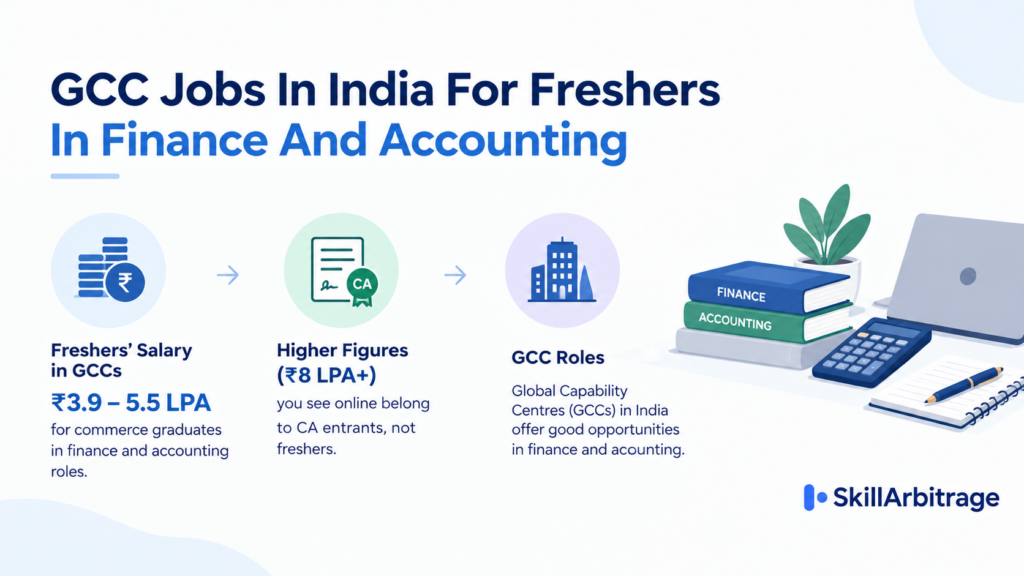

GCC jobs in India for freshers in finance and accounting pay roughly Rs 3.9 lakh to Rs 5.5 lakh a year in the transaction-processing roles a commerce graduate is actually hired into. GCC here means Global Capability Centre, the in-house arm a multinational owns and staffs on its own Indian payroll. The Rs 8 lakh to Rs 14 lakh figures published against this search sit two to three times above every observable employer datapoint for a fresher. A B.Com or CA-Inter entrant starts in accounts payable, accounts receivable, record to report or general ledger work, and employee-reported salary data for named employers in Hyderabad puts that work in the lower band.
India had 2,117 GCCs across 3,728 units employing 2.36 million professionals on $98.4 billion of FY26 revenue, with the centre count up 32% from FY21, per the Zinnov and Nasscom India GCC Landscape 2026 report. 506 Forbes Global 2000 companies and 583 mid-market firms run one. Only 13% of those centres are still early-stage outposts, while 39% now operate as portfolio hubs holding end-to-end ownership of a function. The finance and accounting entry job exists because centres got large enough to run their own transaction processing instead of outsourcing it, which is also why the work is narrow.
Freshers are 16% of expected GCC hiring in FY27, down from 21% in the previous outlook, according to the Taggd GCC Talent Lab survey of FY27 hiring plans, which polled more than 100 GCC chief human resources officers and talent-acquisition leaders with CII. In the same survey 52% of GCCs plan to increase hiring, up from 47%, across roughly 150,000 new roles. So the sector is expanding and getting harder to enter as a fresher at the same time. That tension, rather than the headline salary, is what decides whether this is a realistic first job.
What GCC jobs in India pay a finance fresher
GCC jobs in India pay a finance or accounting fresher in two clearly separated bands, and the qualification you hold decides which one, not the employer’s size or brand. A commerce graduate without a professional qualification sits in the Rs 3.9 lakh to Rs 5.5 lakh band, doing transaction processing. A chartered accountant, CPA, CMA or finance MBA entering controllership, financial planning and analysis (FP&A) or audit work sits higher, though no role-level band for that entry survives checking, which is a finding rather than a gap.
Worth flagging up front: every figure below carries a role and an entrant type. A band quoted without both is the error this page exists to correct.
The intake itself is a consequence of scale. ANSR’s count of BFSI talent in Indian GCCs ran from about 100,000 in 2010 to about 185,000 in 2015 to about 360,000 by 2023, while the centre count moved from roughly 80 to over 185. Talent grew more than threefold in thirteen years while the centre count little more than doubled, so the centres got much bigger, and that scale is what produced a standing entry-level intake in finance operations.
Entry roles and pay for a commerce fresher
A commerce graduate without a professional qualification enters a GCC finance team through transaction processing: accounts payable, accounts receivable, record to report, order to cash, reconciliations, invoice processing, payroll and master data. No computer-science background is required for any of it. The work overlaps closely with what a B.Com graduate can actually do in global accounting and bookkeeping work, and with remote US payroll work from India, which is the same processing skill sold to a different kind of employer.
Employee-reported figures for named employers and named cities put that work in a narrow band.
| Role, employer and city | Band | Source |
|---|---|---|
| FinOps Analyst, Amazon, Hyderabad, 1 to 3 years | Rs 3.88 lakh to Rs 4.52 lakh | Employee-reported Glassdoor data |
| Senior FinOps Analyst, accounts payable, Amazon, Hyderabad | Rs 4.76 lakh to Rs 5.50 lakh | Employee-reported Glassdoor data |
| Finance Associate, Hyderabad, 25th to 75th percentile | Rs 4.35 lakh to Rs 7.63 lakh, average Rs 5.65 lakh | Glassdoor |
| Accounts Payable Analyst, New Delhi, 25th to 75th percentile | Rs 4.21 lakh to Rs 6.77 lakh, average Rs 5.33 lakh | Glassdoor |
| R2R Analyst, India, all experience levels, not fresher-only | Base Rs 5.00 lakh to Rs 7.00 lakh, average total pay Rs 6.96 lakh | Glassdoor India |
| Process Associate, Genpact, fresher | Rs 2.80 lakh CTC, about Rs 20,444 a month in hand | Single-sourced to a secondary aggregator |
| Transaction Processing Associate, Accenture, 0 to 4 years | Rs 2.6 lakh to Rs 3.7 lakh, fresher average Rs 2.9 lakh | Payscale India, single-sourced |
The record-to-report row is the one worth reading twice. Competitor pages publish Rs 7 lakh to Rs 12 lakh for an R2R analyst at 0 to 2 years, and Google’s AI Overview repeats it. Glassdoor India’s average total pay for the same title (every experience level from fresher to team lead) is Rs 6.96 lakh. An average across all levels cannot sit below the band for the least experienced level inside it, so one of those two numbers is wrong, and it isn’t the one with a source attached.
The bottom two rows are the third-party floor, and they make the GCC premium measurable rather than asserted. Here’s what that looks like on one graduate’s first offer. A B.Com graduate joining an Amazon FinOps Analyst role in Hyderabad at the midpoint of its band, about Rs 4.2 lakh, against the same graduate joining a Genpact process associate role at Rs 2.80 lakh CTC, is roughly Rs 1.4 lakh ahead in year one for work that reads almost identically on the job description. Both third-party figures are single-sourced (and weaker than the Glassdoor cuts above them), so treat them as a floor rather than a precise number.
Why does the same work carry two prices? The job title tells you less than the payroll does. The same graduate can be paid Rs 2.8 lakh or about Rs 4.2 lakh for accounts-payable processing in Hyderabad depending on whether the employer owns the process or sells it. That distinction is invisible on a job portal, which is why portal-derived averages for “GCC finance jobs” run high and mean nothing.
Where the Rs 8 lakh figures come from
The Rs 8 lakh to Rs 14 lakh figures published against this search match the Big 4 chartered-accountant fresher range far more closely than they match any observable GCC fresher figure at either entrant level.
The higher-band GCC roles are real. FP&A, controllership, internal audit, transfer pricing and tax, treasury and risk all exist inside Indian GCCs, and Goldman Sachs has been advertising a Controllers, CA Freshers, Analyst intake in Bengaluru that asks for a qualified CA, CFA or CMA, which is the clearest proof that a dedicated fresher intake exists at a marquee centre. What doesn’t exist is a defensible figure for what that intake pays. The analyst bands published for Goldman Sachs India come from secondary aggregators, they disagree with each other by a wide margin, and the employee-reported sample for the same title is dominated by technology roles rather than finance ones, so none of them belongs on this page.
Now set it against the Big 4, all industry-reported rather than published pay scales. A chartered accountant fresher in statutory audit is reported at Rs 8.5 lakh to Rs 9.5 lakh, direct and indirect tax at Rs 9 lakh to Rs 10.5 lakh, and CA freshers across service lines at Rs 8.5 lakh to Rs 12 lakh. The same firms pay a non-CA entrant far less: a CPA fresher Rs 6 lakh to Rs 9 lakh, an ACCA fresher Rs 6 lakh to Rs 8 lakh, and a campus analyst or specialist hire Rs 4 lakh to Rs 7 lakh.
The published GCC band lands on top of the chartered-accountant range almost exactly. And it’s a Big-4-shaped number wearing a GCC label. What sits underneath it on the GCC side is not a lower band but no band at all.

But what a qualification actually buys is a move from the transactional band to the analytical one, not a jump to Rs 14 lakh. CA Inter and CMA open record to report and controllership; CPA exam eligibility for an Indian B.Com graduate matters where US GAAP or IFRS reporting is involved, as does ACCA; CFA and FRM point at BFSI treasury and risk. ACCA’s own finding is that entry-level GCC finance roles now centre on data analytics, FP&A and compliance management. BFSI contributed roughly 20,000 to 25,000 GCC positions last year, the best available proxy for finance-adjacent hiring volume.
The market has already corrected itself on this in public. In December 2025 a finance publication ran a piece built on the claim that a chartered accountant earning about Rs 1 lakh a month at a traditional company could earn two to three times more at a GCC. In March 2026 the same publication ran an interview with a Michael Page India recruiter on GCC finance pay who called that characterisation misleading and put the real figure at 9% to 10% annual hikes, roughly 30% cumulative over three years. That is evidence rather than assertion.
Where the GCC finance jobs are concentrated
The GCC finance jobs are concentrated where the leasing is. GCCs took a record 31 million sq ft of Indian office space in 2025, 37.7% of the country’s gross office leasing and up from about 28 million sq ft in 2024, with over 90% of that activity in tier-1 cities, per JLL’s count of GCC office leasing in 2025.
Bengaluru took 34% to 39% of GCC leasing and hosts over 900 GCC units. Hyderabad took 20% to 23%, Pune 15% to 20%, and more than 200 new GCCs entered India inside two years. US-headquartered firms drove 70% of GCC demand between 2018 and 2025, which is the single best predictor of the shift a new hire will work.
The National Capital Region has a real number behind it: an accounts payable analyst in New Delhi averages Rs 5.33 lakh on employee-reported data, inside the same band as Hyderabad. All of this is the local expression of India’s move toward becoming the world’s operations capital, and the finance intake follows the square footage with a lag of a year or two.
But tier-2 is a real option, though not yet this hiring cycle. The Union Budget 2025-26 committed to a national framework with 16 measures to guide states on promoting GCCs in emerging tier-2 cities, and Coimbatore has already shown a 21% compound annual growth rate in new GCC setups over five years. JLL projects the GCC footprint passing 350 million sq ft within three to four years, with tier-2 cost savings of 10% to 35% against metro locations on its own numbers (the lower of the two ranges in circulation).
What the intake screens for
The intake screens for a commerce degree first: GCC finance and accounting job descriptions name B.Com, M.Com, BBA with a finance specialisation, MBA in finance or accounting, CA, CMA or ICWA and B.Sc Accounting. The “60-60-60” screen (60% in class 10, class 12 and graduation) is an IT-services convention rather than a GCC rule, and single-sourced at that; centres more often weight graduation CGPA and demonstrable skills. Functional screening covers general ledger, accounts payable and receivable, month-end close, intercompany reconciliation, journal entries and financial reporting.
On tooling, SAP S/4HANA FI is the dominant ERP for record to report, with Oracle Cloud and NetSuite appearing, BlackLine and Trintech for reconciliation, Excel with Power Query and Power Pivot, and Power BI. SAP FI familiarity appears in a large share of GCC R2R job descriptions and candidates who have it are shortlisted faster. It isn’t a gate, and the “non-negotiable” framing around it comes from training vendors rather than hiring managers. The shift is the honest cost of the premium: US coverage from India runs roughly 18:30 to 06:30 IST, with the Eastern-time band (about 18:30 to 03:30 IST) the most common for Wall-Street-facing operations.
Freshers enter through company career portals, campus and off-campus drives, structured internship and hackathon programmes, and referrals. They don’t enter through executive-search boards: one large recruiter’s live GCC page carries senior roles only, a finance manager in Gurgaon at Rs 63 lakh to Rs 77 lakh, a general-ledger accounting manager in Bangalore at Rs 36 lakh to Rs 40 lakh, a head of accounting in Hyderabad, and nothing entry-level. And as GCCs shift toward 1 to 5 year lateral hiring, the internship and hackathon route becomes the main door rather than a supplement. That route is time-boxed to final-year students, which makes “apply on portals” quietly wrong advice for a graduate who has already left college.
So the resume has to do the work the channel no longer does. A final-year B.Com student who puts Excel Power Query, one Power BI dashboard built on a public dataset and SAP FI coursework on a one-page resume, and applies through company career portals inside the campus window rather than through an aggregator, is working the channel the hiring mix is actually moving toward.

How realistic a GCC first job is
A GCC first job is getting less likely and better paid at the same time: freshers are 16% of expected GCC hiring in FY27, down from 21% in the previous outlook, even as 52% of GCCs plan to increase hiring overall. Both halves come from the same Taggd survey of more than 100 GCC CHROs and talent leaders, so they are one hiring mix changing shape rather than two datasets in disagreement.
The expansion isn’t in doubt. GCCs took 37.7% of India’s gross office leasing in 2025, the Union Budget 2025-26 committed to a national framework to push them into tier-2 cities, and the Taggd respondents expect roughly 150,000 new roles across FY27 (1 to 5 years of experience takes 30% of them, 6 to 10 years 28%). On the survey’s own mix, 16% of about 150,000 works out to roughly 24,000 fresher roles across the entire sector, and that figure is derived arithmetic rather than a reported number. Finance and accounting is one slice of it.
The optimistic projections sit next to that rather than instead of it. FirstMeridian, carried by IBEF, projects the GCC workforce reaching 3 million by 2030 and adding about 400,000 fresher jobs, with about 150,000 jobs by 2026 of which nearly 100,000 are entry-level suitable, and 40% of the current workforce being women; ACCA projects 2.8 million GCC jobs at 2% of GDP by 2030. And both can be true alongside a falling fresher share. Larger pie, thinner slice.
But one forward signal cuts the other way. The client mix is diversifying away from the US: US-headquartered firms drove 70% of GCC demand from 2018 to 2025 per JLL, while the Michael Page India recruiter puts the US share of GCC placements as having fallen from 80% to between 55% and 60%, with European, Japanese and Australian firms setting up, increasingly in Coimbatore and Kochi. For a fresher the consequence is a shift roster: EMEA and APAC coverage is materially kinder than a US night shift.
Then there’s what happens after year one. GCC pay rises 9% to 10% a year, roughly 30% cumulative over three years, on the recruiter’s own figure. That makes the premium a starting-point advantage which compounds slowly rather than a multiplier.
So which route wins on pay? A GCC beats a third-party provider by roughly half on day one, Rs 3.9 lakh to Rs 5.5 lakh against Rs 2.6 lakh to Rs 3.7 lakh, and then raises at single digits, while a Big 4 associate starts higher on a chartered accountancy and moves faster on promotion cycles. The GCC’s advantage is widest on the day you join and narrows from there, which inverts the usual advice to join one and compound.
And the narrow-scope cost is the other half of the trade. A GCC fresher owns one sub-process inside a global workflow, and that’s what makes the work stable, scalable and well paid at entry. It’s also why three years of it can read thinner on a CV than three years at a mid-size domestic firm where whole sets of books were closed end to end. The same job title at an Indian MNC subsidiary or a listed Indian corporate’s own finance team is a different job: the GCC role sits inside a global process tower serving many entities, while the domestic team owns a single legal entity from trial balance to statutory filing.
Internal mobility is the counterweight worth pricing in. A centre that runs record to report, controllership, FP&A and treasury in the same building can move a transactional analyst into analytical work without a change of employer. A third-party provider is a weaker version of the same offer, because the analytical work it touches belongs to its clients’ finance functions rather than its own. That is the mechanism behind the R2R-to-FP&A move, and it is the strongest argument for the transactional band over the third-party floor.
| Route | Entry pay, sourced | Entrant type | What you own | Trade-off |
|---|---|---|---|---|
| Third-party BPO or GBS, such as Genpact or Accenture Operations | Rs 2.6 lakh to Rs 3.7 lakh, single-sourced | any commerce degree | one sub-process | easiest entry, weakest exit value |
| GCC transactional, covering AP, AR, R2R and GL | Rs 3.9 lakh to Rs 5.5 lakh, employee-reported for named employers | commerce graduate, no professional qualification | one sub-process inside a global workflow | strong brand and internal mobility, US shift, narrow CV |
| GCC qualified entry, covering controllership, FP&A, internal audit and treasury | no band survives checking, so none is quoted here | CA, CPA, CMA or finance MBA | broader work inside one tower | analytical work, still one tower, usually still a US shift |
| Big 4 India associate | Rs 8.5 lakh to Rs 9.5 lakh for a CA in statutory audit, Rs 4 lakh to Rs 7 lakh for a non-CA campus analyst hire, industry-reported | chartered accountants at the top of that range, commerce graduates at the bottom | client engagements end to end | broadest exposure and strongest exit value, punishing hours |
| Domestic Indian firm or CA firm | lowest of the salaried routes, no independent band available | any commerce degree | whole sets of books, end to end | widest ownership, best for CA completion, lowest pay |
| Remote finance roles at US startups and other overseas clients | rate-based rather than salaried, so no annual band applies | any commerce degree with demonstrable skill | varies by engagement | highest ceiling and highest variance, no salary floor, no shift protection, no benefits |
That last row deserves its downsides in prose and not just a table cell: a rate-based engagement with an overseas client has no floor, no notice period protecting you, no employer contribution to anything, and no guarantee the work renews next quarter. It also has the highest ceiling in the table.
Pay and stability sit on one side of this decision, breadth and exit value on the other, and the qualification you hold is the single lever that moves a fresher between the two GCC bands. Whether the thinner fresher slice matters more than the wider entry premium depends on how long you plan to stay in the first job.
FAQs
Is a GCC the same as a BPO or a captive centre?
Ownership and payroll are what separate them. A Global Capability Centre is owned by the multinational and pays you on its own Indian payroll, while a BPO is a third-party vendor that employs you and bills the client for your work. “Captive centre” and “GIC” are older names for the same thing as a GCC. An IT services company is different again: it sells projects to many clients rather than running one company’s own finance operation.
Which credential moves the needle most for a GCC finance job: CMA, ACCA, CPA or SAP FICO?
The credential has to match the function, not the employer, so there is no single ranking. CA Inter and CMA map to record to report and controllership, CPA and ACCA to work involving US GAAP or IFRS reporting, and CFA and FRM to BFSI treasury and risk. SAP FICO is the odd one out: SAP FI familiarity shortens shortlisting for R2R roles rather than acting as a qualification gate.
Will AI and automation shrink entry-level GCC finance jobs?
ACCA’s finding is that entry-level GCC finance roles have already moved toward data analytics, FP&A and compliance management rather than pure transaction processing, and the Taggd survey found nearly half of GCCs reporting that over 25% of their open roles need AI skills. The description of the entry job is moving up the stack faster than the headcount is moving down. Reconciliation and close tooling compresses manual work, so the role trends toward exception handling, validation and controls.
Disclaimer
This article is for informational and educational purposes only. Salary bands quoted here are employee-reported or industry-reported observations as of September 2026; they vary by employer, city and qualification, and they change with each hiring cycle.





 Allow notifications