
Last verified: 2026-07-30
An Amazon seller ships $10,000 of product in a fortnight. The deposit that lands in the bank is $5,752. Nothing has gone wrong, and neither figure is the one you post as sales.
E-commerce bookkeeping is the work of taking that single net deposit apart. You record the gross sales, then every fee, refund, tax and reserve movement the platform took out before paying. Done properly, the deposit ties back to the platform’s own report and the seller can finally see what each channel earns.
The gap between the two numbers is not small. In the settlement worked through below, fees alone take 34.9% of gross sales. Book only the deposit and you lose the entire fee structure, the returns rate, and the margin.
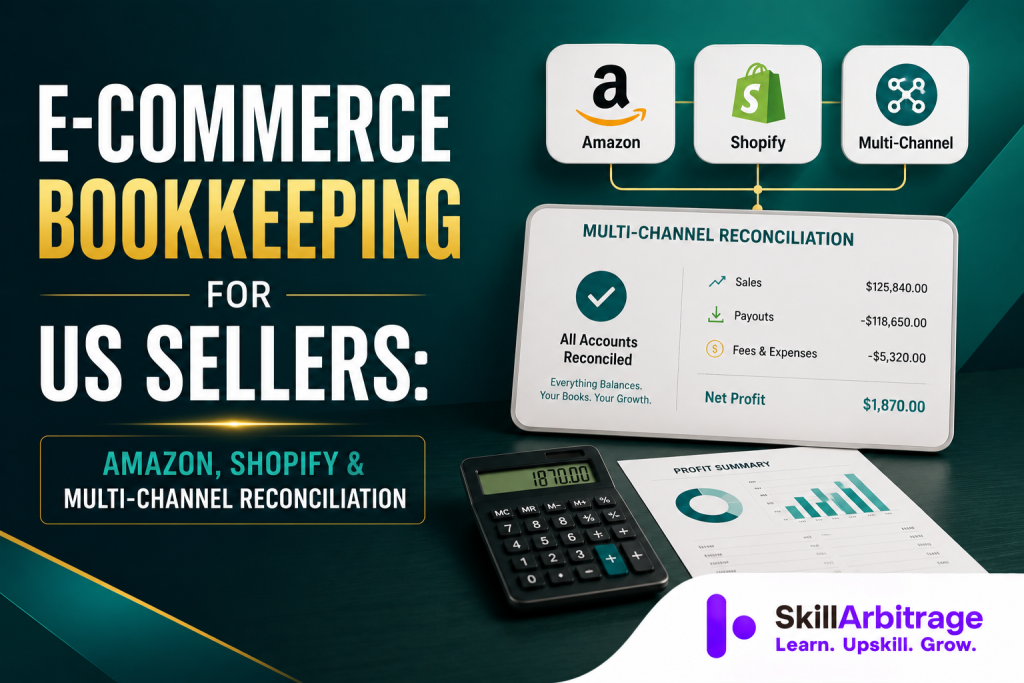
This article sets out how e-commerce bookkeeping works for US sellers on Amazon, Shopify and several channels at once.
The short version: record each settlement at gross. Debit a channel clearing account for what the platform owes, credit sales, and post every fee, refund and reserve movement to its own account against the same clearing account. When the deposit lands, move it out of clearing into the bank. Whatever is left in clearing is what the platform still holds.
Everything below assumes you are the bookkeeper on a US seller’s file, working from settlement reports rather than invoices. That is the first habit to build. On these files, the settlement report is the accounting record.
Why is the payout smaller than the sales figure?
The payout is smaller than the sales figure because the platform deducts everything it is owed before it pays. One deposit can contain a dozen different items, already netted together.
On Amazon, a single disbursement nets sales, refunds, referral fees, fulfilment fees, storage fees, advertising, reimbursements, sales tax the marketplace collected, chargebacks and reserve movements. On Shopify, it nets sales, refunds, processing fees and disputes.
The seller sees one number in the bank. The bookkeeper has to find the ten numbers behind it.
Take the fortnight above. Gross orders were $10,000. Amazon took a 15% referral fee of $1,500, FBA fulfilment fees of $1,180, storage of $190 and advertising of $620. Refunds ran $480, reimbursements added back $122, and $400 went into reserve.
Fees alone were $3,490, or 34.9% of gross. Post the $5,752 deposit as sales and all of it disappears.
Four things break in order when that happens. Revenue is understated by 42.5%. Gross margin becomes meaningless, because the cost of selling sits nowhere. The sales tax reconciliation cannot be done at all. And at year end the Form 1099-K, which reports gross, will not come close to the books.
Fee rates are worth knowing before you start. Amazon charges a 15% referral fee in most categories, 8% on computers, consumer electronics, full-size appliances and video game consoles, and 12% on automotive and powersports and on business, industrial and scientific supplies. The minimum referral fee is $0.30 per item.
Shopify’s own figure for online card transactions is 2.5% to 2.9% plus 30 cents, depending on the plan.
None of this is unusual bookkeeping. It is the same discipline as a bank reconciliation, applied to an account the client cannot see the inside of.

The chart of accounts for e-commerce bookkeeping
The chart of accounts for e-commerce bookkeeping needs one thing a standard small business chart does not have: a clearing account for every place money sits before it reaches the bank.
Build it in six groups.
Clearing accounts. One per settlement source. Amazon Clearing, Shopify Payments Clearing, PayPal Clearing, Stripe Clearing. These are current assets. Each one holds the money a platform owes the seller between the sale and the payout.
Revenue. Product sales, shipping income charged to customers, and gift card redemption. Split by channel only if the client wants channel reporting, which most sellers do.
Contra revenue. Refunds and returns, discounts and coupons, promotional rebates. These sit below sales, never inside it. Netting them into revenue hides the returns rate, which for many categories is the number that decides whether the business works.
Cost of sales. Cost of goods sold, inbound freight, duties, referral fees, fulfilment fees, storage fees and merchant processing fees.
Liabilities. Sales tax payable, gift card liability, customer deposits.
Assets. Inventory on hand, inventory in transit, inventory at the fulfilment centre, and a receivable for the platform reserve.
One decision to make once and record in the workpaper: whether advertising is a cost of sale or an operating expense. Under US GAAP it is an operating expense. Sellers often want it above the margin line because it is a cost of getting the sale.
Either treatment is defensible. Switching between them silently is not. Write down which one you used.
The rest of the structure follows normal rules, and our guide to the US chart of accounts covers the numbering and account groups this sits inside.
Amazon settlement reconciliation
Amazon settlement reconciliation means taking one settlement report, posting every line in it to the right account, and proving that the net figure equals the deposit. It is the core skill on an Amazon file.
What is inside a settlement report
The settlement report is Amazon’s own record of a payment cycle. Find it in Seller Central under Payments, then All Statements, where it downloads as a flat file or XML. The Statement View gives you the summary and the Transaction View gives you the underlying lines.
A settlement period is 14 days for most accounts. Amazon states that it settles seller accounts every two weeks, and that once a payment is initiated it can take up to five business days for the funds to reach the bank.
Inside the file, every line carries a transaction type. Order, Refund, Fee, Reserve, Adjustment and Transfer are the ones you will see most, plus tax lines where Amazon collected and remitted under marketplace facilitator rules.
Work from the file, not from the Seller Central dashboard. The dashboard shows current position. The file shows a closed period, which is what you are posting.
The settlement journal entry
Here is a complete entry for the fortnight described above. Settlement period 1 to 14 June 2026, net disbursement $5,752.
| Account | Debit | Credit |
|---|---|---|
| Amazon clearing | 5,752.00 | |
| Amazon reserve receivable | 400.00 | |
| Sales, Amazon | 10,000.00 | |
| Refunds, Amazon | 480.00 | |
| Marketplace facilitator tax collected | 810.00 | |
| Marketplace facilitator tax remitted by Amazon | 810.00 | |
| Referral fees | 1,500.00 | |
| FBA fulfilment fees | 1,180.00 | |
| Storage fees | 190.00 | |
| Advertising | 620.00 | |
| FBA reimbursements | 122.00 | |
| Totals | 10,932.00 | 10,932.00 |
Then a second, separate entry when the money arrives: debit Bank $5,752, credit Amazon clearing $5,752.
Two lines are worth pausing on. The tax lines cancel each other out on purpose, because Amazon collected the tax and Amazon remitted it. Running it through the seller’s sales tax payable account would create a liability the seller does not owe.
The reserve is a debit to an asset, not an expense. Amazon is holding the seller’s money, not keeping it.
Reserves, deferred transactions and DD+7
The reserve is the part of e-commerce bookkeeping that most often gets misposted. It shows in Seller Central under Payments and Account Summary as an Account Level Reserve, part of the unavailable balance. To see the detail, open Transactions View and filter to Unavailable Balance.
Amazon also operates a delivery date based reserve, widely referred to as DD+7. Funds move to the available balance seven days after confirmed delivery rather than after despatch.
Sellers moved onto it received a notice reading: “On March 12, 2026, in line with your feedback, we’ll update your reserve settings to the standard reserve period of seven days after delivery date (DD+7).” Where an item ships without tracking, the estimated delivery date starts the clock instead.
Two consequences for the books. First, the reserve is an asset and must be carried as a receivable from the platform, then agreed to Seller Central every month. Second, a growing reserve is a cash flow event, not a profitability event.
That distinction matters when the client calls. A seller whose reserve doubled has not become less profitable. They have become less liquid, and the P&L should not say otherwise.
When the settlement straddles month end
A 14-day cycle never lines up with a calendar month, so almost every close has one settlement still open. There are two acceptable ways to handle it.
The accurate method is to split the settlement on the transaction dates in the flat file, posting the pre-month-end lines into the closing month. It is correct and it takes longer.
The faster method is to leave the open settlement sitting in the clearing account and disclose the balance. On cash-basis management accounts this is fine.
Pick one and use it every month. The problem is not which method you choose. The problem is switching, because that puts two months of sales in one and none in the other. Which basis the client reports on decides how much this matters, and our guide to accrual and cash-basis accounting sets out the difference.
Shopify payout reconciliation
Shopify payout reconciliation follows the same logic as Amazon, with a shorter cycle and a much simpler fee structure. The trap is different: on Shopify, several payment providers can be running at once.
The clearing account method
Shopify Payments has a minimum settlement time of three business days in the United States, counted from when the customer’s payment is captured. Charges taken over the weekend are grouped with Friday’s and sent together on the following Wednesday. The bank then needs another one to three days to show the money.
The numbers come from Finances, then Payouts, backed by the payouts report and the Shopify Payments transaction export. Take gross charges, refunds and fees from the report, never from the bank line.
A month with $12,480 in gross charges, $610 of refunds and $384 of processing fees pays out $11,486. The entry is four lines.
| Account | Debit | Credit |
|---|---|---|
| Shopify Payments clearing | 11,486.00 | |
| Refunds, Shopify | 610.00 | |
| Merchant processing fees | 384.00 | |
| Sales, Shopify | 12,480.00 |
The bank deposit then clears the $11,486 out.
One test tells you whether the work is right. After every payout in the period is posted, the clearing account should read zero, or exactly the payout still in transit at the period end. A balance that sits there month after month means something is being missed.
Gateways other than Shopify Payments
Most stores take money through more than one route. PayPal, Amazon Pay, Shop Pay Instalments and buy-now-pay-later providers each settle on their own schedule, into their own account, with their own fees.
Each one needs its own clearing account. Share a clearing account between two gateways and you lose the only control that tells you which one is out.
Manual payment methods are the other gap. Cash on delivery and direct bank transfer produce an order but never a payout, so they have to be recorded from the order record. A store that reconciles only from payouts will never see them.
Chargebacks, refunds and gift cards
Chargebacks take two amounts out of the account at once: the disputed sale and a chargeback fee, reported as $15 in the United States. Shopify states that if the merchant wins, the chargeback amount and the fee are returned in the next payout, although whether the fee comes back can depend on the country.
Post the disputed amount and the fee to separate accounts. Combining them means you cannot tell a won dispute from a lost one.
Refunds are contra revenue, posted below the sales line. This is worth repeating because accounting software makes the wrong treatment easy.
Gift cards are a liability when sold and revenue when redeemed. Booking them as sales on the day of issue overstates revenue and understates the liability, and the error compounds every month the balance grows.
Xero handles this structure well once the accounts exist, and our Xero guide covers the setup. If you are taking on this work as an independent contractor rather than an employee, the terms are worth getting right first: LawSikho’s guide to the consultancy and professional services agreement sets out the scope, payment and tax clauses that apply when an Indian professional bills a foreign client.
Multi-channel reconciliation
Multi-channel reconciliation is what happens when the same seller runs Amazon, Shopify, Etsy and a wholesale line at once. The mechanics do not change. The discipline does.
One clearing account per channel
The rule is simple and it is not negotiable. One clearing account per settlement source, never one shared account.
Amazon, Shopify Payments, PayPal, Etsy, Walmart and Stripe each get their own. Six accounts feels excessive until the first month something is out, and then it is the only reason you can find it in ten minutes rather than two days.
At month end, list every clearing balance beside the platform’s own reported balance. Explain each difference in one line. That schedule is the multi-channel equivalent of a bank reconciliation, and it is the single most useful workpaper on the file.
Duplicate revenue is the specific risk to watch. An order placed in a Shopify store and paid through PayPal appears in the Shopify order report and again in the PayPal payout. Decide which one is the revenue source, then treat the other purely as a cash source.
The channel P&L
Sellers pay for multi-channel bookkeeping because they want to know which channel makes money. A blended profit figure does not answer that.
The minimum useful split is revenue, refunds, cost of goods sold, platform fees, fulfilment and advertising, reported per channel. Overheads such as rent, software and salaries stay unallocated unless the client asks for a full absorption view.
The result is often uncomfortable. A channel with the highest revenue can have the worst contribution margin once a 15% referral fee and fulfilment costs are charged against it. That is the insight the client is buying.
Automation tools help with the volume. A2X and Link My Books post a summarised journal per settlement or payout, splitting revenue, refunds, fees and reimbursements into separate accounts, which removes most of the typing.
They do not remove the judgement. Someone still maps every line type to an account, decides how reserves are treated, and agrees the clearing balance each month. When a platform introduces a new fee type, an unmapped tool sends it to a default account and nobody notices for six months. Our guide to how bookkeepers use AI covers where automated matching helps and where it quietly fails.
Do e-commerce sellers need to track inventory?
E-commerce sellers need to track inventory for management purposes, even where the tax rules let them skip it. These are two separate questions and they get confused constantly.
The 471(c) exemption
A taxpayer that meets the gross receipts test in section 448(c) of the Internal Revenue Code is exempt from the general inventory rules of section 471. It may instead treat inventory as non-incidental materials and supplies, or follow the method used in its financial statements.
The threshold moves every year. For tax years beginning in 2026 it is average annual gross receipts of $32,000,000 or less over the prior three years, set by Revenue Procedure 2025-32. It was $31 million for 2025 and $30 million for 2024. Almost every small seller qualifies.
Qualifying is a tax filing option. It is not permission to run the books without inventory.
A seller with no inventory records cannot see gross margin, cannot value closing stock, cannot spot shrinkage, and cannot tell whether a product line is profitable. Those are management failures, and they are not fixed by a tax election.
Landed cost
Landed cost is what a unit actually costs by the time it is available to sell. It goes into inventory, and it becomes cost of goods sold when the unit ships.
What belongs in it: the unit cost from the supplier, inbound freight, customs duty, brokerage, prep and labelling, and the cost of shipping stock into the fulfilment centre.
What stays out: outbound fulfilment fees, storage, and advertising. Those are costs of selling, not costs of the goods.
Work an example. A unit costs $4.00 from the supplier, with $0.55 of inbound freight, $0.31 of duty and $0.24 of prep. Landed cost is $5.10.
Sell it at $19.99. A 15% referral fee takes $3.00 and an FBA fee takes $4.75. What is left is $7.14 before any advertising, which is where most of the remaining margin usually goes.
Post the supplier invoice straight to cost of goods sold and none of that is visible. The purchase lands in one month and the sale in another, and the margin figure is noise.
FBA shrinkage and reimbursements
Amazon loses and damages stock. It is routine, and it produces two separate bookkeeping events that must both be recorded.
The reimbursement is income. Post it to a separate account rather than netting it against fees, because the seller needs to see how much they are claiming back.
The missing unit still has to leave inventory. If it does not, inventory is overstated on the balance sheet and cost of goods sold is understated on the P&L.
Some loss is normal in any retail operation. For scale, the National Retail Federation put average shrink at 1.6% of retail sales in FY2022, up from 1.4% the year before, in the last National Retail Security Survey it published before discontinuing the series. That figure is measured against sales, not against inventory value, so treat it as context rather than a target.
The number that matters on a client file is their own. Track FBA losses monthly, and when the level jumps, open reimbursement claims rather than absorbing it.
One timing rule underpins all of this. Cost of goods sold lands when the unit ships, not when the stock was bought and not when Amazon settles.
Who collects sales tax, the marketplace or the seller?
Who collects sales tax depends on where the sale happened. On a marketplace the marketplace collects. On the seller’s own store the seller collects. The same business often has both running at once.
Every state that levies a general sales tax, 45 of them plus the District of Columbia, now has a marketplace facilitator law. Missouri’s took effect on 1 January 2023 and was the last to arrive. Amazon calculates, collects and remits sales tax on third-party sales delivered into those states.
Alaska is the case that catches people out. There is no statewide sales tax, but more than 100 local governments levy one, so local collection can still apply.
Shopify is not a marketplace facilitator. It supplies the software for a seller’s own store, so the obligation stays with the seller.
The bookkeeping consequence is precise. Marketplace tax passes through the settlement and must never touch the seller’s sales tax liability account. Store-collected tax accrues as a liability until the return is filed.
Mix the two and the client overpays. They remit tax on Amazon sales that Amazon already remitted, and the error is hard to unwind afterwards.
Registration does not disappear because a marketplace collects. Many states still expect a return, sometimes a zero return, and marketplace sales can still count toward the economic nexus threshold that triggers registration in the first place. Which states, and at what thresholds, is a separate question covered in our guide to US sales tax nexus.
Form 1099-K sits alongside this at year end. The threshold reverted to more than $20,000 in gross payments and more than 200 transactions under the One Big Beautiful Bill Act, confirmed by the IRS in Fact Sheet 2025-08 in October 2025.
The 1099-K reports gross, before fees and refunds. It will therefore never equal the deposits and it is not supposed to. Reconcile it to gross sales in the books, and keep the working. The 1099 forms the seller issues to their own contractors are a different exercise, set out in our 1099 filing season guide.
| Question | Sale on Amazon or another marketplace | Sale on the seller’s own Shopify store |
|---|---|---|
| Who calculates and collects | The marketplace, in every state with a general sales tax, 45 of them plus the District of Columbia | The seller. Shopify is not a marketplace facilitator |
| Who remits to the state | The marketplace | The seller |
| Where it lands in the books | In and out of the settlement, netting to nil. Never in sales tax payable | Sales tax payable, a liability, until the return is filed |
| Does the seller still register | Often yes, and many states still expect a return, sometimes a zero return | Yes, in every state where nexus exists |
| Counts toward economic nexus | In many states, yes, even though the marketplace collects | Yes |
| Appears on Form 1099-K | Yes, inside the gross figure, above $20,000 and 200 transactions | Yes, from the payment processor, on the same threshold |
The month-end close for e-commerce bookkeeping
The month-end close for e-commerce bookkeeping runs in a fixed order, because each step depends on the one before it. Ten steps cover a multi-channel file.
- Reconcile each bank and card account to its statement. Nothing else is reliable until cash is proved.
- Post every settlement and payout that closed in the period.
- Agree each clearing account to the platform’s own reported balance, and explain the residue in one line.
- Agree the platform reserve to Seller Central.
- Roll inventory. Opening, plus purchases and landed costs, less cost of goods sold, equals closing. Then agree closing to the platform and third-party logistics stock reports.
- Agree sales tax payable to tax collected on direct sales only, and confirm marketplace tax is excluded.
- Review the gift card liability against outstanding card balances.
- Check that refunds sit in contra revenue and have not been netted into sales.
- Produce the channel P&L and compare fee percentages to last month.
- Lock the period so reconciled transactions cannot be edited.
Step 9 does more work than it looks. Fee ratios are stable month to month, so a referral fee that drops from 15% of sales to 11% almost always means a mapping broke, not that Amazon changed its rates.
Keep a review pack for each month. It holds the settlement files, the payout reports, the clearing account reconciliations, the inventory roll, and the names of whoever prepared and reviewed the close, with the date.
As the offshore preparer you are usually not the reviewer. Name the reviewer in the workpaper anyway, so the file shows who signed it off.
E-commerce bookkeeping in India and the US
E-commerce bookkeeping works the same way in India and the US at the level of debits and credits. Four practical differences change what actually lands on the file, and each one catches Indian-trained bookkeepers on their first US client.
The tax does not come back. Indian marketplaces deduct tax collected at source under section 52 of the CGST Act, and the seller claims it in the electronic cash ledger. US marketplace facilitator tax never returns to the seller at all. Looking for a credit that does not exist wastes a lot of time.
The settlement report is the accounting record. Indian practice is invoice-led, with a GST invoice raised per order. On a US e-commerce file there is often no invoice anywhere. The settlement file is the source document, and treating it as a bank statement rather than as the ledger is the mistake.
Returns arrive separately. Indian marketplace returns are usually reversed against the original order. US refunds appear as their own lines in a later settlement, often in a different month from the sale. That timing gap is exactly why contra revenue accounts matter more on a US file.
Inventory is optional for tax and compulsory for management. The section 471(c) exemption has no Indian equivalent for a trading business, and an Indian accountant is trained to treat stock records as mandatory. The habit to unlearn is the opposite one, picked up from US clients: that the tax position is also the accounting position.
The Indian side of marketplace tax is set out in detail in iPleaders’ guide to taxation of e-commerce under GST, which is worth reading alongside this article if you are moving between the two systems.
The wider skill set a US e-commerce client expects, beyond reconciliation, is covered in our guide to the top skills for Indian accountants serving US e-commerce brands.
Common e-commerce bookkeeping mistakes
The common e-commerce bookkeeping mistakes are not arithmetic errors. They are shortcuts that produce books which look finished and report the wrong numbers.
- Booking the deposit as sales. Revenue is understated by a third or more, and every fee vanishes. Fix: post at gross, always.
- One shared clearing account for every channel. It still balances, and it tells you nothing about which platform is out. Fix: one account per settlement source.
- Netting refunds against revenue. The returns rate disappears from the reports. Fix: contra revenue accounts, below the sales line.
- Treating the reserve as an expense. A liquidity event becomes a profit event and the P&L is wrong. Fix: carry the reserve as a receivable.
- Counting the same order twice. A Shopify order paid through PayPal appears in both reports. Fix: name one report as the revenue source and use the other only for cash.
- Booking gift cards as revenue on sale. Revenue is overstated and a real liability is missing. Fix: liability on sale, revenue on redemption.
- Accruing marketplace tax as the seller’s liability. The client remits tax Amazon already remitted. Fix: keep marketplace tax out of sales tax payable entirely.
- Recording cost of goods sold when stock is purchased. Margin becomes meaningless because purchases and sales fall in different months. Fix: cost of goods sold lands when the unit ships.
- Reconciling the 1099-K to bank deposits. It reports gross and will never match. Fix: reconcile it to gross sales.
- Leaving an automation tool unmapped. New fee types land in a default account and sit there unnoticed. Fix: review the mapping every quarter and after any platform fee change.
Frequently asked questions
Do I record Amazon sales at gross or net?
At gross. Record total order value as sales, then post each fee, refund and tax line to its own account. The net figure is only the cash movement, not the revenue.
What is an e-commerce clearing account?
It is a current asset account that holds money a platform owes the seller between the sale and the payout. Sales credit it, fees and refunds debit it, and the bank deposit clears it. A balance left behind is money the platform is still holding.
How do I handle an Amazon settlement that crosses month end?
Either split it on the transaction dates in the flat file, which is accurate, or leave it in the clearing account and disclose the balance, which is faster and acceptable on cash-basis management accounts. Use the same method every month.
Is the Amazon reserve an expense?
No. It is the seller’s money that Amazon is holding, so it is an asset. Carry it as a receivable from the platform and agree it to Seller Central at each close.
Does an e-commerce seller have to track inventory?
For tax, a seller under the section 448(c) gross receipts threshold, which is $32 million for tax years beginning in 2026, can use the simplified treatment in section 471(c). For management reporting, inventory tracking is still needed to see gross margin and shrinkage.
Who pays sales tax on Amazon sales?
Amazon calculates, collects and remits it in all 45 states with a general sales tax plus the District of Columbia. The seller still collects and remits on sales through their own store, and may still need to file returns in states where the marketplace collects.
Why does my 1099-K not match my bank deposits?
Because the 1099-K reports gross payment volume before fees, refunds and reserves, while the bank shows the net of all of them. Reconcile the 1099-K to gross sales in the books instead.
How do I account for FBA reimbursements?
Record the reimbursement as income in its own account, and separately remove the lost or damaged unit from inventory. Doing only the first half overstates inventory and understates cost of goods sold.
Do I need A2X or Link My Books to do e-commerce bookkeeping?
No, but they save considerable time at volume by posting one summarised journal per settlement. They still need someone to map the line types, decide how reserves are handled, and agree the clearing accounts each month.
How do I split a Shopify order paid through PayPal?
Record the sale from the Shopify order report and the cash from the PayPal payout, through a separate PayPal clearing account. Using both reports as revenue sources double counts the order.
References
- IRS Fact Sheet 2025-08: FAQs on the Form 1099-K threshold under the One, Big, Beautiful Bill, October 2025
- Revenue Procedure 2025-32, inflation-adjusted items for 2026, including the section 448(c) gross receipts threshold of $32,000,000
- 26 U.S.C. section 471, general rule for inventories, including the 471(c) small business exception
- Amazon: how seller payments work, settlement every two weeks and up to five business days to the bank
- Amazon selling fees and referral fee schedule, category rates and the $0.30 minimum referral fee
- Amazon Marketplace Tax Collection, Amazon customer service
- Amazon Seller Central forums: DD+7 notice, 12 March 2026, text of the delivery date based reserve change
- Shopify Help Center: understanding Shopify Payments payout timing, three business day minimum settlement time for the United States
- Shopify Help Center: payouts with Shopify Payments in the United States
- Shopify Help Center: chargebacks and inquiries
- Shopify: average credit card processing fees 2026, 2.5% to 2.9% plus 30 cents per online transaction
- Avalara state-by-state guide to marketplace facilitator laws, including Missouri from 1 January 2023 and the Alaska local position
- National Retail Federation, National Retail Security Survey 2023, shrink at 1.6% of sales in FY2022
- A2X: Amazon reserve balances and how to account for them
- iPleaders: taxation of e-commerce under GST
This article is for general information and training purposes. It is not tax or accounting advice for any specific business. Confirm current platform fees, reserve terms and state filing requirements before applying any of it to a client file.





 Allow notifications