
Last verified: 2026-07-30
A client’s bank statement closes June at $47,318.40. Their books say $50,531.10. Both figures can be correct.
A bank reconciliation is the process that explains the gap between them, item by item, until nothing is left unexplained. It ends with two adjusted balances that agree, and a short list of journal entries you post to the books.
The gap is normal. Money moves in and out on two different clocks. The bank records a transaction when it settles. The books record it when it happens.
Most of the difference is timing. Some of it is not, and that part is why the work matters.
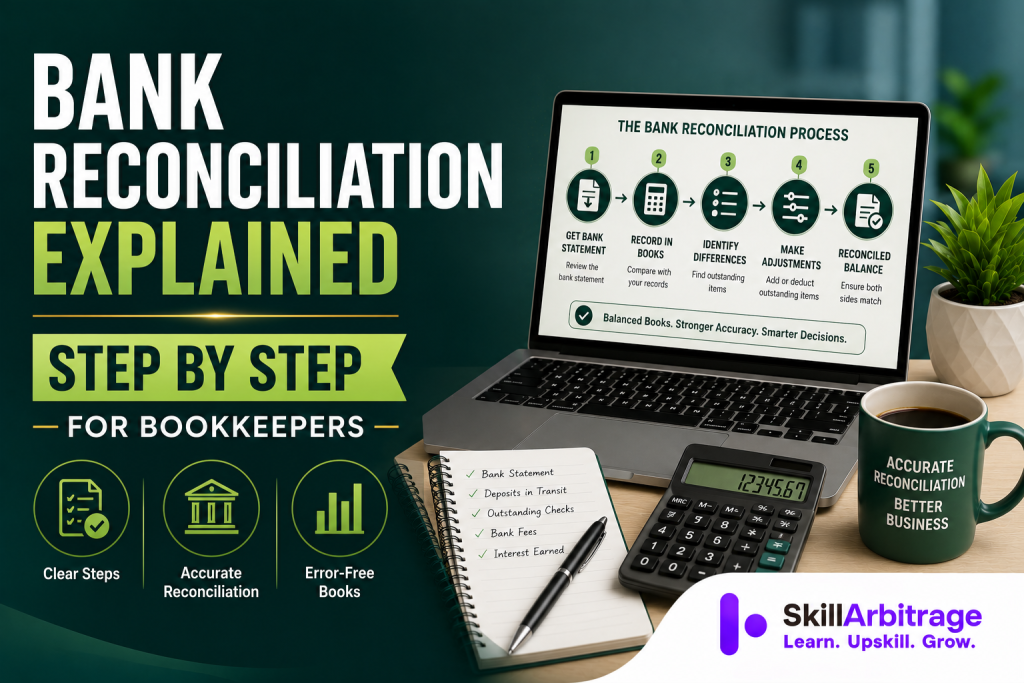
This article sets out how to do a bank reconciliation, step by step, in the order a bookkeeper actually works through it.
The short version: compare the bank statement to the cash account for the same period, and tick off every item that appears on both. Add deposits in transit to the bank balance and subtract outstanding checks. Adjust the book balance for fees, interest and returned items. The two adjusted balances must then match, and only the book-side items get a journal entry.
Everything below assumes you are the preparer working on a US client’s file, not the business owner. You are reconciling someone else’s bank account, in a country whose payment habits may not match your own.
The purpose of bank reconciliation
The purpose of a bank reconciliation is to explain every difference between the bank’s balance and the cash balance in the books, and to leave no amount unexplained. It is a proof, not a formatting exercise.
A completed reconciliation proves one thing: the cash figure on the balance sheet is supported by an external record. That is a narrow claim, and it is worth being precise about it.
It does not prove the coding is right. A payment posted to the wrong expense account still clears the bank. It does not prove the client sent you everything. It only proves that what you recorded agrees with what the bank recorded, once timing is stripped out.
Reconcile monthly at minimum, on the statement close date. Some clients reconcile weekly because their transaction volume is high. Quarterly is too slow, for reasons set out in the deadlines section below.
The case for doing it monthly is not theoretical. In Occupational Fraud 2026: A Report to the Nations, the Association of Certified Fraud Examiners studied 2,402 cases across 143 countries. Median loss per case was $104,000. The typical scheme ran for 12 months before anyone found it.
Tips accounted for 43% of detections. That leaves the majority to be caught by controls, or not caught at all. Reconciliation is one of the cheapest controls a small business has.
Matching a bank feed is not reconciling
Categorising downloaded bank feed lines is data entry. Reconciling is proving a balance against a statement for a fixed period. These are two different jobs, and the first one does not produce the second.
A client can have every feed line categorised and still hold a wrong cash balance. Duplicates get added alongside matched transactions. Someone deletes a transaction that was already reconciled. Items that never reached the feed never get recorded at all.

The feed is a convenience. The statement is the evidence. Reconcile to the statement.
This distinction matters more on accrual books than cash books, because there are more places for a difference to hide. If you are unsure which basis a client is on, check the balance sheet first: our guide to accrual and cash-basis accounting under US GAAP sets out the four accounts that give it away.
What you need before you start
Before you start a bank reconciliation you need four things in front of you: the statement, the prior reconciliation, the cash account register, and whatever paperwork the client has not sent you yet.
The bank statement for the exact period. A PDF from the bank, not a screenshot of a balance and not a CSV export. You need the closing balance, the closing date, and the individual lines.
The prior period’s closing reconciliation. This gives you the opening balance to tie to. Without it you are starting from an assumption.
The general ledger cash account for the same period. Filtered to that account only, with no date overlap into the next month.
The client’s unsent paperwork. Checks written but not yet cashed, deposits made in the last days of the month, card receipts sitting in someone’s drawer. This is usually the item that delays the work.
Get bank portal access or check images where you can. When a statement line reads only as a reference number, the image is the fastest way to identify it.
One rule on scope: reconcile each bank account and each credit card account separately. Never net two accounts together, even where the client treats them as one pot. A netted reconciliation hides the account that is wrong.
If you are setting up a new client from scratch rather than picking up an existing file, the sequence before this point matters too. Our guide to bookkeeping for US small businesses covers the chart of accounts and opening balance setup that this step depends on.
Bank reconciliation step by step
A bank reconciliation runs in seven steps. The order matters, because each step removes one class of difference before the next step starts. Working out of order means chasing an amount that another step would have explained for free.
Step 1: Confirm the opening balance
Tie the opening balance in the books to the closing balance on last month’s reconciliation. They must be identical.
If they are not, stop here. Nothing downstream will balance, and every minute spent on later steps is wasted.
A changed opening balance almost always means someone edited or deleted a transaction that was already reconciled. Find that first.
Step 2: Enter the statement closing balance and date
Take both figures straight from the statement. The closing balance is what the software checks your work against.
A wrong ending balance is the most common false alarm in reconciliation. The reconciliation is fine; the target number is wrong.
Watch the date. If the statement runs to 28 June and you enter 30 June, two days of transactions will look like errors.
Step 3: Tick off items that appear on both sides
Work statement-first. Read each line on the statement and find its match in the books, rather than the other way round.
Statement-first matters because it is the only direction that surfaces items the client never told you about. Working books-first, you would never look for them.
Match on amount and date together. An amount that matches on a different date is a different transaction until you prove otherwise.
Step 4: List the bank-side items
Bank-side items are transactions in the books that the bank has not processed yet. There are two kinds.
Deposits in transit. Money the client received and you recorded, which had not cleared by the statement date. These get added to the bank balance.
Outstanding checks. Checks written and recorded, which the payee has not yet presented. These get subtracted from the bank balance.
Both are pure timing. Neither gets a journal entry, because you cannot post an entry into someone else’s ledger. They will clear on a future statement.
Step 5: List the book-side items
Book-side items are transactions the bank has processed that are not in the books yet. The bank knew about them first.
Typical items: monthly service charges, wire fees, interest credited, customer checks returned for insufficient funds, ACH returns, and automatic debits the client set up and forgot to mention.
Book errors belong here too. A payment recorded at the wrong amount is a book-side correction, not a bank-side one.
Every item on this list gets a journal entry. That is the practical difference between the two lists.
Step 6: Compute both adjusted balances
Run each side to an adjusted figure.
Adjusted bank balance = statement closing balance, plus deposits in transit, less outstanding checks, plus or minus any bank errors.
Adjusted book balance = book cash balance, plus interest and other credits, less fees, returned items and debits, plus or minus any book errors.
The two adjusted figures must be equal. That equality is the reconciliation. A zero in a software difference field is a symptom of it, not the thing itself.
If they do not agree, go to the troubleshooting section below rather than adjusting a number to make them agree.
Step 7: Post the entries and lock the period
Post the book-side journal entries. Until you do, the balance sheet still carries the unadjusted figure.
Save the reconciliation report as a PDF and file it with the statement. Software reports can be regenerated, but they change if the underlying data changes, which is precisely what you are trying to detect.
Then close the period. In QuickBooks Online this is a closing date with a password. In Xero it is a lock date. Without it, a reconciled month can be edited silently, and you will find out next month when Step 1 fails.
A worked example
A worked example makes the two-sided arithmetic concrete. Take a single operating checking account for a small US design firm, for the month ended 30 June 2026.
Here is what you are given. The bank statement closes at $47,318.40. The general ledger cash account shows $50,531.10. The difference is $3,212.70, and at this stage you do not know how much of it is timing and how much is error.
Two deposits had not cleared: $6,450.00 received on 29 June and a card settlement batch of $1,289.65 dated 30 June. Three checks were outstanding: number 2041 for $3,200.00, number 2047 for $865.50, and number 2052 for $1,742.30.
The statement also showed four things the books did not: a $38.00 service charge, $12.15 of interest credited, a customer check for $1,150.00 returned unpaid, and a $15.00 fee for handling that return.
One more item. Check 2039 was written for $980.00 and recorded in the books as $890.00.
The bank side
| Bank side | Amount |
|---|---|
| Closing balance per statement, 30 June 2026 | $47,318.40 |
| Add: deposit in transit, 29 June | $6,450.00 |
| Add: card settlement in transit, 30 June | $1,289.65 |
| Less: check 2041 outstanding | ($3,200.00) |
| Less: check 2047 outstanding | ($865.50) |
| Less: check 2052 outstanding | ($1,742.30) |
| Adjusted bank balance | $49,250.25 |
The book side
| Book side | Amount |
|---|---|
| Cash balance per general ledger, 30 June 2026 | $50,531.10 |
| Add: interest credited | $12.15 |
| Less: bank service charge | ($38.00) |
| Less: customer check returned unpaid | ($1,150.00) |
| Less: returned item fee | ($15.00) |
| Less: correction to check 2039 | ($90.00) |
| Adjusted book balance | $49,250.25 |
Both sides land on $49,250.25. The reconciliation is complete.
Note what happened to the $3,212.70 we started with. It was not one problem. It was ten separate items pulling in different directions.
Seven of those ten were entirely normal: five timing items, the monthly service charge and the interest. Only three needed anyone’s attention, and two of those were the returned customer check and its fee.
The journal entries
Only the book side generates entries. Here they are in full.
Bank service charge
  Dr  Bank service charges              38.00
      Cr  Cash                                    38.00

Interest credited by the bank
  Dr  Cash                              12.15
      Cr  Interest income                          12.15

Customer check returned unpaid
  Dr  Accounts receivable            1,150.00
      Cr  Cash                                 1,150.00

Fee charged for the returned item
  Dr  Bank service charges              15.00
      Cr  Cash                                    15.00

Correction: check 2039 written for $980.00, recorded as $890.00
  Dr  Subcontractor costs               90.00
      Cr  Cash                                    90.00
A note on the returned check. Debiting accounts receivable puts the invoice back on the customer’s account, where it belongs. The customer has not paid. If the client recharges the $15.00 fee to that customer, debit accounts receivable for it too, rather than bank service charges.
A note on the correction. The books credited cash by $890.00 when the bank took $980.00, so cash was overstated by $90.00 and the expense was understated by the same amount. The entry fixes both in one line.
The rule underneath all of this is a single sentence. Bank-side items never generate a journal entry. Book-side items always do. If you want the double-entry reasoning behind these adjustments set out from first principles, iPleaders covers the principles of accounting that the entries above are built on.
| Reconciling item | Side | Effect on that balance | Journal entry? |
|---|---|---|---|
| Deposit in transit | Bank | Add to the statement balance | No |
| Outstanding check | Bank | Subtract from the statement balance | No |
| Bank recording error | Bank | Add or subtract, then notify the bank | No |
| Monthly service charge | Book | Subtract from the book balance | Yes |
| Interest credited | Book | Add to the book balance | Yes |
| Customer check returned unpaid | Book | Subtract, and reinstate the receivable | Yes |
| ACH return or automatic debit | Book | Subtract from the book balance | Yes |
| Book recording error | Book | Add or subtract, depending on direction | Yes |
When a bank reconciliation will not balance
When a bank reconciliation will not balance, work through the causes in a fixed order. Hunting for the amount by scanning the register is slower and it misses compound differences, where two errors partly cancel each other.
The order to check things in
Intuit publishes an elimination sequence for QuickBooks Online in its support documentation, last updated on 1 July 2026. It works as a general method regardless of which software you use.
- Review the opening and beginning balance. Confirm they agree with the prior reconciliation.
- Check the ending balance and ending date you entered against the statement.
- Combine transactions the bank combined. If the bank shows one deposit and the books show five checks, group them.
- Eliminate what you have already matched. This narrows the search.
- Enter transactions on the statement that are not in the books.
- Remove transactions in the books that are not on the statement, after checking whether they appeared on a past reconciliation.
- Review transactions that are close but not exact. Bank fees added to a payment are a common cause.
Only step 6 is genuinely destructive. Before deleting anything, check the register: if a transaction is marked R it was reconciled in a prior period, and deleting it will break last month too.
Once you have a difference figure, its shape often names the cause.
| Symptom | Likely cause | Fix |
|---|---|---|
| Difference equals one transaction exactly | A single item missing from one side | Search the register for that amount |
| Difference divides evenly by 9 | Two digits transposed | Compare the digits, as with $890.00 for $980.00 |
| Difference is exactly twice a transaction | Wrong sign, or a duplicate | Check whether a deposit was entered as a payment |
| Difference is a round number | A manual entry or an opening balance | Check the opening balance entry first |
| Beginning balance moved since last month | A reconciled transaction was edited or deleted | Run the prior reconciliation report and compare |
| Difference equals a group of small deposits | Undeposited funds not grouped | See below |
Undeposited funds and combined deposits
This is the most common single cause on QuickBooks Online files, and it comes from a mismatch in how the bank and the books see the same money.
The client takes four checks to the bank on Friday. The bank records one deposit of $4,800. The books record four receipts of $1,200 each.
Nothing is wrong, but nothing matches. The fix is to route the four receipts through Undeposited Funds and record one bank deposit that groups them. The single deposit then matches the single statement line.
The reverse error is worse. If a deposit is added straight to income while the invoices behind it still sit in Undeposited Funds, the same revenue is counted twice. The reconciliation can still tie.
Where to look in QuickBooks Online and Xero
In QuickBooks Online, the difference field in the Reconciliation window is the working number. The past reconciliation report shows what was ticked in prior months. The C and R markers in the account register tell you whether an item is cleared or reconciled, and there is an option to undo an entire reconciliation when a month is beyond repair.
In Xero, run the Bank Reconciliation Detail report. Xero describes its purpose plainly: “Compare your actual bank balance and the balance of the bank account in Xero.” Where the two do not agree, Xero’s own guidance is to “check for missing, deleted or duplicated transactions”, which is the same three-way search as the QuickBooks sequence above.
One caution on both platforms. Bank rules and cash coding make categorisation faster. They do not reconcile anything. A file where every line has been auto-coded by a rule can still be out.
Automated matching introduces its own failure mode, and it is a quiet one. A payment matched to the wrong open invoice clears the bank line and settles a record that was never paid. The reconciliation ties to the penny.
We cover how to review that work in how bookkeepers can use AI safely. If you are new to the platform itself, start with learning Xero.
| Symptom | Likely cause | Fix |
|---|---|---|
| Equals one transaction exactly | A single item missing from one side | Search the register for that amount |
| Divides evenly by 9 | Two digits transposed | Compare digits, as with $890.00 for $980.00 |
| Exactly twice a transaction | Wrong sign, or a duplicate | Check for a deposit entered as a payment |
| A round number | A manual entry or the opening balance | Check the opening balance entry first |
| Beginning balance moved | A reconciled transaction was edited or deleted | Run the prior reconciliation report and compare |
| Equals a group of small deposits | Undeposited funds not grouped | Group through Undeposited Funds, record one deposit |
Deadlines that depend on reconciliation
Several deadlines depend on reconciliation. A client keeps the right to dispute an item only for a limited period after the statement is made available, and reconciliation is how the item gets noticed inside that period.
This is the part of the job that is genuinely consequential, and it is missing from most reconciliation guides.
The one-year rule on unauthorised items
Article 4 of the Uniform Commercial Code has been adopted, with variations, by the states. Section 4-406 sets out the customer’s duty to examine statements.
Two duties sit in it. First, the customer “must exercise reasonable promptness in examining the statement or the items to determine whether any payment was not authorized”. Second, Section 4-406 provides that a customer who does not “within one year after the statement or items are made available to the customer discover and report the customer’s unauthorized signature on or any alteration on the item is precluded from asserting against the bank”.
One year is the outer limit, not the target. Failing the reasonable promptness duty can shift losses earlier than that. State enactments differ, so check the client’s state: the District of Columbia version is at D.C. Code 28:4-406.
Checks older than six months
UCC Section 4-404 states it in one sentence: “A bank is under no obligation to a customer having a checking account to pay a check, other than a certified check, which is presented more than six months after its date, but it may charge its customer’s account for a payment made thereafter in good faith.”
Two things follow. The bank may pay a stale check, and it may refuse. Certified checks are carved out and do not go stale under this section.
For a bookkeeper, this is a practical trigger rather than a legal one. A check outstanding past six months may or may not clear, so it should not sit quietly on the reconciliation.
Age the outstanding list every month. Anything past six months gets raised with the client, not carried forward again.
ACH disputes and the clock on them
ACH runs on its own clocks, and they are not the same as the check rules above. Two things matter to a bookkeeper: how fast an entry settles, and how long anyone has to dispute it.
On settlement, Nacha estimates that 80% of all ACH payments settle in one banking day or less. An ACH credit “can settle the same day, the next banking day, or in two banking days”. An ACH debit cannot have a settlement date more than one banking day into the future.
On disputes, Nacha’s limitation on warranty claims caps how long the receiving bank can claim against the originating bank’s authorisation warranty. The limits differ by account type, and a business checking account is a non-consumer account.
For an entry to a non-consumer account, the limit is one year from the settlement date of the entry. Nacha describes this as “analogous to one-year rule in UCC 4-406 that applies to checks and items charged to bank accounts”.
For an entry to a consumer account, the first 95 calendar days from the settlement date of the first unauthorised entry are always covered. Outside that window, the limit is two years from the settlement date.
Note what the non-consumer limit is measured from. It runs from each entry’s own settlement date, not from the day the client got round to looking at the statement.
One change is worth diarising. From 18 September 2026, Nacha’s funds availability rule for non-same-day credit entries removes the 5:00 pm local time receipt condition.
The receiving bank must then make the funds available “no later than 9:00 a.m. (RDFI’s local time) on the Settlement Date”. Some deposits that used to sit in transit overnight will stop doing so.
The practical consequence is simple. Every one of these clocks starts when the item settles, and none of them waits for the client. A business reconciling quarterly can be three months into a one-year limit before anyone has looked at the entry.
Reconciliation is not itself legally mandatory for a US small business. It is a control. What the deadlines above create is a commercial reason to run that control on time.
Controls, review and records
Controls around reconciliation decide whether it catches anything. A reconciliation prepared and reviewed by the same person catches honest mistakes and very little else.
Who prepares and who reviews
The principle is segregation of duties. The GAO Green Book, the federal standard for internal control, puts it at paragraph 10.22: management “considers the need to separate control activities related to authority, custody, and accounting of operations to achieve adequate segregation of duties”.
Applied to a bank account, those three are the person who approves a payment, the person who holds the checkbook or the banking login, and the person who records and reconciles. Ideally they are three people. At an absolute minimum, the last one is not also one of the first two.
Most small clients cannot split those duties, because the owner is often two of the three roles at once. The Green Book anticipates exactly this at paragraph 10.23: if segregation “is not practical within a business process because of limited personnel or other factors, management designs alternative control activities to mitigate the risk”.
The workable version for a small business is short. The owner opens the bank statement themselves, before it reaches the bookkeeper. The owner reviews the completed reconciliation and the outstanding items list, not just the final number.
This is where reconciliation becomes a fraud control rather than an accounting chore. Reviewing the underlying detail is what surfaces payments to an unfamiliar payee, and LawSikho’s guide to dealing with corporate frauds, from accounting frauds onward sets out how those patterns tend to look once someone starts looking.
What to attach to each reconciliation
Keep a monthly pack. It is the difference between a defensible file and a claim you cannot support.
- The bank statement PDF
- The reconciliation report as saved at the time
- The outstanding items list, with the age of each item
- The journal entries posted, with their references
- The preparer’s name, the reviewer’s name, and both dates
As an offshore preparer you are usually not the reviewer. Name the reviewer explicitly on the workpaper rather than leaving the field blank. An unnamed reviewer reads as no reviewer.
Firms working on US tax data will already be under contractual security terms that reach the workpapers themselves, which is a separate matter from who signed them off.
How long to keep it
IRS Publication 583 lists deposit slips and cancelled checks among the supporting documents a business should keep, because they support the entries in the books and on the return.
On retention, the governing principle is that records must be kept as long as they may be needed for the administration of any provision of the Internal Revenue Code. The IRS period of limitations table turns that into dates.
Three years is the general rule. It stretches to 6 years where income is understated by more than 25% of the gross income shown on the return, and 7 years for a claim relating to a bad debt deduction or a worthless security. There is no limit at all where no return was filed or a fraudulent return was filed. Employment tax records must be kept for at least 4 years after the tax becomes due or is paid, whichever is later.
Seven years is the common firm policy because it covers the longest ordinary period. Confirm the client’s own policy rather than assuming, and confirm where those files are allowed to be stored.
Bank reconciliation in India and the US
Bank reconciliation works the same way in India and the US. Four practical differences change what actually lands on the reconciliation, and each one catches Indian-trained accountants on their first US file.
Paper checks are still live in the US. Indian practice moved to NEFT, RTGS, IMPS and UPI, so an Indian accountant rarely sees a long outstanding-cheque list. US small businesses are different. In the Federal Reserve’s 2024 Business Payments Study, a survey of 2,000 US businesses, 73% reported using checks in the previous 12 months, and small firms reported the highest use of any size band at 83%.
National check volume keeps falling. Business use of checks has not fallen with it, and outstanding checks remain a routine category on a US small business reconciliation. Do not expect the list to be short.
Stale-dating rules differ by half. In the US, UCC 4-404 puts the mark at six months. In India, RBI circular DBOD.AML BC.No.47/14.01.001/2011-12 of 4 November 2011 directed that from 1 April 2012 banks “should not make payment of cheques/drafts/pay orders/banker’s cheques” presented beyond three months from the date of the instrument. The month in which you start chasing an uncleared item therefore differs by country.
Settlement timing creates deposits in transit differently. UPI and IMPS settle in seconds, so the Indian habit is to expect the bank and the books to agree almost immediately. ACH does not work that way. Nacha estimates 80% of ACH payments settle in one banking day or less, which means a fifth do not, and a credit can settle the same day, the next banking day, or in two banking days. Check deposits take longer still, so deposits in transit are a normal recurring category on a US file.
The artefact has a different name. Indian training calls the output a bank reconciliation statement, usually taught as a two-column exam format. US software calls it a reconciliation report and generates it for you. The arithmetic is identical. What the client expects to receive is not.
The habit worth unlearning is the instinct that an uncleared item means an error. On US books, timing differences are expected. Only their age tells you anything.
This gap between Indian and US practice is one of the first things a US firm tests in a working trial. Our guide to starting a US bookkeeping career from India covers the rest of that ground, and reconciliation work is priced separately by most firms, which we cover in how to charge US clients as a remote bookkeeper.
Common bank reconciliation mistakes
The common bank reconciliation mistakes are not arithmetic errors. They are shortcuts that make the reconciliation tie while leaving the books wrong, which is worse than an obvious failure because nobody goes looking.
1. Forcing the difference to zero with a plug entry. An unexplained $340 written off to miscellaneous expense. The reconciliation ties and the cause is never found. Park it in a suspense account with a dated note instead, and clear it next month.
2. Reconciling to the online balance instead of the statement. The bank portal shows today’s balance, including items that settled after the period closed. Use the statement closing balance and closing date, nothing else.
3. Editing a transaction that is already reconciled. This silently changes next month’s beginning balance, and the error surfaces a month late in a different place. Set a closing date with a password once a month is signed off.
4. Treating a cleared bank line as proof the coding is right. A payment matched against the wrong open invoice still clears. The reconciliation ties to the penny while the subledger shows an invoice as paid that was never paid. Agree the receivables and payables ageings to their control accounts as a separate step.
5. Deleting a duplicate without checking which copy is reconciled. Delete the reconciled copy and you break the prior period. Check the R marker in the register first.
6. Netting accounts. Reconciling a checking account together with its linked savings account or card. One reconciliation per account, always, even where the client treats them as one pot.
7. Carrying an outstanding check forward for years. An uncleared check is not a permanent balance sheet item. Age the list, chase anything past six months, and raise unclaimed property obligations with the client’s US advisor, since those rules are set by state.
Frequently asked questions
How often should a bookkeeper reconcile a bank account? Monthly at minimum, on the statement closing date. High-volume clients benefit from weekly, which turns month-end into a review rather than a search. Quarterly is risky, because the limits on disputing an unauthorised item run from the date it settled, not from the date anyone looked at it.
What is the difference between a deposit in transit and an outstanding check? Both are timing differences on the bank side, running in opposite directions. A deposit in transit is money you recorded that the bank has not credited yet, so it is added to the bank balance. An outstanding check is a payment you recorded that the payee has not presented yet, so it is subtracted.
Which bank reconciliation items need a journal entry? Only book-side items. Bank fees, interest credited, returned checks, ACH returns and corrections of recording errors all need entries. Deposits in transit and outstanding checks never do, because they are already in the books and simply have not reached the bank.
Why does my beginning balance not match in QuickBooks Online? Almost always because a transaction that was previously reconciled has been edited or deleted. Run the prior reconciliation report and compare it to the register, looking for items where the R marker has been removed. On a first-time reconciliation, the cause is usually a wrong opening balance in the chart of accounts instead.
Does reconciling the bank feed count as a bank reconciliation? No. Categorising feed lines is data entry. Reconciliation proves the resulting balance against a statement for a fixed period. A fully categorised feed can still carry duplicates, deletions, and items that never reached the feed.
How long should a client keep bank statements and cancelled checks? Records must be kept as long as they may be needed for the administration of the Internal Revenue Code. The IRS period of limitations makes 3 years the general rule, 6 years where income is understated by more than 25%, and 7 years for a bad debt or worthless security claim. Employment tax records run to at least 4 years after the tax is due or paid. Seven years is the common firm policy because it covers the longest ordinary period.
How long can a client dispute an unauthorised item on a bank statement? Under UCC 4-406 as adopted by the states, a customer who does not discover and report an unauthorised signature or alteration within one year of the statement being made available is precluded from asserting it against the bank. That one year is an outer limit. A separate duty of reasonable promptness can shift losses well before it expires.
What do I do with a check that has been outstanding for over a year? Do not keep carrying it forward. Confirm with the payee whether it was ever received, void and reissue if the liability is still owed, and raise unclaimed property with the client’s US advisor if the payee cannot be found. Escheatment rules are set by state, not federally.
Should the same person prepare and review the reconciliation? No. The GAO Green Book asks management to separate authority, custody and accounting, so the person who approves payments or holds the banking login should not be the person who reconciles the account. Where a client is too small to split duties, the Green Book calls for alternative control activities instead. In practice that means the owner opens the statement and reviews the reconciliation with its supporting detail.
Is a bank reconciliation statement the same thing as a US reconciliation report? The arithmetic is the same. A bank reconciliation statement is the Indian term, usually presented as a two-column statement. US accounting software produces a reconciliation report automatically at the end of the process. Deliver whichever format the client asks for.
References
- UCC Section 4-406, Customer’s duty to discover and report unauthorized signature or alteration, Legal Information Institute, Cornell Law School
- D.C. Code Section 28:4-406 (an example state enactment)
- UCC Section 4-404, Bank not obliged to pay check more than six months old, Legal Information Institute, Cornell Law School
- Nacha, Funds availability requirements for non-same day credit entries (Subsection 3.3.1.1, effective 18 September 2026)
- Nacha, How ACH payments work (settlement timing)
- Nacha, Limitation on warranty claims (one year for non-consumer accounts; 95 days then two years for consumer accounts)
- IRS Publication 583, Starting a Business and Keeping Records
- IRS, How long should I keep records? (period of limitations table)
- Federal Reserve Payments Insights Brief, 2024 Business Payments Study (survey of 2,000 US businesses; check usage by business size at Appendix 2)
- GAO, Standards for Internal Control in the Federal Government, Green Book (GAO-25-107721), Principle 10 (segregation of duties at paragraphs 10.21 to 10.23)
- ACFE, Occupational Fraud 2026: A Report to the Nations, key findings
- Intuit, Fix issues at the end of a reconciliation in QuickBooks Online (updated 1 July 2026)
- Intuit, Fix issues the first time you reconcile an account in QuickBooks Online
- Xero Central, Bank Reconciliation Detail report
- Reserve Bank of India, Payment of Cheques/Drafts/Pay Orders/Banker’s Cheques, DBOD.AML BC.No.47/14.01.001/2011-12, 4 November 2011 (three month validity, effective 1 April 2012)
This article is for informational and educational purposes only. It does not constitute professional, financial, legal, or tax advice. Banking rules, state enactments of the Uniform Commercial Code, and software procedures change. Consult a qualified US accounting professional before acting on any reconciliation or record retention decision.




 Allow notifications