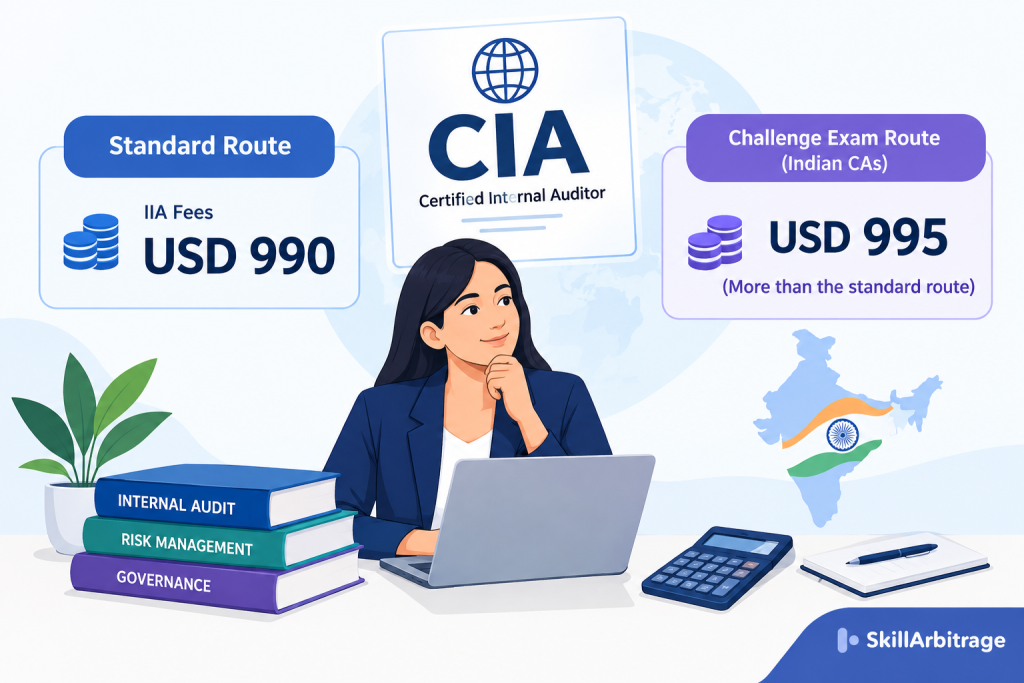

The Certified Internal Auditor costs USD 990 in fees on the standard route at Institute of Internal Auditors member rates, and USD 1,515 for a non-member, before a single hour of coaching or a single trip to a test centre. That figure covers one application and three exams, and it is the number that settles the question for most candidates in India well before the syllabus does.
The CIA is the internal audit profession’s global credential, awarded by the Institute of Internal Auditors and held by more than 200,000 professionals worldwide. Three computer-based exams, an education requirement, and a work-experience requirement stand between a candidate and the designation. There is also a clock on one of the routes: the IIA’s experience-based Challenge Exam pilot accepts applications only until 30 September 2026.
What the fee schedule does not tell an Indian candidate is where the credential actually pays. Section 138 of the Companies Act, 2013 governs who must appoint an internal auditor in India and who is qualified to be appointed, and the CIA is not named in it. The Indian statutory market routes through chartered accountants and cost accountants. The CIA’s value from India sits somewhere else: in the global capability centres and cross-border mandates where the employer is a US or European parent and the standard being applied is the IIA’s, not the Companies Act’s.
That distinction decides whether USD 990 is a sound purchase or a misdirected one, and it turns on the numbers rather than on the prospectus.
What the Certified Internal Auditor costs and requires from India
The three exam parts and what each one tests
The CIA is three separate exams, sat in any order, each passed independently. The IIA rebuilt the syllabus to align with its Global Internal Audit Standards, which were released on 9 January 2024 and took effect on 9 January 2025, and the updated exams followed in May 2025. The part names changed with that revision, so material published before 2025 describes a syllabus that is no longer being tested.
Part 1, Internal Audit Fundamentals, runs 125 questions in 150 minutes, the longest of the three. Its weightings are Foundations of Internal Auditing at 35%, Governance, Risk Management, and Control at 30%, Ethics and Professionalism at 20%, and Fraud Risks at 15%. Two-thirds of the paper sits on foundations and governance, and only 15% on fraud, which is the reverse of the balance most candidates assume before they read the specification.
Part 2, Internal Audit Engagement, runs 100 questions in 120 minutes and is the most lopsided of the three. Engagement Planning alone carries 50%, Information Gathering, Analysis, and Evaluation carries 40%, and Engagement Supervision and Communication carries the remaining 10%. Nine-tenths of the paper is planning and fieldwork.
Part 3, Internal Audit Function, also runs 100 questions in 120 minutes, and its weightings sit where candidates least expect. Engagement Results and Monitoring takes 45%, Internal Audit Operations 25%, and Internal Audit Plan and Quality of the Internal Audit Function take 15% each. This is the part that tests running a function rather than running an engagement, which puts it furthest from the daily work of a candidate whose experience sits entirely at the fieldwork level.
Those weightings are published in the IIA’s Expanded Test Specifications for each part and are worth reading before buying any coaching, because they show exactly where the marks are. A study plan that gives equal time to four Part 3 domains is spending a quarter of its effort on 15% of the paper.
The specifications also show how far the syllabus has moved from financial audit. Part 1 asks candidates to distinguish assurance services from advisory services, identify the components a Global Internal Audit Standards-compliant internal audit charter must contain, and recognise the situations in which the independence of the function is impaired, including where the chief audit executive’s functional reporting line is wrong or budget limits restrict the work. The assurance services it names run to third-party and contract compliance audits, IT security and privacy audits, performance and quality audits, and audits of organisational culture and of the management reporting process. A candidate who reads “audit” and prepares for vouching and ledger testing is preparing for the wrong paper.
Eligibility, experience, and the Internal Audit Practitioner entry route
Eligibility runs on two axes at once: what a candidate has studied, and how long they have worked in internal audit. The IIA sets the experience requirement against the education level, so a higher qualification shortens the experience needed rather than replacing it.
A master’s degree requires one year of internal audit experience. A bachelor’s degree requires two years. An active Internal Audit Practitioner, the IIA’s entry-level designation, requires five years, of which two must fall within the past three. Qualified accountants applying on the strength of a professional licence need an active licence in good standing and a letter to that effect from their body.
The experience has to be internal audit experience or its equivalent, which is the requirement that catches Indian applicants most often. A commerce graduate two years into statutory audit at a firm is not automatically two years into internal audit, and the application asks for the distinction to be evidenced. Proof of education is required in every category.
There is also a deadline on the whole programme. Candidates have three years from the date of acceptance into the CIA programme to complete the eligibility requirements, and the IIA sells a single 12-month extension at USD 275 for members and non-members alike, available once per certification programme. A candidate who clears two parts and then stalls for a promotion cycle can lose the first two.
For anyone short of the experience, there is a designation that sits below the CIA and doubles as an entry route. The Internal Audit Practitioner requires no bachelor’s degree, no prior experience and no education prerequisite at all. Government-issued photo identification and an application through the IIA’s Certification Candidate Management System are the whole barrier to entry, and the IIA aims it at university students, beginner internal auditors and professionals without a degree.

The reason it matters to a CIA candidate is that the IAP exam is the CIA Part 1 exam. Same 125 questions, same 150 minutes, same syllabus. Candidates have two years from approval to sit it, and an active IAP waives Part 1 when they move on to the CIA. The fees are identical to the CIA’s Part 1 line, at USD 120 to apply and USD 310 for the exam at member rates, but the IAP carries student pricing that the CIA does not: USD 45 to apply and USD 165 for the exam.
That sequencing is worth noting for a commerce graduate in India who has the degree but not the two years. Sitting Part 1 as an IAP gives a usable designation immediately, keeps the CIA clock unstarted while the experience accrues, and at student rates costs USD 210 rather than USD 430. The cost of holding it is 20 CPE hours a year from 2026 onwards, and the waiver covers Part 1 only. The experience requirement still has to be met in full.
The Challenge Exam route for Indian chartered accountants and cost accountants
The IIA runs a Challenge Exam that compresses all three parts into one paper of 150 questions in 180 minutes, and two Indian bodies are on its approved list. Members of the Institute of Chartered Accountants of India and the Institute of Cost Accountants of India both qualify. The Institute of Company Secretaries of India is not on the list. Students are ineligible in every case, and applicants need a letter of good standing from their own body plus government-issued photo identification.
That single paper replaces 325 questions and six and a half hours of examination with 150 questions and three hours, sat once rather than across three separate registrations inside a three-year window. It is the same time arbitrage that makes a US credential such as the CPA worth considering alongside an Indian qualification rather than instead of it.
Two changes landed in 2026 and both matter to the timing of an application. From 1 June 2026, the Challenge Exam became a unified paper, meaning every candidate sits the same exam regardless of which eligibility pathway admitted them. Separately, the IIA opened a pilot pathway for professionals with ten or more years of experience in internal audit, quality assurance, risk management, audit and assessment disciplines, compliance, external audit, or internal control. That pathway admits experienced practitioners who hold none of the qualifying accounting credentials, and it is the narrower window: applications run from 1 April to 30 September 2026 only, with testing in June, September or November 2026, and no exam extensions permitted.
Applications for the standard Challenge Exam are accepted year-round, with testing windows in February, June, September and November.
What the whole thing costs in dollars
The IIA prices the application and each exam part separately, and membership status changes every line. On the standard route, a member pays USD 120 to apply, then USD 310 for Part 1 and USD 280 each for Parts 2 and 3. That totals USD 990. A non-member pays USD 240 to apply, then USD 445, USD 415 and USD 415, totalling USD 1,515.
The Challenge Exam is priced as a bundle: USD 150 to apply and USD 845 for the exam for members, USD 380 and USD 1,245 for non-members. The totals are USD 995 and USD 1,625.
Set those four numbers side by side and the finding is not the one most candidates expect. At member rates the Challenge Exam costs USD 995 against the standard route’s USD 990, a difference of five dollars. At non-member rates it is USD 110 more expensive. The Challenge Exam buys time, not money, and a CA choosing it because it sounds like the economical route has misread the schedule.
What does change the arithmetic is membership itself. The IIA prices members roughly a third below non-members across the standard route, and on the Challenge Exam the gap is USD 230 on the application and USD 400 on the exam. IIA India charges INR 4,500 for one year of individual membership, with longer terms at INR 8,800 for two years and INR 12,900 for three, plus a one-time entrance fee of INR 2,000. Against a USD 630 saving on the Challenge route, the membership pays for itself several times over on the first exam, which makes joining before applying the single largest cost decision in the process.
One caveat applies to every figure here. The IIA states that pricing may differ in countries where exams are administered through agreements with National Institutes, so the global schedule above is the reference point rather than a guaranteed invoice. Confirm the applicable rate with IIA India before budgeting.
At IIA member rates the Challenge Exam costs $5 more than sitting all three parts, and at non-member rates it costs $110 more. It replaces 325 questions and six and a half hours of examination with 150 questions and three hours, so it buys time, not money. Membership is the line that actually moves the total: it saves $525 on the standard route and $630 on the Challenge route.
What holding the credential costs every year after
Passing is not the end of the spending. Practising certified holders must complete 40 hours of continuing professional education every year. The renewal period runs from 1 January to 31 December, and the CPE has to be both earned and attested to by 31 December. Non-practising and retired holders sit under reduced requirements set out in the IIA’s certification renewal policy.
Renewal fees are not published as a single global figure. The IIA states that they vary by country and by membership status, which again points back to IIA India for the applicable rate. The 40-hour obligation is the fixed cost, and it is a real one for anyone whose employer does not fund training: forty hours is a working week a year, every year, for as long as the designation is held.
What the Certified Internal Auditor is actually worth from India
Start with the limit, because it is the part most prospectuses leave out. Section 138 of the Companies Act, 2013 provides that the internal auditor of a company “shall either be a chartered accountant or a cost accountant, or such other professional as may be decided by the Board”. The CIA is not named. It can qualify a person under the residual clause if a particular board decides so, but it confers no statutory standing of its own, and the Act’s default reading routes appointments through the two Indian institutes.
Rule 13 of the Companies (Accounts) Rules, 2014 sets who must make that appointment: every listed company, every unlisted public company crossing INR 50 crore in paid-up share capital, INR 200 crore in turnover, INR 100 crore in outstanding bank borrowings or INR 25 crore in outstanding deposits, and every private company crossing INR 200 crore in turnover or INR 100 crore in borrowings. That is a large, mandatory, recurring market, and a CIA is not the credential that opens it.
One Indian regulator has moved closer to the IIA’s methodology, even if it has not moved closer to its credential. The Reserve Bank of India’s circular on Risk-Based Internal Audit, RBI/2020-21/88 dated 3 February 2021, required all deposit-taking non-banking financial companies, non-deposit-taking NBFCs and core investment companies with assets of INR 5,000 crore or more, and primary urban co-operative banks with assets of INR 500 crore or more, to adopt a risk-based internal audit framework by 31 March 2022. The RBI describes RBIA as a methodology that links an organisation’s overall risk to its evaluation of internal controls and governance.
That is the CIA syllabus’s own framing, and it is the reverse of a compliance-checklist audit. The RBI went further than a stated principle, requiring the institutions it covers to set up committees to handle the transitional and change-management work and to report progress to their boards and senior management.
The circular does not name the CIA or any other credential, so it creates no entitlement. What it creates is a large Indian population of NBFCs and co-operative banks now running audit functions on a risk-based model that a CIA holder has been examined on and a purely statutory-audit background has not. The credential is not required there. The vocabulary is.
The market the CIA does open outright is the one that has been growing fastest. The Zinnov and Nasscom India GCC Landscape 2026 report counts 2,117 global capability centres in India operating across 3,728 units, employing 2.36 million professionals and generating USD 98.4 billion in export value in FY2026, with more than 506 Forbes Global 2000 companies running a centre here. Global risk and compliance work is among the functions migrating into those centres, alongside the third-party risk management work that sits next to internal audit on most org charts. In a GCC, the parent’s audit committee sets the standard, and the standard is the IIA’s.
The pay gap is what drives that migration, and it cuts both ways. Payscale’s India research puts the average internal auditor salary at INR 8,15,673 a year, on a tenth-to-ninetieth-percentile range of INR 2,40,000 to INR 20,00,000, drawn from 179 profiles and last updated in June 2026. Entry-level auditors with under a year of experience average INR 4,39,229, rising to INR 6,16,685 across one to four years. Payscale’s US research for the same role reports an average of USD 69,895 on a range of USD 52,000 to USD 95,000, from 1,002 profiles updated in July 2026, with entry level at USD 57,358.
Read those two datasets together and the position is clear enough. The gap is why the work moves to India, and it is also the ceiling on what an India-based auditor is paid for doing it. A credential does not close a gap that size. What it does is qualify a candidate for the shortlist where the gap is smallest, which is the senior end of GCC and cross-border work rather than the entry end.
Recognition supports that. More than 200,000 CIA certifications have been awarded worldwide, and the IIA reports more than 265,000 members across 170 countries. IIA India operates six chapters, in Delhi, Bombay, Calcutta, Bangalore, Madras and Hyderabad, plus eleven audit clubs attached to the geographically closest chapter. The infrastructure to sit the exam, meet practitioners and log CPE hours exists in every major Indian metro.
So the trade-off is a narrow one, and it is not the trade-off the marketing implies. Between USD 990 and USD 1,625 in fees, plus IIA India membership, plus 40 CPE hours every year afterwards, buys a credential that is read fluently by the multinational employers hiring into India for global mandates and carries no weight in the statute that governs Indian internal audit appointments.
For a professional whose next five years run through a GCC, a Big Four risk practice or a cross-border mandate, the fee is small against the shortlists it opens. For one whose work is Section 138 appointments at Indian companies, the same fee buys recognition the statute does not ask for. The credential is identical in both cases. The market the candidate is standing in is what differs, and that is the question worth settling before the application fee is paid.
FAQs
Can an Indian chartered accountant skip the three CIA exam parts?
Members of the Institute of Chartered Accountants of India and the Institute of Cost Accountants of India are both on the IIA’s approved qualified accounting bodies list, which admits them to the Challenge Exam: one paper of 150 questions in 180 minutes in place of all three parts. Applicants must hold an active membership, supply a letter of good standing from their institute and provide government-issued photo identification. Students of either body are ineligible. Members of the Institute of Company Secretaries of India are not on the approved list.
Is the CIA recognised for a statutory internal audit appointment in India?
Section 138 of the Companies Act, 2013 requires the internal auditor to be a chartered accountant or a cost accountant, or such other professional as may be decided by the Board. The CIA is not named in the provision, so it carries no automatic statutory standing, though a board may accept it under the residual clause. For appointments under Rule 13 of the Companies (Accounts) Rules, 2014, the Indian institutes remain the default route.
How long does the CIA take from acceptance into the programme?
Three years is the outer limit the IIA sets: candidates have that long from the date of acceptance to complete the eligibility requirements. A single 12-month extension is available at USD 275, once per certification programme. The experience requirement runs alongside that window rather than inside it, at one year for a master’s degree holder, two years for a bachelor’s degree holder and five years for an Internal Audit Practitioner.
Does the CIA need to be renewed, and what happens if the CPE is missed?
Practising certified holders must complete 40 hours of continuing professional education a year and attest to them by 31 December, within a renewal period running from 1 January. Reduced requirements apply to non-practising and retired holders under the IIA’s certification renewal policy, and renewal fees vary by country and membership status rather than being set as a single global figure. Holders who complete all three exam parts are not required to retest when the syllabus changes, as was the case with the 2025 alignment to the Global Internal Audit Standards.
References
- Certified Internal Auditor overview, The Institute of Internal Auditors
- Certification eligibility and pricing, The Institute of Internal Auditors
- CIA Challenge Exam for CPAs and CAs, The Institute of Internal Auditors
- Qualified accounting bodies CIA Challenge Exam, India, The Institute of Internal Auditors
- CIA Challenge Exam for experienced auditors, The Institute of Internal Auditors
- The IIA enhances CIA Challenge Exam program, expanding access through new pathway pilot, The Institute of Internal Auditors, April 2026
- CIA examination expanded test specifications, Part 1 to Part 3, The Institute of Internal Auditors, 2024
- Global Internal Audit Standards, The Institute of Internal Auditors, effective 9 January 2025
- CPE requirements, The Institute of Internal Auditors
- Internal Audit Practitioner designation, The Institute of Internal Auditors
- Individual membership fees, The Institute of Internal Auditors India
- Section 138, Companies Act, 2013 and Rule 13, Companies (Accounts) Rules, 2014, Ministry of Corporate Affairs, Government of India
- Risk-Based Internal Audit, RBI/2020-21/88, Reserve Bank of India, 3 February 2021
- India GCC Landscape Report 2026, Zinnov and Nasscom, 2026
- Internal Auditor salary, India, Payscale, June 2026
- Internal Auditor salary, United States, Payscale, July 2026
Disclaimer
This article is for informational and educational purposes only and does not constitute professional, financial, legal, or career advice. Certification fees, eligibility rules, exam windows and continuing education requirements are set by the Institute of Internal Auditors and can change, and pricing may differ where exams are administered through National Institute agreements. Verify current terms with the IIA and IIA India before acting on them.





 Allow notifications