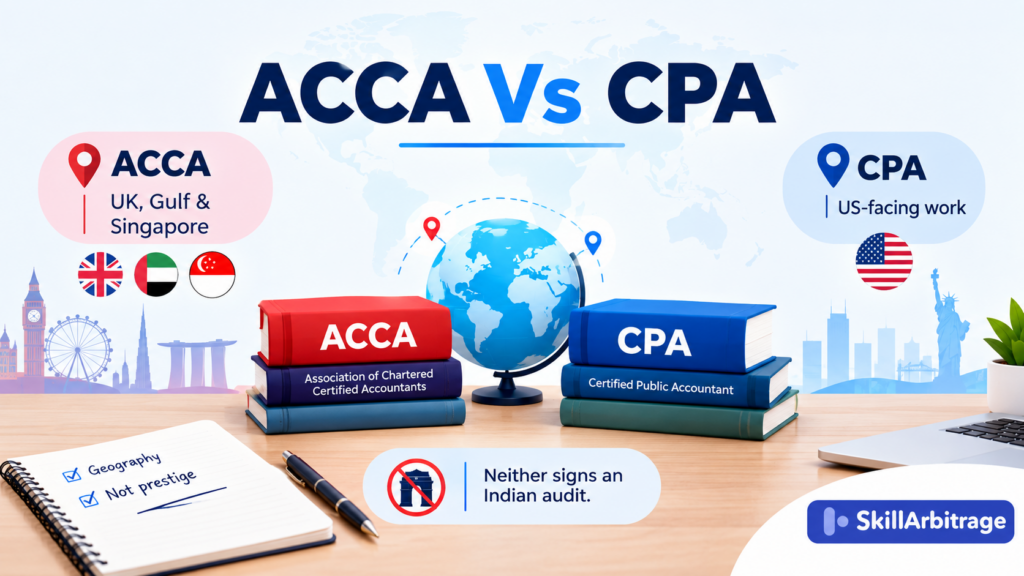

ACCA vs CPA is settled by geography rather than prestige: the US CPA is the stronger credential if your work will touch US GAAP, US federal tax or SEC reporting, and ACCA is stronger if it will touch IFRS in the UK, the European Union, the Gulf or Singapore. Neither one lets you sign a statutory audit report in India, where that right belongs only to a chartered accountant holding an Institute of Chartered Accountants of India certificate of practice. On a clean first-attempt run the two cost within about ₹26,000 of each other. What separates them in practice is the entry gate, because a three-year B.Com can start ACCA immediately and usually cannot sit the CPA at all.
That cost finding is worth stating plainly, because almost every comparison published against this search treats the CPA as the expensive option and ACCA as the affordable one. Run the two fee schedules properly and they converge. ACCA’s published India rates come to roughly £2,560 for a B.Com entrant with four exemptions who passes everything first time, and the CPA route from India comes to roughly $3,113 in board and administration fees. At ₹127 to the pound and ₹96 to the dollar on 30 September 2026, that’s about ₹3.25 lakh against ₹2.99 lakh.
The gap that does matter opened up in 2025. The American Institute of Certified Public Accountants and the National Association of State Boards of Accountancy approved an additional route to CPA licensure in May 2025, published in the ninth edition of the Uniform Accountancy Act that July: a bachelor’s degree with an accounting concentration, two years of experience and the Uniform CPA Exam. It’s model legislation, so each state adopts it on its own timetable, and it does not change how an Indian transcript gets evaluated.
ACCA vs CPA on entry, exams and cost
ACCA and the US CPA sit at opposite ends of the accessibility scale: ACCA will take a school leaver, and the CPA turns away most Indian graduates until they add university credits. That difference decides more of these comparisons than syllabus, salary or brand ever does, and every figure below assumes a first attempt that both bodies’ pass rates make optimistic.
Who can start each one
ACCA has no degree requirement. A candidate who meets the minimum entrance requirements registers straight into the ACCA Qualification, and one who doesn’t starts at Foundations level, exiting with the ACCA Diploma in Accounting and Business at RQF Level 4 before joining the main route. Nothing on an Indian transcript blocks entry.
Exemptions then decide how much of it you actually sit. ACCA assesses them against the university’s syllabus rather than the degree title, so two B.Com holders from different universities can be awarded different papers. A B.Com commonly clears the three Applied Knowledge exams and sometimes Taxation, while a fully qualified Indian chartered accountant can be awarded up to nine, covering all of Applied Knowledge and Applied Skills and leaving only the four Strategic Professional exams. They aren’t free either, at £86 per Applied Knowledge paper and £114 per Applied Skills paper.
The CPA runs the opposite way. Before an application reaches a state board, the candidate’s academic record has to convert into US semester credit hours, and the board sets the threshold: broadly 120 credits to sit and 150 to be licensed. The US Bureau of Labor Statistics states that all states require 150 semester hours for licensure, “which is 30 hours more than the usual 4-year bachelor’s degree”. NASBA International Evaluation Services performs that conversion for foreign transcripts.
Here’s where most Indian candidates stop. A three-year B.Com typically evaluates at around 90 US semester credits, leaving the holder roughly 30 short of sitting the exam in most jurisdictions and about 60 short of licensure, so an M.Com, an MBA or professional-body membership becomes the usual bridge rather than an optional upgrade. That bridge carries its own fees and its own year or two, and it belongs inside the comparison rather than in a footnote. The May 2025 pathway softens the requirement without removing the evaluation, since two years of experience substitutes for the extra 30 credits but the transcript still has to clear whichever floor the state applies.
The exams and how long they take
Thirteen exams against four is the headline. ACCA runs three Applied Knowledge exams, six Applied Skills exams and four Strategic Professional exams, two compulsory and two chosen from four options, plus a separate Ethics and Professional Skills Module. The CPA runs three core sections (Auditing and Attestation, Financial Accounting and Reporting, Regulation) and one discipline chosen from Business Analysis and Reporting, Information Systems and Controls, or Tax Compliance and Planning. Each CPA section runs four hours and needs a scaled 75 to pass.
The calendars differ more than the counts do. ACCA sits four sessions a year, in March, June, September and December, with Applied Knowledge on demand and a ceiling of four exams per session and eight a year. CPA core sections run year-round under continuous testing, while NASBA states that the discipline exams “can only be scheduled for the first month of each quarter”.
Then there’s the clock the CPA runs and ACCA doesn’t. The three remaining sections have to follow the first inside a rolling credit window, which NASBA extended from 18 months to 30 in an April 2023 amendment to Model Rule 5-7 of the Uniform Accountancy Act, adopted board by board. Miss it and the earliest pass expires. An unpassed ACCA paper simply waits for the next session.
Pass rates show where the months actually go. ACCA’s published figures for its most recent session put Business and Technology at 89% and Corporate and Business Law at 82% at the top, against Advanced Audit and Assurance at 39% and Performance Management at 41% at the bottom. The 2025 CPA cumulative figures run from Tax Compliance and Planning at 77.65% down to Financial Accounting and Reporting at 42.12% and Business Analysis and Reporting at 41.94%.
Realistically a focused CPA candidate clears the exams in 12 to 18 months, and an ACCA candidate with exemptions takes two to three years, because four sessions a year is a hard floor on thirteen papers. Membership takes longer than the exams either way. ACCA requires 36 months of supervised experience and nine performance objectives, five Essentials and four Technical, each signed off by a workplace supervisor, while CPA licensure requires whatever the chosen state board specifies.
What each qualification costs
ACCA publishes region-specific rates. The India schedule for the December 2026 session runs £89 initial registration, £140 student annual subscription, £83 for the ethics module, £151 per Applied Skills exam at standard entry, £268 for Strategic Business Leader and £191 each for Strategic Business Reporting and the Options papers. Late entry is where it bites, taking an Applied Skills paper to £387 and a Strategic Professional paper to £430. Admission to membership is a further £326, and members pay £326 a year after that.
Put a real candidate through it. A B.Com holder with four exemptions who passes everything first time pays £89 to register, £372 in exemption fees (three Applied Knowledge papers at £86 and one Applied Skills paper at £114), £755 for the five remaining Applied Skills exams at £151, £83 for the ethics module, £841 across Strategic Professional (£268 for Strategic Business Leader, £191 for Strategic Business Reporting and £191 for each of two Options), and £420 in student subscriptions over three years, which totals about £2,560, or roughly ₹3.25 lakh at ₹127 to the pound.

The CPA bill has two layers, and quoting only the first is why the route looks cheaper than it is. NASBA’s Washington jurisdiction page lists a $96.00 education evaluation application fee, a $103.00 exam application fee and a $268.59 exam section fee. Sitting in India then attracts a separate administration charge, which NASBA’s international administration page sets at $460.00 per section against $390.00 everywhere else internationally.
Four sections at $268.59 comes to $1,074.36, the India fee at $460 a section adds $1,840, and the $96 evaluation plus the $103 application takes the total to about $3,113, or roughly ₹2.99 lakh at ₹96 to the dollar. Fees vary by state board, so read Washington as representative rather than universal.
So the two land about ₹26,000 apart, which is noise at this scale. Neither includes coaching, and coaching is where the real spread lives.
Resits decide which is genuinely cheaper for a given candidate. An ACCA resit costs the same as the original entry, £151 to £268 by level, while a CPA resit costs the section fee and the India administration fee again, $728.59 a go. Per attempt the CPA punishes harder, but there are four sections to fail against thirteen papers. Read that against the pass rates above and the exposure is concentrated in the advanced reporting and performance papers on both sides.
Where each qualification is recognised
Recognition and signing rights are different things, and the gap between them is where most of these comparisons quietly mislead. A qualification can be respected by employers across dozens of countries and still confer no legal authority in any of them. Both ACCA and the US CPA are widely recognised by employers. Only one of them is a statutory audit qualification, and neither is one in India.
Start with India, because that’s where most readers of this page are sitting. Section 141(1) of the Companies Act 2013 provides that a person is eligible for appointment as auditor of a company “only if he is a chartered accountant”, and the Act ties that term back to the Chartered Accountants Act 1949, which means an ICAI member holding a certificate of practice. There is no reciprocal arrangement that extends that right to an ACCA member or a US CPA. In India both are employment credentials rather than practice licences, and if the ambition is Indian statutory practice, the honest answer is that neither qualification is the route.
The UK position is where ACCA’s legal standing actually shows. The Financial Reporting Council lists ACCA as both a Recognised Supervisory Body under Schedule 10 of the Companies Act 2006 and a Recognised Qualifying Body under Schedule 11, one of four RSBs and five RQBs. An ACCA member can therefore progress to an audit qualification and a practising certificate and sign a UK statutory audit, which is a genuine legal right rather than an employer preference. That matters for anyone eyeing UK-facing bookkeeping and Making Tax Digital work, even though most of that work needs no licence at all.
The CPA’s authority is narrower and deeper. It’s a state licence rather than a national one, issued by an individual board of accountancy, and the Bureau of Labor Statistics notes that any accountant filing a report with the Securities and Exchange Commission is required to be a licensed CPA. One country, one licence, one very large capital market behind it.
Reach is where ACCA’s numbers do the talking. ACCA reports over 266,100 members and 546,500 future members across 179 countries, and its qualification is built on International Financial Reporting Standards, which are the reporting language of the UK, the European Union, most of the Gulf, Singapore, Malaysia and much of Africa. The CPA is not a global licence in that sense. It’s one jurisdiction’s licence that happens to carry weight wherever US capital, US parent companies and US reporting obligations reach, which is a great deal of the world without being all of it.
Now the part that decides Indian salaries: where the jobs physically are. ACCA’s own 2025 research on global capability centres reports over 1,700 GCCs operating in India in 2023-24, expected to exceed 2,200 by 2030, generating about US$64.6 billion in export revenue in FY24 against US$46 billion the year before. Citing the Reserve Bank of India, the same report forecasts the sector contributing 2% of India’s GDP and generating 2.8 million jobs by 2030, with 20,000 global leadership roles based in India. The centres it describes hire finance people into treasury and fund accounting, financial planning and analysis, internal audit and controls, regulatory reporting and Sarbanes-Oxley controllership, which maps closely to what GCC finance and accounting hiring actually looks like for an Indian entrant.
Fair warning on that source: it’s ACCA’s own report, and its view that ACCA professionals hold an advantage in internationally-reported roles is a claim by an interested party. The observable version is narrower and more useful. The parent company’s home country decides which reporting standard its Indian centre works in, so a US-parented centre running Sarbanes-Oxley controls and US GAAP reporting values the CPA, and a UK, European or Japanese-parented centre running IFRS values ACCA. Pick the credential that matches the employers you can name.
Pay data points the same way, with heavy caveats. Payscale’s India figures put CPA certification holders at an average of ₹979,000 a year from 299 respondents as of 29 March 2026, and ACCA certification holders at ₹701,000 from 173 respondents as of 18 May 2026. That’s roughly 40% apart, and it is not proof that the letters pay more.
Both are self-reported, both are certification-level rather than role-level, the samples are small and unequal, and the CPA’s credit-hour barrier pre-selects for candidates who already held a master’s degree or a CA before they started. Part of that gap is the qualification the candidate walked in with.
The US benchmark puts the whole thing in perspective. The Bureau of Labor Statistics reports a median annual wage of $83,680 for accountants and auditors as of May 2025, with 5% projected growth from 2025 to 2035 and about 115,300 openings a year. That’s the labour market the CPA is priced against, and it isn’t the Indian one, which is precisely why the credential travels well and the salary doesn’t.
Total board and administration fees, Rs lakh ACCA fees and charges, India schedule, December 2026 session. NASBA Washington jurisdiction fees and NASBA international administration fee for India. The two routes land about Rs 26,000 apart. The single largest line on the CPA side is not an exam fee: it is the USD 460 per section NASBA charges to sit the exam in India. ACCA India fee schedule, December 2026 session. NASBA Washington jurisdiction and NASBA international administration fees. First attempt, no resits, coaching excluded. Converted at Rs 127 to the pound and Rs 96 to the dollar on 30 September 2026. Fees vary by state board and by ACCA region.

ACCA vs CPA for an Indian commerce graduate
For an Indian commerce graduate the choice is usually made by the transcript before ambition gets a vote, because the CPA has an entry gate and ACCA doesn’t. Everything else is a genuine trade-off. That one isn’t, and it’s the first thing to check.
Eligibility today is criterion one. Holding only a three-year B.Com, you can register with ACCA this week and you almost certainly cannot sit the CPA without adding credits first. Bridging is a real project with its own fees and one to two years attached, so the CPA’s timeline for that candidate is not 12 to 18 months, it’s the bridge plus the exams. Compare like with like or the comparison is worthless.
Criterion two is whose books you intend to touch. US GAAP, US federal tax, SEC reporting, US public accounting firms and the Indian centres of US parents point to the CPA. IFRS work for UK, European, Gulf, Singaporean or Japanese employers points to ACCA. If you already have a shortlist of employers, that list answers the question faster than any comparison table.
Then there’s the one most people skip, which is how your next three years genuinely look. The CPA’s 30-month credit window punishes interruption: a job change, a relocation or a difficult year can expire a section you already passed. ACCA’s four-session calendar punishes speed instead, because thirteen papers cannot be compressed below a floor no matter how much time you have. Stable and fast favours the CPA; unpredictable and patient favours ACCA.
Criterion four applies if you’re already a chartered accountant, and it changes the maths entirely. Up to nine ACCA exemptions can reduce the qualification to four Strategic Professional exams, at exemption fees lower than the exam fees they replace, which makes ACCA a genuinely short addition. CA membership also strengthens a CPA credit evaluation. Both become cheaper, but only one becomes short.
The last one is what nobody selling a course will tell you. If the goal is remote or freelance finance work for overseas clients rather than a salaried role, neither qualification is the gating credential. Firms hiring an offshore bookkeeper, a month-end closer or a fractional controller screen on ledger tooling, close discipline and the ability to work in the client’s standard, which is why a Xero advisor certification can outperform a professional qualification on that particular shortlist. For US tax work specifically, the Enrolled Agent credential is cheaper, faster and carries IRS representation rights the CPA also carries, and for internal audit the Certified Internal Auditor route is a narrower and quicker answer.
There’s also a sequence worth considering rather than a choice. A B.Com holder who wants the CPA eventually can register with ACCA now, clear Applied Knowledge and Applied Skills while completing an M.Com or working toward the credit threshold, and reach the CPA with the reporting and audit material already familiar. That costs more in total than picking one, obviously, and it’s only sensible if the ACCA papers are doing real work in the meantime rather than filling time. The version that doesn’t work is registering for both and progressing in neither, which the 30-month CPA window punishes hardest.
| Criterion | ACCA | US CPA |
|---|---|---|
| Entry for a 3-year B.Com | Open, no degree required; Foundations route if entrance requirements aren’t met | Usually blocked; roughly 90 evaluated credits against a 120 threshold to sit |
| Exams | 13 papers across three levels, plus the ethics module | 4 sections: 3 core plus 1 discipline, 4 hours each, 75 to pass |
| Exam calendar | Four sessions a year, max 4 per session and 8 per year | Core continuous year-round; disciplines in the first month of each quarter |
| Time limit | None; an unpassed paper waits for the next session | 30-month rolling credit window, adopted board by board |
| Hardest papers by pass rate | AAA 39%, PM 41%, APM 42% (most recent ACCA session) | FAR 42.12%, BAR 41.94% (2025 cumulative) |
| Experience for membership | 36 months supervised, nine performance objectives | Set by the state board, 1 to 2 years depending on the pathway |
| Board and admin fees, first attempt | About £2,560 for a B.Com with four exemptions | About $3,113 including the $460 per section India fee |
| Statutory audit rights in India | None | None |
| Statutory audit rights elsewhere | UK, as an FRC-recognised qualifying and supervisory body | US, as a state-issued licence; required for SEC filings |
| Reported average pay in India | ₹701,000, Payscale, 173 respondents | ₹979,000, Payscale, 299 respondents |
Read down that table and the trade-off resolves cleanly. ACCA buys accessibility, a legal audit route in the UK and a qualification you can start today at the price of thirteen exams and three years; the CPA buys a far shorter exam route, a licence tied to the world’s deepest capital market and a measurably higher reported salary at the price of an education barrier most Indian graduates have to spend a year or two clearing first. Neither is the better qualification in the abstract, because the abstract is not where either of them gets used. The one that wins is the one whose employers you can already name.
SkillArbitrage courses for either route
Both qualifications are exam bodies rather than employers, and neither teaches the job you will actually be hired to do on day one. That’s the gap worth covering while you study, and it’s where SkillArbitrage’s programmes sit.
If the CPA is the route, the CPA Prep and Global Finance Career Acceleration programme is the direct match, built around the core-plus-discipline exam structure and the global finance roles it opens. Pair it with the Executive Certificate in US Accounting and Bookkeeping, which teaches the US GAAP close, accounts payable and receivable cycles, and the QuickBooks and Xero workflows that US firms hire for. That second one matters more than it sounds: it’s the credential that gets you earning in dollars while the exams are still in progress, and CPA experience requirements have to be served somewhere.
If ACCA is the route, or if you’re undecided, the same US accounting and bookkeeping programme still applies, and US Tax Compliance is the natural companion for anyone aiming at US-facing work without the CPA licence. For the analytical roles the GCC research describes, Financial and Data Analytics and AI-Powered Remote Accounting Automation cover the ground that entry-level finance work is moving toward: validating data, managing exceptions, automating reconciliations and building the reporting that mid-level roles are judged on.
Two more are worth knowing about. The International Job Hunt Accelerator handles the part neither exam body teaches, which is converting a qualification into an offer from an employer on another continent. And the SkillArbitrage Jobs board carries live remote and freelance finance roles if you’d rather test the market before committing to three years of exams. The full catalogue of over 100 programmes sits at skillarbitra.ge/courses.
FAQs
Can you hold both ACCA and the US CPA?
Holding both is common among finance professionals working across US and IFRS reporting, and the overlap makes the second one lighter than the first. Audit, financial reporting and tax content repeats substantially, though neither body grants exemptions against the other’s exams. The usual sequence is CPA first for candidates who already cleared the credit requirement, and ACCA first for those who did not.
Does ACCA or the US CPA give exemptions in the Indian CA course?
ICAI sets its own exemption arrangements through mutual recognition agreements, and neither ACCA nor the US CPA currently carries one that reduces the Indian CA examinations. A candidate who wants Indian statutory signing rights has to qualify through ICAI itself, because section 141 of the Companies Act 2013 restricts company audit appointments to chartered accountants holding a certificate of practice.
Is either qualification needed for remote bookkeeping or accounting work with overseas clients?
Ledger tooling, month-end close experience and fluency in the client’s reporting standard are what overseas firms screen offshore finance hires on, and most such roles require no professional qualification at all. A Xero or QuickBooks certification plus demonstrable close work will open more freelance doors, faster, than a part-qualified ACCA record. The qualifications pay off in salaried and licensed work rather than in freelance rate cards.
What happens if the CPA credit window expires or an ACCA paper keeps failing?
Expiry of the 30-month window means the earliest section passed drops off and has to be retaken, at the full section fee plus the $460 India administration fee again. ACCA has no equivalent clock, so a failed paper simply re-enters at the next session for the same fee, though late entry raises an Applied Skills paper from £151 to £387. Neither body caps the number of attempts.
References
Official guidance and regulations
- ACCA, Fees and charges, India, December 2026 session rates
- ACCA, Pass rates for ACCA qualifications
- ACCA, Practical experience requirement, 36 months and nine performance objectives
- NASBA, CPA Exam international administration, India per-section fees
- NASBA, CPA Exam FAQ, continuous testing and discipline windows
- Government of India, Section 141, Companies Act 2013, eligibility and disqualifications of auditors
- Financial Reporting Council, Recognition of RSBs and RQBs, Companies Act 2006 Schedules 10 and 11
- Journal of Accountancy, AICPA and NASBA approve new CPA licensure path, May 2025
Data and research
- US Bureau of Labor Statistics, Accountants and auditors, May 2025 wage data
- ACCA, Global capability centres in India, 2025
- ACCA, About us, membership and country figures
- Payscale, Certified Public Accountant (CPA) salary in India, 29 March 2026
- Payscale, Chartered Certified Accountant (ACCA) salary in India, 18 May 2026
Disclaimer
This article is for informational and educational purposes only and is not professional, financial or career advice. Fees, pass rates, exam rules and licensure requirements are as published on 30 September 2026 and change by session and by state board; verify current figures with ACCA and your chosen board of accountancy before committing.




 Allow notifications