

Most finance professionals overlook the venture studio model entirely, here’s why that’s a mistake, and how you can turn it into a career-defining opportunity.
Table of Contents
Here is a question most finance professionals never think to ask: Can you help someone build multiple startups without raising money first?
Sounds counterintuitive. But some of the world’s most successful venture studios are doing exactly that, and they are becoming massively valuable without starting with a single rupee or dollar of investor cash.
As a corporate finance professional or consultant, understanding this model could be one of the most powerful tools you ever bring to a client. In this guide, we break down what a venture studio is, how the capital-free launch model actually works, and exactly where you can plug in to create real value.
What Is a Venture Studio and Why It Matters
A venture studio, also called a startup studio, is a company that builds other companies. Not one at a time. Systematically, repeatedly, and at scale.
Unlike traditional startup founders who wait for a great idea to strike, venture studios start with validated market opportunities, license intellectual property, assemble founding teams, build products, and create entire funding pipelines from scratch.
They are not passive supporters of founders. They are co-founders.
Venture Studio vs Incubator vs Accelerator
These three terms are often confused, but they represent fundamentally different models:
| Model | Role | Capital | Involvement |
|---|---|---|---|
| Incubator | Supports early-stage ideas with workspace and mentorship | Minimal | Low |
| Accelerator | Takes existing startups and fast-tracks growth | Small equity stake | Medium |
| Venture Studio | Builds companies from scratch as an active co-founder | Significant equity | Very High |
The venture studio model is the most hands-on, and arguably the most powerful, of the three. And the most exciting development in recent years is that the best studios have figured out how to launch this model without needing large amounts of capital upfront.
Key Takeaway: A venture studio does not wait for entrepreneurs to come to it. It creates entrepreneurs and the companies they lead.
The Capital-Free Venture Studio Playbook
The biggest myth about launching a venture studio is that you need a large fund before you can start. The reality is that the most innovative studios have built an entirely different model, one that generates capital through the value it creates, not before it creates it.
The NLC Health Ventures Model
NLC Health Ventures of the Netherlands is Europe’s largest health tech venture builder. Since 2015, they have created over 100 startups, most of them without raising money before launch.
Their secret is deceptively simple: they license dormant intellectual property from universities and research institutions.

They have partnered with over 40 leading institutions including Amsterdam University and Oxford, and their team specifically hunts for high-potential patents that have been filed but never commercialized. Patented ideas sitting on a shelf, waiting for someone with the business acumen to bring them to market.
How IP Licensing Replaces Upfront Capital
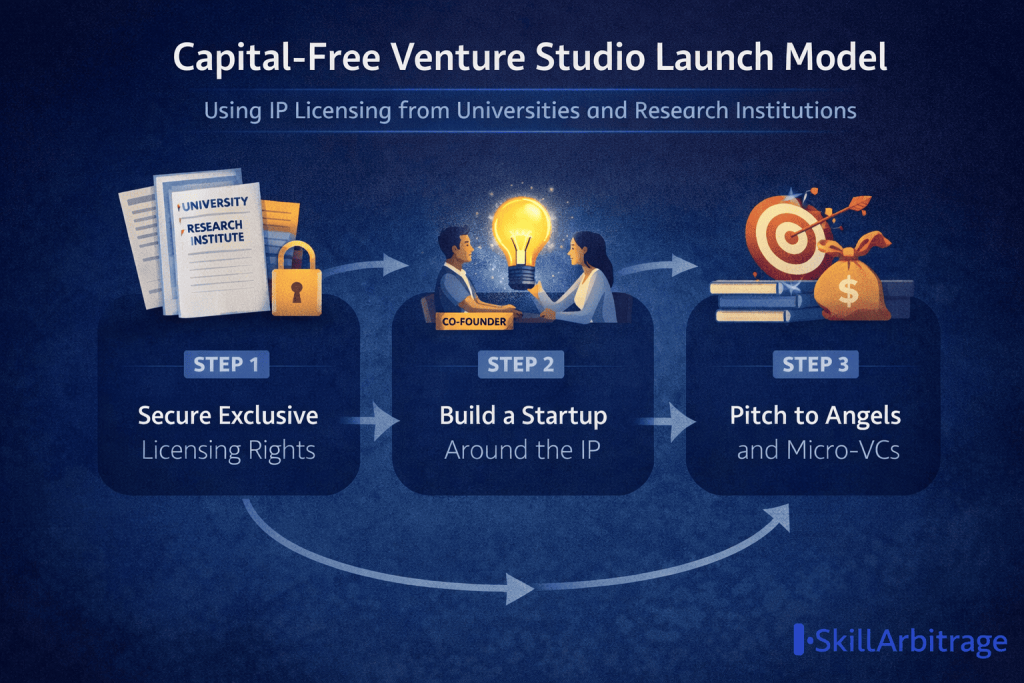
Once NLC identifies a promising patent, their process follows three clear steps:
Step 1 — Secure Exclusive Licensing Rights They negotiate exclusive rights to the patent through a licensing agreement — with no upfront buyout cost. The institution receives future royalties rather than an immediate payment, which eliminates the need for large capital at the outset.

Step 2 — Build a Startup Around the IP They bring in a co-founder with relevant domain expertise, create a viable business model around the technology, and validate market demand before building the full product.
Step 3 — Pitch to Angels and Micro-VCs Crucially, they raise funds after securing the IP but before building the product. And that capital funds both the startup being built and the venture studio’s own operational costs simultaneously.
This is the key insight: the studio does not need its own fund. It uses the startup’s fundraise to cover studio costs as well, making the entire operation self-financing from day one.
Real World Venture Studios Using This Approach
NLC is not alone. Several of the world’s most respected venture studios have built variations of the same capital-light model:
Betaworks (New York City) Betaworks used a “build first, raise later” approach in the early 2010s. They launched products including Giphy and Dots entirely before bringing in external capital, proving that product validation could replace the traditional requirement for upfront funding.
Zebra Ventures (San Francisco) Zebra Ventures partners with domain experts from underserved markets and co-founds ventures using strategic partnerships and service equity, meaning legal firms, design agencies, and finance professionals contribute services in exchange for equity rather than cash. This dramatically reduces the cash needed to launch.
Antler (Global) Antler operates on a deliberately low-capital initial model: pairing talented individuals with validated ideas, building minimum viable products quickly, and raising external funds only at the point of market validation. Their model has now scaled to over 30 cities worldwide.

The common thread across all three is strategy over capital. You do not need crores to start a studio. You need a repeatable process, and a smart finance person to architect it.
Key Takeaway: The world’s best venture studios prove that intellectual property, strategic partnerships, and service equity can replace the need for a large upfront fund.
Where You Come In as a Finance Professional
If you are a corporate finance advisor or consultant, this model is one of the most powerful playbooks you can bring to a client, particularly family offices, domain experts, corporate innovators, and entrepreneurs who want to build at scale without raising a traditional fund.
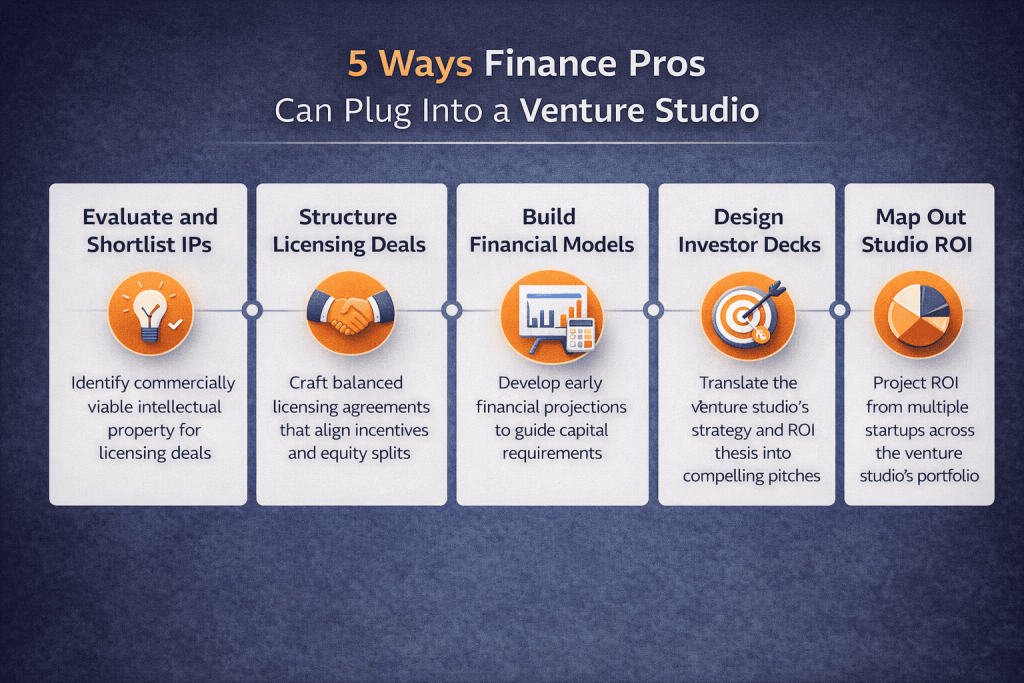
5 Ways Finance Pros Can Plug Into a Venture Studio
1. Evaluate and Shortlist IPs for Commercial Viability Not every patent is worth licensing. Your job is to apply financial analysis to identify which intellectual properties have genuine commercial potential, assessing market size, revenue model fit, and competitive positioning before a single licensing negotiation begins.
2. Structure Licensing Deals and Co-Founder Equity Licensing agreements need to be financially sound for both the studio and the institution providing the IP. You can structure deals that align incentives, setting royalty rates, milestone payments, and equity splits that make the arrangement viable long-term for everyone involved.
3. Build Early Financial Models and Capital Plans Before any investor conversation happens, the numbers need to tell a coherent story. You build the 12–24 month financial models, define the capital requirements at each stage, and create the sensitivity analysis that shows investors the studio can survive adverse conditions.
4. Design Investor Decks to Pitch Angel Rounds The pitch for a venture studio is different from a standard startup pitch, it needs to communicate not just one company’s potential, but the studio’s entire portfolio thesis and ROI model. You translate the studio’s strategy into a compelling financial narrative that angels and micro-VCs can act on.
5. Map Out Venture Studio ROI Across Multiple Companies This is where your skills are truly unique. A venture studio makes money differently from a single startup, through equity stakes across a portfolio of companies, licensing fees, carried interest, and management fees. You model this multi-company ROI structure to show investors and clients how the studio generates returns at scale.
Pro Tip: You do not need to raise a fund to add value here. You need a repeatable process and the financial expertise to execute it. That is exactly what a skilled finance professional brings.
Why This Is a Career-Defining Opportunity
Here is the broader picture: the venture studio model is one of the fastest-growing structures in the global startup ecosystem. As more family offices, corporations, and domain experts look for ways to build at scale without traditional VC dependency, demand for finance professionals who understand this model is rising rapidly.
The professionals who can walk into a client meeting and say “Here is how we can build five companies in three years without raising a single rupee upfront” are not just advisors. They become indispensable strategic partners.
This is not just an opportunity in India. The model is global. Clients in the US, UK, Netherlands, Singapore, and beyond are actively looking for this expertise.
If you build the skills, the process, and the track record, your consulting career can reach an entirely different level, one that crosses borders, asset classes, and industries.
Conclusion
The venture studio model is rewriting the rules of how companies are built. You do not need millions in the bank to launch one. You need a smart playbook, the right IP, and a finance professional who can architect the entire financial structure around it.
By mastering IP evaluation, licensing deal structuring, financial modelling, investor storytelling, and portfolio ROI mapping, you position yourself as the most valuable person in the room, for clients who want to build at scale without traditional fundraising constraints.
Ready to take the next step? Start by identifying one client, a family office, a corporate innovator, or a domain expert, who could benefit from this model. Bring them the playbook. Build the financial model. And let your expertise open doors that most finance professionals do not even know exist.





 Allow notifications

It’s interesting how venture studios are able to scale multiple startups without upfront capital by using IP licensing. As a finance professional, I can see how this model could open up new opportunities for strategic financial structuring, especially in industries where intellectual property holds significant value.
This breakdown of the capital-free venture studio model really highlights a powerful shift in how startups can be built—especially for finance pros looking to add value without traditional capital constraints. The IP licensing approach is particularly clever, and it’s great to see how this model can be scaled systematically. It’s a fresh perspective that could really help professionals rethink their role in early-stage company building.