


Whether you’re a seasoned CA or an aspiring finance consultant, these five services can open the door to high-value, long-term relationships in the venture capital world.
Table of Contents
Why VCs Need Corporate Finance Professionals
Most people picture venture capitalists as the ones writing the cheques. But here’s what they miss, someone has to do the rigorous analytical and relationship work that happens before that cheque is written, and the continuous oversight that happens after. This is where corporate finance professionals play a critical role in supporting venture capital decision-making.
VC funds have one core job: find great deals, evaluate them thoroughly, and help portfolio companies grow toward a profitable exit. That requires serious financial firepower, and fund managers cannot always do it alone.
This is exactly where corporate finance professionals can step in and build a high-value finance assignments for global clients
The VC Ecosystem Is Broader Than You Think
Venture capital is not a monolith. The ecosystem spans multiple types of investors, each with distinct needs:
- Angel Investors — High-net-worth individuals investing personal capital in early-stage startups, often providing mentorship alongside funding
- Venture Capital Firms — Professional firms pooling institutional capital to invest across startup stages
- Corporate Venture Capital (CVC) — Investment arms of large corporations backing startups aligned with their strategic goals
- Seed Funds — Specialized vehicles focused exclusively on early-stage seed capital
- Growth Equity Investors — Providers of expansion capital to mature companies that want to scale without ceding control
- Mezzanine Financing Firms — Hybrid debt-equity providers, often supporting companies preparing for an IPO
Despite these differences, corporate finance professionals remain essential across all segments of the VC ecosystem, but all of them depend on the same underlying financial capabilities. That’s your opportunity.
Key Takeaway: Whether you work with a seed fund in Bengaluru or a growth equity firm in Singapore, the core finance skills translate directly.
#1 — Deal Sourcing: Finding the Right Opportunities
Corporate finance professionals play a key role in building and maintaining high-quality deal pipelines. Without a strong pipeline of investment candidates, even the most sophisticated fund will struggle to generate returns.
Corporate finance professionals can add enormous value here, not just by crunching numbers, but by becoming trusted nodes in the startup ecosystem.
How to Build a Deal Flow Network
Building a reliable deal pipeline requires consistent relationship development. Here’s where to focus:
- Engage directly with startups to understand their funding timelines, capital needs, and growth plans
- Collaborate with angel investors and co-investors to share leads and market intelligence
- Attend industry conferences, Demo Days, and sector-specific events to stay ahead of emerging trends and meet founders early
- Build relationships with accelerators and incubators, they are often the first to know which startups are ready for institutional funding
Using Data Analytics for Smarter Deal Sourcing
Relationship-building alone is not enough in today’s data-rich environment. Finance professionals should also:
- Use high-quality data providers (such as PitchBook, Tracxn, or Crunchbase) to screen potential investments against specific criteria
- Develop customized VC target lists based on investment thesis, stage focus, and sector preferences
- Identify active VC firms that have previously invested in similar companies, these are your best referral sources
Pro Tip: The best deal sourcing professionals combine warm introductions with data-driven screening. Neither approach alone is sufficient.
#2 — Financial Due Diligence: Going Beyond the Numbers
Financial due diligence is where corporate finance professionals truly demonstrate their value in the VC process. It is the structured process of verifying a startup’s financial health, and separating genuine opportunity from polished pitch decks.
The Three Stages of Financial Diligence
A rigorous due diligence process typically follows three phases:
- Initial Screening — Applying predefined criteria to quickly filter out unsuitable candidates before investing deeper resources
- In-Depth Analysis — A detailed review of historical financials, future projections, unit economics, and key assumptions
- Final Review — Presenting findings to the investment committee to support the final go/no-go decision
Building Due Diligence Checklists That Work
Tailored checklists are one of the most practical tools a finance professional can offer a VC. A comprehensive checklist should cover:
Historical Financial Statements

- Income statements, balance sheets, and cash flow statements, at least 2–3 years where available
Financial Projections
- Revenue forecasts, cash burn rates, and the underlying assumptions that drive them
Key Unit Economics
- Customer Acquisition Cost (CAC), Customer Lifetime Value (LTV), churn rate, and gross margin
Beyond gathering data, finance professionals should also:
- Analyze revenue streams for sustainability and scalability
- Examine cost structures to identify hidden financial risks
- Build scenario models, best case, worst case, and base case, to stress-test projections
- Run sensitivity analyses to show how changes in key assumptions affect outcomes
You must also be able to develop robust financial models that project future performance under various scenarios. This includes:
- Sensitivity Analysis: Assess how changes in key assumptions impact financial outcomes.
- Scenario Planning: Create best-case, worst-case, and most-likely scenarios to help VCs understand potential risks and rewards
#3 — Startup Valuation: Picking the Right Method
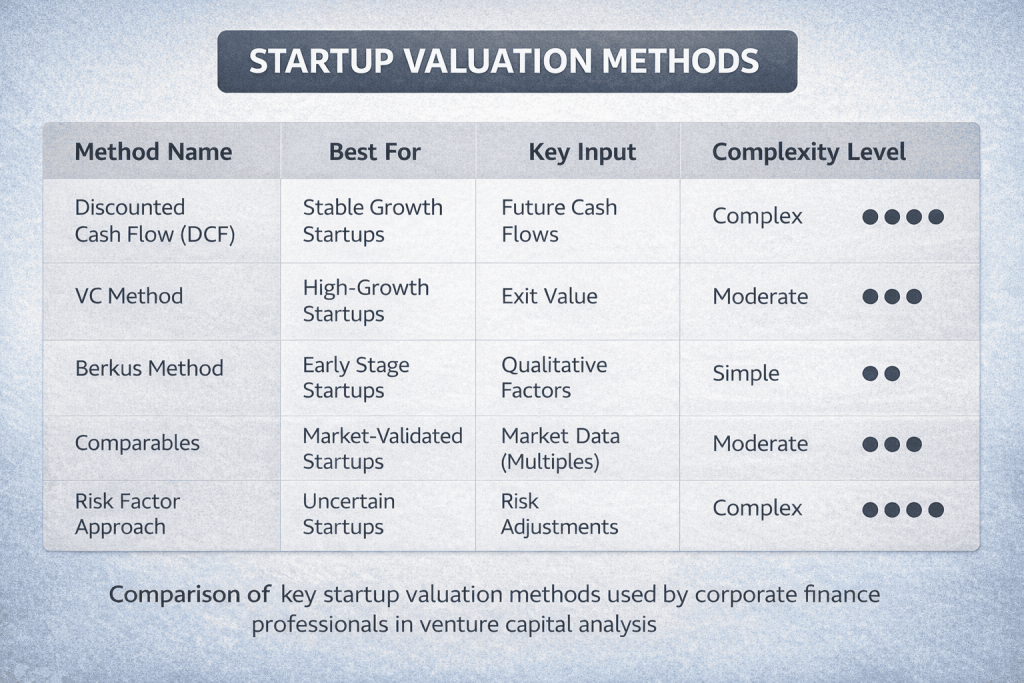
Valuing a startup is part science, part art. Unlike established businesses with years of audited financials, startups often have limited history and highly uncertain futures. Knowing which valuation method to apply and when, is a critical skill.
Five Valuation Methods Every Finance Pro Should Know
1. Discounted Cash Flow (DCF) Method Projects future cash flows and discounts them to present value. Best suited for startups with relatively predictable revenue streams and established business models.
2. Venture Capital (VC) Method Estimates the future exit value of the startup and works backward to determine today’s implied valuation based on the expected return multiple. Ideal for high-growth, pre-revenue or early-revenue companies where an eventual IPO or acquisition is anticipated.
3. Berkus Method A qualitative scoring approach that assigns value to key startup elements, concept, prototype, management team, strategic relationships, and product rollout. Particularly useful for pre-revenue, early-stage companies where financial modelling is not yet meaningful.
4. Comparable Market Approach Values the startup relative to recent transactions or current valuations of similar companies in the same sector. Effective when there are sufficient comparable businesses with public or disclosed data.
5. Risk Factor Summation Method Starts with a base valuation and systematically adjusts it upward or downward based on a range of risk factors, management, market size, competition, technology, and more. Useful for high-risk ventures where risks need to be explicitly quantified.
10 Practical Steps to Evaluate Startup Financials
Once you’ve selected the right valuation method, here is how to execute the evaluation effectively:
- Perform detailed assessments of income statements, balance sheets, and cash flow statements
- Analyze key metrics: CAC, LTV, and burn rate
- Build financial models projecting performance under multiple scenarios
- Use sensitivity analysis to test how assumption changes affect valuations
- Collect and organize complete documentation from the startup
- Facilitate clear communication between the startup and the VC throughout the process
- Provide education on valuation methods and their appropriate applications
- Share best practices for interpreting financial data in context of market conditions
- Leverage software tools to enhance data analysis speed and accuracy
- Implement CRM systems to manage deal flow and investor relations efficientl
#4 — Continuous Portfolio Monitoring
Writing the cheque is only the beginning. At this stage, corporate finance professionals support ongoing performance tracking and risk management. Corporate finance professionals can help VCs maintain continuous, structured oversight of their portfolio.
Tools and Frameworks for Real-Time Oversight
Implement Advanced Portfolio Management Software Modern VC management platforms (such as Visible, Carta, or Allvue) offer real-time dashboards that integrate multiple data sources for a consolidated view of portfolio performance.
Automate Data Collection Automated tools can gather updates from portfolio companies, financial statements, operational metrics, headcount data, reducing manual effort and ensuring timely information delivery.
Leverage AI and Machine Learning AI-driven platforms can scan news, social media, and market reports in real time, alerting VCs to emerging risks or opportunities across their portfolio before they become material issues.
Define and Track KPIs Work with each portfolio company to establish relevant Key Performance Indicators. Regular KPI reviews allow VCs to benchmark performance, catch early warning signs, and intervene before small problems become large ones.
Build a Continuous Monitoring Framework A well-defined framework outlines: which data is collected, how frequently, by whom, and what triggers an escalation. This creates accountability and ensures consistency across the portfolio.
Key Takeaway: The finance professionals who build robust monitoring systems become irreplaceable partners to their VC clients, not just one-time engagements.
#5 — Exit Strategy Planning: Turning Investments into Returns
Corporate finance professionals help maximize returns by planning and executing optimal exit strategies. They are the moment when paper returns become real returns. Corporate finance professionals who understand exit dynamics can help VCs maximize outcomes at this critical stage.
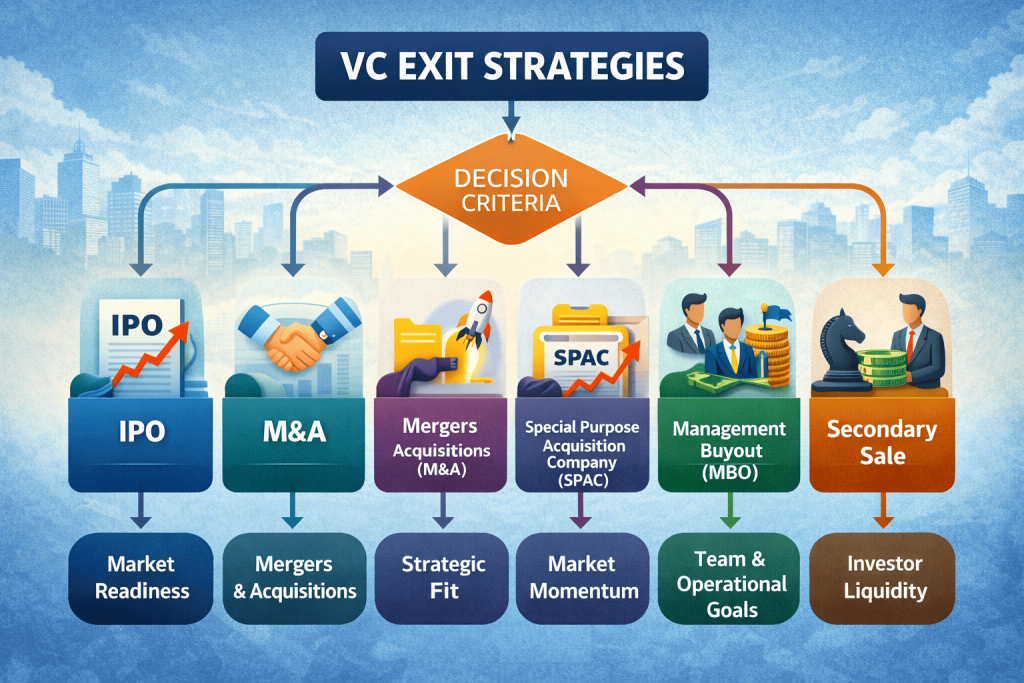
Common VC Exit Routes
- Initial Public Offerings (IPOs) — Taking the company public via a stock exchange listing
- Mergers & Acquisitions (M&A) — Selling the company to a strategic or financial acquirer
- Special Purpose Acquisition Companies (SPACs) — Merging with a publicly traded shell company as an alternative to a traditional IPO
- Management Buyouts (MBOs) — The company’s management team buys out the VC’s stake
- Secondary Sales — Selling the equity stake to another private investor or fund
The right exit route depends on market conditions, company performance, the VC’s return timeline, and investor preferences.
How Finance Pros Support Exit Readiness
1. Develop Comprehensive Exit Plans Work with VCs to map out potential exit routes and timelines for each portfolio company and build in flexibility for changing market conditions.
2. Conduct Market Research Analyze current M&A activity, identify likely strategic acquirers, and use data tools to assess optimal timing for exits based on sector multiples and market momentum.
3. Facilitate Networking Organize introductions between portfolio companies and potential acquirers or secondary buyers. Your network is a direct financial asset here.
4. Monitor Exit Readiness Implement financial monitoring systems that track whether each portfolio company is meeting the milestones required for a successful exit, revenue targets, profitability thresholds, customer metrics.
5. Prepare for Due Diligence Help portfolio companies organize their financial statements, cap tables, legal documents, and operational data well in advance. A company that is exit-ready from day one commands a higher valuation and closes faster.
The Career Opportunity Is Bigger Than You Think
Here is the broader picture: the demand for skilled finance professionals in the VC ecosystem is growing, not just in India, but across the US, UK, Canada, Singapore, and every major financial center globally.
The professionals who build expertise in deal sourcing, due diligence, startup valuation, portfolio monitoring, and exit planning are not just employees. They become trusted advisors with repeat mandates, referral networks, and the ability to command premium fees.
If you build a solid track record and combine it with smart networking, you can take your career to an entirely different level, one that crosses borders and asset classes.
Conclusion
Corporate finance professionals are uniquely equipped to solve some of the most important challenges in the venture capital world, from finding and evaluating deals to monitoring portfolios and planning exits. These are not peripheral activities. They are core to how VC funds generate returns.
The five services covered here, deal sourcing, financial due diligence, startup valuation, continuous monitoring, and exit planning, represent a clear, actionable roadmap for finance professionals who want to build a meaningful presence in the VC ecosystem.
Ready to take the next step? Start by deepening your expertise in one of these five areas, build your first two or three VC relationships, and let your track record do the rest. The opportunity is global, and it is waiting for professionals who are ready to seize it.





 Allow notifications

This post really captures how strategic corporate finance roles are in the VC world. It’s not just about crunching numbers—professionals are actively shaping decisions from deal sourcing to exit planning, which often makes all the difference in portfolio success.
As someone who’s worked on both sides of the table, I really appreciate how this post highlights the depth of value corporate finance pros bring to VC decision-making—especially in deal sourcing and due diligence. It’s easy to overlook the analytical groundwork that makes or breaks an investment, but your breakdown of the three stages of financial diligence really resonated. The emphasis on building real relationships and using data to drive smarter decisions is spot on.