
Academic writers are becoming essential in modern academia, where university faculty, including professors, principal investigators, and research scientists, operate in an environment often described as “publish or perish.” To advance their careers, they must continuously produce scholarly publications.
Table of Contents
A typical tenure-track professor is expected to publish approximately 1-2 research papers per year, often resulting in 5-10 publications within a five- to six-year period to meet tenure requirements.
Look at how many professors there are in the US:
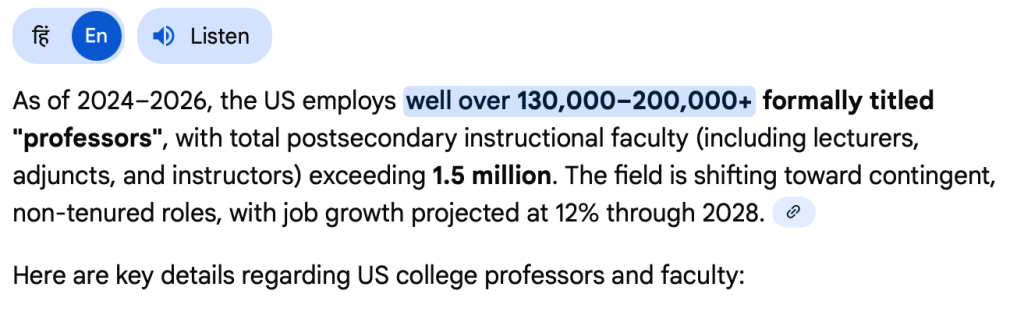
This is literally 1 US faculty member per Indian faculty here.

Publications are not only essential for tenure but also play a crucial role in:
- securing research funding
- achieving promotions
- leading research centers or collaborations
Research funding itself is substantial. For example, U.S. university investment in research reached $117.7 billion in R&D in FY24, representing an 8.1% increase from FY23.(source)

Because of this highly competitive environment, professors increasingly rely on academic writers and research collaborators to support various aspects of scholarly work.
The Pressure to Publish in Academia
A professor’s research output often determines their professional growth. Strong publication records help scholars:
- obtain research grants
- gain academic recognition
- lead research groups or centers
- receive tenure and promotions
Studies have also shown that publication history strongly correlates with research funding success. For example, researchers with 5-9 first-authored papers were about 1.6 times more likely to obtain an independent grant than those with none.
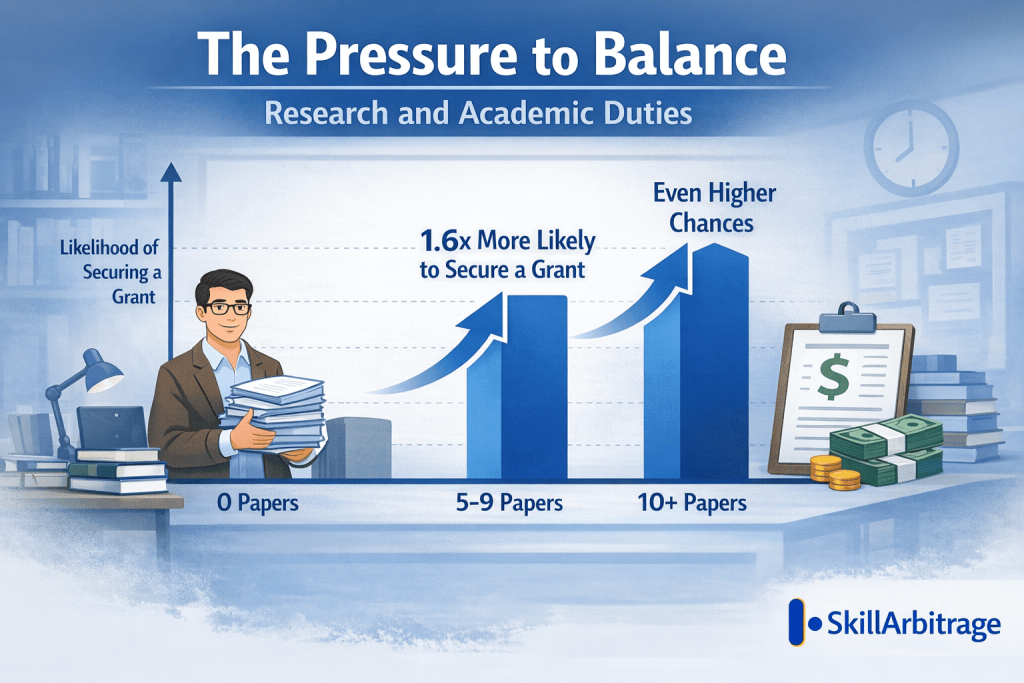
Those with 10 or more published papers have even higher chances of obtaining funding. (Source: Association of Publication Record and Independent NIH Funding | PLOS One).
However, faculty members must balance several responsibilities simultaneously, including:
- teaching courses
- administrative duties
- mentoring students
- managing research projects
These responsibilities often leave limited time for writing and preparing manuscripts, creating demand for academic writers support.
Growing Global Investment in Academic Research
The need for research output is unlikely to decline because global investment in academic research continues to increase.
For example:
- U.S. universities significantly increased research spending in recent years.
- The European Union allocated €95.5 billion for research and innovation from 2021-2027 through the Horizon Europe program.
- €7.3 billion alone is available in 2025 for research initiatives.
As universities worldwide expand research funding, the demand for research collaboration, manuscript preparation, and academic writing support continues to grow.
Opportunities to Collaborate With Professors Worldwide
Academic collaboration is not restricted to a specific discipline. Scholars across many fields, including history, artificial intelligence, biology, economics, and public policy, regularly work with researchers and assistants globally.

Language is rarely a barrier in academia. Many researchers from countries such as China, Japan, and Korea publish in English, and collaboration with English-speaking researchers or writers is common.
As a result, academic writers can collaborate with professors and research teams across different regions and disciplines.
Types of Academic Support Professors Often Need
Professors frequently seek assistance with a range of research and publishing activities. These include writing, research support, analysis, editing, and academic communication.
Below are some of the most common forms of assistance.
1. Manuscript Writing and Research Collaboration
Professors may seek help drafting research manuscripts or contributing to collaborative academic projects.
In many cases:
- multiple researchers contribute to a paper
- authorship is shared among contributors
- collaborators receive research credit for their work
For example,
- Consider a scenario where a think tank is producing a report on climate policy. An Indian environmental researcher could help write a chapter of the report, contributing analysis and text, and be listed as a co-author.
- In academia, multi-authorship is common and encouraged when multiple people contribute. Indian PhDs across disciplines (from biotechnology to economics) can collaborate on papers with international teams.
- This is not ghostwriting; the Indian writer would receive authorship or research assistant credit for their contributions, leading to significant career growth, international recognition, and opportunities to travel abroad.
- Want to know how you can find such projects ? You can use a platform like Kolabtree , to find such projects.
2. Conducting Surveys and Field Research
Researchers sometimes need assistance collecting primary data to test or expand their theories.
This support may involve:
- conducting surveys
- managing field research
- compiling responses
- organizing datasets for further analysis
Such work allows professors to extend their research to different populations or geographic regions.
3. Data Analysis and Interpretation
Many research projects require significant data analysis. Professors may need help with:
- statistical testing
- graph creation
- data processing
- interpreting research results
Modern analytical tools and AI technologies can assist with tasks such as statistical modeling or analyzing large datasets.
Researchers or academic writers often provide the dataset and research questions, while collaborators help process the data and summarize findings.
4. Literature Reviews
Academic publishing requires extensive familiarity with existing research.
Literature reviews involve:
- identifying relevant academic publications
- summarizing existing findings
- organizing research themes
- identifying gaps in current knowledge
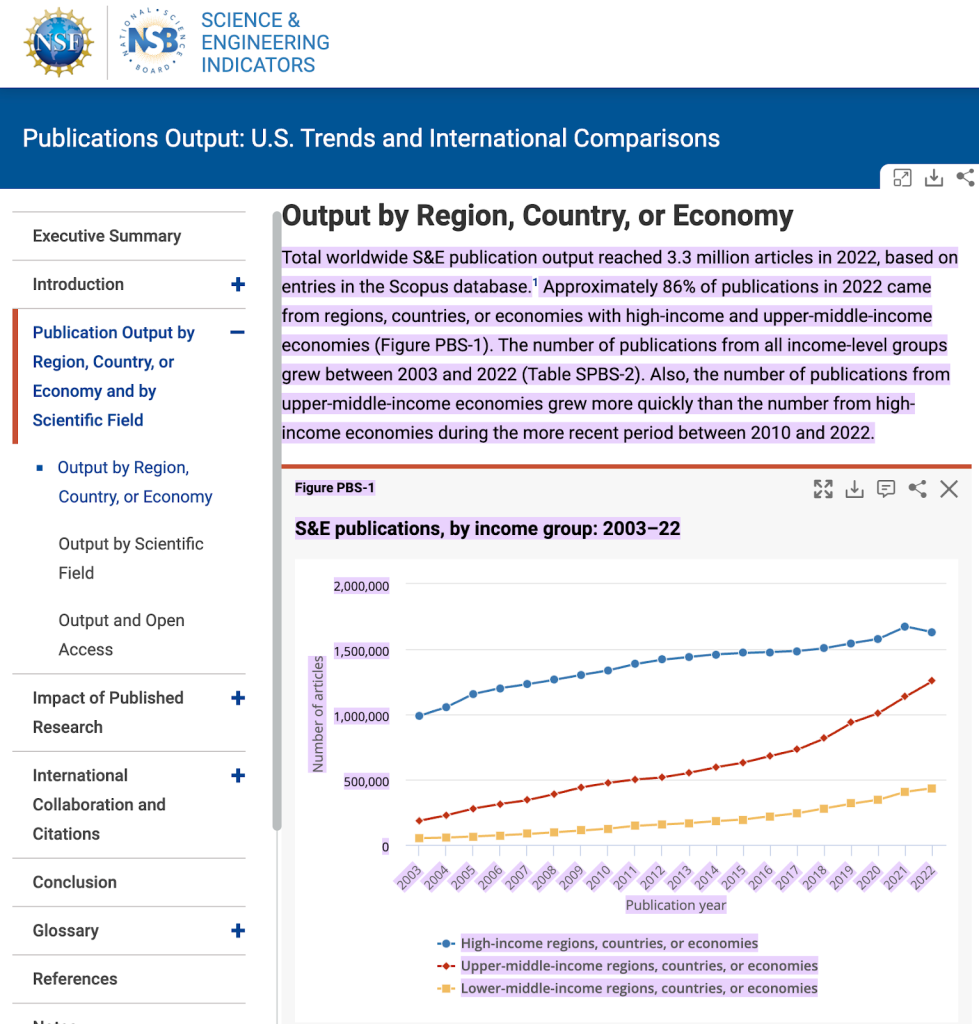
Because the number of academic journals continues to expand, keeping up with new research can be challenging.
5. Editing and Formatting Manuscripts
Academic journals often have strict formatting guidelines and style requirements.
Researchers may require help with:
- manuscript formatting
- citation styles
- reference organization
- submission preparation
The global content editing services market was valued at USD 5.8 billion in 2024 and is projected to grow to USD 10.2 billion by 2033, with a CAGR of 7.5% over the period 2026–2033. (Content Editing Services Market Size, Trends and Projections).
6. Transcription and Data Coding
In fields such as sociology, public health, and anthropology, researchers frequently work with qualitative data.
Tasks may include:
- transcribing interviews
- coding qualitative data
- summarizing field notes
- organizing open-ended survey responses
These processes help researchers convert raw data into structured insights more efficiently.
7. Pre-Submission Review and Manuscript Feedback
Before submitting a paper to a journal, researchers often seek detailed feedback on draft manuscripts.
This may involve:
- reviewing the logical structure of the paper
- identifying weaknesses in arguments
- suggesting improvements to clarity and organization
- checking for methodological inconsistencies
Such review support helps authors strengthen their work before formal peer review.
8. Preparing Grant Proposals
Research funding applications require carefully written proposals that clearly explain:
- the research objective
- methodology
- expected outcomes
- societal or scientific impact
Grant proposals are highly competitive and require significant time and preparation.
9. Communicating Research to Wider Audiences
Researchers increasingly share their work beyond academic journals.
This may involve:
- preparing summaries for social media
- communicating research insights to broader audiences
- participating in academic discussions through digital platforms
These activities help scholars expand the reach and visibility of their research.
10. Academic Writers Assist With Academic Book Writing
Some professors publish academic books in addition to journal articles.
Support may include:
- drafting chapters
- compiling research material
- organizing references
- editing manuscripts before submission to publishers
11. Supporting European Academics Publishing in English
Many researchers in Europe work in environments where English is a second language.
Scholars from countries such as:
- France
- Italy
- Spain
- Germany
- Poland
- Greece
- Hungary
- Belgium
often aim to publish in international English-language journals.
Collaborative academic writing and editing support can help researchers present their work clearly in English while maintaining academic accuracy.





 Allow notifications