
Networking with professors, academicians, and researchers globally can help you unlock countless academic writing, research, and collaboration opportunities. If you’re an aspiring academic writer or researcher, or even someone looking to break into freelance academic work, learning how to connect with the right people is essential.
Table of Contents
Effective Strategies to Network with Professors and Researchers
Use Google Scholar to Identify Active Researchers
One of the most powerful tools for finding professors and researchers who are actively working on projects is Google Scholar. Using Google Scholar allows you to find academic papers published within your area of work. Here’s how you can do it:
- Step 1: Open Google Scholar and type in your desired topic, for example, “Carbon Regulations.”
- Step 2: Filter the results to show only academic sources and papers published within the last 3 to 5 years. This ensures you’re connecting with professors who are currently working on relevant research.

- Step 3: Look at the first few results, as these are often recent papers from active researchers.
- Step 4: When you open a research paper, you will often find the author’s name, their email address, and the university they are affiliated with.
Once you’ve identified these professors or researchers, do some background research on their work, and reach out with a personalized pitch.
Use Official University Websites to Establish Direct Contact
Another effective way to network with professors is by visiting university websites directly. Every university has a faculty page where they list the contact information of their professors, including emails, phone numbers, or links to their LinkedIn profiles. Here’s how you can use this strategy:
- Visit University Websites: You can go to any university’s website and find the faculty page for the department that interests you.

- Look for Relevant Professors: Find professors whose research aligns with your work, and look for any contact details they have posted.

This method gives you direct access to faculty and their areas of expertise, which can lead to more meaningful connections.
How to Help Professors: What They Need
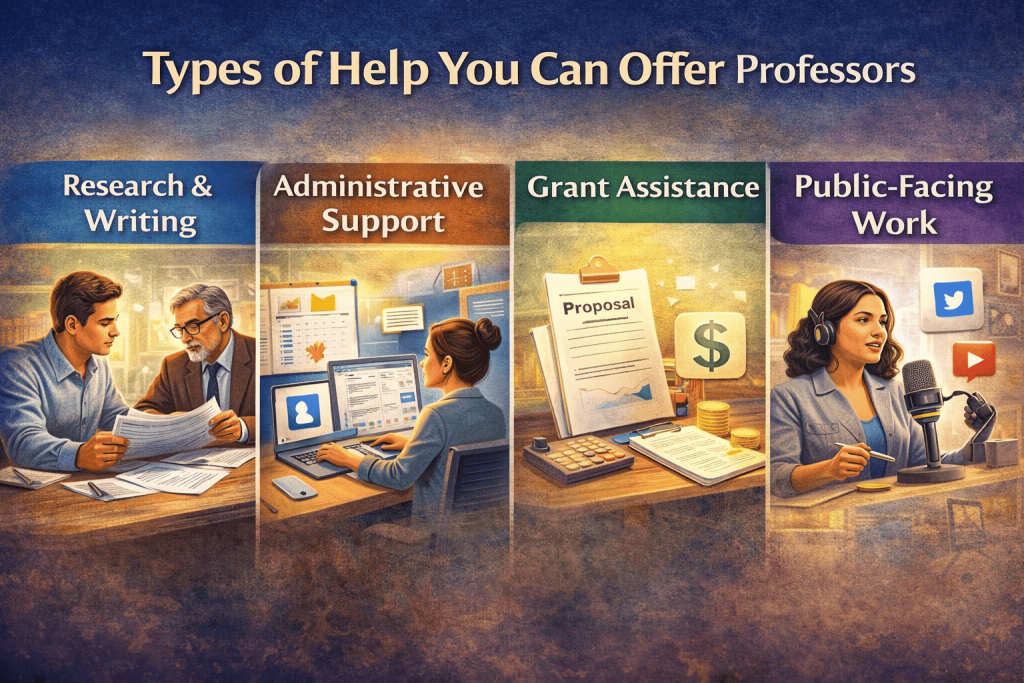
Once you’ve established a connection with professors, it’s crucial to know how you can assist them. Here are the four primary ways you can offer your help:
1. Research and Writing Work
Professors often need assistance with a wide range of writing tasks. These could include:
- Literature Reviews: Summarizing and reviewing current research in a particular field.
- Data Collection: Gathering and organizing data for academic studies.
- Qualitative and Quantitative Analysis: Analyzing data and generating insights.
- Proofreading and Editing: Ensuring that manuscripts are polished and ready for submission.
- Citation Formatting and Manuscript Submission: Preparing papers for journals, ensuring they adhere to submission guidelines.
You can offer valuable services by supporting professors in their writing and research tasks.
2. Administrative, Operational, and Liaisoning Work
Professors need assistance with the logistical side of their research and academic work. This includes:
- Coordinating with Co-authors and Editors: Managing communication and project timelines with other collaborators.
- Managing Timelines and Deliverables: Keeping track of deadlines for submissions, conferences, and other academic projects.
- Reference Databases: Using tools like Zotero, Mendeley, and EndNote to manage citations and references.
- Preparing Ethics and Compliance Documents: Helping with the preparation of IRB (Institutional Review Board) or ethics committee documentation.
- Grant Documentation and Budgeting: Assisting with preparing financial reports and project budgets for research grants.
These administrative tasks, though behind the scenes, are crucial to ensuring the smooth running of research projects.
3. Pitching for Grants and Government Projects
Professors and researchers often need help in the pursuit of funding. You can assist by:
- Researching Funding Opportunities: Identifying potential grants or research funding.
- Drafting and Formatting Grant Proposals: Writing the technical and narrative portions of funding applications.
- Preparing Financial Sections: Assisting with the budget and financial reporting required for grant applications.
- Compliance Documentation: Ensuring all necessary compliance documents are in place for project submissions.
Having a good understanding of the grant application process can make you an indispensable asset to any academic team.
4. Public-Facing Work
Increasing visibility in the public domain is vital for many professors. You can help professors translate their academic work for wider audiences:
- Social Media Management: Sharing insights from their research to increase their visibility on platforms like LinkedIn or Twitter.
- Podcasts and Webinars: Helping professors get featured on podcasts or webinars to discuss their research and gain a larger audience.
- Book Outlines and Drafts: Assisting in writing book chapters or outlining a book.
- Creating Infographics and Visuals: Simplifying complex academic concepts into visuals that are easier to understand.
By helping professors engage with the broader public, you not only assist in disseminating their research but also elevate their professional profile.
Crafting the Perfect Message for Networking
One of the key elements of networking is how you communicate with professors. Below is a sample email template you can use to reach out to professors:
Subject: Helping You Expand on Your Recent Research

Dear Dr. [Last Name],
Congratulations on your recent publication in [Journal Name]. I am quite intrigued by your unique take on [Topic].
I am myself a researcher in <field> in India and would love to conceptualise a field research on this topic, which could enable you to develop your findings further.
In addition, I could also help you to:
- Share insights from your research on social media, and get yourself invited to podcasts to amplify your recognition with mainstream audiences
- Assist you in preparing manuscripts for your subsequent writings
- Ensure stylesheet compliance, literature reviews, create diagrammatic and visual representations, and perform data analysis of any existing field surveys, so that you can save massive amounts of time, even liaise with journals and potential grant providers.
- I can help you prepare grant proposals.
- Liaise with journals and potential grant providers, perform any last-minute changes that come up quickly, so that your publication/proposal submission plans are not derailed.
- Support you in applying for upcoming conferences in your field of work, prepare executive summaries, and paper drafts.
I’d love to go on a Zoom call with you to discuss how I can make a tangible difference to your efforts – just hit yes and I will send you a couple of time slots.
Thank you in advance!
Best regards,
[Your Name]
Is this better than the pitches that you currently send?
Can you write such pitches on your own now?
Wait, let me send you 30 more such pitches that will come in handy for you while reaching out!
This message allows you to introduce yourself, show genuine interest in their research, and offer specific ways in which you can help. Always personalize your pitch and tailor it to the individual professor’s work.
Moving Beyond Basic Networking
Once you have received a response from a professor, it’s important to focus on building trust. Professors are highly connected, and once they trust you, they may offer recommendations to other academics, which can lead to a flood of new opportunities.
To foster trust, make sure you deliver on your promises. Be professional, reliable, and consistent in your work. Your reputation will grow, and the more professors and researchers you work with, the more visibility you’ll gain in the academic world.
What Happens When You Get a Response?
Once you send out your networking emails and get a response, it’s essential to focus on how to nurture and move forward with that relationship. Add Value First, Ask for Work Later Here’s what you should consider:
- How will you take the relationship forward? It’s important to continue offering value, showing your expertise, and maintaining communication.
- How will you build trust? Consistently providing value and being professional is key to building trust with professors. The more value you add, the stronger your relationship will become, leading to more opportunities.
- How will you do the work successfully? To secure future collaborations, you need to deliver high-quality work. Professors are well-connected with other academics, so gaining a recommendation from them can open the door to numerous opportunities.
By proving yourself reliable and professional, professors can become your biggest advocates, recommending you to their network of colleagues and offering you more work.
The Reality of Freelance Academic Writing
Most academic writers in India and other countries often focus on freelancing for high school or undergraduate students—writing academic essays, statements of purpose, and other student documents.
- This market is highly crowded.
- It’s vulnerable to automation and AI advancements that may replace many of the tasks.
- The ethics are questionable, and this work often provides no professional recognition or satisfaction.
While it may seem like an entry point, this market offers limited growth and low returns. It’s important to recognize that pursuing higher-quality academic work will help you grow in your career much faster.
Opportunities with Global Professors
Unlike the crowded essay-writing market, working with global academicians and professors on real academic projects presents far more rewarding and well-paid opportunities.
Many professors may even acknowledge you as a co-author or research assistant. Though this doesn’t always happen, and some work may require ghostwriting, the collaboration is financially rewarding and offers recognition.
By working directly with professors, you’ll earn more, build global recognition, and gain credibility. It’s far more rewarding than writing essays and SOPs.
Imagine the Career Growth
Helping professors with research, academic writing, and other essential tasks can skyrocket your career in several ways:
- Grants and Fellowships: As a collaborator, you may get the chance to apply for grants and fellowships, even for your doctoral or post-doctoral studies.
- International Recognition: Professors often have access to conferences and events where you could gain exposure as a recognized researcher.
- Increased Income: You’ll earn more by offering higher-value services than by working in the crowded market of student essays.
Through these collaborations, you’re not just earning money—you’re also doing work that you’re passionate about and building a strong research portfolio.
The Need for Public Profile Assistance
Academicians and professors often require help with their public profile. Although many are focused on research and publications, they also want to influence public policy, government, and public discourse. However, due to time constraints, many do not have the bandwidth to manage this.
For example, Andrew Huberman, an Associate Professor of Neurobiology at Stanford University, successfully transitioned from academic research to building a global health influencer brand. His Huberman Protocol on sleep is followed worldwide, and he used his podcast to share esoteric scientific knowledge with the public.
Why don’t other professors do the same? Because they don’t have the time or expertise in public relations. This creates a golden opportunity for you to step in and help with managing their public presence.
Help Professors Publish Books and Gain Public Recognition
Many renowned professors write bestselling non-fiction books, such as:
- Daniel Kahneman, a professor at Princeton University, wrote Thinking, Fast and Slow.
- Yuval Noah Harari, a history professor at Hebrew University, authored Sapiens: A Brief History of Humankind.
- Steven Levitt, co-author of Freakonomics, is an economics professor at the University of Chicago.
- Nassim Nicholas Taleb, former NYU professor, wrote The Black Swan.
Professors who publish books often experience significant financial and professional rewards. These books lead to speaking engagements, consulting opportunities, and the chance to build courses, masterclasses, and webinars.
You can help professors write book chapters, prepare drafts, or convert academic papers into mainstream content—all of which can enhance their professional success.
Real Networking in Academia: The Case of Reid Hoffman
Reid Hoffman, the founder of LinkedIn, initially wanted to be a teacher. However, he recognized that academic books and Ph.D. dissertations had limited real-world impact. He wanted to create a platform where professionals could connect and expand their public portfolio. His mission was to help professionals gain a wider reach and influence, which led to the creation of LinkedIn.
This is how real networking is done.
It’s about expanding your reach and building your public profile, not just publishing academic papers. This strategy also applies to professors, helping them extend their reach can greatly benefit you as well.





 Allow notifications