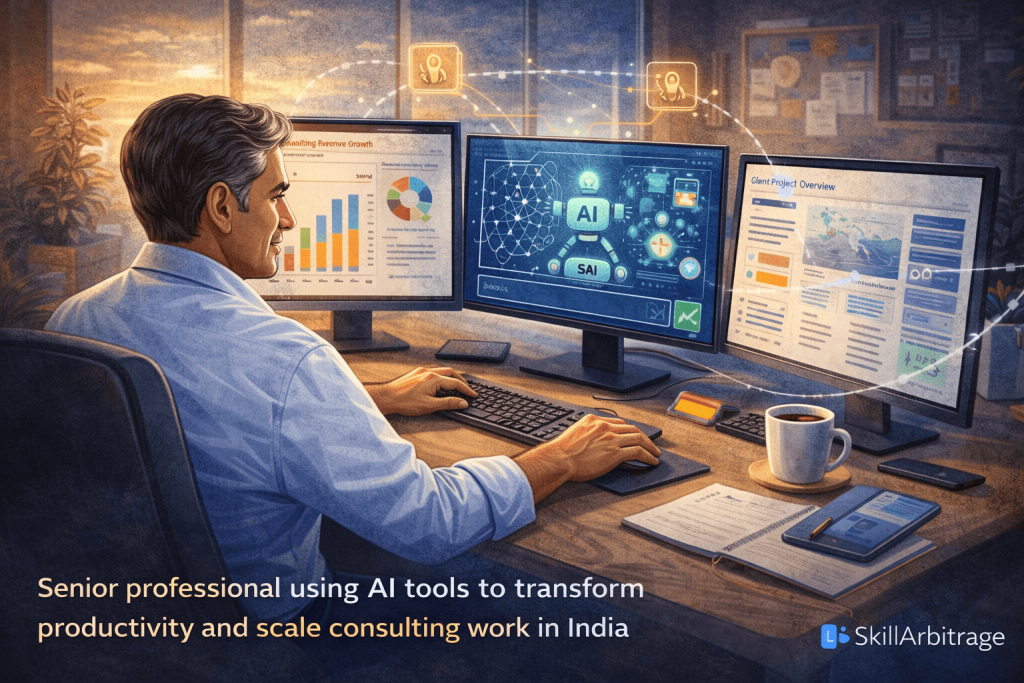

You have two options when scaling your work: hire junior employees and train them extensively, or hire expensive senior professionals. Both have real costs, in money, time, and management overhead.
Table of Contents
But there is a third option that most professionals have not fully explored yet.
What if you could train AI instead, and make it your personal work agent?
It works 24/7, never takes leave, never loses context, and costs a fraction of even your most junior hire.
For senior professionals in India across engineering, sales, HR, finance, operations, and marketing, AI tools are no longer optional; they are the fastest way to multiply your output without multiplying your hours.
Here is exactly what that looks like in practice.
Why Most Senior Professionals Are Failing to Use AI Effectively
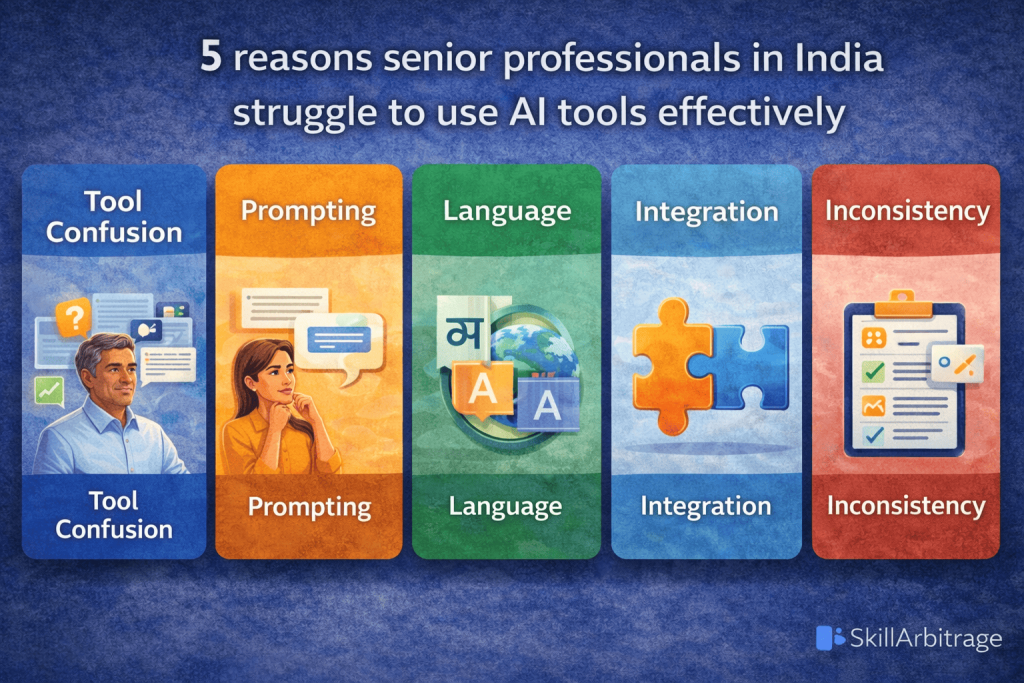
The AI revolution is already here. But most professionals are stuck, not because AI does not work, but because they are using it incorrectly. After 18 months of working with 12,000+ senior professionals and testing 500+ AI tools, here are the five real problems holding people back.
Problem 1 — Tool Overload Confusion
There are 15,000+ AI tools in the market today. ChatGPT, Claude, Gemini, Perplexity, Jasper, Copy.ai, Midjourney, DALL-E, the list grows every week. Which one should you use for what?
Most professionals waste hours jumping between tools and getting mediocre results from all of them. The problem is not the tools, it is having no system for choosing between them.
Problem 2 — The Prompting Problem
You have probably tried ChatGPT, asked it to write an email or create a report and received something generic, robotic, and unusable. That is not a failure of AI. That is a failure of prompting.
AI is like a Ferrari: incredibly powerful, but if you do not know how to drive it, you will stall at the first turn. Based on research across 50,000+ prompts, 95% of professionals are not prompting AI effectively, and they are judging the technology based on that experience.
Problem 3 — Language and Localisation Barriers
Can AI understand industry-specific jargon? Can it generate content in Hindi, Tamil, or regional languages when needed? Can it adapt to Indian business contexts rather than defaulting to Western frameworks?
Most professionals assume it cannot, and so they never try. In reality, AI handles all of this well when set up correctly. The assumption is the barrier, not the technology.
Problem 4 — Integration With Existing Tools
Your work does not happen in isolation. You use Excel, PowerPoint, CRM systems, and project management platforms. The challenge is not using AI in a separate window, it is making AI work with your existing tools rather than creating yet another silo.
This integration layer is what most AI tutorials skip entirely.
Problem 5 — Inconsistent Output Quality
Sometimes AI produces brilliant insights. Sometimes it confidently generates completely wrong information. This inconsistency causes professionals to lose trust in the tool entirely, and stop using it after a few disappointing sessions.
Reliable, professional-grade output every time is absolutely achievable, but it requires a specific setup that most people do not know about.
These five problems collectively cost professionals hours every week and significant income every year. The question is not whether AI is useful, it is whether you have the right approach to make it consistently useful for your specific work.
What 18 Months of Research With 12,000+ Professionals Revealed About AI
After 18 months of working with senior professionals across engineering, sales, marketing, HR, finance, and operations, testing 500+ tools and writing 50,000+ prompts, here are the three most significant discoveries.
The Context Library Method
AI’s effectiveness jumps by 400% when you feed it the right context, but not in the way most people think.
Instead of explaining your company, role, and preferences in every single prompt, you can train AI with a “context library”, 15 to 20 reference documents that teach the AI your industry terminology, company processes, writing style, and even specific communication preferences. Once built, this library transforms AI from a generic assistant into one that already understands your world.
The CRISPE Prompting Framework
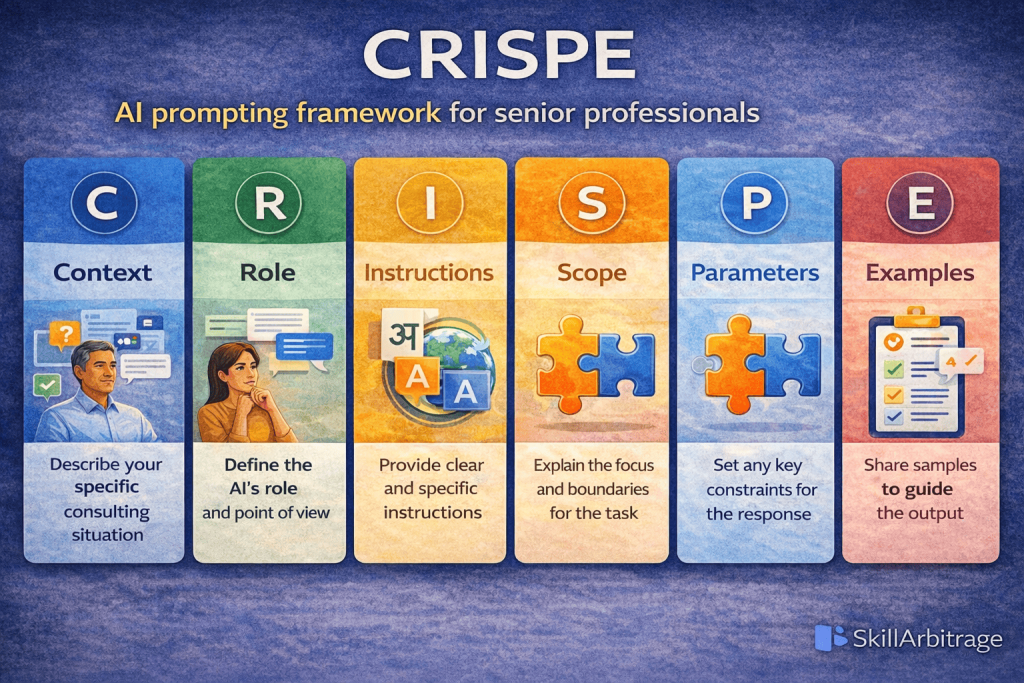
Forget vague prompts like “act like an expert.” After testing 12,000+ prompt structures, the CRISPE framework consistently produces significantly better outputs:
- C — Context (background information the AI needs)
- R — Role (what perspective should it take)
- I — Instructions (what exactly do you want it to do)
- S — Scope (what boundaries apply)
- P — Parameters (format, length, tone)
- E — Examples (critically: show bad examples, not just good ones)
The last point is the one most people miss. When you show AI what you do not want, a bad email, a weak report structure, an off-tone response, output accuracy improves by 67%. Showing negative examples is more powerful than showing positive ones.
How AI Tools Can Train Each Other
This is the discovery that changes how most professionals think about the AI ecosystem. AI tools are not isolated, they can be used in combination, with one tool generating training data, another refining it, and the output fed back into the first for increasingly specialised results.
The tools work better together than any single tool works alone.
Will AI Replace Senior Professionals? Here Is the Honest Answer
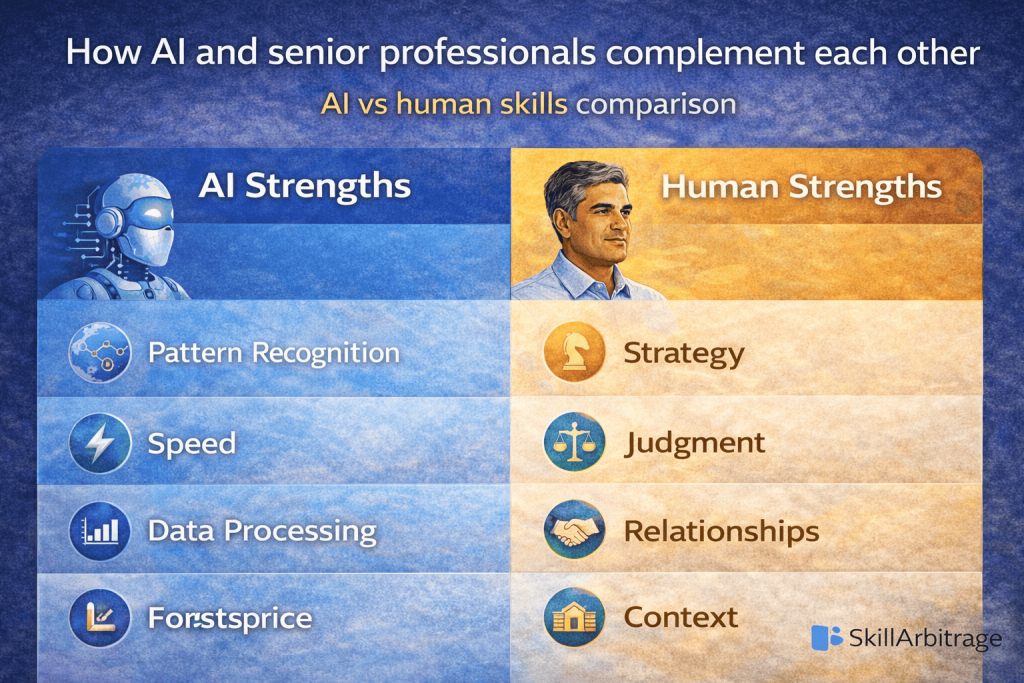
No. But the nuance matters, and understanding it will change how you think about AI entirely.
AI Is Pattern Recognition — You Are a Pattern Creator
AI can analyse 10,000 sales calls and identify what works. But it cannot build the relationship that closes a complex B2B deal. It cannot read the room in a tense negotiation. It cannot mentor a struggling team member through a personal crisis. Pattern recognition and pattern creation are fundamentally different skills, and only humans have the latter.
AI Lacks Context — You Provide Wisdom
AI can pull information from millions of sources. But it does not know your company’s unwritten rules. It does not understand why the leadership team killed a particular project. It cannot navigate office politics or build strategic alliances over time. Your accumulated organisational context is irreplaceable.
AI Executes — You Strategise
Give AI a clearly defined task and it will execute it well. But it cannot define what success looks like for your specific situation. It cannot pivot when market conditions change unexpectedly. It cannot make judgment calls that require years of lived professional experience.
The right analogy: Think of AI like Excel in the 1990s. Excel did not replace accountants, but accountants who refused to learn Excel were replaced by those who did. The same dynamic is playing out now with AI. The senior professional who learns to use AI effectively will replace the one who does not.
What AI Actually Becomes: Your 24/7 Junior Team
Here is a practical reframe that makes this concrete. Using the right AI tools effectively is equivalent to having a team of junior professionals who:
- Never take sick leave or vacation
- Work at 3 AM without any drop in quality
- Remember every detail from every document or meeting they have ever processed
- Write first drafts in seconds, not hours
- Analyse spreadsheets with 10,000 rows in minutes
- Create presentation structures while you focus on strategy
- Research competitors and market trends continuously in the background
This is not hypothetical. Senior professionals across India are doing exactly this right now, in sales, in HR, in finance, in operations, and in consulting.
The gap between professionals using AI this way and those who are not is widening every month.
The Cost of Waiting: Why Learning AI Now Matters
Every week without an effective AI workflow is a week where the gap between you and AI-enabled peers grows.
They are automating what you are doing manually. They are analysing what you are still estimating. They are scaling their output while yours stays flat.
The global AI market is projected to reach $1.8 trillion by 2030. The professionals who build genuine AI fluency now, not just awareness, but practical, role-specific fluency, will capture a disproportionate share of the value this shift creates.
The barrier to entry is not technical. You do not need to learn coding. You do not need to understand machine learning. You need to know which tools to use, how to use them effectively, and when to apply them to your specific work.
That practical knowledge gap is closable, but only if you start closing it.
Conclusion
AI will not replace senior professionals. But it will dramatically amplify those who learn to use it well, and make those who do not increasingly less competitive.
Your 10+ years of domain expertise, strategic judgment, and professional relationships are not at risk. They are, in fact, the exact foundation that makes AI most powerful in your hands. AI handles the execution. You provide the direction, the context, and the wisdom that no model can replicate.
The professionals seeing the biggest gains from AI are not the youngest or the most technical, they are the most experienced ones who have learned to delegate the right tasks to the right tools.
AI will not replace you. But a professional using AI will. The only decision that matters is which side of that shift you choose to stand on.




 Allow notifications