
A department head with eighteen years behind her watched a two-year analyst turn a blank page into a client-ready draft in about nine minutes. The analyst had used an AI tool. She could have written a better draft, and she knew it. But better wasn’t the point that morning. Faster was. And the quiet thought that followed her out of that meeting is the one keeping a lot of experienced professionals awake in 2026: if the thing I spent a career getting good at can now be done in minutes by someone junior with the right tool, what exactly am I being paid for?
That’s the fear. Here’s the more useful way to hold it. Your experience isn’t becoming worthless. It’s being repriced. The parts of your value that were about executing faster or knowing more facts than the person next to you are getting cheaper, because AI is very good at exactly those things. The parts that were about judgment, context, reading a room, owning a decision, and getting other people to do their best work are getting scarcer, and scarce is where the money and the security live.
For senior professionals, AI is not mainly a tools story. It’s a role story. Younger colleagues will out-prompt you, and that’s fine. What they can’t easily do is what you’re now being asked to do: decide where AI belongs in the work, lead a team through the awkward middle of adopting it, and carry the accountability when a machine-generated answer turns out to be confidently wrong. This piece is about that job. Not which button to press. How to stay relevant, how to lead the adoption your organization is already expecting from you, and how to point your career at the capabilities that appreciate instead of the ones quietly losing value.
Worth flagging up front: this is the leadership and career companion to a more hands-on guide. If what you want is the personal, sit-down-with-the-tool version, our piece on how AI can transform your work as a senior professional without replacing you covers prompting technique and tool selection in detail. This one starts where that leaves off: once you can use the tools yourself, how do you lead with them?
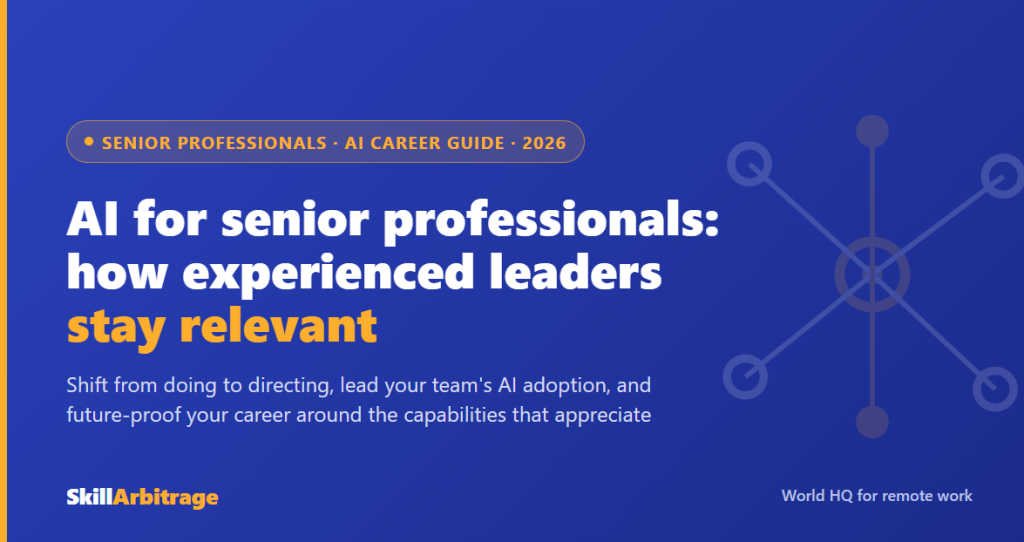
Senior professionals stay relevant with AI by shifting from doing the work to directing it: applying judgment the model can’t replicate, leading their team’s adoption, and repositioning toward orchestration, governance, and outcomes. Relevance in 2026 depends less on how well you personally use AI and more on how well you multiply a team’s output through it, and how much accountability you’re willing to own for the result.
The sections below move from the honest diagnosis to the practical plan. First, why experience is being revalued. Then a way to locate exactly where you stand, what relevance now means for someone at your level, and the part most guides skip entirely: how to actually lead adoption when your own team is the thing slowing it down.
Why AI is changing what your experience is worth
For most of a long career, seniority meant a compounding stack of advantages: you’d seen the edge cases, you knew where the bodies were buried, you could produce in an hour what took a junior a day. Experience was, in large part, an execution premium. Generative AI attacks that premium directly, because it collapses exactly the kind of fast, competent, first-pass execution that used to separate a ten-year professional from a two-year one.
The adoption numbers make the pressure concrete. According to McKinsey’s State of AI 2025 research, 88% of organizations now use AI regularly in at least one business function, up from 78% a year earlier. So the tools are already in your building. The catch is that most of those organizations still see no meaningful impact on their bottom line: only about 6% clear McKinsey’s bar for “AI high performers,” the ones actually capturing significant value from it. Read those together and the real situation comes into focus: almost everyone has the tools, very few have the results, and the gap between the two is a leadership problem, not a technology problem. That gap is your opening.
The tasks AI automates first are the ones you learned the craft on
Here’s the part that stings, and that a lot of upbeat AI content skips. The tasks getting automated first are disproportionately the ones that used to build a career: taking notes, producing the first draft, running the basic research, assembling the deck. Commentary around the World Economic Forum’s workforce research has flagged the second-order worry directly, that when the entry-level, learning-by-doing tasks are the first to be handed to a machine, it gets harder for anyone to build the judgment that senior roles reward.
For you, this cuts two ways. Your own routine output is now cheap to reproduce, which is uncomfortable. But the deeper skill those routines were quietly training, the pattern recognition, the sense of what “good” looks like, the instinct for what’s about to go wrong, is exactly what’s becoming rare. You already have it. The next cohort may struggle to build it the way you did. That asymmetry, oddly, is working in your favour.
Where senior judgment still wins
So what doesn’t the model do? It doesn’t carry accountability. It has no stake in whether the client renews, no memory of the political history behind a decision, no feel for how much risk this particular boss will tolerate this particular quarter. It predicts plausible text. It does not weigh consequences.
That’s why the tasks where a mistake is expensive, hard to detect, or irreversible stay stubbornly human. Deciding which of three defensible options actually fits the situation. Knowing when the “correct” answer is politically impossible and something workable matters more. Sitting across from a nervous stakeholder and telling them the truth in a way they can act on. None of that is a text-generation problem. All of it is judgment, and judgment is precisely what seniority is supposed to supply.
The repricing of experience, not the end of it
Put the pieces together and you get a revaluation, not an extinction. The World Economic Forum’s Future of Jobs Report 2025 estimates that 39% of the core skills workers need will change by 2030, and that of every 100 workers, 59 will need retraining, with 11 unlikely to get it and therefore at real risk of being left behind. The professionals who slide into that at-risk group won’t be the ones who lacked experience. They’ll be the ones whose experience stayed frozen in the execution era while the value moved up the stack.
The better approach, in our view, is to stop defending the old premium and start building the new one. Your experience becomes more valuable the moment you attach it to AI’s speed instead of competing with it. A veteran who can direct a model, catch its errors, and decide what to do with its output is worth more than either a junior with the tool or a senior without it. That’s the position to aim for, and the rest of this guide is about getting there.
The relevance audit: where you actually stand
Before you fix anything, you need an honest read on where you currently sit. Most senior professionals overestimate their AI standing in one specific way: they conflate “I’ve tried ChatGPT a few times” with “I’m fluent enough to lead.” Those are miles apart. So let’s build a quick, unflattering self-assessment before we talk solutions.
The three relevance zones
Think of yourself as sitting in one of three zones. The first is the avoider: you’ve mostly kept AI at arm’s length, you’re privately hoping it’s overhyped, and your team has noticed. The second is the passive user: you use AI occasionally for small personal tasks, a summary here, an email there, but it hasn’t changed how your team works and you couldn’t confidently coach anyone through it. The third is the fluent director: you use AI on real work, you understand where it fails, and you’re actively shaping how the people around you adopt it.

Which one is you, really? Be strict. The passive-user zone is the most dangerous, because it feels like progress while producing none of the leadership signal that actually protects a senior career. Dabbling privately is not the same as leading, and in a market where your organization is watching for adoption leadership, the difference is visible from the outside.
Honest signals you’re falling behind
A few tells worth checking against yourself. Your team has stopped bringing AI questions to you, because they’ve learned you don’t have answers. You describe AI mostly in terms of its risks and rarely in terms of its uses. You’ve delegated “the AI thing” to a junior enthusiast and quietly checked out of it. When a peer demos something the tool did, your instinct is to explain why it wouldn’t work in your area rather than to ask how they built it.
None of these are fatal. But if two or three feel familiar, you’re closer to the avoider zone than your job title suggests you can afford to be. The point of naming them isn’t guilt. It’s to convert a vague unease into a specific, fixable gap.
The gap check: measure the right thing about yourself
Don’t measure your prompt-writing polish. Measure your leadership readiness. Can you name the two or three workflows in your area where AI would genuinely help, and the ones where it would be reckless? Could you sit with a resistant team member and address their actual fear rather than lecture them about productivity? Do you understand your organization’s data and governance rules well enough to keep your team out of trouble?
Those are the questions that predict whether you’ll lead the adoption or be managed through it. If the answers are shaky, that’s not a verdict, it’s a syllabus. The next sections are built to fill exactly those gaps, starting with what “relevant” even means at your level now.
What staying relevant actually means for a senior professional
“Stay relevant” gets thrown around like everyone agrees on what it means. For a senior professional in 2026, it has a specific shape, and it’s almost the opposite of the advice aimed at juniors. A junior stays relevant by getting faster and more technically fluent. You stay relevant by getting better at the things that don’t scale with keystrokes.
From doing to directing
The core shift is from producing the work to directing it. Your value used to be substantially in your own output. Increasingly it’s in your ability to get high-quality output from a system, part people, part AI, that’s bigger than you. That’s a genuinely different skill, and plenty of excellent individual contributors find it uncomfortable, because it means letting go of being the best hands in the room and becoming the best judgment in the room instead.
Think of it this way. A film director doesn’t operate the camera, hold the boom, or act. They decide what the scene needs, assemble the right capabilities, and take responsibility for whether it works. AI hands senior professionals a version of that role whether they wanted it or not. The question is whether you step into it deliberately or resist it until someone else is asked to.
Judgment, taste, and context as the durable moat
What survives automation is a specific cluster: judgment (which option actually fits), taste (recognizing quality and its absence), and context (the unwritten history and constraints a model can’t see). These aren’t soft skills in the dismissive sense. They’re the hardest things to build and the slowest to transfer, which is exactly why they hold their value while raw execution deflates.
AI actually sharpens the value of this cluster, because it floods the zone with plausible output that still needs someone to judge it. When a model can generate ten competent-looking strategies in a minute, the scarce skill isn’t generating an eleventh. It’s knowing which one is right, which one is subtly wrong, and which one is right but wrong for this company. That discernment is your product now, more than any document you produce.
From T-shaped expert to orchestrator
The old career ideal was T-shaped: deep in one specialty, broad enough to collaborate. The emerging senior ideal adds a third dimension, the ability to orchestrate AI and people together toward an outcome. You keep your depth, because it’s what lets you catch the model’s errors in your domain. But you add range in directing tools, coordinating across functions, and translating between what the business wants and what the technology can do.
Does this mean you need to become technical? Not in the coding sense. It means you need to become fluent enough to direct, the way a good editor doesn’t have to be a faster typist than the writer, but does have to know precisely what a strong piece looks like and how to get there. If you want to shore up the underlying capabilities, our overview of the generative AI skills working professionals need maps the concrete building blocks. Relevance, at your level, is the sum of deep judgment plus the range to direct. Hold both, and you’re hard to replace.
Leading AI adoption is now part of the senior role
Here’s the shift most senior professionals haven’t fully absorbed. Using AI yourself is table stakes. The job your organization increasingly needs from you is leading other people through adoption, and that’s a completely different competence. It’s less about your prompts and more about your ability to move a group of skeptical, busy humans from “not my problem” to “this is how we work now.”
And this is where the earlier statistic gets its teeth. Recall that 88% of organizations use AI regularly, yet only about 6% capture significant value from it. The reason for that chasm is rarely the technology. It’s adoption, and adoption is a leadership deliverable. McKinsey’s research identifies leadership championing adoption and a dedicated team to drive it as among the strongest predictors of success, and finds that senior leaders who visibly role-model AI use see markedly better outcomes. Translation: the results are gated on people like you actually leading, not just approving.
Why adoption stalls even when the tools are everywhere
Adoption stalls for a reason that has almost nothing to do with the software. According to BCG’s AI at Work 2025 survey, more than three-quarters of leaders and managers use generative AI several times a week, but regular use among frontline employees has stalled at around 51%. BCG calls it a “silicon ceiling”: the tools reach the top of the org quickly and then get stuck before they reach the people doing the actual work. Buying licenses is easy. Changing daily behaviour is the hard part, and it’s the part that’s been neglected.
That ceiling is where value goes to die. A tool that leadership loves and the frontline ignores produces exactly the no-impact outcome the McKinsey data describes. Breaking through it is your work now, and it starts with understanding who’s actually blocking it and why.
The middle-management resistance trap
The uncomfortable finding: the resistance often lives in the middle, among experienced managers, and it’s more rational than it looks. Industry surveys in 2025 found that a large share of CEOs report employees are reluctant or even hostile toward AI, with middle management frequently identified as the primary point of friction in organizations running active AI programs. If that describes people on your team, or honestly describes you, it’s worth understanding before judging.
Why would experienced managers resist? Because they’re often undertrained relative to the teams they’re supposed to be coaching, which creates a visible competence gap that feels professionally threatening. Nobody wants to look less capable than their own direct reports at something suddenly deemed essential. The resistance isn’t stubbornness so much as self-protection, and you don’t dissolve it with a mandate. You dissolve it by removing the threat, which points directly at how you sequence training.
Sequence training so managers are ahead of their teams
One of the most practical findings in the BCG work is about order. Regular AI usage is sharply higher among employees who get at least five hours of training plus in-person coaching. But the sequencing matters as much as the volume: managers should be trained deeper and earlier than their teams, not at the same time. A manager who feels a step ahead of their reports becomes an advocate. A manager thrown into the same session as their team, exposed as a novice, becomes a blocker.
If you’re leading adoption, this is a lever you can pull immediately. Get yourself and your managers genuinely fluent before you push the tools down to the frontline. It costs a few weeks and it changes the entire emotional physics of the rollout, from threatened people protecting their standing to confident people extending their reach.
Role-modeling: visible use moves the needle
The single cheapest, highest-return move is to use AI visibly yourself. The BCG data is striking here: the share of employees who feel positive about generative AI rises from 15% to 55% when there’s strong leadership support, yet only about a quarter of frontline workers say their leaders give them enough guidance. That’s an enormous, mostly untapped lever sitting in plain sight.
So what does role-modeling actually look like? It’s showing your team the messy prompt that didn’t work before the one that did. It’s saying “I used the model to pressure-test this, here’s what it missed and here’s what I kept.” It’s normalizing the tool as something serious people use in serious work, not a toy or a threat. Say it out loud, do it in front of them, and you give everyone below you permission to try. That permission, more than any license purchase, is what breaks the silicon ceiling.
A change-management playbook for AI on your team
Understanding why adoption stalls is one thing. Running the change is another. This is a practical, sequence-able playbook you can start on Monday, and deliberately not a tool tutorial, because the tools change every quarter while the change-management fundamentals don’t.
Start with one high-friction workflow, not a platform rollout
The most common mistake is going wide: buy a big platform, announce it company-wide, run a launch, and wonder six months later why nothing changed. Go narrow instead. Pick one workflow your team genuinely hates, something repetitive, time-consuming, and low-stakes enough that errors are cheap to catch. Monthly reporting. First-draft responses. Meeting summaries. Initial research passes.
Why narrow? Because a single workflow gives you a clean before-and-after, a contained place to learn what breaks, and a visible win you can point to. Our guide to workflow automation for professionals goes deeper on choosing and mapping that first process. Land one real improvement in one real workflow and you’ve got proof, and proof travels through an organization faster than any mandate.
Measure outcomes, not tool logins
Here’s where a lot of leaders fool themselves. They track adoption by counting seats activated or logins per week, then report “80% adoption” upward while the actual work hasn’t changed. Logins are theatre. The question that matters is whether the outcome improved: did the report get done faster, did quality hold, did the team get hours back to spend on higher-value work?
Pick one or two outcome metrics before you start, capture a baseline, and measure against it. Time-to-complete for the target workflow. Error or rework rate. Hours reclaimed. Real numbers, honestly captured, do two things: they tell you whether the change is working, and they give you the evidence to defend and expand it. Vanity metrics do neither.
Psychological safety and the fear underneath resistance
Under most resistance sits a fear, and usually it’s some version of “will this make me redundant?” If your team believes that adopting AI is helping build the case for their own replacement, they will quietly sabotage it, and no training budget will fix that. Let’s be honest: telling people “AI won’t replace you” while efficiency targets climb is not reassuring, it’s contradictory.
The more credible move is to be specific about what the reclaimed time is for. If AI frees ten hours, name the higher-value work those hours go toward, the deeper client relationships, the projects that never got attention, the skills worth building. People adopt tools that make their work better and resist tools they suspect are measuring them for the door. Your job is to make the first story true and visible, not just stated.
Governance and the guardrails you’re accountable for
Freedom without guardrails is how organizations end up in the news for the wrong reasons. As a senior professional, you’re accountable for what your team feeds into these tools and what they do with the output. That means a few non-negotiables: clear rules on what data can and can’t go into which tools, a verification step for anything AI-generated that reaches a client or a decision, and a bright line on the calls that always stay human.
McKinsey’s State of Organizations 2026 found that 72% of leaders feel their organizations aren’t fully ready for the changes coming at them, and thin governance is a big part of that unreadiness. You don’t need a hundred-page policy. You need a one-page set of rules your team actually understands and follows, written in plain language, owned by you, and revisited as the tools and the risks evolve.
Future-proofing your career: capabilities that compound
Step back from your current role and look at the trajectory. Future-proofing isn’t about chasing every new tool. It’s about investing your finite learning time in capabilities that appreciate as AI spreads, and quietly divesting from the ones losing value. Some skills are getting more valuable precisely because AI is getting more capable. Others are depreciating for the same reason. Knowing which is which is the whole game.
Skills that appreciate
The capabilities gaining value share a trait: they get more useful the more AI-generated output is floating around. Judgment appreciates, because someone has to decide which of the machine’s plausible answers is actually right. Cross-functional translation appreciates, because someone has to sit between what the business wants and what the technology can do and make them meet. The ability to direct AI toward a real outcome appreciates. So does governance and ethical judgment, as organizations wake up to the risk of ungoverned AI. And the durably human skills, persuasion, relationship-building, negotiation, mentoring, appreciate because they were never the machine’s to take.
Notice the pattern. These are the skills that were always hard to measure and slow to build, which is exactly why they resist automation. The Future of Jobs Report 2025 puts AI and big data at the very top of fastest-growing skills, but pairs them with analytical thinking, resilience, flexibility, and leadership, the human layer that decides whether the technical layer produces anything worthwhile.
Skills that depreciate
The flip side is worth naming plainly. Pure manual execution is depreciating, because it’s the first thing AI does well. Being a human gatekeeper of information, the person who knows where the file is or how the process runs, is depreciating, because retrieval is now trivial. And narrow single-tool mastery, defining yourself by fluency in one specific piece of software, is a fragile bet when the tools turn over every year.
This doesn’t mean these skills become worthless overnight. It means they’re a bad place to invest your next thousand hours of learning. If your professional identity rests mainly on doing a repeatable task quickly or holding information others can’t easily reach, that identity needs to migrate upward, toward decisions, relationships, and orchestration, before the ground shifts under it.
Repositioning your scope and title toward AI-augmented leadership
Future-proofing shows up in how you position yourself, not just what you learn. The professionals pulling ahead are visibly redefining their scope around AI-augmented outcomes: not “I run reporting” but “I own the decision quality that reporting feeds,” not “I manage the team” but “I’ve made this team measurably faster and better with AI.” Same person, repositioned toward the part that’s appreciating.
The practical reality is that titles and scopes are more negotiable than people assume, especially now, when organizations are actively looking for someone to own AI adoption in each function. If you can credibly say you led your team through it, delivered a real result, and can do it again, you’ve turned the disruption that threatened you into the exact thing that makes you promotable. That’s the move: stop being someone AI happens to, and become the person who makes AI happen for others.
| Capability | Direction | Why |
|---|---|---|
| Judgment: deciding which answer is right | Appreciates | AI floods the zone with plausible output; someone must decide what is actually correct and own the consequences. |
| Cross-functional translation | Appreciates | Someone has to sit between what the business wants and what the technology can do and make them meet. |
| Directing AI toward a real outcome | Appreciates | The scarce skill is orchestration, not generation. Directing a system beats being the fastest pair of hands. |
| Governance and ethical judgment | Appreciates | Organizations are waking up to the risk of ungoverned AI; accountable oversight is in short supply. |
| Persuasion, relationships, mentoring | Appreciates | The durably human layer that decides whether the technical layer produces anything worthwhile. |
| Pure manual execution | Depreciates | The first thing AI does well; speed at routine output is no longer a differentiator. |
| Human gatekeeping of information | Depreciates | Retrieval is now trivial; knowing where the file is no longer confers advantage. |
| Narrow single-tool mastery | Depreciates | A fragile bet when the tools turn over every year; identity should rest on judgment, not one product. |
Building an AI-capable team without breaking the apprenticeship pipeline
There’s a second-order problem almost nobody is talking about, and senior leaders are the ones who’ll have to solve it. If AI now does the junior tasks, the drafting, the note-taking, the first-pass research, then how does the next generation build the judgment that only comes from grinding through those tasks? You built your instincts on ten thousand small reps. Automate the reps away and you risk a cohort that can direct AI but has never developed the judgment to know when it’s wrong.
This matters to you specifically, because judgment is the scarce asset your whole strategy depends on. If your organization stops producing people with it, the value of the ones who have it climbs, but the pipeline behind you hollows out, and eventually that’s everyone’s problem.
Reskill in place versus hire AI-native
The WEF data offers a hopeful frame here. Its research suggests roughly half of employers plan to redeploy staff from AI-exposed roles into other parts of the business rather than simply cut them, treating disruption as a reskilling opportunity. For you as a team leader, that’s the more durable path than churning your people for AI-native hires. The person who already knows your domain and your context, retrained to direct AI, is often more valuable than a fresh hire fluent in tools but blind to the business.
So the default should be reskill first. Bring your existing people up the stack, teach them to direct rather than just execute, and preserve the domain knowledge that took years to build. Hire AI-native talent to fill genuine gaps, not to replace institutional memory you’ll miss the moment it walks out.
Protecting how juniors build judgment
This is the subtle part. If you hand every entry-level task to a machine, you’ll get fast output and a generation that never learned to think. The fix isn’t to withhold AI from juniors, that just makes them slower and no wiser. It’s to change what you ask them to do with it. Have them critique the AI’s draft, not just accept it. Ask them why the model’s answer is wrong, and make them find the flaw. Use the machine’s output as a teaching object, a thing to be interrogated, rather than a finished product to be shipped.
Done well, AI can actually accelerate judgment-building, because a junior can now see ten flawed drafts and learn to spot the flaws faster than they ever could producing one draft at a time. But that only happens if a senior person deliberately designs the learning in. Left alone, AI trains people to accept output. Led well, it trains them to evaluate it. That design choice is yours.
Deciding what goes to AI versus a person, on purpose
The teams that get this right make a deliberate call about what to automate and what to route to a person for development reasons. A useful test: automate the tasks that are pure throughput, where doing them by hand teaches nothing anymore, and deliberately keep some judgment-building work in human hands even when a machine could do it, because the point of that work is the human who grows from doing it.
That’s a genuinely new leadership decision, and it’s an experienced person’s call to make. The efficiency-maximizer automates everything and wonders in three years why no one on the team can think. The wiser leader spends a little efficiency to keep the apprenticeship pipeline alive. Which kind of team are you building?
Common mistakes senior professionals make with AI
Even well-intentioned leaders trip on a predictable set of mistakes. Naming them is the fastest way to avoid them, so here are the four we see most often, and what to do instead.
Over-delegating judgment to the model
The most dangerous mistake is quietly outsourcing the one thing you’re not supposed to. It starts small: the model’s analysis is good, so you stop pressure-testing it. Then a decision goes out based on a confident answer nobody actually checked. AI is a text-prediction engine, not a source of truth, and it will produce a fluent, well-structured, completely wrong recommendation without any signal that it’s wrong. The moment you treat its output as a decision rather than an input, you’ve handed away exactly the judgment that justifies your seniority.
Performative adoption
Then there’s adoption theatre: the town halls, the enthusiastic emails, the pilot that gets announced and never changes how anyone works. It feels like leadership and produces nothing, which is precisely the no-impact trap the McKinsey data describes. The tell is when you’re measuring activity, licenses bought, sessions run, instead of outcomes. Real adoption is boring and specific: one workflow, measurably better, then the next. If you can’t point to a concrete result, you’re doing theatre, however good the slides looked.
Waiting for the tool to mature
A comfortable form of avoidance is waiting for the technology to settle down. “I’ll get serious about AI once it’s more reliable” sounds prudent and functions as procrastination, because the tools are improving continuously and there’s no finish line to wait for. Meanwhile your more decisive peers are building fluency, making mistakes on low-stakes work, and compounding a lead. The reliability you’re waiting for arrives as a skill you build by using the imperfect version now, not as a product update you’ll be notified about.
Treating governance as someone else’s job
The last one bites hardest. Plenty of senior professionals assume AI governance belongs to IT, legal, or compliance, and mentally check out of it. But you’re the one accountable for what your team does with these tools, and “I didn’t know they were putting client data into a public chatbot” is not a defence that protects you or the organization. Governance isn’t bureaucracy you can delegate away. It’s a core part of leading adoption responsibly, and owning it is part of what separates a leader from a permissive bystander.
A 90-day plan to stay relevant and lead adoption
Enough diagnosis. Here’s a concrete, time-boxed plan to move from wherever the relevance audit put you to genuinely leading. Ninety days, three phases, designed for someone who’s already busy and can’t disappear for a bootcamp. The sequence matters, so resist the urge to jump ahead.
Days 1 to 30: personal fluency and the relevance audit
The first month is about you, not your team, because you can’t lead where you haven’t been. Pick one real piece of your own work and do it with AI in the loop every day, not toy tasks, actual work with real stakes and real judgment required. The goal isn’t polished prompts. It’s building a gut feel for where the tools help, where they fail, and where they’ll quietly mislead you.
Run the relevance audit from earlier this piece honestly, and name your two or three biggest gaps. Get specific about the workflows in your area where AI genuinely fits and the ones where it would be reckless. By day 30 you should be able to hold a credible conversation about AI in your domain, including its limits, without bluffing. That credibility is the foundation everything else stands on.
Days 31 to 60: lead one workflow and sequence team training
Month two is where you start leading others. Choose one high-friction, low-stakes workflow on your team and lead its move to an AI-assisted approach, personally, not by delegating it to an enthusiast. Set a baseline metric before you start and measure against it, so you’ll have a real result rather than a vibe.
In parallel, sequence the training the way the evidence says to: get yourself and any managers under you fluent before the frontline, so nobody’s exposed as a novice in front of their own team. Start using AI visibly in your normal work and narrate it out loud, the failures included. This is the month you convert private competence into public leadership, and the two moves, one real workflow plus role-modeled use, are what actually break the silicon ceiling on a team.
Days 61 to 90: scale, govern, and reposition
The final month is about making it durable. Take what worked in your one workflow and extend it to two or three more, using the result you captured as your evidence and your permission slip. Write the one-page governance rules your team will actually follow, the data lines, the verification step, the human-only decisions, and make sure everyone knows them.
Then reposition yourself. Document what you led and the result you delivered, and start framing your scope around AI-augmented outcomes rather than tasks. Have the conversation with your own leadership about owning AI adoption in your function, because right now they’re looking for exactly that person and you’ve just spent ninety days becoming them. Ninety days won’t make you a technologist. It will move you from AI-anxious to AI-leading, and in an environment where only about 6% of organizations capture real value from AI, leading is a long way ahead of the pack.
Frequently asked questions
How can senior professionals stay relevant with AI in 2026? By shifting from doing the work to directing it. Relevance now comes from judgment, leading your team’s AI adoption, and repositioning toward outcomes and orchestration rather than personal execution speed. The professionals at risk aren’t the ones who lack experience, they’re the ones whose experience stayed stuck in the execution era while the value moved up toward decisions, relationships, and governance.
Will AI make experienced professionals obsolete? No, but it’s repricing what experience is worth. Routine execution is getting cheaper because AI does it well; judgment, accountability, and the ability to lead people through change are getting scarcer and more valuable. For the honest, longer version of the replacement debate, our companion guide on how AI can transform your work as a senior professional without replacing you covers it in depth.
Do senior professionals need to learn to code or prompt to stay relevant? Not in a technical sense. You need to be fluent enough to direct AI and catch its errors, the way a strong editor doesn’t need to type faster than the writer but does need to know exactly what good looks like. The skills that matter most are judgment, governance, and leading adoption, not programming.
What is a senior professional’s role in AI adoption? To lead it, not just approve it. That means role-modeling AI use visibly, sequencing training so managers are ahead of their teams, picking the right first workflow, measuring real outcomes, and owning the governance. McKinsey’s research finds leadership championing and a dedicated adoption team among the strongest predictors of whether AI actually delivers results.
Why does AI adoption stall on experienced teams? Because adoption is a behaviour-change problem, not a software problem. BCG’s 2025 research found regular frontline use stuck around 51% even as leaders adopt quickly, a “silicon ceiling.” Resistance often concentrates in middle management, frequently because those managers are undertrained relative to their teams and feel professionally exposed.
How do you overcome team resistance to AI as a manager? Address the fear underneath it rather than mandating compliance. Train managers deeper and earlier than their teams so they feel a step ahead, be specific about what the reclaimed time is actually for, and use AI visibly yourself. Employee positivity toward AI rises from 15% to 55% with strong leadership support, so your visible engagement is the biggest lever you have.
Which skills are most future-proof for senior professionals? Judgment, cross-functional translation, AI direction, governance and ethics, and the durably human skills like persuasion, negotiation, and mentoring. These appreciate as AI spreads because someone still has to decide which machine-generated answer is right and own the consequences. Manual execution, information gatekeeping, and narrow single-tool mastery are the depreciating bets.
Should managers be trained on AI before their teams? Yes. The evidence points to sequencing, not simultaneous training. A manager who’s genuinely fluent before their reports becomes an advocate; one exposed as a novice alongside their team tends to become a blocker. Get leadership and management fluent first, then push adoption to the frontline.
How do you protect junior development when AI does the entry-level tasks? Change what you ask juniors to do with AI rather than withholding it. Have them critique and correct the model’s output instead of accepting it, and use AI’s drafts as teaching objects to interrogate. Keep some judgment-building work deliberately in human hands even when a machine could do it, because the point of that work is the person who grows from doing it.
What is a realistic first AI project for a senior leader to lead? One high-friction, low-stakes workflow your team already dislikes, monthly reporting, first-draft responses, meeting summaries, or initial research. Set a baseline metric, lead the change personally, and measure the outcome rather than logins. A single visible win travels through an organization faster than any company-wide mandate.
How is this different from just using AI tools yourself? Using the tools well is table stakes; leading others through adoption is the senior job, and it’s a separate skill built on change management, training sequencing, governance, and role-modeling. If you want the hands-on personal-use guide instead, see our companion piece on using AI tools as a senior professional. This guide is about multiplying a team’s output, not just your own.
How long does it take to become AI-fluent as a senior professional? About 30 focused days to reach credible personal fluency, and roughly 90 to move from anxious to actively leading adoption. Fluency comes from using the imperfect tools on real work now, not from waiting for a more polished version. The professionals compounding a lead are the ones who started before they felt ready.
References
Research & data
- The State of AI: how organizations are rewiring to capture value: McKinsey & Company, 2025
- AI at Work 2025: Momentum Builds, but Gaps Remain: Boston Consulting Group, 2025
- Future of Jobs Report 2025: World Economic Forum, 2025
- The State of Organizations 2026: McKinsey & Company, 2026
- NASSCOM AI Adoption Index: Tracking India’s Sectoral Progress on AI Adoption: EY-NASSCOM
This article is for informational and educational purposes only and does not constitute professional, financial, legal, or career advice. AI capabilities, workforce data, and organizational guidance in this area are evolving; verify the current position and consult a qualified professional before acting on any career, hiring, or governance decision.




 Allow notifications