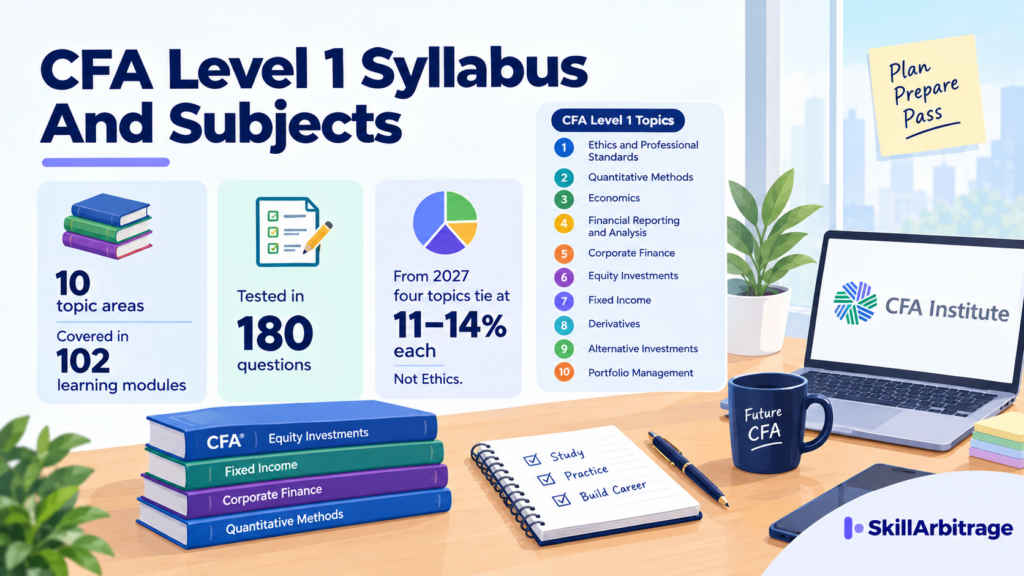

The CFA Level 1 syllabus covers ten topic areas, built from 102 learning modules in the 2027 curriculum, and it is examined in 180 multiple choice questions split across two 135-minute sessions of 90 questions each. CFA Institute publishes a weight range for every topic rather than a fixed question count, so the same syllabus produces a slightly different exam for each candidate. Four topics share the heaviest band in 2027 at 11 to 14 percent: Quantitative Methods, Financial Statement Analysis, Equities and Fixed Income. Ethical and Professional Standards, which led at 15 to 20 percent through 2026, now sits at 10 to 15 percent.
That last change is the one worth pausing on, because it reverses the most repeated piece of advice about this exam. Ethics was the single heaviest topic at Level 1 for years, and “start with Ethics, it carries the most marks” became standard guidance. For anyone sitting from 2027 onward that’s no longer accurate, and Quantitative Methods moves the other way, from 6 to 9 percent up to 11 to 14 percent, which roughly doubles it at the bottom of the band.
Four topic areas were also renamed. Corporate Issuers is now Corporate Finance, Equity Investments is now Equities, Derivatives is now Derivatives and Risk Management, and Portfolio Management is now Portfolio Construction (Equities carries rebuilt content too, not just a new label). Anyone registering in late 2026 is realistically sitting a 2027 window, which means an article written against the 2026 curriculum won’t match the contents page they open. Fees, exam dates and registration sit outside this article, and our guide to CFA eligibility and fees in India covers them.
CFA Level 1 syllabus and topic weights
The CFA Level 1 syllabus is organised into ten topic areas, each carrying a published weight range that caps how many of the 180 questions it can contribute. Those ranges are the whole architecture of the exam, and they’re the reason two candidates in the same February window can walk out having answered different papers.
Here’s the part most published tables get wrong. A weight of 11 to 14 percent is not a target of 12.5 percent. It’s a genuine range, so Fixed Income can arrive as 20 questions for one candidate and 25 for another, and a topic in the 6 to 9 percent band can swing between 11 and 16. Planning against the midpoint of every band assumes an exam nobody actually sits.
So what does a band actually mean in questions? Converting it is simple arithmetic on the 180-question total, and it changes how the table reads. “10 to 15 percent” is abstract. “Roughly 18 to 27 questions” is a decision about where a weekend goes.
| Topic area (2027 name) | Session | 2027 weight | 2026 weight | Approx. questions of 180 | 2027 learning modules |
|---|---|---|---|---|---|
| Ethical and Professional Standards | 1 | 10-15% | 15-20% | 18-27 | 10 |
| Quantitative Methods | 1 | 11-14% | 6-9% | 20-25 | 11 |
| Economics | 1 | 6-9% | 6-9% | 11-16 | 8 |
| Financial Statement Analysis | 1 | 11-14% | 11-14% | 20-25 | 12 |
| Corporate Finance | 1 | 6-9% | 6-9% | 11-16 | 7 |
| Equities | 2 | 11-14% | 11-14% | 20-25 | 12 |
| Fixed Income | 2 | 11-14% | 11-14% | 20-25 | 19 |
| Derivatives and Risk Management | 2 | 6-9% | 5-8% | 11-16 | 10 |
| Alternative Investments | 2 | 6-9% | 7-10% | 11-16 | 7 |
| Portfolio Construction | 2 | 8-12% | 8-12% | 14-22 | 6 |
Both weight columns come from CFA Institute’s Level I exam page, which publishes the two years side by side and groups them by session. The question column is that weight range applied to 180, the module column and the 102 total come from Soleadea’s per-topic breakdown, and the 2026 column uses the 2027 names for comparability (the four renames are set out below).
That session column is worth reading closely, because the two sittings are not interchangeable. CFA Institute groups the first five topics into Session 1 and the last five into Session 2, so the first session carries Ethics, Quantitative Methods, Economics, Financial Statement Analysis and Corporate Finance, and the second carries the five asset-class and portfolio topics. A candidate who has prepared the asset classes thoroughly and left Economics thin carries that imbalance into one session rather than across the day.
The four topics weighted 11 to 14 percent
Quantitative Methods, Financial Statement Analysis, Equities and Fixed Income each carry 11 to 14 percent in 2027, which works out to roughly 20 to 25 questions apiece. Together they account for between 44 and 56 percent of the paper. No single topic dominates the 2027 exam the way Ethics once did (at 15 to 20 percent it could reach a fifth of the paper).
Quantitative Methods covers time value of money, returns, probability, sampling, estimation and hypothesis testing, and regression. Financial Statement Analysis works through the income statement, balance sheet and cash flow statement, inventories, long-lived assets, income taxes and financial reporting quality. Equities handles market organisation, indexes, industry and company analysis, and the valuation models used to price a share. Fixed Income covers bond features, pricing and yield measures, term structure, credit analysis and securitisation.
Now, the module counts in that last column are where this group stops looking uniform. Fixed Income is built from 19 learning modules, more than any other topic on the syllabus, while Equities reaches the same weight with 12 and Quantitative Methods with 11. Same marks, substantially more ground to cover. But that gap is a planning signal, and it’s the cleanest reason why dividing study time strictly by weight understates what Fixed Income demands.
Ethics and Portfolio Construction
Ethical and Professional Standards carries 10 to 15 percent in 2027, roughly 18 to 27 questions, and Portfolio Construction carries 8 to 12 percent, roughly 14 to 22. Ethics moved furthest between the two curricula, down from a 2026 band of 15 to 20 percent.
Here’s the oddity. The content expanded even as the weight fell. Ethics went from 5 learning modules to 10, because the seven Standards of Professional Conduct were split into one module each, with separate modules for the Code and Standards, for ethics and trust in the profession, and for applying the framework to cases. But that is more modules for fewer available marks.
Portfolio Construction is the smaller of the two and the most stable on the whole syllabus: the weight band hasn’t moved, and at 6 modules it’s the lightest topic by content. It covers portfolio risk and return, the needs of individual and institutional investors, the capital asset pricing model, and an introduction to risk management. Worth flagging: this is the topic Level 2 and Level 3 lean on heavily. Thin preparation here tends to surface later rather than in February.
The four topics weighted 6 to 9 percent
Economics, Corporate Finance, Derivatives and Risk Management, and Alternative Investments each sit at 6 to 9 percent in 2027, or roughly 11 to 16 questions. And the four combined contribute less than the top band’s four. That’s a reasonable argument for taking them second rather than first.

Economics covers supply and demand, the firm and market structures, aggregate output and growth, business cycles, monetary and fiscal policy, international trade and exchange rates. Corporate Finance deals with corporate structures and governance, capital investment, capital structure, working capital and business models. Derivatives and Risk Management runs through forwards, futures, swaps and options, pricing and valuation concepts, and the uses of derivatives in managing risk. Alternative Investments covers private capital, real estate, infrastructure, natural resources, hedge funds and digital assets, which is the groundwork for the M&A and private equity career tracks that draw a lot of Level 1 candidates in the first place.
Two of these moved for 2027 and in opposite directions. Derivatives came up from 5 to 8 percent, and Alternative Investments came down from 7 to 10 percent. Neither shift is dramatic on its own. But the two share a band now, having sat on opposite sides of one, so a 2026 study plan still ranks Alternative Investments above Derivatives.
The 2027 CFA Level 1 syllabus changes
Seven of the ten topic areas changed in name, in weight, or in both, since Derivatives did both, and only Economics, Financial Statement Analysis and Fixed Income were untouched. Four topic areas were renamed:
- Corporate Issuers became Corporate Finance
- Equity Investments became Equities
- Derivatives became Derivatives and Risk Management
- Portfolio Management became Portfolio Construction
The weight moves matter more. Ethics fell from 15 to 20 percent to 10 to 15 percent, and Quantitative Methods climbed from 6 to 9 percent to 11 to 14 percent.
Two smaller shifts sit underneath those. Derivatives and Risk Management rose from 5 to 8 percent to 6 to 9 percent, and Alternative Investments slipped from 7 to 10 percent to 6 to 9 percent. The other six kept their weight bands unchanged.
Underneath the weights, the curriculum grew from 93 learning modules to 102. Ethics accounts for five of the nine added modules and Equities for the other four, on per-topic breakdowns published by Soleadea and AnalystPrep. Equities went from 8 modules to 12, adding financial statement forecasting and disaggregated modelling, scenario analysis with probability weighting, equity analyst research reports, and practical application of CAPM and multi-factor models. Five Forces and PESTLE analysis are now tied explicitly to valuation rather than sitting as standalone frameworks.
Quantitative Methods is the one to watch, because its module count stayed at 11 while most of the content underneath was replaced. Hypothesis testing was folded into a broader estimation and hypothesis testing module, the tests-of-independence module was dropped, and the old rates and returns module gave way to three modules on asset returns, return types and benchmarking.
And there’s a new module on financial data science, covering big data, machine learning, artificial intelligence and large language models in investment management. For anyone treating Level 1 as groundwork for remote or international finance work, that’s the most interesting line in the 2027 curriculum (the entry-level exam now examines the vocabulary of data science directly). It lines up with what the global capability centres hire for, covered in our look at GCC finance and accounting roles for freshers.
One practical consequence. Published weightings for Quantitative Methods currently run anywhere from 6 to 9 percent to 11 to 14 percent depending on which page you land on, and both are correct for their own year. Check which window a table governs before you plan against it.
[INFOGRAPHIC-01]

Study order and materials
Study order does not follow the weights, because the marks a topic carries and the volume of material sitting behind those marks are two different things. “Allocate your time in proportion to the weightings” is the standard advice on nearly every page covering this exam, and it is the wrong instruction.
The syllabus itself shows why. Fixed Income and Equities carry identical 11 to 14 percent bands, yet Fixed Income is built from 19 learning modules against Equities’ 12. Portfolio Construction reaches 8 to 12 percent on 6 modules. Proportional-to-weight planning treats those as equivalent workloads, and they aren’t remotely equivalent.
Third-party study planners already price this in. 300Hours allocates roughly 50 to 70 hours each to Financial Statement Analysis and Fixed Income against 40 to 60 for Ethics, a sequence driven by content volume rather than by marks available.
Where does an Indian commerce background sit in this? Reasonably well, on the overlap alone. A B.Com or CA Inter candidate has already met Financial Statement Analysis, Economics, Corporate Finance and parts of Portfolio Construction in some form, while Ethical and Professional Standards and Alternative Investments are usually genuinely new ground.
The 2027 reweighting cuts in their favour too, given that Quantitative Methods, the topic that gained the most, is heavy on material a commerce syllabus already touches. That overlap is also why the CFA route gets weighed against the accounting qualifications, and our comparison of ACCA and CPA covers that choice.
Study hours against topic weights
CFA Institute’s own figure is that successful candidates report spending over 300 hours on average preparing for each level. By weight alone, Fixed Income and Equities get about 38 hours each. Split the same budget by learning modules instead, at roughly three hours a module across 102 modules, and the picture changes.
Fixed Income’s 19 modules draw about 56 hours on a module-weighted split against the 38 a weight-weighted split gives it, while Portfolio Construction’s 6 modules draw about 18 hours against 30. Run the arithmetic across all ten topics and roughly 30 hours shift, most of it out of Portfolio Construction and Ethics and into Fixed Income and Derivatives. Equities and Financial Statement Analysis barely move, because at 12 modules each they sit close to what their weight already buys them.
In practice neither split is right on its own, and most candidates land between them. The useful move is to plan the first reading pass by module count, since that governs how long reading takes, then weight revision and practice questions toward the marks (19 modules and 20 to 25 questions means a big topic’s reading time and a mid-sized one’s revision time).
The CFA Institute curriculum and third-party books
Registration includes the curriculum. CFA Institute provides the digital curriculum, practice questions, mock exams and flashcards through its Learning Ecosystem. So a registered candidate already owns a complete set before buying anything. The printed curriculum costs extra, and third-party packages too.
Is the official curriculum enough on its own? For Level 1, on the structure of the exam, it’s sufficient: it’s the source the questions are written from, and the 102 modules carry learning outcome statements that define what can be asked. The common argument against it is volume rather than quality.
Third-party condensed notes exist because reading the full curriculum end to end is slow, and candidates working full time often trade coverage for speed. That’s a genuine trade-off and not a quality gap, which is a distinction worth keeping straight before spending on a package.
Fair warning on one thing the big syllabus pages leave out entirely. Since the February 2024 Level 1 exam, a Practical Skills Module has been a requirement rather than an extra. Candidates complete one module per level, each taking 10 to 20 hours, and the Level 1 options are Financial Modeling or Python Programming Fundamentals.
Miss it and the consequence is not a delay. CFA Institute’s Practical Skills Modules policy states that where a module is not completed and submitted by the time results are released the exam result is voided, no pass or fail is issued, and continuing in the programme means registering again, paying the applicable fees and retesting at the same level. The same module cannot be reused later, so a candidate taking Python at Level 1 needs a different one at Level 2. Budget the 10 to 20 hours inside the 300, because it isn’t separate from the exam in any practical sense.
FAQs
How many subjects are there in the CFA Level 1 syllabus?
Ten topic areas, built from 102 learning modules in the 2027 curriculum and 93 in the 2026 one. They are examined across 180 multiple choice questions in two 135-minute sessions of 90 questions each, with five topics in each session: Ethics, Quantitative Methods, Economics, Financial Statement Analysis and Corporate Finance in the first, the five asset-class and portfolio topics in the second.
Which CFA Level 1 subject carries the most weight?
Four topics share the top band at 11 to 14 percent each in 2027: Quantitative Methods, Financial Statement Analysis, Equities and Fixed Income. That is a change from 2026, when Ethical and Professional Standards led on its own at 15 to 20 percent and now sits at 10 to 15. Any guidance naming Ethics as the heaviest topic is describing the 2026 syllabus or earlier.
Is the CFA Institute curriculum enough on its own for Level 1?
The official curriculum is the source the exam questions are written from, and it arrives with practice questions and mock exams included in the registration fee, so it is complete by itself. Third-party notes compete on compression rather than on coverage. The decision is about available study time, not about whether the official material leaves gaps.
Is the Practical Skills Module compulsory at Level 1?
One Practical Skills Module per level is required, and it has applied at Level 1 since the February 2024 exam. Level 1 candidates choose Financial Modeling or Python Programming Fundamentals, each needing 10 to 20 hours. CFA Institute’s policy is that an incomplete module at results release voids the exam result, with no pass or fail issued and a paid resit at the same level to continue.
References
CFA Institute
- CFA Program Level I exam. CFA Institute. The 2027 and 2026 Level I topic weight tables published side by side and grouped into Session 1 and Session 2, 180 multiple choice questions in two 135-minute sessions of 90 questions, approximately 90 seconds per question, and the reported average of over 300 hours of preparation per level. The shorter
/programs/cfa/exam/level-ipath redirects here and is the same page - Practical Skills Modules. CFA Institute. Level I options of Financial Modeling and Python Programming Fundamentals, one module required per level, and 10 to 20 hours each
- Practical Skills Modules policy. CFA Institute, policy updated 29 October 2024. Voiding of the exam result where a module is not completed and submitted by the time results are released, no pass or fail issued, and the requirement to register again, pay the applicable fees and retest at the same level
- CFA Program curriculum. CFA Institute. Digital curriculum, practice questions, mock exams and flashcards provided to registered candidates through the Learning Ecosystem
- CFA Program Level I results, February 2024. CFA Institute press room. The February 2024 Level I cohort as the first group subject to the Practical Skills Module requirement, which neither PSM page itself dates
Learning module counts and curriculum changes
- 2027 CFA curriculum changes, Level 1 per-topic learning module counts for 2026 and 2027 and the increase from 93 to 102 modules. Soleadea
- 2027 CFA curriculum changes for Levels I, II and III, Level 1 learning outcome movement in Quantitative Methods and Equities and the restructuring of the Ethics modules. AnalystPrep
- CFA Level 1 topics, 2026 per-topic learning module and question counts. UWorld
Study hour allocation
- CFA Level 1 study order,
/cfa-level-1-study-order/. 300Hours. Cited for the per-topic study-hour estimates only, and expressly not for topic weights: its curriculum-changes page states that the 2027 weights match 2026, which the two CFA Institute tables above contradict
This article is for informational and educational purposes only and does not constitute professional, financial or investment advice. Topic weights, learning module counts and programme requirements are set by CFA Institute and change between exam years, and the figures above were verified against its published pages on 6 October 2026. Readers should confirm the weights and requirements for their own registered exam window with CFA Institute before building a study plan around them.




 Allow notifications