
Last verified: 2026-08-07
Software writes the journal entries now. What it won’t do is tell you when one of them is wrong. That single gap is why double-entry bookkeeping went from a data-entry skill to a review skill, and why it still pays.
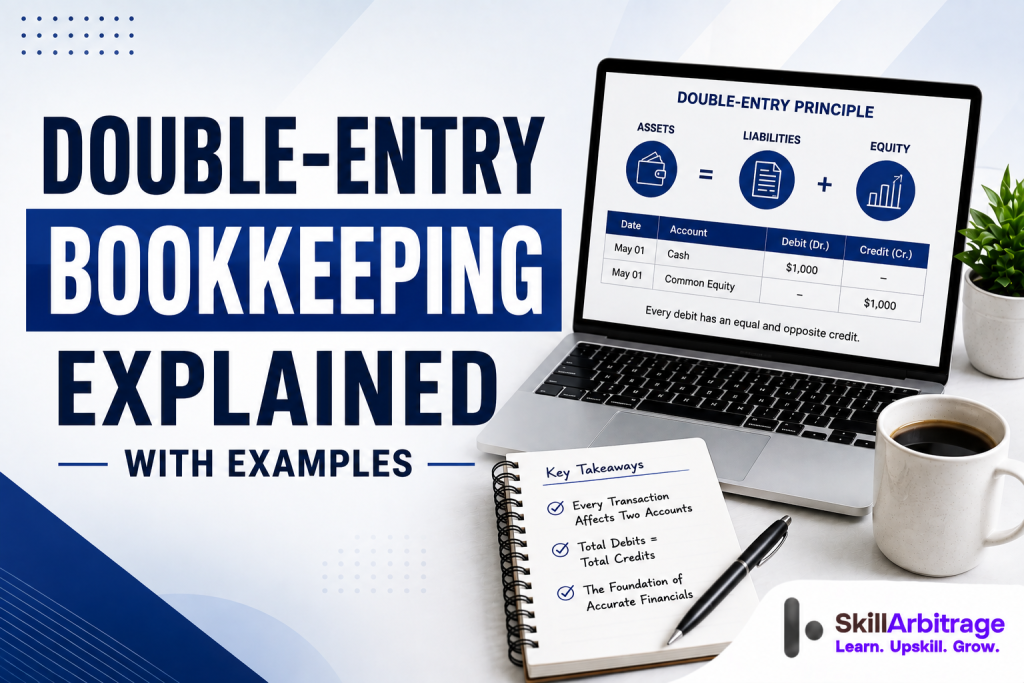
Every transaction in double-entry bookkeeping is recorded twice, once as a debit and once as a credit, for the same amount. Sell a service for $1,000 on credit and you debit Accounts Receivable $1,000 and credit Service Revenue $1,000. Total debits always equal total credits, which keeps assets equal to liabilities plus equity.
That balancing rule is the entire system, and everything below is what it takes to apply it: the equation it protects, the debit and credit rules, the entries themselves, and the check that proves the work.
The numbers behind the shift are worth knowing. The U.S. Bureau of Labor Statistics projects employment of bookkeeping, accounting and auditing clerks to fall 6 percent between 2024 and 2034, a drop of 94,300 jobs from a base of 1,613,400, with median pay at $49,210 in May 2024 (U.S. Bureau of Labor Statistics (2024)). BLS points to software automating routine tasks.
But the same page projects about 170,000 openings a year over that decade, and says clerks are expected to move into a more analytical and advisory role. Read together, those two facts say something specific. The typing is going away. The judgement is not.
How does double-entry bookkeeping work?
Double-entry bookkeeping works by recording every transaction in at least two accounts, so that the amount entered on the debit side always equals the amount entered on the credit side. Nothing goes in on its own. If cash moves, something else moved with it, and the entry has to show both halves.
Think about what a one-sided record can prove. If you write down “received $1,200”, the note tells you cash went up. It doesn’t tell you why. It could be a sale, a loan, a refund, or the owner putting money in, and each of those means something completely different about the health of the business.
Double entry forces you to answer the “why” at the moment you record the “what”. That’s the whole design.
1.1 The two-sided rule, and why one entry is never enough
Every transaction has a source and a destination. Money, or value, leaves one place and arrives somewhere else. The debit records where value went. The credit records where it came from.
Take that $1,200 again. If it was a cash sale, you debit Cash $1,200 because cash increased, and credit Service Revenue $1,200 because the revenue is what caused the increase. Two accounts, one amount, opposite sides.
Because the two sides always match, the books carry a built-in arithmetic check. Add up every debit in the ledger and every credit in the ledger, and the two totals should be identical. When they aren’t, you know something is wrong before anyone else finds out.
That check is the reason the system survived 500 years of accounting technology changes.
1.2 Journals, ledgers and the order they run in
Entries move through two books, in a fixed order. First the journal, then the ledger.
The journal is the chronological record. Every transaction gets written there in date order, as it happens, with its debit and its credit. The ledger is the same information rearranged by account, so you can see everything that hit Cash, or everything that hit Accounts Payable.
The IRS describes this sequence plainly in its guidance for new businesses: a double-entry system uses journals and ledgers, and transactions are entered in a journal first and then posted to ledger accounts (IRS Publication 583).

Those two books answer different questions. The journal answers “what happened on 14 March”. The ledger answers “what is the balance of Cash right now”. You need both.
1.3 Where double-entry bookkeeping came from
The method is older than most people assume. Accountancy can be traced back to the 13th century, though the first printed bookkeeping treatise came later, published in Venice in 1494 (Library of Congress history of accounting guide).
That book was Summa de Arithmetica, Geometria, Proportioni et Proportionalità, written by a Franciscan friar and mathematician. It included the first printed description of the double-entry bookkeeping system, which Venetian merchants were already using, according to the Institute of Chartered Accountants in England and Wales. It was written in Italian rather than Latin, and that choice, along with its worked examples, is a large part of why it travelled.
Here’s the part that matters for a working bookkeeper. Nothing about the underlying logic has changed since. Manual ledgers became spreadsheets, spreadsheets became QuickBooks and Xero, and the debit still equals the credit.
So why learn the entries at all when the software balances everything automatically? Because the software guarantees the two sides match. It doesn’t guarantee they’re the right two accounts.
That distinction is also where bookkeeping and accounting separate. Bookkeeping is recording the transactions correctly. Accounting is interpreting what the resulting statements mean. Double entry sits at the base of both.
The accounting equation behind every entry
The accounting equation behind every entry is Assets = Liabilities + Equity. Everything a business owns was funded either by borrowing (liabilities) or by the owners (equity). The two sides describe the same pile of value from different directions, which is why they can never drift apart.
Double entry is simply the bookkeeping method that keeps this equation true after every single transaction. Not at month-end. After every one.
2.1 Assets = Liabilities + Equity, and the five account types
Five account types cover everything in a set of books.
Assets are what the business owns or is owed: cash, bank accounts, accounts receivable, inventory, equipment. Liabilities are what it owes: accounts payable, loans, sales tax collected but not yet remitted, customer deposits. Equity is the owners’ residual claim: capital contributed, plus profits retained, minus drawings.
Then two more that feed equity. Revenue is what the business earns. Expenses are what it spends to earn it.
If you’re setting up a client’s books from scratch, the account structure matters as much as the entries. We’ve covered how a US chart of accounts is structured separately, and it’s worth reading alongside this.
2.2 How revenue and expenses feed equity
Revenue and expenses aren’t separate from the equation. They’re a temporary split of equity.
When a business earns $1,200, equity rises by $1,200. When it pays $2,000 of rent, equity falls by $2,000. Bookkeepers route these through Revenue and Expense accounts during the year so the profit-and-loss statement has something to report, then close them into equity at year end.
That’s why the full equation is sometimes written as Assets = Liabilities + Equity + Revenue – Expenses. Same rule, more detail.
In practice, the point that trips people up is treating equity like a pot of cash. It isn’t. Equity is a residual figure, the number left over once you subtract what’s owed from what’s owned, and a business can have healthy equity and no money in the bank at the same time.
2.3 How transactions maintain the equation
The equation holds after every transaction, whatever the transaction is. Rather than prove that once, run five different types through it and watch the running balance.
| # | Transaction | Assets | Liabilities | Equity | A = L + E |
|---|---|---|---|---|---|
| 1 | Owner invests $10,000 cash | +10,000 | 0 | +10,000 | 10,000 = 0 + 10,000 |
| 2 | Buys $5,000 equipment on credit | +5,000 | +5,000 | 0 | 15,000 = 5,000 + 10,000 |
| 3 | Cash sale of $1,200 | +1,200 | 0 | +1,200 (revenue) | 16,200 = 5,000 + 11,200 |
| 4 | Pays $2,000 rent in cash | -2,000 | 0 | -2,000 (expense) | 14,200 = 5,000 + 9,200 |
| 5 | Pays $3,000 against the equipment bill | -3,000 | -3,000 | 0 | 11,200 = 2,000 + 9,200 |
Rows 3 and 4 are the ones to study. They’re where revenue and expense actually reach equity, and that’s the step most people skip when they’re learning.
Row 5 is worth a second look too. Paying a supplier reduces assets and liabilities by the same amount and never touches equity at all. The business is no richer or poorer for having paid a bill it already owed.
Row 2 is the one that catches new bookkeepers. Buying equipment on credit doesn’t reduce anything. It grows both sides of the equation, because you gained an asset and took on a debt in the same moment.
The pitfall here is booking an asset purchase straight to an expense account. If that $5,000 of equipment lands in an expense account, profit drops by $5,000 in a single month, the balance sheet never shows the asset, and the depreciation that should have been spread over several years never happens. The books still balance. They’re just wrong, which is a theme we’ll return to.
Which accounts increase with a debit?
Assets and expenses increase with a debit. Liabilities, equity and revenue increase with a credit. That single sentence covers the rule, and the rest of this section is about making it stick.
The terms themselves are the obstacle. “Debit” comes from the Latin debere, to owe, and neither word means in accounting what it means at a bank. That mismatch confuses almost everyone at the start.
3.1 The debit and credit rules by account type
Here is the full rule set in one place.
| Account type | Increases with | Decreases with | Normal balance | Examples |
|---|---|---|---|---|
| Asset | Debit | Credit | Debit | Cash, Accounts Receivable, Equipment |
| Expense | Debit | Credit | Debit | Rent, Salaries, Processing Fees |
| Liability | Credit | Debit | Credit | Accounts Payable, Loans, Sales Tax Payable |
| Equity | Credit | Debit | Credit | Owner’s Capital, Retained Earnings |
| Revenue | Credit | Debit | Credit | Service Revenue, Sales Revenue |
Some people memorise this with a mnemonic. DEAD CLIC is a common one: Debits increase Expenses, Assets and Drawings, Credits increase Liabilities, Income and Capital.
Use it if it helps. But don’t rely on it, because mnemonics break the moment you meet a contra account, which is an account that sits inside one category and behaves like the opposite. Accumulated Depreciation is an asset account with a credit balance. Sales Returns is a revenue account with a debit balance.
Work from the equation instead. Assets sit on the left of Assets = Liabilities + Equity, so they increase on the left side, which is the debit side. Liabilities and equity sit on the right, so they increase on the right, which is the credit side. Get that, and you never need the mnemonic again.
This is also where bookkeepers trained in India sometimes hesitate. The traditional Indian teaching uses the golden rules of personal, real and nominal accounts, which arrive at exactly the same answers by a different route. The debits and credits don’t change when you move to a US client’s file. Only the vocabulary and the chart of accounts do.
3.2 Normal balances, and what an abnormal balance signals
Every account has a side it normally sits on. Assets and expenses normally carry debit balances. Liabilities, equity and revenue normally carry credit balances.
An abnormal balance is a free diagnostic. A credit balance in Cash means the books show the bank account overdrawn, which is either true or an error. A debit balance in Accounts Payable usually means a supplier was overpaid, or a payment was recorded twice.
Scan the trial balance for abnormal balances before anything else. It takes thirty seconds and it catches a surprising amount.
Reducing an expense follows the same logic in reverse. Expenses increase with a debit, so to reduce one you credit it. That’s what happens when a supplier refunds you: cash comes back in as a debit, and the expense comes down as a credit.
3.3 Why the bank statement’s “credit” means the opposite
This is the single most common source of confusion, and it has a clean explanation.
Your bank statement is written from the bank’s point of view, not yours. When money lands in your account, the bank owes you more, so the bank credits your account in its books. In your own books, the same event is a debit to Cash, because your asset went up.
Both records are correct. They’re just kept by two different parties looking at the same money from opposite sides.
One related term worth separating: a debit note is a document a buyer sends a supplier to request a reduction in an invoice, usually for returned or faulty goods. A debit entry is a line in a ledger. Similar words, different things.
Journal entry examples for common transactions
Journal entry examples for common transactions are the fastest way to make the rules concrete. Below are thirteen transactions a small US business generates in a typical month, each with its entry and a line on why it works that way.
The business in these examples sells both services and products, which is why two revenue accounts appear. Keep them in view, because the trial balance in the next section is built from exactly these numbers.
4.1 Owner investment, cash sale, credit sale, customer deposit
Owner invests $10,000 to start the business. Debit Cash $10,000. Credit Owner’s Capital $10,000. Cash is an asset and it increased, so it’s debited. The owner’s claim on the business increased by the same amount.
Cash sale of $1,200 for services. Debit Cash $1,200. Credit Service Revenue $1,200. The revenue is credited because revenue increases equity, and equity increases on the credit side.
Credit sale of $1,000, invoice issued, payment due in 30 days. Debit Accounts Receivable $1,000. Credit Service Revenue $1,000. No cash moved, and that’s the point. The work is done, so the revenue is earned and recorded now. What you hold instead of cash is a right to collect, which is an asset.
When the client pays 30 days later, you debit Cash $1,000 and credit Accounts Receivable $1,000. Revenue is not touched a second time, because it was already recorded. That collection entry is shown here to complete the picture, but the trial balance later assumes the invoice is still outstanding at month-end.
Customer pays a $500 deposit for work not yet started. Debit Cash $500. Credit Customer Deposits $500. Cash arrived, but nothing has been earned yet. The deposit is a liability, because the business owes the customer either the work or the money back.
That last one is where a lot of small-business books go wrong. Recording a deposit as revenue overstates income in the current period and understates it later.
4.2 Purchase on account, expense paid in cash, equipment, payroll
Buys $300 of supplies on account. Debit Supplies $300. Credit Accounts Payable $300. The business received goods and promised to pay. Assets up, liabilities up.
Pays $2,000 rent in cash. Debit Rent Expense $2,000. Credit Cash $2,000. Expenses increase with a debit. Cash decreased, so it’s credited.
Buys $5,000 of equipment on credit. Debit Equipment $5,000. Credit Accounts Payable $5,000. Equipment is an asset with a life beyond this month, so it goes on the balance sheet rather than into an expense account. This is the transaction from the equation table, now written as a journal entry.
Payroll of $4,000 gross, with $700 withheld for taxes. Debit Salaries Expense $4,000. Credit Cash $3,300. Credit Payroll Taxes Payable $700. The full cost of employing someone is $4,000, so that’s the expense. Only $3,300 leaves the bank. The withheld $700 is money the business is holding on someone else’s behalf, which makes it a liability until it’s remitted.
4.3 Compound entries: card sale net of fees, sale with sales tax
A compound journal entry is one with more than two lines. The rule doesn’t change: total debits still equal total credits.
Card sale of $100, with $7 taken as a processing fee, $93 deposited. Debit Cash $93. Debit Processing Fees $7. Credit Sales Revenue $100. This is the entry offshore bookkeepers most often get wrong on Stripe, Shopify and PayPal payouts. The temptation is to record only the $93 that hit the bank.
Don’t. Post the gross. The customer paid $100, so revenue is $100, and the $7 is a real cost of doing business that belongs in an expense account. Netting it understates revenue and hides the expense completely, which distorts the profit margin and makes the fee invisible when someone asks why costs are rising.
Sale of $1,000 plus $85 of sales tax collected, invoiced. Debit Accounts Receivable $1,085. Credit Sales Revenue $1,000. Credit Sales Tax Payable $85. The customer owes $1,085. But only $1,000 is yours. The $85 is collected on behalf of a state tax authority and sits as a liability until it’s filed and paid.
Customer returns goods and is refunded $150. Debit Sales Returns $150. Credit Cash $150. Sales Returns is a contra-revenue account. Using it instead of debiting Sales Revenue directly keeps gross sales and returns visible as separate figures, which matters when a client wants to know their return rate.
Bank charges a $12 monthly account fee. Debit Bank Charges $12. Credit Cash $12. Bank fees follow the same principle as card fees. The fee is a real expense and gets its own account, rather than being quietly subtracted from a deposit where nobody will ever see it.
4.4 Depreciation and the contra-asset entry
Equipment loses value over time, and the books have to show that. Depreciation spreads the cost of an asset across the years it’s actually used.
Monthly depreciation of $250 on the equipment. Debit Depreciation Expense $250. Credit Accumulated Depreciation $250. The expense reduces profit for the month. The credit goes to Accumulated Depreciation rather than to Equipment itself.
That’s deliberate. Accumulated Depreciation is a contra-asset account, and keeping it separate means the balance sheet can show both the original cost of the equipment and how much value has been written off. Credit the asset account directly and you lose the original cost forever.
How do you post entries and build a trial balance?
You post entries and build a trial balance by moving each journal line into its ledger account, totalling every account, and then listing those totals in two columns to confirm the debits equal the credits. Until entries are posted, they’re just a diary. Posting is what turns them into balances.
5.1 Journal entries and the general ledger
The journal and the general ledger hold the same entries arranged two different ways. The journal is by date. The general ledger is by account.
Posting is the act of copying each journal line into its account in the general ledger. Take the credit sale from the last section. In the journal it appears once, as a single dated entry with two lines. In the ledger, the $1,000 debit lands in the Accounts Receivable account and the $1,000 credit lands in the Service Revenue account, each joining whatever was already there.
Larger businesses add subsidiary ledgers underneath. An accounts receivable subsidiary ledger holds a separate running balance for every customer. An accounts payable subsidiary ledger does the same for every vendor. The sum of all customer balances must equal the Accounts Receivable balance in the general ledger, which is then called the control account.
When those two disagree, something was posted to the control account without going through a customer. It’s a fast way to catch a stray manual entry.
In QuickBooks Online and Xero, all of this happens the moment you save a transaction, and you’ll never see the posting step. What you can see is the general ledger detail report, which lists every account with every transaction that hit it.
Learn to read that report. It’s the book of record, not the bank feed. The bank feed only knows what moved through the bank, which leaves out every invoice, bill, accrual and depreciation entry in the file.
5.2 Reading a T-account
A T-account is a way of sketching one ledger account on paper. Draw a T, put the account name on top, debits on the left, credits on the right.
Cash, from our thirteen transactions, looks like this. On the left, debits of $10,000, $1,200, $500 and $93. On the right, credits of $2,000, $3,300, $150 and $12. Left side totals $11,793, right side totals $5,462, so the balance is $6,331 on the debit side.
Nobody draws these professionally any more. But they’re still the quickest way to think through an unfamiliar transaction before you enter it, and they’re how most accounting exams test the logic.
5.3 Building the trial balance
A trial balance lists every ledger account with its closing balance in either the debit or the credit column, then totals both. Here it is, built from the thirteen transactions above.
| Account | Debit | Credit |
|---|---|---|
| Cash | 6,331 | |
| Accounts Receivable | 2,085 | |
| Supplies | 300 | |
| Equipment | 5,000 | |
| Accumulated Depreciation | 250 | |
| Accounts Payable | 5,300 | |
| Customer Deposits | 500 | |
| Sales Tax Payable | 85 | |
| Payroll Taxes Payable | 700 | |
| Owner’s Capital | 10,000 | |
| Service Revenue | 2,200 | |
| Sales Revenue | 1,100 | |
| Sales Returns | 150 | |
| Rent Expense | 2,000 | |
| Salaries Expense | 4,000 | |
| Processing Fees | 7 | |
| Bank Charges | 12 | |
| Depreciation Expense | 250 | |
| Totals | 20,135 | 20,135 |
Both columns come to $20,135, so the arithmetic is sound. Notice that Accounts Payable is $5,300, which is the $300 of supplies plus the $5,000 of equipment, and that Cash reflects all eight transactions that touched it.
Trace one number back if you want to prove the system to yourself. Sales Tax Payable shows $85 because exactly one transaction created it, and nothing has been remitted yet.
Run the trial balance before the close, not after. It’s a standard report in every accounting package, and it’s the cheapest error check available. The same logic drives the month-end close, where the trial balance is the gate everything else passes through.
5.4 Why the trial balance is not a balance sheet
The two get confused constantly, and they do different jobs.
A trial balance is an internal working list of every account, including revenue and expenses, arranged in debit and credit columns. Its only purpose is to prove the arithmetic. Nobody outside the finance function ever sees one.
A balance sheet is a formal financial statement showing assets, liabilities and equity at a point in time. Revenue and expenses don’t appear on it, because they’ve been rolled into equity through the profit-and-loss statement.
Put simply, the trial balance is the check. The balance sheet is the output.
Cr Service Revenue 1,000
What errors does a trial balance miss?
A trial balance misses every error that affects both sides equally. It proves that debits equal credits and nothing more. It cannot tell you whether the amounts were right or whether they went to the correct accounts.
So how can a set of books balance perfectly and still be wrong? Because balancing and being correct are two different tests, and a trial balance only runs the first one. A balanced set of books is not a correct set of books.
6.1 The six errors that survive a balanced trial balance
Six error types pass the check completely.
| Error | What it is | Example |
|---|---|---|
| Omission | The transaction was never recorded at all | An invoice never entered. Nothing is out of balance because nothing was posted |
| Commission | Right account type, wrong account | A payment credited to the wrong customer. Accounts Receivable is correct in total, the customer balances are not |
| Principle | Wrong class of account entirely | $5,000 of equipment posted to Repairs Expense. Debits still equal credits |
| Compensating | Two separate errors that cancel out | Sales overstated by $500 and an expense overstated by $500 |
| Original entry | The wrong amount posted to both sides | An invoice for $850 recorded as $580 in both the debit and the credit |
| Reversal | Debit and credit swapped | Cash credited and Revenue debited instead of the other way round |
The error of principle is the expensive one. Booking equipment as an expense understates profit this year, overstates it in later years, misses the depreciation, and can change the client’s tax position. Every column still adds up.
6.2 Finding an out-of-balance ledger
When the two columns don’t agree, the difference itself tells you where to look.
Take the difference and divide it by 9. If it divides evenly, you’re probably looking at a transposition: 540 entered as 450, or 85 as 58. Transposed digits always produce a difference divisible by 9.
Divide it by 2 instead. If that comes out evenly, an amount was posted to the wrong side. A $300 credit entered as a $300 debit produces a $600 gap, which is twice the original figure.
If the difference matches a transaction amount exactly, one side of that entry was never posted. And if none of these work, scan for abnormal balances, then compare this month’s trial balance against last month’s account by account. Whatever changed unexpectedly is where the problem is.
6.3 Correcting entries vs deleting the transaction
Here’s the habit that separates a professional from an amateur, and it takes ten seconds to learn.
When you find an error, do not delete the original transaction. Post a correcting entry instead. If $5,000 of equipment was wrongly debited to Repairs Expense, the fix is to debit Equipment $5,000 and credit Repairs Expense $5,000, dated when you found it, with a note explaining why.
Deleting the original destroys the audit trail. Cloud accounting systems log every edit and deletion, and a US firm reviewing your work can see exactly what you removed. And a file full of deletions looks like someone hiding something, even when nothing was hidden.
This matters more now than it did ten years ago. Automated categorisation has made an unbalanced trial balance almost impossible to produce, so the errors that survive into finished books are precisely the six above, the ones balancing never caught. Books can now be confidently, arithmetically perfect and still wrong.
Which is exactly why review has become the part clients pay for. Anyone can post entries. Reading a general ledger and spotting the misclassification is a different skill, and it’s the one that holds its value.
The control that catches most of what a trial balance can’t is reconciliation. Comparing the ledger against an independent outside record is the only way to find an omission, and reconciling the bank account every month is where most bookkeepers catch theirs.
When is double-entry bookkeeping required by law?
Double-entry bookkeeping is required by law in some jurisdictions and for some entity types, and left to the business owner’s choice in others. The answer genuinely depends on where the business is registered, which is why readers find contradictory advice within a week of searching.
Take the two jurisdictions that matter most to an Indian bookkeeper serving international clients.
7.1 The US position: what the IRS actually says
The IRS does not require every US taxpayer to use double-entry bookkeeping. Its guidance for new businesses frames the choice as the owner’s, stating that you must decide whether to use a single-entry or a double-entry system, and noting that the double-entry method has built-in checks and balances to assure accuracy.
What the IRS does require is that your books show gross income, deductions and credits, and that supporting documents such as invoices, receipts and bank statements back up the entries (what records the IRS expects a business to keep).
That’s a meaningful distinction, and it’s worth being precise about it with clients. Federal tax law sets a standard of adequacy, not a required bookkeeping method. A very small sole proprietorship with no inventory and no payroll can meet that standard on a single-entry cash log.
7.2 US GAAP, public companies and lenders
The practical triggers usually arrive before any legal one does.
US Generally Accepted Accounting Principles, the reporting framework maintained by the Financial Accounting Standards Board (Financial Accounting Standards Board), assume accrual accounting, and accrual accounting cannot be done without double entry. Tracking accounts receivable, accounts payable, inventory and deferred revenue requires two-sided entries by definition.
Public companies must follow GAAP. Private companies typically hit the requirement indirectly, through a lender, an investor, or an audit. Professional standards for the practitioners doing the work sit with the AICPA (AICPA).
So the trigger is rarely the tax code. It’s the first bank loan, the first outside investor, the first year with inventory, or the switch to accrual basis. If you’re unsure which basis a client is on, accrual and cash-basis accounting under US GAAP covers the distinction and the IRS rules around it.
One more separation worth making. Double entry and accrual are not the same thing.
Double entry is a recording method. Accrual is a timing rule about when revenue and expenses are recognised. A business can keep double-entry books on a cash basis, and some do.
Both QuickBooks Online and Xero are built on double entry underneath, regardless of which basis the client reports on. The software gives you a cash-basis or accrual-basis view of the same double-entry data.
7.3 The Indian position: Companies Act, 2013, s.128
India is more direct about it. Section 128 of the Companies Act, 2013 requires every company to keep books of account that give a true and fair view of its affairs, and specifies that those books be kept on an accrual basis and according to the double-entry system of accounting (Ministry of Corporate Affairs).
That’s a statutory mandate, not a recommendation, and it carries penalties. The requirement came forward from section 209 of the Companies Act, 1956, so it’s been settled law in India for decades. The wider set of standards that sit around it, including the true and fair view and the accrual requirement, are set out in this iPleaders explainer on the accounting standards that sit behind the Companies Act.
Note that it applies to companies. Indian sole proprietors and many partnerships are not caught by section 128.
The pitfall for anyone working across borders is assuming one country’s rule is universal. An Indian bookkeeper who tells a US sole proprietor that double entry is legally mandatory is wrong, and an Indian bookkeeper who tells a private limited company in India that it’s optional is also wrong. Check the jurisdiction and the entity type every time.
The underlying debit and credit logic, though, is identical in both countries. Only the reporting framework and the statutory obligations differ.
Single-entry vs double-entry bookkeeping
Single-entry bookkeeping records each transaction once, usually as a line in a cash log. Double-entry records it twice, as a matched debit and credit. The gap between them is much wider than “one entry versus two”.
8.1 What single entry can and cannot track
| Capability | Single entry | Double entry |
|---|---|---|
| Cash in and out | Yes | Yes |
| Accounts receivable (who owes you) | No | Yes |
| Accounts payable (who you owe) | No | Yes |
| Inventory | No | Yes |
| Balance sheet | No | Yes |
| Profit-and-loss statement | Partial | Yes |
| Built-in error check | No | Yes |
| Audit trail | Weak | Strong |
Single entry can tell you how much cash you have. It can’t tell you what you’re worth, what you’re owed, or what you owe. It produces no balance sheet, because it never tracks the other side of anything.
It also has no self-check. Miss a transaction in a double-entry system and the trial balance may catch it. Miss one in a cash log and there’s nothing to compare it against.
Single entry is a cash log with a more impressive name. That’s the honest description, and it’s fine for what it is: a sole proprietor with no staff, no inventory, no credit sales and few transactions.
8.2 The point at which a business has to switch
There are four fairly reliable triggers.
The first is selling on credit. The moment a business invoices rather than takes payment on the spot, it needs to track receivables, and single entry can’t. The second is inventory, which requires tracking cost of goods sold against stock on hand.
The third is outside money. A lender or investor will ask for a balance sheet, and a cash log cannot produce one. The fourth is hiring, because payroll liabilities need to be tracked between the pay run and the remittance.
Converting later is harder than starting right. The business has to reconstruct opening balances for every account from historical records. And those records are usually incomplete by the time anyone asks. If you’re setting up books for a new client, setting up books for a US small-business client walks through the full setup sequence.
8.3 What this means for a bookkeeping career
The career outlook splits in an interesting way, and the split is the whole story.
BLS projects bookkeeping, accounting and auditing clerk employment to decline 6 percent from 2024 to 2034. Over the same period it projects accountants and auditors to grow 5 percent, faster than the average for all occupations, adding about 72,800 jobs.
The pay gap says the same thing. Median pay for clerks was $49,210 in May 2024. For accountants and auditors it was $81,680. Roughly 170,000 clerk openings a year are still expected, though they come from replacement rather than growth.
Read that as a description of which work is disappearing. The clerical layer is shrinking. The judgement layer is growing. BLS says as much, describing clerks as expected to take on a more analytical and advisory role, analysing books and pointing out areas for efficiency rather than entering data by hand.
Early signals suggest the same thing about the error mix. As automation removes arithmetic errors, the remaining risk concentrates in classification and completeness, which are judgement problems. Nobody has automated the question “should this have gone to an asset account”.
This has a serious side too. Books that balance perfectly can still be deliberately false, and accounting fraud is usually a classification and disclosure problem rather than an arithmetic one. For readers who want to understand how that plays out in Indian law, LawSikho’s guide covers how accounting fraud is detected and prosecuted in India in some detail.
For a bookkeeper in India serving US clients, the practical conclusion is narrow and useful. Being fast at data entry is a shrinking asset. Being able to open a general ledger, read it, and say what’s wrong with it is not.
How do you practise double-entry bookkeeping?
You practise double-entry bookkeeping by working transactions end to end, from journal entry through to trial balance, before you ever touch a client’s live file. Reading about it is not the same as doing it. The trial balance either ties or it doesn’t, and that feedback is what actually teaches the system.
Three drills, in order.
9.1 Work a month of transactions by hand
Start with the thirteen transactions from the examples section. Write each journal entry from memory, post them to ledger accounts, then extract a trial balance without looking back at the table.
Do it on paper or in a spreadsheet, not in software. Software balances the entry for you, which removes the exact step you’re trying to learn.
One hand-worked month teaches more than ten hours of video, because there’s no partial credit. If your columns don’t agree, you have to find out why, and finding out why is the skill.
9.2 Break your own trial balance on purpose
This is the drill almost nobody does, and it’s the most valuable one.
Take your completed practice set and deliberately introduce each of the six error types from the errors section, one at a time.
Transpose two digits. Post an asset to an expense account. Swap a debit and a credit. Omit a transaction entirely.
Then hunt each one down. You’ll learn quickly that three of them break the trial balance and three don’t, and that the three that don’t are the ones you’ll actually meet in a real client file.
Practising only the happy path is the common mistake. It means the first misclassification you ever see is one in a client’s live books, under time pressure, with someone waiting on the numbers.
9.3 Move to a sandbox company file
Once the logic is solid, move into the tools. QuickBooks Online and Xero both offer trial or demo company files, so you can post entries and pull reports with no client data at risk.
Post the same thirteen transactions there. Then open the general ledger detail report and the trial balance and confirm the software produced what you produced by hand. Where the two disagree, work out which is right and why.
That final comparison is the point of the whole exercise. It’s what turns a definition you can recite into a system you can actually audit.
9.4 Where this leaves you
Double-entry bookkeeping comes down to one rule applied consistently: every transaction is recorded twice, in equal and opposite amounts, so the accounting equation stays true. The debit and credit rules follow from the equation. The journal, the ledger and the trial balance are just the machinery that applies the rule and proves it was applied.
What’s changed is not the rule. It’s that software now handles the applying, and the proving, on its own. What software can’t do is decide which two accounts a transaction belongs in, and that decision is where every meaningful error now lives.
So the reason to learn this properly isn’t to compete with the software at posting entries. It’s to be the person who can look at a balanced set of books and tell whether they’re actually true. That job existed in 1494 and it still exists in 2026, and it’s the part of the work that pays.
Frequently asked questions
1. What is double-entry bookkeeping? Double-entry bookkeeping is a recording method where every transaction is entered in at least two accounts, as a debit in one and a credit in another, for the same amount. Total debits always equal total credits. This keeps the accounting equation, Assets = Liabilities + Equity, true after every transaction.
2. What is the accounting equation? The accounting equation is Assets = Liabilities + Equity. It states that everything a business owns was funded either by debt or by its owners. Revenue and expenses expand it, since both flow into equity, giving Assets = Liabilities + Equity + Revenue – Expenses.
3. Why is it called debit and credit? “Debit” comes from the Latin debere, meaning to owe, and “credit” from credere, to trust or believe. Both terms were formalised in the 1494 printed description of the method. In modern bookkeeping they simply mean the left side and the right side of an entry, with no sense of good or bad attached.
4. What is a trial balance? A trial balance is an internal list of every ledger account with its closing balance, arranged in debit and credit columns and totalled. Its purpose is to confirm that total debits equal total credits. It’s a working document, not a financial statement, and it’s usually run before the month-end close.
5. Is double-entry bookkeeping required by law? It depends on the jurisdiction and the entity. In India, section 128 of the Companies Act, 2013 requires companies to keep books on an accrual basis using the double-entry system. In the US there is no blanket federal requirement for all taxpayers, though GAAP, lenders and accrual accounting make it necessary in practice.
6. Does the IRS require double-entry bookkeeping? No. IRS guidance for new businesses presents single-entry and double-entry as a choice the business owner makes, while noting that double entry has built-in checks and balances. What the IRS does require is that your books show gross income, deductions and credits, supported by documents such as invoices and bank statements.
7. Do I need double entry for a sole proprietorship? Not necessarily. A sole proprietor with no inventory, no payroll and no credit sales can often manage on a single-entry cash log. The moment the business invoices customers, carries stock, hires staff or approaches a lender, single entry stops being adequate.
8. Does QuickBooks use double entry? Yes. QuickBooks Online is built on a double-entry ledger, as is Xero. The software creates both sides of every entry automatically, which is why users rarely see the debits and credits unless they open the journal or the general ledger report.
9. Which accounts increase with a debit? Assets and expenses increase with a debit. That includes Cash, Accounts Receivable, Equipment, Rent Expense and Salaries Expense. Contra accounts are the exception: Accumulated Depreciation is an asset account that increases with a credit.
10. Which accounts increase with a credit? Liabilities, equity and revenue increase with a credit. That includes Accounts Payable, Loans, Sales Tax Payable, Owner’s Capital, Retained Earnings and all revenue accounts. The logic comes from the equation: these sit on the right-hand side, so they grow on the right, which is the credit side.
11. What is a compound journal entry? A compound journal entry is one that affects more than two accounts. A card sale of $100 with a $7 processing fee is a common example: debit Cash $93, debit Processing Fees $7, credit Sales Revenue $100. The balancing rule is unchanged, since total debits still equal total credits.
12. What is a contra account? A contra account sits within one account category but carries the opposite normal balance. Accumulated Depreciation is a contra-asset with a credit balance, and Sales Returns is a contra-revenue with a debit balance. They exist so the original figure and the reduction stay visible separately rather than being netted into one number.
13. Single-entry vs double-entry bookkeeping: which should I use? Use single entry only for a very small cash-based business with no receivables, payables, inventory or staff. Use double entry for everything else. Double entry is the only method that produces a balance sheet, tracks what you’re owed and what you owe, and carries a built-in arithmetic check.
14. Is double-entry bookkeeping the same as accrual accounting? No. Double entry is a method of recording transactions. Accrual is a timing rule about when revenue and expenses are recognised. Accrual accounting requires double entry to work, but double-entry books can be kept and reported on a cash basis.
15. What is the difference between a trial balance and a balance sheet? A trial balance is an internal check listing every account, including revenue and expenses, in debit and credit columns. A balance sheet is a formal financial statement showing assets, liabilities and equity at a point in time. Revenue and expenses don’t appear on a balance sheet, because they’ve already been rolled into equity.
16. Why won’t my trial balance balance? Take the difference and divide it by 9. If it divides evenly, you probably have transposed digits, such as 540 entered as 450. If it divides evenly by 2, an amount was posted to the wrong side. If the difference exactly matches a transaction amount, one side of that entry was never posted.
17. My debits equal my credits but the numbers are still wrong. Why? Because a trial balance only proves the arithmetic, not the accuracy. Any error affecting both sides equally will pass it, including a transaction posted to entirely the wrong account, a wrong amount entered on both sides, or a transaction omitted altogether. Reconciliation and review are what catch these.
18. What errors does a trial balance not catch? Six types: omission (never recorded), commission (right account type, wrong account), principle (wrong class of account entirely), compensating (two errors cancelling out), original entry (wrong amount on both sides), and reversal (debit and credit swapped). The error of principle is usually the most costly, since it can change the client’s tax position.
References
- IRS Publication 583, Starting a Business and Keeping Records (Internal Revenue Service)
- What kind of records should I keep (Internal Revenue Service)
- US Generally Accepted Accounting Principles (Financial Accounting Standards Board)
- Professional standards for accounting practice (AICPA and CIMA)
- Companies Act, 2013, section 128, books of account (Ministry of Corporate Affairs, India)
- Occupational Outlook Handbook, Bookkeeping, Accounting, and Auditing Clerks (U.S. Bureau of Labor Statistics, 2024)
- Occupational Outlook Handbook, Accountants and Auditors (U.S. Bureau of Labor Statistics, 2024)
- Historical accounting literature, the 1494 Summa (Institute of Chartered Accountants in England and Wales)
- History of Accounting, Early History to 17th Century (Library of Congress)
This article is for educational purposes only and does not constitute professional, financial, legal, or immigration advice. For guidance specific to your situation, consult a qualified professional.





 Allow notifications