
Last verified: 2026-07-21
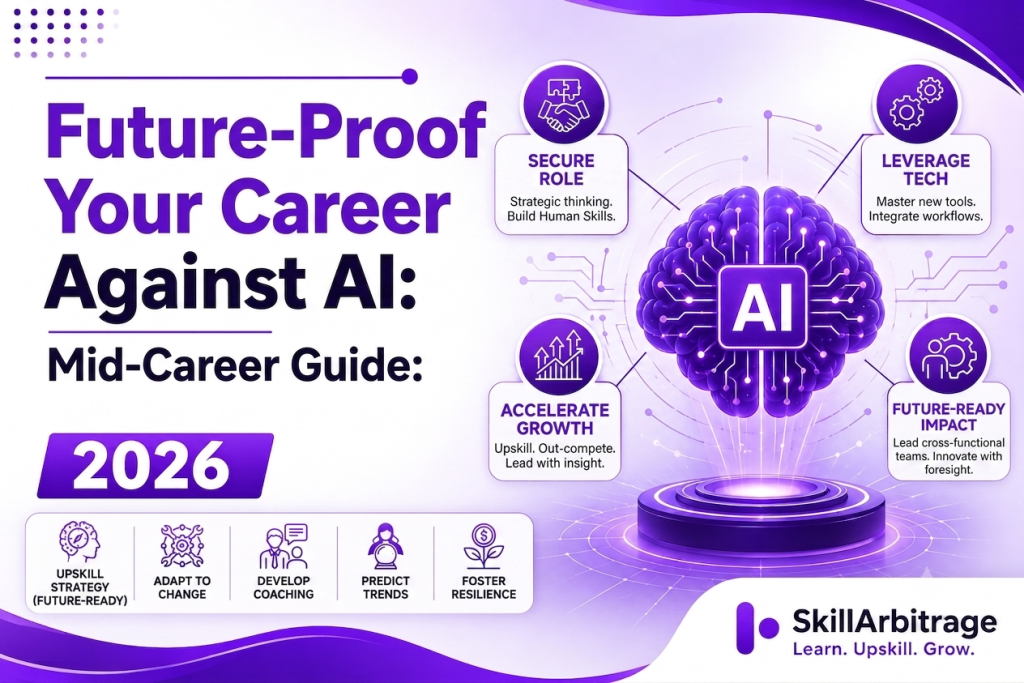
To future-proof your career against AI, stop asking whether a machine can do your job and start measuring how much of your working week it can already do. Whole jobs rarely vanish at once. Tasks do, and they go quietly: the weekly report that now takes a model ten minutes, the first-draft memo, the deck nobody wants to build. Future-proofing is personal risk management. You audit which of your tasks are exposed, you shed or automate those yourself, and you reinvest the freed time into work a model cannot replicate, judgment, accountability, relationships, and context only you hold.
This article sets out how to future-proof your career against AI: score your exposure, cut your automatable tasks, and build a moat that keeps your work valuable.
Consider a common scene in 2026. A mid-career manager who once spent Friday afternoons pulling a status report watches a colleague generate a cleaner version in the time it takes to get coffee. Nothing was announced. No role was cut. But a task that used to justify part of a salary just got cheap, and that is how the pressure actually arrives, one task at a time.
That is the useful frame for anyone between 35 and 55 who has more career behind the starting line than ahead of it. You are not trying to out-type a model. You are trying to make sure the shrinking pile of things only you can do is worth more than the growing pile a model can do for anyone.
You future-proof your career against AI by treating it as personal risk management: audit which of your tasks a model can already do, shed or automate those yourself, and reinvest the time into judgment, relationships, and accountability that do not transfer to software. Exposure is measured in tasks, not whole jobs, which is why the size of your title matters less than the mix of your week.
The sections below move from diagnosis to plan. First, what future-proofing actually means at this stage. Then a way to score your own exposure, why the middle of a career is the sharp end, the concrete moves that lower your number, and a plan you can start this month.
What future-proofing your career against AI actually means
Future-proofing your career against AI means lowering the share of your work that a model can already do well, and raising the share it cannot touch. It is a defensive, personal job, closer to managing a risk exposure than to learning a new app. The goal is not to become the best prompter in the building. It is to make sure that when routine work gets cheap, your value has already moved to where the money and the security still sit.
The data supports treating this as repricing rather than replacement. According to McKinsey’s State of AI 2025 research, 88% of organizations now use AI regularly in at least one function, up from 78% a year earlier, yet only about a third have moved past pilots to real scale. The tools are everywhere; the value is not. That gap is where careers are won or lost, because it is filled by people who can turn a capable model into a useful result, not by the model itself.
Exposure, not extinction
The right unit of worry is the task, not the title. A model does not arrive one morning and take your job; it takes a slice of your week, then another, until the remaining slice no longer justifies the cost of you. PwC’s 2025 Global AI Jobs Barometer, which analysed close to a billion job ads, found that jobs most exposed to AI are actually growing 3.5 times faster than the market, not disappearing. Exposure reshapes a role; it rarely erases it outright.
That reshaping is still a threat if you sit still, which is why the question of whether machines fully replace experienced people is a distraction from the practical work. If you want that debate settled with numbers, our piece on whether AI will actually replace experienced professionals covers it. This guide assumes the answer is “your tasks, not your job, unless you let the two become the same thing,” and moves straight to lowering the risk.
Why this is your job, not your employer’s
Future-proofing is something you own, because no one else has the incentive to do it for you. Your employer optimises for the organization’s output, not for the durability of your particular role. If AI lets the company deliver your function with fewer or cheaper people, that is a win on their side of the ledger and a risk on yours. Waiting for a training program to rescue you is a passive bet on someone else’s priorities.
There is one exception worth naming. If you also lead a team, part of your defence is leading its adoption well, which is a different job with its own playbook; the leadership version of staying relevant and leading AI adoption covers that management task. This guide stays on the individual: what you do about your own exposure, regardless of whether anyone reports to you.
Score your role’s AI exposure
Your AI exposure is the share of your working time spent on tasks a model can already do well, and you can put a rough number on it in about twenty minutes. Most people carry a vague dread instead of a figure, which is worse, because dread does not tell you what to change. A score does. The method is simple: list your recurring tasks, rate each on how automatable it is and how much of your time it eats, and combine the two.
The point of scoring is not precision to the decimal. It is to convert “I feel replaceable” into “these three tasks are 60% of my week and a model can already do them,” which is an actionable sentence. Once you can see which specific work is exposed, the defence stops being abstract.
The three signals that make a task exposed
A task is highly exposed when it carries all three of these signals at once. First, it is routine and repeatable, following a pattern the task has followed many times before. Second, it is fully digital, done entirely in text, spreadsheets, slides, or code, with no physical or in-person component. Third, it is low-stakes in judgment, meaning a wrong output is cheap to catch and cheap to fix, so no one is betting much on your discernment.

Reverse those signals and you get the tasks that stay human. Work that is novel, that touches the physical world or a real relationship, or that carries expensive and hard-to-detect consequences resists automation, because the cost of a confident wrong answer is too high to hand to a system that cannot be held accountable. Sorting your week by these three signals is the whole diagnostic.
A worked exposure audit
Here is the method applied to a real mid-career role, a marketing manager, so you can copy the format. List each recurring task, rate its automatability from 1 (a model cannot do it) to 5 (a model does it well today), estimate the share of your week it takes, and multiply the two, then read the weighted total.
| Recurring task | Automatability (1-5) | Share of week | Weighted exposure |
|---|---|---|---|
| Drafting posts, emails, and first-pass copy | 5 | 25% | 1.25 |
| Pulling and summarising campaign reports | 5 | 15% | 0.75 |
| Competitor and market research write-ups | 4 | 10% | 0.40 |
| Deciding quarterly strategy and budget trade-offs | 2 | 15% | 0.30 |
| Managing the team and handling performance issues | 1 | 20% | 0.20 |
| Negotiating with agencies and senior stakeholders | 1 | 15% | 0.15 |
Add the weighted column and divide by 5 to get a rough exposure percentage. Here the weighted total is 3.05 out of a possible 5, which is about 61% exposure. Read plainly, roughly 60% of this manager’s week sits on tasks a model can already do well, and almost all of it is concentrated in drafting, reporting, and research. That concentration is good news, because it tells you exactly where to act.
Reading your score
Your score falls into one of three bands, and each points to a different urgency. Below about 30% exposure, you are in a low-exposure role and your job is mostly to keep it that way with a periodic re-check. Between 30% and 55%, you are in the watch band: a meaningful chunk of your week is automatable, and you should start shifting your task mix before the market forces it. Above 55%, you are in the high-exposure band, where the majority of your paid time is on work a model does cheaply, and repositioning is no longer optional.
The marketing manager above, at 61%, sits firmly in the high band despite a respectable title and real management duties. That is the trap this scoring exposes: a senior-sounding role can still be mostly automatable work, and the title hides it until someone runs the numbers.
The mid-career squeeze: why 35 to 55 is the sharp end
Mid-career professionals face the sharpest version of AI exposure because they combine an expensive salary with a task mix that is still heavily automatable. A junior is cheap, so automating their tasks saves little. A senior leader’s week is mostly judgment, relationships, and accountability, which resist automation. The person in the middle is often paid a senior salary to do work that has quietly become automatable, and that combination puts a target on the role.
This is not a claim that mid-career workers are less capable. It is an observation about economics. Automation gets deployed where the cost saved is largest, and the largest saving comes from replacing expensive time spent on cheap-to-automate tasks. That is a precise description of a lot of mid-career work.
The cost-to-automatable ratio
The metric that matters here is the ratio of your cost to the automatable share of your work. A model does not evaluate your years of service; it makes a slice of your output reproducible at near-zero marginal cost, and someone then compares that saving against your salary. When both numbers are high, a well-paid role and a heavily automatable week, the arithmetic gets uncomfortable fast.
You lower the ratio from either side. You cannot easily cut your own salary, and you should not want to. So the lever you actually control is the denominator: shrink the automatable share of your week, and the case for replacing you weakens on its own. This is why the exposure audit is not academic. It is the number your role is quietly being judged against.
Where mid-career sits against juniors and seniors
Exposure does not rise smoothly with seniority; it tends to peak in the middle. Entry-level workers do exposed tasks but cost little, so the return on automating them is small and often not worth the disruption. Senior leaders have usually shed hands-on execution in favour of decisions, people, and outcomes, which are the least exposed activities. Mid-career professionals are the ones most likely to be both expensive and doing work a model can now do, which is the worst square to be standing on.
The encouraging counterpoint is that the same middle position is the easiest to move from, because you already have the domain depth to climb toward judgment work. A junior lacks the experience to reposition upward quickly; you do not. The squeeze is real, and so is your ability to step out of it.
The runway problem
Time is the hidden variable in mid-career risk. Someone at 28 who ignores AI for three years still has decades to recover. Someone at 48 who does the same is closer to the point where changing direction gets genuinely harder, and where the market’s assumptions about adaptability start to work against them. The exposure is not only higher; the time to respond is shorter.
That is an argument for acting early rather than for panic. A small, deliberate shift in your task mix compounds, and starting it at 40 buys years of that compounding before it is needed. Learning the tools themselves is the most reversible part of this and can be done at any age; our guide on reskilling and learning AI in your 40s and 50s covers the how. The scarce resource is not learning capacity. It is the runway to reposition before exposure turns into redundancy.
Moves that lower your AI exposure
You lower your AI exposure by changing your task mix on purpose, and there are three moves that do the work. Shed and automate the exposed tasks yourself, move the freed time up the judgment stack, and become the person who directs the AI rather than the person competing with it. Done together, they drop your exposure score and raise the part of your value a model cannot reach.
None of these require you to become a technologist. They require you to be deliberate about what you spend your week on, which is a decision you already make by default. The only change is making it on purpose, guided by your exposure audit.
Shed and automate your exposed tasks first
The strongest defence is to automate your own exposed work before someone automates it for you. If a model can draft your weekly report, be the one who builds that workflow, hands back the saved hours, and redirects them to work that is harder to replace. This flips a threat into a credential: instead of being the person whose reporting got automated, you become the person who automated it and freed the team to do more.
This is offence disguised as defence. The professional who says “I cut four hours a week off routine reporting and reinvested them in customer research” is describing exactly the repositioning that protects a career. The one who quietly keeps doing the four hours by hand is preserving the most exposed part of their job and calling it work. PwC’s barometer found that wages are rising twice as fast in industries more exposed to AI, and that jobs demanding AI skills carry an average wage premium of 56%, which tells you the reward flows to the people who put the tools to work, not to the ones avoiding them.
Move up the judgment stack
The second move is to take the time automation frees and spend it on higher-judgment work, which means trading tasks with cheap mistakes for tasks with expensive ones. Take the marketing manager from earlier. Drafting and reporting were 40% of the week and almost fully exposed. Handing those to a model and reinvesting the time into pricing strategy, positioning decisions, and direct customer conversations moves that 40% from the exposed column to the moat column, without changing the job title at all.
The worked version looks like this. Pick one exposed task you own, name the higher-judgment task it sits next to, and consciously shift your hours toward the second. Reporting sits next to deciding what the numbers mean and what to do about them; first drafts sit next to shaping the argument and owning the recommendation. The model can produce the artifact; deciding whether it is right, and carrying that decision, is the work that stays yours.
Direct the AI instead of competing with it
The third move is to become the person who directs the model well, since a professional who can brief a model, catch its errors, and decide what to do with its output is worth more than either the tool alone or a peer who refuses to touch it. You do not need to compete with the model on speed, a contest you will lose. You need to sit above it, supplying the judgment and accountability it lacks. That is a durable position precisely because McKinsey’s data shows most organizations have the tools but cannot yet turn them into results.
If you manage people, this scales into leading adoption across a team, which is its own discipline and a separate defence worth building. For the individual version, the skill is narrower and learnable: enough fluency to direct the tool confidently, plus the domain judgment you already have to know when its output is wrong.
| Task | Move | Why |
|---|---|---|
| First-draft copy, emails, and posts | Shed | Fully digital, routine, and cheap to fix. A model produces the draft in minutes; own the automation, not the typing. |
| Pulling and summarising routine reports | Shed | Pattern-based digital output. Automate it yourself and hand back the saved hours as a visible win. |
| First-pass research write-ups | Shed | Easily reproduced and cheap to check. Keep the deciding, not the compiling. |
| Deciding what the numbers mean and what to do | Build | Accountable judgment on an ambiguous call. A model can suggest; it cannot be answerable for the choice. |
| Client and stakeholder relationships | Build | Trust and context a model has no access to. The assets that do not transfer to software. |
| Owning a decision and its consequences | Build | Someone has to carry the risk. That responsibility is structurally human and stays valuable. |
Build a career moat AI cannot copy
A career moat is the part of your value that does not transfer to a model, and building one is the offensive half of future-proofing. Lowering exposure removes risk; building a moat adds value that competitors, human or machine, cannot easily reproduce. The strongest moats share a trait: they depend on things a model has no access to, such as private context, real relationships, and the authority to be accountable for a decision.
Moats are built deliberately, not accumulated by accident. The professionals who feel secure in 2026 are usually the ones who can point to specific assets, a book of trusted clients, deep knowledge of one messy domain, a track record others rely on, rather than a general sense of being good at their job. General competence is exactly what a model competes with. Specific, non-transferable assets are what it cannot.
Proprietary context and relationships
Your most defensible asset is the context a model will never be trained on, because it lives in your head and your relationships rather than on the public internet. The unwritten reasons a key client makes decisions the way they do, the history behind why a process exists, the trust a colleague places in your read of a situation, none of that is in any training set. A model can draft an email to a client; it cannot know that this client goes quiet when nervous and needs a call, not a document.
You deepen this moat by going narrow and staying present. Become the person who understands one domain, one market, or one set of relationships more deeply than anyone else in reach, and keep investing in the human ties that no interface can replicate. The specific AI skills a field expects can be learned, as one profession’s list of the generative AI skills its people are now asked to build shows, but the context in which you apply them is yours alone.
Accountability and judgment as billable moats
Accountability is a moat because someone has to be answerable for a decision, and a model cannot be. When a recommendation goes wrong, an organization needs a person who owned the call, understood the trade-offs, and can be trusted to make the next one better. That responsibility is not a soft skill; it is a role a machine structurally cannot fill, which is why the work carrying it stays valuable even as the surrounding tasks get automated.
Judgment under ambiguity sits in the same category. The hard calls in most professions are not “what is the correct answer” but “which defensible option fits this situation, given constraints no document fully captures.” Choosing well when the inputs are incomplete, and standing behind the choice, is precisely what a text-prediction system does not do. Position yourself as the person who makes those calls, and you have attached your value to the part of the work that does not get cheaper.
Proof of work
A moat only protects you if it is visible, so the third piece is making your non-transferable value legible to the people who decide your future. Judgment and relationships are easy to undervalue precisely because they are quiet. A record that makes them concrete, decisions you owned and their outcomes, problems only you could untangle, clients who stayed because of you, turns an invisible moat into a defensible reputation.
Build this deliberately. Keep a running account of the calls you made and how they turned out, the messy situations you resolved, and the relationships that produced results, and use it wherever your value is being weighed, whether that is a performance review, a client pitch, or a move to a role that rewards judgment over execution.
Which mid-career and senior roles are most and least exposed
Exposure clusters by the task mix of a role, not by its prestige, so two roles at the same level can face very different risk. The pattern is consistent: roles built on routine digital output are highly exposed, while roles built on physical presence, high trust, or accountability for expensive decisions are not. Knowing which band your function sits in tells you how hard you need to push on the moves above.
The WEF’s Future of Jobs Report 2025, drawn from more than 1,000 large employers, estimates that 39% of the core skills workers need will change by 2030, down from 44% in 2023, with AI and big data the fastest-growing skill demand. The report also projects 170 million new roles created and 92 million displaced this decade, a net gain that still involves large movement between which roles are safe and which are not. Your job is to know which side of that movement your function sits on.
Higher-exposure functions
Functions dominated by routine digital production carry the highest exposure, because the bulk of their week is exactly what models do well. This includes much of content and copy production, basic data analysis and reporting, entry-to-mid customer support, routine bookkeeping and standard financial reporting, first-pass legal and contract drafting, and template-driven administrative work. The common thread is not the industry; it is that the day is mostly generating, summarising, or formatting text and numbers to a known pattern.
If your function is here, the audit will show a high score, and the response is urgency rather than alarm. These are also the roles where directing AI well produces the largest visible gains, so the same exposure that threatens the role rewards the person who repositions fastest.
Lower-exposure functions
Functions built on the physical world, deep trust, or accountable judgment carry the lowest exposure, because their core work resists reproduction. Skilled trades and hands-on technical roles, senior client and relationship management, complex negotiation and dispute resolution, roles requiring physical presence and care, and leadership positions where the job is deciding and being answerable all sit here. A model can assist each of these, but it cannot perform the part that defines them.
The lesson for a high-exposure professional is to migrate the mix toward these characteristics rather than to change careers wholesale. Even within an exposed function, the tasks that involve a real relationship, a physical component, or an accountable decision are the ones to move toward. How a single field reorganises around this, and what its new roles and salaries look like, is visible in accounts of how one profession’s roles, skills, and salaries are being reshaped by technology.
What to do if your role is high-exposure
If your role sits in the high-exposure band, treat it as a signal to reposition early, not as a verdict. The barometer’s finding that AI-exposed jobs are growing 3.5 times faster than the market means the function is not vanishing; it is changing shape, and the people who shape it deliberately keep the upside. Run the audit, pick the two most exposed tasks, and start the shed-and-move-up sequence this quarter rather than waiting for the change to be imposed.
The path from a high-exposure role often runs toward higher-value remote and independent work, where judgment and AI fluency together command a premium. Our roundup of high-paying remote roles for experienced professionals with AI skills maps several of those destinations for people repositioning out of exposed functions.
A personal plan to future-proof your career against AI
A personal plan to future-proof your career against AI runs in three moves over roughly ninety days: audit your exposure, reduce it, and reinforce your moat. This is the individual version, not a team rollout, and it is built to be started alone, this week, without waiting for permission or a company program. The aim by day 90 is a measurably lower exposure score and at least one moat asset you did not have before.
Keep the plan small enough to actually finish. Trying to overhaul your whole career in a quarter fails; shifting one exposed task, building one moat, and adding one source of resilience succeeds and compounds. Momentum beats ambition here.
First 30 days: audit and pick one moat
Spend the first month getting an honest number and choosing a direction. Run the exposure audit from earlier: list your recurring tasks, score each for automatability and time-share, and calculate your weighted exposure. Then pick a single moat to build over the quarter, the domain you will go deeper in, the relationships you will invest in, or the accountable work you will move toward, based on where your lowest-exposure, highest-value work already points.
By the end of the month you should be able to say two specific things: your exposure percentage and the two tasks driving most of it, and the one moat asset you are choosing to build. Vague intentions do not survive a busy quarter; a number and a named target do.
Days 31 to 90: shed a task, ship proof, add an income line
The middle two months are for action on three fronts. Shed one exposed task by automating it yourself and reinvesting the hours in higher-judgment work. Ship one piece of proof that makes your moat visible, a documented decision you owned, a problem you resolved, a result a relationship produced. And add one income line beyond your single employer, because dependence on one payer is its own form of AI exposure.
That third front matters more than people expect. A career that rests entirely on one job is fragile to any disruption, automation included, so building a second stream is defensive as well as lucrative. Fractional and consulting work is a common route, and our guide on monetising AI skills through fractional and consulting work lays out how to start one alongside a full-time role.
Ongoing: a quarterly re-audit
After the first ninety days, the plan becomes a quarterly habit, because exposure creeps back as models improve and your tasks drift. Once a quarter, re-run the audit, check whether your exposure score moved, and pick the next task to shed and the next moat asset to build. Fifteen minutes every three months keeps the number honest and the direction current.
This is the part that actually future-proofs the career, rather than the one-time push. AI capability is not static, so a defence built once and forgotten decays. A defence that gets re-checked every quarter stays ahead of the tools, which is the whole point.
Common mistakes when you future-proof your career against AI
The most common mistake is mistaking tool-collecting for repositioning, and it is worth naming the traps directly so you can avoid them. Future-proofing fails in predictable ways, and almost all of them share a root: they feel like progress while leaving your actual exposure untouched. Catching yourself in one of these is usually cheaper than the market catching you.
Tool-chasing instead of changing your task mix
Learning every new tool while keeping the same task mix is motion without movement. Fluency with a model is necessary, but it does not lower your exposure if you still spend your week on the same automatable work, now done slightly faster. The professionals who mistake a growing app collection for security are often the most exposed, because the effort goes into using the tools rather than repositioning around them. The test is simple: has your exposure score actually fallen, or just your time-per-task?
Ignoring the mid-career squeeze
Assuming that a good title or long tenure is protection is the mistake most specific to this audience. Seniority protects you only to the extent that your week is genuinely made of judgment, relationships, and accountability; where it is still made of automatable output, the title just makes you an expensive version of an exposed role. The audit exists precisely to puncture the comfort of a senior-sounding job that is quietly two-thirds automatable.
Waiting for the dust to settle
Deciding to wait until AI stabilises is a bet against a moving target, and it is the costliest delay at mid-career. The tools are not going to hold still and let you catch up at a convenient moment; McKinsey’s adoption curve and PwC’s job-ad data both point one direction. Waiting also burns the one resource mid-career professionals have least of, runway, so the cost of a year lost is higher for you than for someone a decade younger.
Depending on a single employer
Relying entirely on one job as the source of income and identity leaves you fully exposed to any single decision, automation included. Even a strong role at a stable company is one reorganisation away from changing, and a professional with a second income line and an external reputation absorbs that shock far better than one without. Diversifying is not disloyalty; it is the same risk management that the rest of this plan applies to your tasks, applied to your income.
Frequently asked questions
How do you future-proof your career against AI? You future-proof your career against AI by scoring how much of your week a model can already do, shedding or automating those exposed tasks yourself, and reinvesting the freed time into judgment, relationships, and accountability that a model cannot replicate. It is personal risk management applied to your task mix, repeated as a quarterly habit rather than a one-time fix.
Which jobs are most at risk from AI in 2026? Roles built on routine digital output face the highest exposure: content and copy production, basic reporting and data analysis, entry-to-mid support, standard bookkeeping, and first-pass drafting. The risk tracks the task mix, not the industry or the title, so a senior-sounding role can still be highly exposed if most of its week is automatable work.
Is mid-career the most vulnerable stage, and why? Mid-career, roughly 35 to 55, is often the sharpest exposure because it combines an expensive salary with a task mix that is still heavily automatable. Juniors are cheap to keep, and senior leaders mostly do judgment and accountability work, so the largest saving from automation frequently comes from the well-paid middle doing work a model can now do.
How do I measure my own AI exposure? List your recurring tasks, rate each from 1 to 5 on how well a model can do it today, estimate the share of your week it takes, and multiply the two. Add the weighted results and divide by five for a rough exposure percentage. Below 30% is low, 30 to 55% is a watch zone, and above 55% means repositioning is urgent.
Do I need to learn to code or prompt to stay safe? You do not need to code, but you do need enough fluency to direct a model confidently and catch its errors. The durable protection is not tool mastery on its own; it is pairing basic fluency with the domain judgment you already have. Learning the tools is the most reversible part and can be done at any age.
Will AI actually replace experienced professionals? For most roles, AI absorbs tasks rather than replacing whole jobs, though a role that stays entirely made of automatable tasks can effectively be replaced over time. The practical takeaway is to lower the automatable share of your own week rather than debate the headline. Our separate analysis covers the replacement question in detail.
What skills are hardest for AI to copy? The hardest to copy are accountable judgment, deep proprietary context, real relationships and trust, complex negotiation, and physical or in-person work. These resist automation because they depend on things a model has no access to or cannot structurally do, such as being answerable for a decision or knowing the unwritten history behind one.
Should I change jobs or roles to lower my exposure? Usually you can lower exposure inside your current role by shifting your task mix toward judgment and relationships before considering a full change. A move makes sense when your function is high-exposure and offers little room to reposition upward. Migrating the mix toward lower-exposure tasks is generally faster and less risky than switching careers.
How is future-proofing different from just using AI tools? Using AI tools makes you faster at your current tasks; future-proofing changes which tasks make up your week. Someone can be a heavy tool user and still be highly exposed if their work is unchanged in character. Future-proofing is measured by a falling exposure score and a growing moat, not by how many tools you have adopted.
How long does it take to lower my AI exposure meaningfully? A focused ninety-day plan, audit, shed one task, build one moat asset, and add one income line, produces a measurable drop and real momentum. Meaningful repositioning is a matter of quarters, not years, provided it is deliberate. Sustained protection then comes from a quarterly re-audit, because the tools keep improving.
Is it too late to future-proof my career after 50? It is not too late, though the runway is shorter, which is an argument for starting now rather than for giving up. Professionals past 50 usually hold the deepest domain context and strongest relationships, which are exactly the low-exposure assets that make a good moat. The move is to lean into those and shed the exposed execution.
Does diversifying income really protect against AI disruption? Yes, because dependence on a single employer is its own exposure, and a second income line plus an external reputation absorbs shocks that a single job cannot. Fractional or consulting work also forces you to package your judgment for a market, which sharpens the moat. Diversifying income is risk management applied to where your money comes from, not just to what you do.
References
- McKinsey, The State of AI in 2025
- World Economic Forum, Future of Jobs Report 2025
- PwC, 2025 Global AI Jobs Barometer
This article is for informational and educational purposes only and does not constitute professional, financial, legal, or career advice. Readers should consult a qualified professional before making decisions about their career, income, or education.


 Allow notifications