
Last verified: 10 July 2026
Type “Best generative ai prompt engineering certifications” into Google and you’ll get tens of millions of results, half of them promising you’ll be “job-ready in 30 days.” Here’s the uncomfortable truth a recruiter will tell you off the record: the certificate line on your resume gets about six seconds of attention, and then they go looking for something else.
What are they looking for? Proof.
Proof that you can actually make an AI model do useful, reliable work. A certificate says you finished a course. A portfolio of working prompts says you can do the job. And in India’s 2026 hiring market, where nearly every fresher now lists “ChatGPT” and “prompt engineering” on their profile, the certificate on its own has quietly stopped being a differentiator.
So why write an entire guide comparing certifications if the paper barely matters? Because the good courses do something the certificate can’t. They teach you the skill and force you to build the proof. The real trick is knowing which ones deliver that, which ones just hand you a PDF, and when it’s genuinely worth paying for structure you could technically get for free.
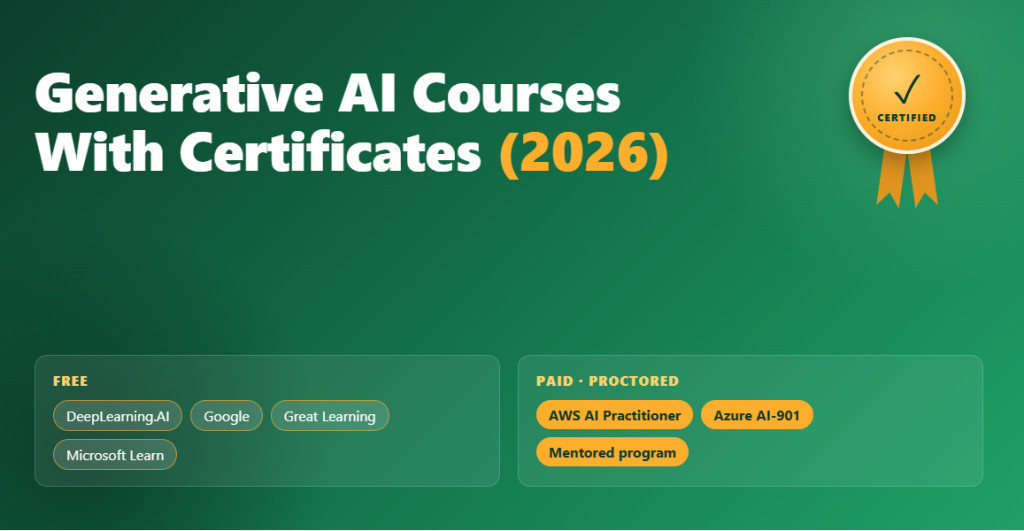
This guide reviews the strong free options first: DeepLearning.AI, Google, Great Learning, Microsoft Learn. It’s honest about exactly where each one stops helping. Then it covers the paid, mentored route, including SkillArbitrage’s own programme, and the specific situations where paying earns its keep. No disguised sales pitch. If free is enough for you, this guide will say so plainly.
One promise before we start. Every price, certificate detail, and course feature below was checked against the official source on 10 July 2026. This field moves fast, though (course prices and “free for now” offers change without much notice), so treat the specifics as a snapshot and click through to confirm before you pay for anything. If you’re still deciding whether this skill is worth learning at all, the pillar guide to generative AI skills for working professionals in India makes the wider case first.
Is a generative AI course with certificate worth it? Yes, for the skill and the portfolio you build, not for the certificate itself. In India’s 2026 market, recruiters treat a completion certificate as a tiebreaker between two similar candidates, not as a reason to hire. What earns the interview is demonstrable proof you can make an AI model produce reliable work.
| Course | Free or paid | Cost | Certificate | Mentorship | Best for |
|---|---|---|---|---|---|
| DeepLearning.AI: ChatGPT Prompt Engineering for Developers | Free | Free (limited-time) | No (on free tier) | No | Hands-on API prompting |
| Google Prompting Essentials | Paid | ~$49/mo (7-day trial) | Yes (Google) | No | A name-brand starter cert |
| Great Learning: Prompt Engineering for ChatGPT | Free course | Free; certificate = fee | Optional (paid) | No | A fast 3-hour intro |
| Microsoft Learn: generative AI paths | Free | Free | No (badges only) | No | Structured self-study |
| AWS: Foundations of Prompt Engineering | Free | Free | No proctored cert | No | AWS-leaning learners |
| AWS AI Practitioner / Azure AI-901 (exam) | Paid | ~$100 (AWS) | Yes (proctored) | No | A recognised resume credential |
| SkillArbitrage: Generative AI & Prompt Engineering | Paid | Rs 63,000 | Yes | Yes (live feedback) | Accountability, portfolio, job support |
How to judge a generative AI or prompt engineering course
Before you spend a rupee or a weekend, how do you tell a course that builds a skill from one that just prints a certificate? Five things separate them. Score any course you’re considering against these before you enrol.
Hands-on projects, not just slides. In our view, the single biggest predictor of whether a course is worth your time. If you finish and have nothing you actually built, only videos you watched, the skill didn’t transfer. Look for courses that make you write prompts, break them, and fix them against real inputs.
Current tools and models. A course recorded in early 2023 that only covers basic ChatGPT is teaching you last season’s game. In 2026 you want exposure to the current models and the techniques that matter now: structured prompting, retrieval-augmented generation, and evaluating output quality rather than eyeballing it.
A portfolio artefact at the end. This is the part almost every free course skips. The best learning leaves you with something a hiring manager can inspect: a set of documented prompts, a small project, a workflow you automated. If the only takeaway is a certificate, you’ve learned to complete a course, not to do the work.
Who issues the certificate. A completion certificate from an unknown platform carries almost no weight. One from Google, Microsoft, AWS, or a recognised university carries some. And a proctored exam credential, the kind you can actually fail, carries the most, because it’s harder to game. More on which specific ones matter later.
Support and accountability. Free courses hand you the material and wish you luck. That’s fine if you’re self-driven. If you’ve started three courses and finished none, the honest question isn’t “which course is best,” it’s “what will actually make me finish.” That’s a real, and underrated, reason people pay.
The best generative ai prompt engineering certifications courses
Let’s be honest about something the paid best Generative Ai Prompt Engineering Certifications ads won’t tell you: you can learn the fundamentals of prompt engineering for free, from some of the best names in the field. Here are the strongest free options in 2026, and the exact point where each one stops being enough.

DeepLearning.AI: ChatGPT Prompt Engineering for Developers
Still the sharpest free starting point for anyone comfortable with a little code. This short course, built by DeepLearning.AI in partnership with OpenAI, runs about one hour and forty minutes across nine lessons, and it’s genuinely good: summarising, inferring, transforming text, and building a simple chatbot through the OpenAI API. As of 10 July 2026 it’s free to take during the DeepLearning.AI platform beta.
The catch? Two of them. You need basic Python to follow along, and the free tier does not include a shareable certificate (completion accomplishments are a paid Pro-membership feature). So it’s a fantastic skill-builder and a weak resume line. If you ask us, take it for what you’ll learn, not for the paper.
Google Prompting Essentials
If you want a recognisable name on your certificate without a university price tag, Google Prompting Essentials on Coursera is the obvious pick. It teaches a clean five-step prompting framework, covers text and multimodal prompting, and is designed around real workplace tasks. The whole thing runs under 10 hours, so you can finish it in a couple of focused weekends.
Now, the honest bit on cost. This one isn’t truly free. There’s a 7-day free trial, after which the Coursera subscription runs about $49 a month (US pricing; the India price varies and financial aid is available). Finish inside the trial and you can walk away with a Google certificate for nothing, which is exactly what a disciplined learner should aim to do.
Great Learning Academy: Prompt Engineering for ChatGPT
For Indian learners who want something quick, free, and India-based, Great Learning Academy’s free course covers the basics in roughly three hours across eight self-paced modules: LLM fundamentals, tokenisation, and hands-on prompt techniques. The course itself costs nothing to take.
Worth flagging one thing people get wrong: the course is free, but the certificate is an optional paid add-on. So you can learn for free and simply skip the certificate, or pay the one-time fee if you want the paper. Either way, treat this as a warm-up, not a career-maker. Three hours gets you literate, not hireable.
Microsoft Learn: generative AI learning paths
Microsoft Learn’s generative AI modules are completely free, well-structured, and beginner-friendly, walking you through how large language models work, how to write effective prompts, and the basics of AI agents. For zero cost and zero sign-up friction, they’re an excellent self-study path.
Here’s what to understand before you list it anywhere: Microsoft Learn modules give you achievements, XP, and a “pass” on your profile, but not a formal certificate. The formal Microsoft credential comes only from the separate, paid Azure AI Fundamentals exam (covered below). So use the free modules to learn, then decide if the paid exam is worth it. Don’t confuse a badge for a certification.
AWS and Vanderbilt: two more worth knowing
Two honourable mentions round out the free tier. Amazon’s Foundations of Prompt Engineering on AWS Skill Builder is a free, roughly four-hour course that moves from basic to advanced prompt techniques, ideal if you’re heading toward AWS tools. And Vanderbilt University’s Prompt Engineering for ChatGPT on Coursera is free to audit (videos only); the certificate and graded work sit behind the usual Coursera fee of around $49. At roughly 19 hours, it’s the most in-depth of the free-to-audit options.
The catch with free courses
So if the fundamentals are free, why does anyone pay? Fair question. But the answer isn’t that free courses teach bad content. Some of the content above is world-class. It’s what they structurally cannot give you.
Free, self-paced courses have a completion problem, and it’s not a small one. Nobody’s checking whether you show up. There’s no feedback on the prompts you write, so you can’t tell whether your work is actually good or just feels good. There’s no one reviewing your portfolio, no deadline forcing you to finish, and, critically, no job support at the end. You get the map. You’re on your own for the journey.
Based on what we’ve seen, for a self-motivated learner with a clear goal, that’s completely fine, and paying would be a waste. But be honest with yourself about your own track record. If you’ve collected half-finished courses before, the missing ingredient was never more free material. It was accountability. The mistake we see most often is assuming the fix is more free material. It isn’t. That gap, between “I understand prompting” and “I’ve proven I can do the job and someone helped me get there,” is exactly where a paid, mentored program earns its place. It’s also why we tell career-switchers that the roadmap in how to become a prompt engineer in India matters more than any single certificate.
When a paid, mentored program is actually worth it
Let’s be clear about when paying is smart and when it isn’t, because the answer isn’t “always.” If you’re disciplined, technical, and just need to learn concepts, the free options above will serve you well. Save your money. But if you’ve stalled on self-paced courses before, paying for structure can be the smartest money you spend.
We’d recommend paying in three specific situations. First, when you need accountability to actually finish (a cohort, deadlines, and someone expecting your work changes everything for most people). Second, when you want feedback on real projects, because a mentor catching why your prompt fails on edge cases teaches you faster than any video. Third, when you want a portfolio and a job outcome, not just knowledge, and you’d rather follow a structured path than assemble one from twenty free videos.
That last point is the honest case for a mentored program. You’re not paying for information (that’s free now). You’re paying for structure, feedback, and accountability, the three things free courses can’t provide.
Free vs paid: a decision table
Enough theory. Which route is right for you? It depends less on the courses and more on who you are and what you’re trying to do. Match yourself to the closest row.
| Your situation | Best route | Why |
|---|---|---|
| Just testing if you like this | Free (DeepLearning.AI or Microsoft Learn) | Zero cost, real fundamentals, quit anytime with nothing lost |
| Working professional upskilling | Free cert (Google Prompting Essentials in the trial) | A name-brand certificate and a workplace-ready framework in a weekend or two |
| Want a recognised credential | Paid exam (AWS AI Practitioner or Azure AI-901) | A proctored certification carries real weight; you can fail it, so it means something |
| Career-switcher wanting a job | Paid, mentored program | Accountability, project feedback, and a portfolio matter more than free content you won’t finish |
The pattern is simple once you see it. The less structure and accountability you need, the more free options make sense. The more you need someone in your corner making sure you finish and produce proof, the more a paid program pays for itself. There’s no shame in either. Know which learner you are.
Certifications that carry weight on an Indian resume
Time for the question underneath all of this. Which certificate actually helps you get hired in India, and how much? The honest hierarchy has three tiers, and the top one probably isn’t what the ads pushed at you.
The credentials recruiters actually recognise
At the top sit proctored, vendor-backed exams, the kind you can fail. The AWS Certified AI Practitioner (exam AIF-C01) costs $100, runs 90 minutes with 65 questions, and validates foundational knowledge of AI, machine learning, and generative AI. Microsoft’s Azure AI Fundamentals is a comparable proctored credential (note: the current exam is AI-901, updated in April 2026, not the older AI-900). Google Cloud’s Generative AI Leader is a newer, business-oriented proctored option. Confirm current exam pricing on each official page, since it varies by region and changes.
The middle tier is name-brand course certificates: Google Prompting Essentials, or the paid Generative AI with Large Language Models certificate from DeepLearning.AI and AWS (around 16 hours, deeper and more technical). These signal effort and familiarity with a recognised curriculum. Useful, not decisive.
The bottom tier is unbranded completion certificates from courses nobody’s heard of. They fill a line on a resume and little else. If that’s all a course offers, take it for the learning and spend zero time expecting the paper to open doors.
Why your portfolio beats any certificate
Here’s the part that should reframe how you spend your effort. In a field with no single industry-standard certification, your portfolio does the work the certificate can’t. Three to five documented projects, showing a real problem, the prompts you wrote, the output, and how you improved it across versions, prove capability in a way no completion badge ever will.
Our recommendation, based on what actually moves hiring managers: use a certificate to structure your learning and add one recognisable credential to your profile, then pour the rest of your energy into building and documenting real work. The same logic runs through how senior professionals in India are using AI tools to change how they work: the value was never the tool or the certificate, it was the outcome they could show. Build the proof, and the certificate becomes a nice-to-have rather than the thing you’re hiding behind.
Frequently asked questions
Is a generative AI course with certificate worth it in India? Yes, mainly for the skill and portfolio you build, not the certificate alone. In 2026, recruiters treat a completion certificate as a tiebreaker rather than a reason to hire. Choose a course that makes you build real, documented work, and the certificate becomes a useful bonus on top of proof you can do the job.
Which free prompt engineering certification is best? For a genuinely free, name-brand certificate, Google Prompting Essentials on Coursera is the strongest pick if you finish inside the 7-day trial. For pure free learning without a certificate, DeepLearning.AI’s ChatGPT Prompt Engineering for Developers and Microsoft Learn’s generative AI paths are excellent.
Do free Great Learning or Coursera certificates have value on a resume? Some, but modestly. A recognisable issuer like Google or a known university adds mild credibility. An unbranded completion certificate adds very little. In every case, a portfolio of real projects carries far more weight with Indian recruiters than the certificate itself.
Is Google Prompting Essentials free? Partly. It’s on Coursera with a 7-day free trial, after which the subscription is about $49 a month (US pricing; India pricing varies, and financial aid is available). Finish within the trial week and you can earn the Google certificate at no cost.
Does DeepLearning.AI give a certificate? Not on the free tier. The ChatGPT Prompt Engineering for Developers short course is free to take (as of July 2026), but shareable completion accomplishments are part of a paid Pro membership. Take it for the hands-on skill, not for a resume certificate.
What is the best paid prompt engineering course in India? It depends on your goal. For a recognised exam credential, AWS Certified AI Practitioner or Azure AI Fundamentals (AI-901). For mentorship, accountability, and a job-focused portfolio, a structured program like SkillArbitrage’s Generative AI & Prompt Engineering course suits career-switchers who won’t finish a free, self-paced course alone.
Do I need to know coding to learn prompt engineering? No, not to start. You can build serious skills and a portfolio using ChatGPT, Claude, or Gemini in the browser with no code. Basic Python helps later for tasks like connecting models to data and running evaluations, and a few courses (such as DeepLearning.AI’s) assume it, but it isn’t the entry ticket.
AWS AI Practitioner vs Microsoft AI-901: which is better for Indians? Both are respected, foundational, proctored credentials. Pick AWS AI Practitioner if you’re heading toward AWS-based roles, and Azure AI Fundamentals (AI-901) if your target employers use Microsoft’s cloud. For most learners, the choice matters less than actually holding one and backing it with a portfolio.
Can I get a job with just a prompt engineering certificate? Rarely on the certificate alone. Employers hire for demonstrated ability, so a certificate plus a portfolio of real, working projects is what lands interviews. Treat the certificate as one signal among several, not as a standalone job ticket.
How long does it take to learn prompt engineering? The fundamentals take a few weekends: most free courses run from 2 to 18 hours. Reaching a hireable standard, with a documented portfolio of 3 to 5 real projects, typically takes two to four months of consistent effort alongside a job or studies.
References
- DeepLearning.AI, “ChatGPT Prompt Engineering for Developers” (verified 10 July 2026): course length, content, free access, and certificate terms.
- Coursera, “Google Prompting Essentials” (verified 10 July 2026): duration, subscription cost, free trial, and certificate.
- Great Learning Academy, “Prompt Engineering for ChatGPT” (verified 10 July 2026): free enrolment, duration, and optional paid certificate.
- Microsoft Learn, “Fundamentals of Generative AI” (verified 10 July 2026): free modules, badges/XP, and no formal certificate.
- AWS Skill Builder, “Foundations of Prompt Engineering” and Coursera / Vanderbilt, “Prompt Engineering for ChatGPT” (verified 10 July 2026): free access, audit terms, and duration.
- AWS Certified AI Practitioner (AIF-C01), Microsoft Certified: Azure AI Fundamentals, and Google Cloud Generative AI Leader (verified 10 July 2026): exam cost, format, and scope.
This article is for informational and educational purposes only and does not constitute professional career or financial advice. Course prices, certificate terms, and exam fees are drawn from the official sources cited as of 10 July 2026 and change frequently; confirm current details on the provider’s official page before enrolling or paying. SkillArbitrage course details are subject to cohort availability.




 Allow notifications