
Last verified: July 2026
Let’s start with the question you’re actually asking, the one most guides tiptoe around. Is “prompt engineer” still a real career in 2026, or did you just miss the boat on a job that already sank? If you want to know how to become a prompt engineer in India without wasting six months chasing a title that’s quietly disappearing, you need the honest version first.
Here it is. The standalone job called “prompt engineer” is shrinking. In May 2025, Fortune reported that generative-AI terms appear in only about 3 of every 1,000 job postings on Indeed, and quoted an Indeed labour economist saying prompt engineering “is still definitely a good thing to have, but it’s not an entire title.” The two-hundred-thousand-dollar unicorn role that made headlines in 2023? That version is mostly gone.
So why is this guide 2,500 words long instead of one line telling you to give up?
Because the skill didn’t die. It moved. The ability to make a large language model do precise, reliable, useful work is now baked into dozens of better-paying roles: AI engineer, AI product specialist, automation lead, AI-ops. The same Fortune piece notes that while the job title declined, listings tagging prompt engineering as a skill kept climbing, and AI literacy ranks as the single fastest-growing skill on LinkedIn. In other words, nobody’s hiring a “prompt engineer” to sit in a corner writing clever prompts all day. Plenty of people are hiring for the thing you’d actually learn.
That’s good news if you’re a student, a fresher, or someone switching careers from a non-technical background. You’re not late. You’re early to the version of this skill that lasts. And you don’t need a computer science degree or heavy coding to start (more on exactly what you do need below).
This guide gives you the honest roadmap: what the work really involves in 2026, the six steps to get from zero to hireable, the skills checklist that matters, what the pay actually looks like in India (with sourced numbers, not hype), and how the role is evolving so you build for the next five years instead of the last two.
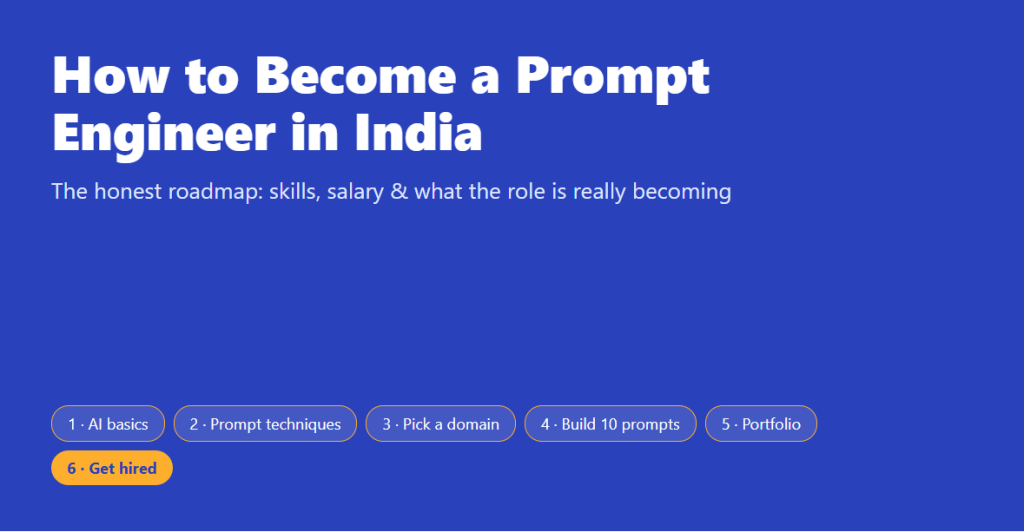
How to become a prompt engineer in India: the 6-step roadmap
- Learn AI and LLM basics (how models work, what they can’t do).
- Master core prompt techniques (zero-shot, few-shot, chain-of-thought).
- Pick a domain (support, marketing, legal, coding, finance).
- Build 10 real, working prompts that solve actual problems.
- Package them into a portfolio anyone can inspect.
- Apply for AI-adjacent roles, not just the “prompt engineer” title.
What a prompt engineer actually does today
Forget the myth of someone typing one magic sentence and watching a model produce gold. What does the work look like on a normal Tuesday? Mostly it’s problem-shaping. You take a fuzzy business need (“summarise these 400 support tickets and flag the angry ones”) and turn it into instructions a model follows reliably, at scale, without going off the rails on ticket number 380.
That means writing the instruction, testing it against tricky inputs, noticing where it breaks, and fixing it. Then wrapping it so a non-technical colleague can use it. Then checking the output stays good when the data changes next week. It’s closer to careful editing plus quality control than to programming. And it’s genuinely useful, which is exactly why companies stopped hiring a dedicated person to do only this.
Why the standalone title is shrinking
Two things happened. First, the models got better at understanding sloppy instructions, so the raw “prompt whisperer” edge faded. Second, companies realised that prompting on its own doesn’t ship a product. You need someone who can also connect the model to real data, measure whether the output is correct, and control the cost. So the narrow title folded into broader ones.
The industry that once treated prompting as a niche job now treats it the way it treats knowing Excel: assumed, not celebrated. Our take? That’s a promotion for the skill, not a demotion. A capability every AI team needs is worth more than a title nobody’s hiring for.
Where the skill lives now
In 2026, prompting shows up inside AI engineer roles, AI product roles, automation and operations roles, and increasingly in ordinary jobs across marketing, HR, and finance. If you’ve read how senior professionals in India are using AI tools to transform their work, you’ve already seen the pattern: the value isn’t the prompt, it’s the outcome the prompt produces. Learn to produce outcomes and the title takes care of itself.
Do you need a degree or coding to become a prompt engineer?
Short answer: no degree, and no, you don’t need to be a programmer. This is the single biggest misconception that stops Indian freshers and career-switchers before they start. So let’s kill it properly.
You don’t need a B.Tech or a computer science background. Some of the sharpest prompt work comes from people with domain expertise, not technical training: a lawyer who knows exactly what a good contract clause looks like, a support lead who knows what a genuinely helpful reply sounds like, a marketer who knows their audience cold. The model brings the horsepower. You bring the judgement about what “good” means.

What about coding?
Coding helps, but it isn’t the entry ticket. Here’s the honest split. To start and build a portfolio, you need zero code: you can do serious work in ChatGPT, Claude, or Gemini through the browser. To move into higher-paying AI engineer roles later, basic Python becomes valuable, mostly for connecting models to data and running evaluations. Think of it as a skill you grow into, not a wall you climb first.
So what do you actually need? Three things. Precise language, because a vague instruction produces a vague result every time. Logical decomposition, the ability to break a messy task into clear steps. And a bit of stubbornness, because good prompting is iterative and the second version is always better than the first. Everything else is learnable in weeks, not years.
The 6-step roadmap to become a prompt engineer in India
Here’s the path, start to finish. No fluff, no “manifest your AI career” nonsense. Each step builds on the last, and you can complete the whole thing in roughly two to four months of consistent effort alongside a job or studies.
Step 1: Learn AI and LLM basics
Before you write a single serious prompt, understand what you’re working with. Learn, in plain terms, how a large language model generates text (it predicts, it doesn’t “know”), what a token is, why context windows matter, and why models sometimes state false things with total confidence. You don’t need the maths. You need the mental model, because it explains why certain prompts work and others fail.
Step 2: Master core prompt techniques
This is the craft. Learn zero-shot and few-shot prompting, chain-of-thought reasoning, role and format instructions, and how to give the model examples of what you want. We’ll break these down in the skills section below. Spend real time here, because this is the part that separates someone who “uses ChatGPT” from someone who engineers reliable output.
Step 3: Pick a domain
Generic prompting skill is a commodity. Prompting skill plus domain knowledge is a career. Pick one area you either know or want to work in: customer support, marketing content, legal drafting, software development, finance, or data analysis. Depth beats breadth. An employer hiring for support automation wants someone who understands support, not someone who’s dabbled in ten fields.
Step 4: Build 10 real, working prompts
Theory is worthless until it survives contact with a real problem. Build ten prompts that solve genuine tasks in your chosen domain: a prompt that turns messy meeting notes into action items, one that drafts a first-pass reply to a refund request, one that extracts structured data from invoices. Test each against difficult inputs. Document what broke and how you fixed it. That documentation is gold in an interview.
Step 5: Package a portfolio
Ten working prompts nobody can see won’t get you hired. Put them where a hiring manager can inspect them (we cover exactly how in the portfolio section below). Show the problem, the prompt, the output, and the iteration. This is your proof of skill, and in a field with no standard certification, proof beats claims every time.
Step 6: Apply, and aim wider than the title
This is where most people aim too narrow. Don’t search only for “prompt engineer.” Search for AI engineer, AI specialist, automation associate, AI content roles, and AI-ops openings, then read the responsibilities. Many of them are 60% prompting work under a different name. Widen the net and your odds jump.
Want a structured path through all six steps instead of piecing it together from free videos? SkillArbitrage’s Generative AI & Prompt Engineering programme covers LLM fundamentals, the full range of prompt techniques, domain-specific projects, and portfolio building, with mentorship from practitioners working in AI day to day. Explore the course →
The prompt engineering skills checklist
If steps two and four are the “what to do,” this is the “what to actually know.” These are the techniques a competent prompt engineer uses without thinking. Master these five and you’re past the line where most self-taught learners stall.
Zero-shot and few-shot prompting. Zero-shot means asking the model to do a task with no examples (“classify this review as positive or negative”). Few-shot means giving it two or three worked examples first, so it copies the pattern. Knowing when to switch from zero to few-shot is one of the highest-impact habits you’ll build. Few-shot fixes a surprising number of “the AI got it wrong” problems.
Chain-of-thought prompting. For anything involving reasoning or multiple steps, asking the model to work through its logic before answering measurably improves accuracy. It’s the difference between “give me the answer” and “think step by step, then give me the answer.” Simple to write, and it matters most exactly where mistakes are expensive.
RAG basics. Retrieval-augmented generation, or RAG, means feeding the model relevant information (a policy document, a product manual, past tickets) alongside the question, so it answers from real data instead of guessing. You don’t need to build a RAG system from scratch to start, but you must understand the concept, because most real business use of AI depends on it. This is where basic Python eventually earns its place.
Evaluation. Anyone can write a prompt that works once. A professional proves it works consistently. Evaluation means building a small set of test inputs, running your prompt against all of them, and scoring the outputs, so you can tell whether version three is genuinely better than version two or just feels better. This single skill is what employers mean when they say “rigorous.”
Context engineering. The newest and fastest-growing piece. It’s the broader discipline of managing everything the model sees: the instruction, the retrieved data, the conversation history, the tool outputs, the format rules. As models get more capable, the job shifts from crafting one clever line to designing the whole information environment the model works inside. Learn this and you’re building for where the field is going, not where it was.
Prompt engineer salary in India (freshers to senior)
What can you actually earn? Fair warning before the numbers: salary data for this exact title in India is thin, because, as we’ve covered, the standalone role is small and shrinking. Treat these as directional, not gospel, and notice how wide the ranges are. That spread tells its own story.
As of 19 June 2026, Indeed India lists the average base salary for a prompt engineer at about ₹4,81,348 per year, but that figure rests on only 20 reported salaries. That tiny sample is itself the most honest data point on this page: it means very few people in India hold this exact title. Glassdoor India puts the average higher, around ₹7,00,000 per year with a typical range of roughly ₹4.27 lakh to ₹9.75 lakh, and its “AI prompt engineer” figure sits near ₹6,12,000, rising to about ₹8,12,000 in Bengaluru.
What the ranges mean for freshers
For a fresher or career-switcher, treat entry-level AI-adjacent roles as landing somewhere in the ₹4 lakh to ₹8 lakh band, heavily dependent on your domain, your portfolio, and the city. The wide gap between the Indeed and Glassdoor averages isn’t a contradiction. It reflects a young, unstandardised market where the title means different things at different companies, and where the same skill sits under five different job names.
Here’s the strategic read. Chasing the “prompt engineer” salary as a headline number is the wrong game, because aggregator sites and a handful of companies define that narrow figure. Chasing the skill, and applying it under the broader AI-role titles that actually pay well, is where the real earning path sits. Build the capability, and the compensation follows the responsibility, not the job title.
How the role is evolving into AI-generalist work
If you take one idea from this guide, make it this: build for the role prompt engineering is becoming, not the one it was. What does that direction look like? It points toward the AI generalist, someone who can shape a problem, prompt the model, connect it to data, evaluate the results, and orchestrate several AI steps into a working system.
That last word, orchestration, is where a lot of the 2026 demand is heading. Businesses don’t want a clever answer in a chat window. They want a reliable pipeline: intake, process with AI, check, act, all running with minimal human babysitting. The same shift is visible in how AI is transforming customer support jobs in 2026, where the valuable person isn’t the one who writes one good reply, but the one who designs the whole AI-assisted support flow.
So how do you build for that? Add one adjacent skill at a time on top of your prompting base. Learn enough Python to run evaluations. Learn the basics of connecting a model to a data source. Learn how automation tools chain steps together. You don’t need all of it on day one. But every layer you add moves you from “person who prompts” toward “person who builds AI systems,” and that’s the difference between a title that’s fading and a career that’s compounding.
Building a portfolio that actually gets you hired
In a field with no universal certification, your portfolio is your resume. So what should it contain, and where should it live? A hiring manager glancing at it for thirty seconds needs to see proof you can make AI do reliable work, not a wall of screenshots.
Structure each entry the same way: the problem, the prompt, the output, and the iteration story. That fourth part matters most. Showing version one failed and version three succeeded, and explaining exactly why, proves you understand the craft rather than got lucky once. Include your ten domain prompts from step four, and for at least two of them, add a small evaluation table showing how the prompt performed across several test inputs.
Where should it live? A public GitHub repository, a Notion page, or a simple personal site all work, and any of them beats “I’m good with ChatGPT, trust me.” Link it at the top of your resume and your LinkedIn. Then start applying, and apply widely, because remote and India-based AI roles are opening across exactly the kinds of functions covered in these high-income remote careers. The portfolio gets your foot in the door. Your domain judgement closes it.
Ready to put this into practice? The SkillArbitrage Jobs board lists vetted remote and AI-adjacent roles, plus international freelance projects, updated regularly for professionals building global careers from India. Browse open roles →
Frequently asked questions
Is prompt engineering still a good career in India in 2026? Yes, but not as a standalone job title, which is shrinking. The skill is in strong demand inside broader roles like AI engineer, AI product specialist, and automation lead. Learn prompting as part of a wider AI skill set and the career prospects are genuinely good.
Can I become a prompt engineer without a coding background? Yes. You can build serious skills and a full portfolio using ChatGPT, Claude, or Gemini through the browser, with no code at all. Basic Python becomes useful later if you move into AI engineering roles, but it isn’t needed to start.
How long does it take to become a prompt engineer? Roughly two to four months of consistent effort to go from zero to a hireable portfolio, if you follow a structured roadmap alongside a job or studies. The core prompt techniques take a few weeks; building and documenting ten real prompts takes the rest.
What is the salary of a prompt engineer in India for freshers? Entry-level AI-adjacent roles typically fall in the ₹4 lakh to ₹8 lakh per year band, depending on domain, portfolio, and city. Indeed India listed an average of about ₹4.81 lakh in June 2026, though from a very small sample, while Glassdoor’s averages run higher.
Do I need a degree to become a prompt engineer? No specific degree is required. Domain expertise and demonstrable skill through a portfolio matter far more than formal qualifications in this field. People from non-technical backgrounds regularly move into AI-adjacent roles.
Which domain should I specialise in as a prompt engineer? Pick one you already know or genuinely want to work in: customer support, marketing, legal drafting, software development, or finance. Prompting skill combined with real domain knowledge is far more employable than generic prompting alone.
What is the difference between prompt engineering and context engineering? Prompt engineering focuses on writing the instruction you give a model. Context engineering is broader, covering everything the model sees: the instruction, retrieved data, conversation history, and tool outputs. Context engineering is where the field is moving as models grow more capable.
Are prompt engineering certifications worth it? They can help you learn in a structured way, but no single certification is an industry standard that guarantees a job. A strong portfolio of real, working prompts carries more weight with employers than any certificate on its own.
What tools should a prompt engineer know? Start with the major large language models: ChatGPT, Claude, and Gemini. As you advance, add familiarity with retrieval-augmented generation concepts, basic Python for evaluation, and an automation or workflow tool. Breadth across the main models matters more than mastery of any one.
Will AI replace prompt engineers? AI has already absorbed the narrowest version of the job, which is why the standalone title is fading. It won’t replace people who combine prompting with domain judgement, evaluation, and system-building, because those require human decisions about what “correct” and “valuable” actually mean.
This article is for informational and educational purposes only and does not constitute professional career, financial, or recruitment advice. Salary figures are drawn from third-party aggregators as of the dates cited and will change over time. Verify current market data and consult a qualified professional before making career decisions.





 Allow notifications