


A rare opportunity is emerging as hundreds of independent director roles open up across listed Indian companies in 2026. Most professionals don’t know how to position themselves beyond clearing the IICA exam. This post shows how to network effectively, find vacancies, and become a recommended candidate.
Table of Contents
Why 2026 Is a Unique Year for Independent Director Appointments
The Vacancy Trigger: Two-Term Limits Hit Home
Independent directors who were appointed in 2016 and have already been reappointed once must step down in 2026 after completing two consecutive terms. This SEBI-mandated cooling-off period creates a wave of vacancies across listed Indian companies every year, and 2026 is no exception.
IPOs Are Adding Fresh Board Seats
In addition to outgoing directors, every fresh IPO requires the appointment of independent directors to comply with corporate governance norms. Combined, these two forces are creating one of the most active years for independent director appointment opportunities. The same pattern played out in 2025 and will continue every year.
10 Steps to Become an Independent Director in India
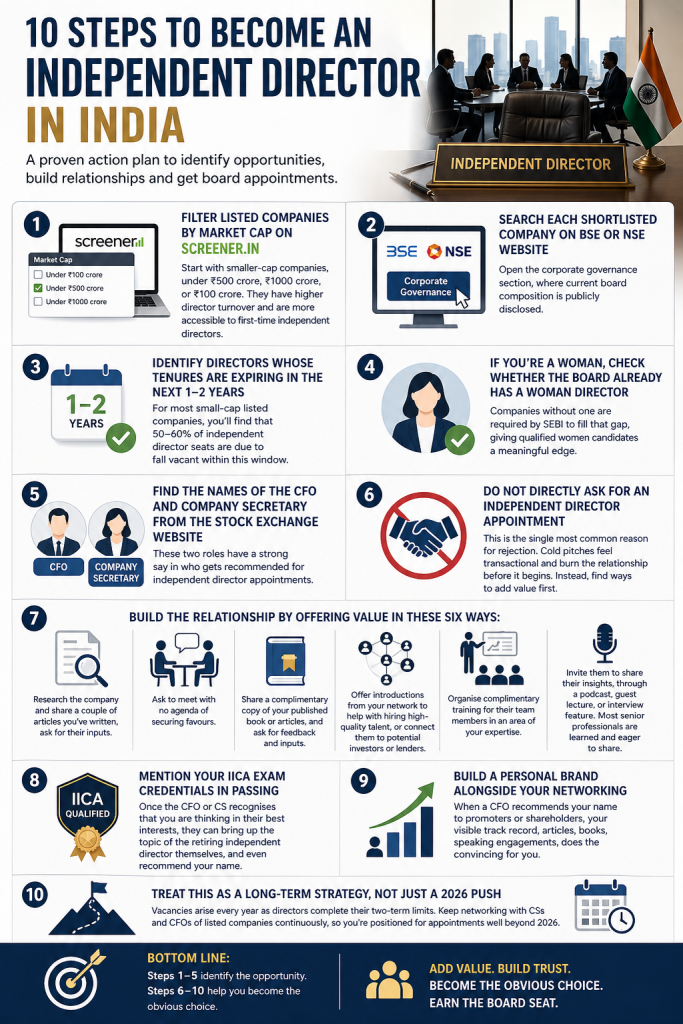
Here’s the complete action plan, distilled into 10 sequential steps. The rest of this guide expands on each one with examples and context.
Step 1: Filter listed companies by market cap on Screener.in
Start with smaller-cap companies, under ₹500 crore, ₹1000 crore, or ₹100 crore. They have higher director turnover and are more accessible to first-time independent directors.
Step 2: Search each shortlisted company on the BSE or NSE website
Open the corporate governance section, where current board composition is publicly disclosed.
Step 3: Identify directors whose tenures are expiring in the next 1–2 years
For most small-cap listed companies, you’ll find that 50–60% of independent director seats are due to fall vacant within this window.
Step 4: If you’re a woman, check whether the board already has a woman director
Companies without one are required by SEBI to fill that gap, giving qualified women candidates a meaningful edge.
Step 5: Find the names of the CFO and Company Secretary from the stock exchange website
These two roles have a strong say in who gets recommended for independent director appointments.
Step 6: Do not directly ask for an independent director appointment
This is the single most common reason for rejection. Cold pitches feel transactional and burn the relationship before it begins. Instead, find ways to add value first.
Step 7: Build the relationship by offering value in these six ways:
- Research the company and share a couple of articles you’ve written, ask for their inputs.
- Ask to meet with no agenda of securing favours.
- Share a complimentary copy of your published book or articles, and ask for feedback and inputs.
- Offer introductions from your network to help with hiring high-quality talent, or connect them to potential investors or lenders.
- Organise complimentary training for their team members in an area of your expertise.
- Invite them to share their insights, through a podcast, guest lecture, or interview feature. Most senior professionals are learned and eager to share.
Step 8: Mention your IICA exam credentials in passing
Once the CFO or CS recognises that you are thinking in their best interests, they can bring up the topic of the retiring independent director themselves, and even recommend your name.
Step 9: Build a personal brand alongside your networking
When a CFO recommends your name to promoters or shareholders, your visible track record, articles, books, speaking engagements, does the convincing for you.
Step 10: Treat this as a long-term strategy, not just a 2026 push
Vacancies arise every year as directors complete their two-term limits. Keep networking with CSs and CFOs of listed companies continuously, so you’re positioned for appointments well beyond 2026.
Bottom line: Steps 1–5 identify the opportunity. Steps 6–10 earn you the recommendation. Skip either half and the appointment doesn’t happen.
How to Find Listed Companies With Upcoming Director Vacancies
Most aspiring directors skip this step entirely. They clear the IICA exam, update their LinkedIn, and then wait. Here’s a smarter approach.
Step 1: Shortlist Companies by Market Cap Using Screener
Smaller-cap listed companies are the most accessible starting point. Use Screener.in to filter companies by market capitalisation. A few useful starting filters:

- Companies with market cap less than ₹1000 crores: https://www.screener.in/screens/40622/market-cap-less-than-1000-crores/?page=
- Companies with market cap less than ₹100 crores:
https://www.screener.in/screens/5571/market-cap-less-than-100/?page= it was this link - Companies greater than 500 cr market cap: here
Try multiple thresholds, under ₹500 crore, under ₹1000 crore, and so on, to build a working list.
Step 2: Check the Corporate Governance Section on BSE/NSE
Search each shortlisted company on the BSE or NSE website. Navigate to the corporate governance section, which lists the current board composition.
Step 3: Track Director Tenure and Reappointments
Look at the names of board members and check when their existing director appointments expire. For most small-cap listed companies, you’ll often find that 50–60% of independent director positions are due to fall vacant in the next 1–2 years. That’s where your independent director networking strategy comes in.
A Bonus Advantage for Women Professionals
If you are a woman, check whether the company has any women directors on the board. SEBI mandates at least one woman director for listed companies, which gives qualified women candidates a meaningful edge in board selection.
How to Network with CFOs and Company Secretaries (Without Sounding Desperate)
The Company Secretary and CFO of a listed company have a significant say in who gets recommended for independent director positions. Their names are publicly available on stock exchange disclosures. The challenge isn’t finding them, it’s approaching them the right way.
The Mistake Most Aspiring Directors Make
Do not directly ask for an appointment as an independent director. This is the single most common reason for rejection. Cold pitches feel transactional, signal that you don’t understand board dynamics, and burn the relationship before it begins.
Smart Ways to Add Value First
Your goal is to build a relationship where the CFO or CS sees you as someone working in the company’s best interest. Once that’s established, they’ll often raise the topic of an upcoming vacancy themselves, and even recommend your name. Try one or more of these approaches:
- Show genuine research. Read about the company, then share a couple of your published articles and ask for their inputs.
- Meet without an agenda. Ask for a meeting to learn, not to extract a favour.
- Send a complimentary copy of your book or articles if you’ve published, and request feedback.
- Make introductions. Offer to introduce them to high-quality talent for hiring, potential investors, or lenders.
- Organise free training for their team in your area of expertise.
- Invite them to share their insights through a podcast, guest lecture, or interview feature. Most senior professionals appreciate well-prepared platforms.
You can mention in passing that you have cleared the IICA exam for independent directors. Once they recognise your credibility and goodwill, the conversation about an upcoming directorship vacancy becomes natural, not forced.
Why Clearing the IICA Exam Is Not Enough
Thousands of professionals clear the IICA’s Independent Director Databank exam every year. Yet only a small fraction secure actual appointments. Why?
- They don’t build a personal brand.
- They don’t proactively network with prospective listed companies.
- They wait to be discovered instead of creating visibility.
Clearing the exam qualifies you for the databank. It does not get you the appointment. The appointment comes from being recommended by people inside the company, typically the CFO, CS, promoter, or an existing board member.
Building a Personal Brand That Gets You Recommended
A strong personal brand multiplies the impact of every networking conversation. When a CFO recommends your name to promoters or shareholders, your visible track record, articles, books, speaking engagements, thought leadership, does the convincing for you.
This is also a long-term play. Even if no specific 2026 vacancy fits you, the relationships you build now will surface board opportunities for years to come. Independent director networking is compounding work.
Key takeaway: Identify vacancies early, lead with value, and let the appointment conversation come to you.
Priyanka Karwa, Director of the Placements Team, has supported over 100 professionals to clear the IICA’s exam and helped 25 professionals secure independent director appointments in the last 6 months alone using exactly this strategy.
Here is a video
Frequently Asked Questions
Q1. How do I check if a listed company has upcoming independent director vacancies?
Search the company on the BSE or NSE website, open the corporate governance section, and review director tenure. Positions expiring within 1–2 years signal upcoming vacancies.
Q2. Is clearing the IICA exam enough to become an independent director?
No. The IICA exam qualifies you for the Independent Directors Databank, but actual appointments come through recommendations and networking, especially from CFOs and Company Secretaries.
Q3. Should I directly ask a CFO or CS for an independent director appointment?
No. Direct asks have a high rejection rate. Build the relationship by adding value first, through research, introductions, or thought leadership, and let the opportunity surface organically.
Q4. Do women have an advantage in independent director appointments?
Yes. SEBI requires every listed company to have at least one woman director, so qualified women candidates often have an edge, especially in companies currently below this threshold.
Q5. What kind of listed companies should I target first?
Start with small-cap listed companies (market cap under ₹500–1000 crore). They are more accessible, have higher director turnover, and are often more open to first-time independent directors.
Conclusion
Becoming an independent director in India in 2026 is less about credentials and more about relationships. The vacancies exist, they are sitting in plain sight on the BSE and NSE corporate governance disclosures of hundreds of listed companies. Your job is to identify them early, network with the right CFOs and Company Secretaries, and lead with value instead of asking for favours. Combine the IICA exam with a strong personal brand and a deliberate networking strategy, and the appointments will follow.





 Allow notifications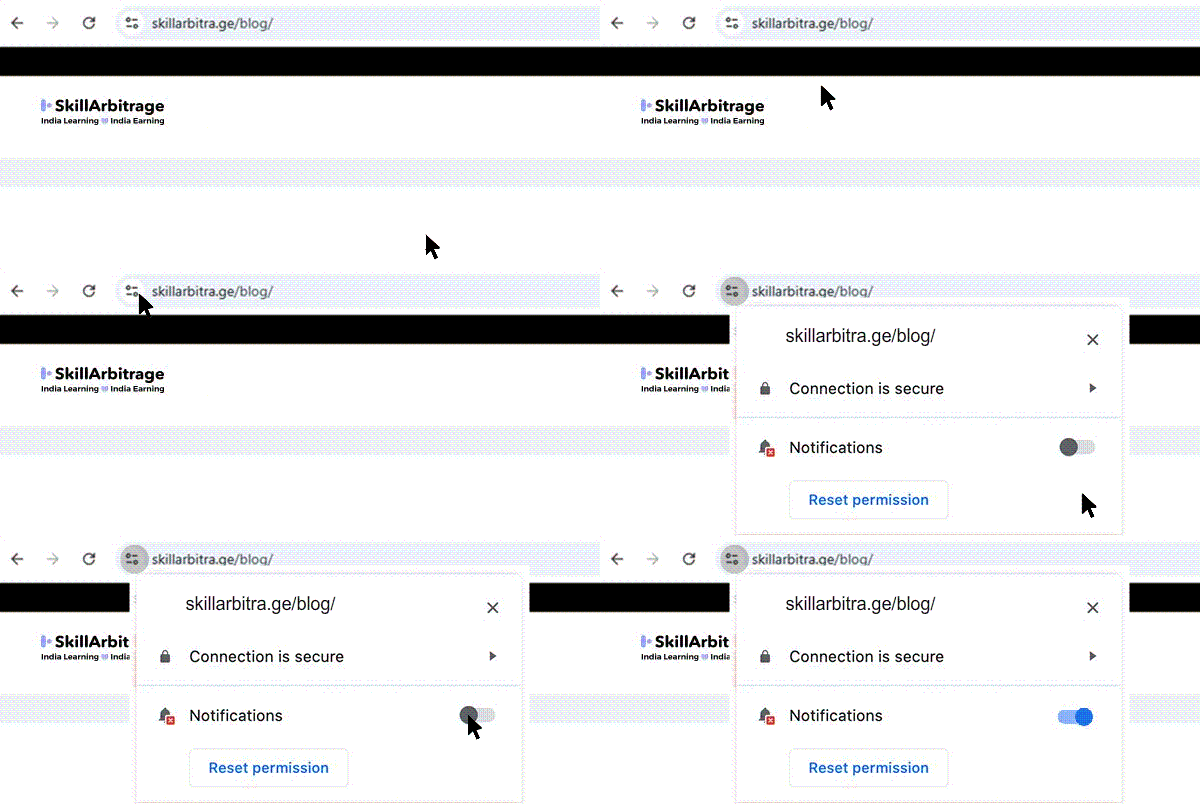
This breakdown of networking with CFOs and CSs really resonates—especially the emphasis on building value-driven relationships rather than just asking for opportunities. It’s a refreshing take that aligns with the idea of positioning yourself as a thoughtful contributor, not just a candidate. The step-by-step approach makes it actionable, especially for those looking to navigate the independent director space strategically.
I really liked how you connected personal branding with relationship building. It’s a helpful reminder that networking is just one piece of the puzzle, and maintaining visibility and credibility over time can make a real difference in positioning for independent director roles.