
Companies are actively seeking customer support professionals who can not only handle day-to-day operations but also generate more revenue from existing customers and automate routine processes to reduce costs.
Table of Contents
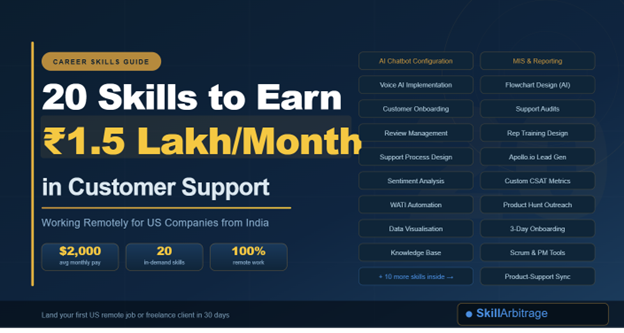
Why Customer Support Skills Are Your Fastest Path to ₹1.5 Lakh/Month
Here is a number worth bookmarking: US companies are paying $1,500–$2,000 per month that is ₹1.2–1.6 lakh for Indian professionals who can manage customer support and operations remotely. Not after ten years of experience. Right now. With skills you can learn in weeks.
The shift is happening because companies are no longer just looking for people to answer tickets. They want professionals who can build systems, implement AI tools, analyse data, and run operations all from a laptop, anywhere in the world.
“When you become proficient in even half of these skills, earning ₹1 lakh per month is not a dream it is a predictable outcome.”
The 20 Skills — Complete Breakdown
Each skill below includes what it is, why companies pay for it, and what you can realistically earn. These are not theoretical they are drawn from active job postings, freelance marketplaces, and real hiring data.
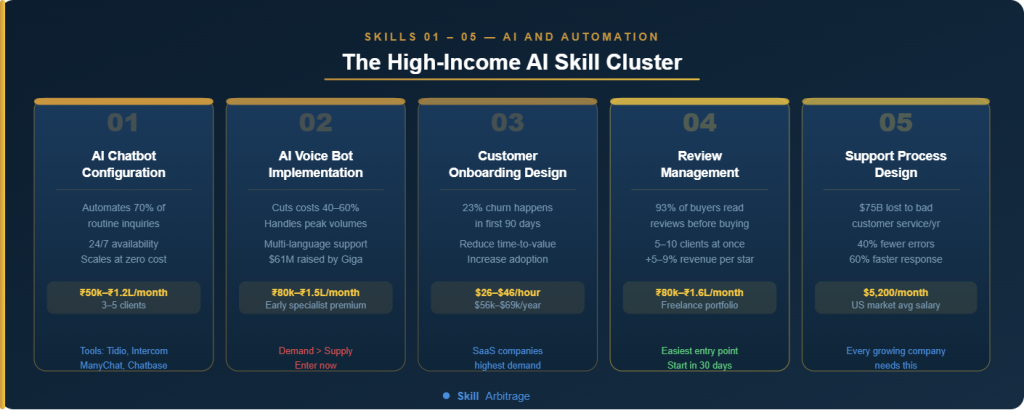
1. Configure AI Chatbots for Clients
Learn to set up AI chatbots tailored to client needs and position yourself as a chatbot consultant finding freelance or full-time work in this fast growing field.
Why companies pay: Businesses face overwhelming customer inquiries that drain resources and delay responses. Chatbots reduce customer service costs by automating up to 70% of routine inquiries, eliminate 24/7 staffing costs, reduce response times from hours to seconds, and scale support without proportional cost increases.
- Automates repetitive FAQs and lead qualification
- Frees human agents for complex, high-value interactions
- Handles appointment booking, product queries, and data collection
Earning potential: ₹50,000–₹1,20,000/month as a chatbot consultant managing 3–5 clients.
To watch a live demonstration of chatbot implementation and learn this skill, click here.
2. Implement AI Voice Bots for Customer Support
Master the implementation of voice AI systems that handle customer queries automatically, reducing response times and operational costs while maintaining quality.
Why companies pay: Voice bots cut operational costs by 40–60% while maintaining 24/7 availability. They handle high call volumes during peak times, eliminate hold times, provide consistent service quality, and understand accents and multiple languages.
Companies like Giga recently raised $61 million for voice AI solutions already deployed at Fortune 100 companies like DoorDash. The demand for voice AI specialists far exceeds supply, creating premium opportunities for early adopters.
Earning potential: Premium positioning as an early specialist — ₹80,000–₹1,50,000/month.
To see how voice AI transforms customer support and learn implementation strategies, click here.
3. Design Customer Onboarding Plans That Reduce Churn
Poor onboarding causes 23% of customer churn within the first 90 days, costing companies millions in lost revenue. If you can design onboarding strategies that reduce time-to-value and increase product adoption, companies will pay a premium.
Why companies pay: Every percentage point of churn reduction translates directly to retained revenue. A company with 1,000 customers at $100/month saves $23,000/month by reducing first-90-day churn by just 1%.

Earning potential: Customer Onboarding Specialists earn $56,000–$69,200 annually ($26–$46/hour).
To learn how to design onboarding plans that drive product adoption and reduce churn, click here.
Find hands-on step-by-step demo of creating an onboarding plan: https://youtu.be/bRgzJd2xDBE
4. Pitch and Execute Review Management
Learn to monitor, respond to, and strategically manage online reviews across platforms, turning customer feedback into reputation gold and packaging this as a standalone service for businesses.
Why companies pay: Online reviews drive 93% of consumer purchase decisions. A one-star increase in Yelp rating leads to a 5–9% increase in revenue. Poor review management costs businesses up to 22% of potential customers.
- Review specialists earn $25–$100/hour depending on experience
- One freelancer can manage 5–10 clients simultaneously
- Monthly income potential: $2,500–$20,000
Click here to watch the video.
Earning potential: ₹80,000–₹1,60,000/month managing a portfolio of small business clients.
Learn how to target local restaurants for offering review management services:
5. Build Customer Support and Operations Processes
Build efficient, scalable processes from scratch that standardise workflows, reduce errors, and ensure consistent quality across entire support operations.
Why companies pay: Companies lose $75 billion annually due to poor customer service. Systematic processes reduce errors by 40%, improve response times by 60%, and enable scaling without proportional cost increases.
Every growing company hits a breaking point where informal processes fail. Process consultants who can document, optimise, and implement scalable support operations are always in demand across industries and company sizes.
Earning potential: Average US Support & Operations salary: $5,200/month (₹4.3 lakh). Entry-level remote roles for Indians: $2,000–$3,000/month.
6. Create Management Information Systems (MIS)
Develop management information systems that track key metrics, generate actionable reports, and provide leadership with the insights they need for strategic decision-making.
Why companies pay: Executives make million-dollar decisions daily but often lack real-time data. MIS systems eliminate manual report compilation, provide real-time visibility into key metrics, identify trends before they become problems, and automate executive dashboards.
Without MIS, companies fly blind making decisions based on gut feel rather than data. You become the person who turns chaos into clarity.
Earning potential: MIS consultants command $35–$75/hour for dashboard and reporting projects.
7. Create Professional Flowcharts Using AI Tools
Master the art of creating clear, visual flowcharts using AI tools like ChatGPT, Mermaid, and draw.io to transform complicated workflows into simple, actionable diagrams.
Why companies pay: Without clear process documentation, companies experience chaos no one knows who is responsible, or what has been missed. New hires keep asking the same questions, founders repeat instructions endlessly, and tasks fall through the cracks.
A single well-designed flowchart can replace lengthy emails and confusing verbal instructions. The difference is dramatic: with a flowchart for client onboarding, everything runs like clockwork update CRM, send welcome packet, schedule kickoff call, systematically executed.
To learn the complete flowchart creation process using AI tools, click here.
8. Conduct Customer Sentiment Analysis and Predictive Analytics
Companies that predict churn before it happens save 5–10x the cost of acquiring replacement customers. Sentiment analysis identifies unhappy customers before they leave negative reviews or cancel subscriptions.
Why companies pay: This skill proactively identifies at-risk customers allowing intervention before churn, spots upsell opportunities among delighted customers, reveals product issues from support conversations, and quantifies satisfaction trends.
Reactive businesses lose customers. Predictive businesses retain them. The demand for this skill is evident in job postings offering $70,000–$110,000 annually for specialists who can turn support data into revenue intelligence.
To learn sentiment analysis and predictive analytics techniques that directly impact revenue, click here.
9. Conduct Customer Support Audits (Call and Ticket Data)
Create audit frameworks with pre-defined parameters to evaluate agent performance, identify top performers, spot training gaps, and develop targeted improvement plans.
Why companies pay: Support audits reveal why CSAT scores are dropping, identify top performers to promote, expose training gaps that cost thousands in inefficiency, and pinpoint process breakdowns. Companies pay $5,000–$15,000 for comprehensive audits because they recover those costs within weeks through improved operations.
Most support leaders lack frameworks for systematic auditing. You become the person who brings structure, objectivity, and actionable insights transforming subjective management opinions into objective data.
10. Create Onboarding and Product Training for Customer Support Representatives
Design effective training programmes using website content and company materials that get new support reps fully productive and confident in their roles quickly.
Why companies pay: Poor training costs companies an average of $4,129 per hire plus $1,252 in training costs over $5,000 in direct costs per employee. New reps who receive structured training reach full productivity 50% faster and have 30% lower turnover.
- Reduces time-to-productivity from 8–12 weeks to 3–4 weeks
- Standardises service quality across the entire team
- Decreases supervisor time spent answering basic questions
- Builds confidence that reduces new hire stress and early exits
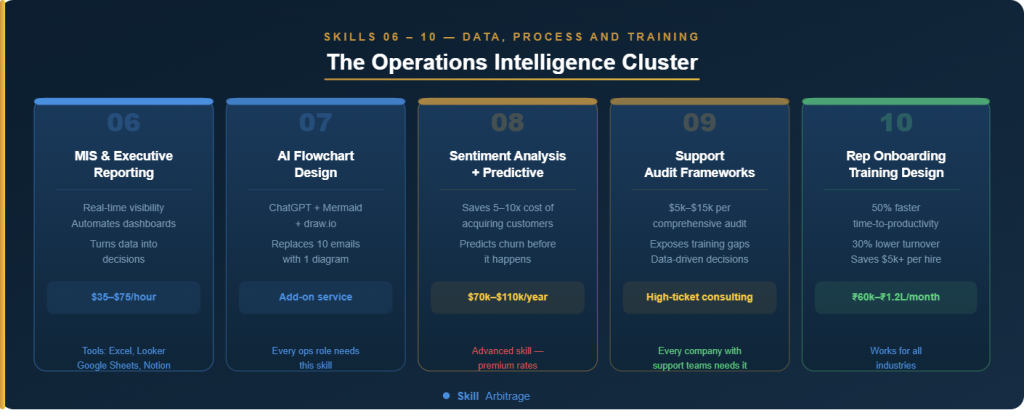
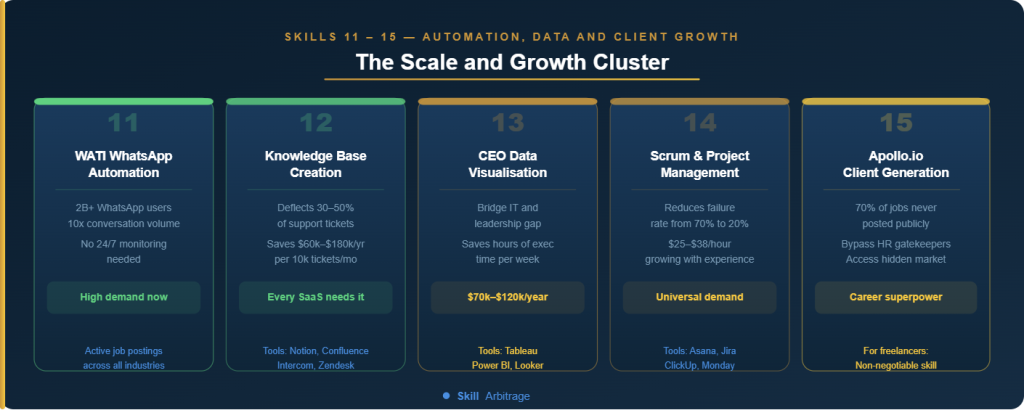
11. Automate Customer Interactions on WhatsApp (WATI)
Set up automated WhatsApp workflows using WATI to handle common queries, send proactive updates, and create seamless customer experiences at scale.
Why companies pay: Automation allows one person to handle 10x the conversation volume while maintaining a personal touch. WATI transforms WhatsApp from a manual chat tool into a scalable marketing and support channel automating appointment reminders, order updates, FAQs, and lead qualification.
It eliminates the need for 24/7 WhatsApp monitoring while ensuring instant responses. With WhatsApp having 2+ billion active users globally, this skill has enormous demand across every industry.
12. Build a Knowledge Base
Build comprehensive, searchable knowledge bases that empower customers to self-serve while reducing ticket volume and freeing up teams for complex issues.
Why companies pay: Well-designed knowledge bases deflect 30–50% of support tickets, allowing companies to serve more customers without hiring more staff. Every deflected ticket saves $5–$15 in support costs. A company handling 10,000 tickets monthly saves $60,000–$180,000 annually with effective self-service.
Most knowledge bases fail because they are written from an internal perspective, not a customer perspective. You become valuable by understanding information architecture, search optimisation, and writing that actually helps people find answers.
13. Create Data Visualisations for CEOs and Top Management
Transform raw data into compelling visual dashboards covering support tickets, onboarding status, refunds, reviews, and team performance that executives can understand at a glance.
Why companies pay: Executives spend hours each week hunting for information buried in spreadsheets. Effective dashboards save executive time while enabling faster, better decisions. CEOs pay premium rates for visualisations they can actually understand and use.
Few people combine data skills with an understanding of executive needs. You bridge the gap between IT and leadership, making yourself indispensable. Data visualisation professionals earn $70,000–$120,000 annually in the US market.
14. Use Project Management Tools and Scrum Methodology
Apply project management methodologies and tools to coordinate cross-functional initiatives, track progress, manage resources, and deliver support and ops projects on time.
Why companies pay: Failed projects cost companies millions. Professional project management reduces failure rates from 70% to below 20%. Project managers earn an average of $25.49/hour in early career, rising to $38/hour with 20+ years of experience.
Companies invest in PM expertise because it is the difference between on-time, on-budget success and expensive failures that damage customer relationships and team morale.
15. Use Apollo.io to Find Potential Clients
Master Apollo.io for lead generation, prospect research, and outreach automation — turning it into your personal client generation engine that ensures a constant flow of opportunities.
Why this matters: If you choose freelancing, lead generation is a career superpower. Apollo mastery makes you self-sufficient in finding opportunities and indispensable to any revenue generation function. 70% of job opportunities never get posted publicly tools like Apollo help you access the hidden market.
This skill has a compounding return: the better you get at finding clients, the more you earn, the more you can specialise, and the higher rates you can command.
16. Set Custom Satisfaction Metrics
Move beyond standard CSAT scores by creating custom metrics aligned with specific business goals, providing more meaningful insights into customer experience and team performance.
Why companies pay: Standard CSAT scores miss crucial nuances. Custom metrics aligned with business goals provide actionable insights that generic surveys cannot. Companies pay for metric design because measuring the wrong things wastes resources while missing real problems. The right metrics drive the right behaviours.
Most companies blindly use CSAT/NPS without questioning whether they measure what matters. You differentiate yourself by designing measurement systems that drive business outcomes elevating you from operator to strategic consultant.
To learn how to design custom satisfaction metrics that actually drive business results, click here.
17. Turn WATI Into a Real-Time Feedback Engine
Discover the innovative approach that transforms WhatsApp Business API into a powerful, real-time customer feedback collection and analysis system.
Why companies pay: Real-time feedback enables immediate service recovery while customers are still engaged. This approach captures insights that surveys miss and resolves issues before they become negative reviews. Traditional surveys have 5–15% response rates. WhatsApp-based feedback gets 40–60% engagement.
Companies invest because it transforms customer communication from one-way updates to two-way intelligence gathering turning every customer interaction into a data point that improves the product and service.
18. Reach Out to Potential Employers on Product Hunt
Learn strategic networking techniques to connect with hiring managers and founders on Product Hunt, opening doors to opportunities that never get posted on job boards.
Why it works: 70% of job opportunities never get posted publicly. Product Hunt connects you directly with founders and hiring managers at innovative companies. Your strategic outreach bypasses HR gatekeepers and competitive application pools, putting you in front of decision-makers when they are most excited about their product.
Founders on Product Hunt are in pitch mode open to conversations. Your well crafted message transforms you from a stranger to a potential hire. This networking technique has landed operations professionals jobs at unicorn startups.
19. Create 3-Day Training Programmes for New Hires
Design intensive, focused training programmes with clear milestones that compress the typical onboarding timeline from weeks to just 3 days without sacrificing quality.
Why companies pay: Traditional onboarding takes 2–3 months to reach productivity. Compressed 3-day intensive training gets hires contributing immediately while reducing supervisor burden by 60%. Every week of unproductivity costs $1,000+ per hire in lost output.
Most training is built through accumulation adding more content rather than optimising what matters. You become invaluable by creating training that respects everyone’s time while achieving superior results. Upwork listings for this skill show rates of $35–$75/hour.
20. Keep Product and Customer Support Teams Working Together
Build bridges between product and support teams through effective communication frameworks, shared goals, and feedback loops that improve the product while enhancing customer satisfaction.
Why companies pay: Product teams building in isolation create features customers do not want. Support teams handling avoidable issues waste resources. The disconnect costs companies 20–30% in wasted development effort and creates preventable customer frustration.
Operations professionals who bridge product and support become strategic partners to leadership. You are not just handling tickets you are shaping product direction with voice of customer insights that no one else in the company has access to.
How to Prioritise Which Skills to Learn First
With 20 skills on the table, the question becomes: where do you start? Here is a practical prioritisation framework based on earning speed and market demand:
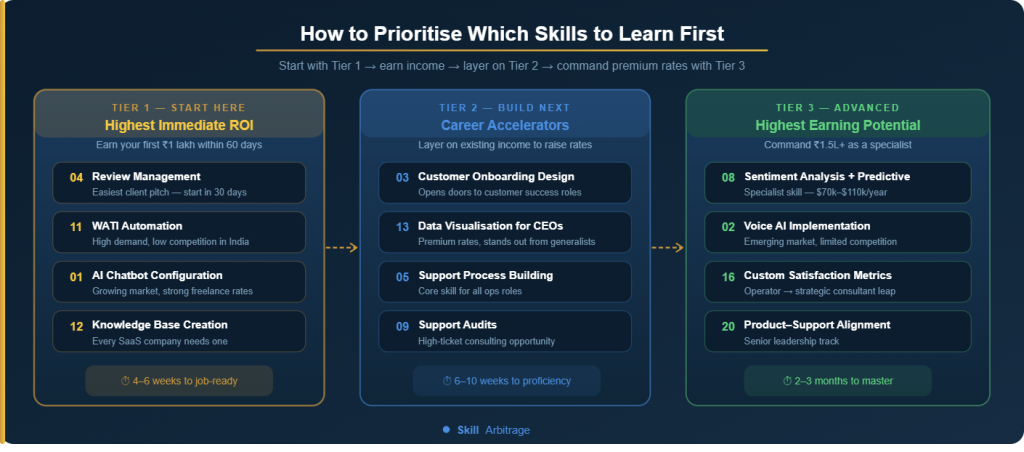
Start Here (Highest Immediate ROI)
- Review Management (#4) — Fastest path to freelance income, easiest client pitch
- WATI Automation (#11 and #17) — High demand, low competition in India
- AI Chatbot Configuration (#1) — Growing market, strong freelance rates
- Knowledge Base Creation (#12) — Every SaaS company needs one, steady demand
Build Next (Career Accelerators)
- Customer Onboarding Design (#3) — Opens doors to customer success roles
- Data Visualisation (#13) — Premium rates, differentiates you from generalists
- Support Process Building (#5) — Core skill for operations roles
- Support Audits (#9) — High-ticket consulting opportunity
Advanced (Highest Earning Potential)
- Sentiment Analysis (#8) — Specialist skill commanding top rates
- Voice AI Implementation (#2) — Emerging market with limited competition
- Custom Satisfaction Metrics (#16) — Strategic consulting positioning
- Product-Support Alignment (#20) — Senior operations and leadership track
“Right now, support professionals with half your experience are earning a minimum of $2,000–$3,000 per month working remotely for US startups.“





 Allow notifications