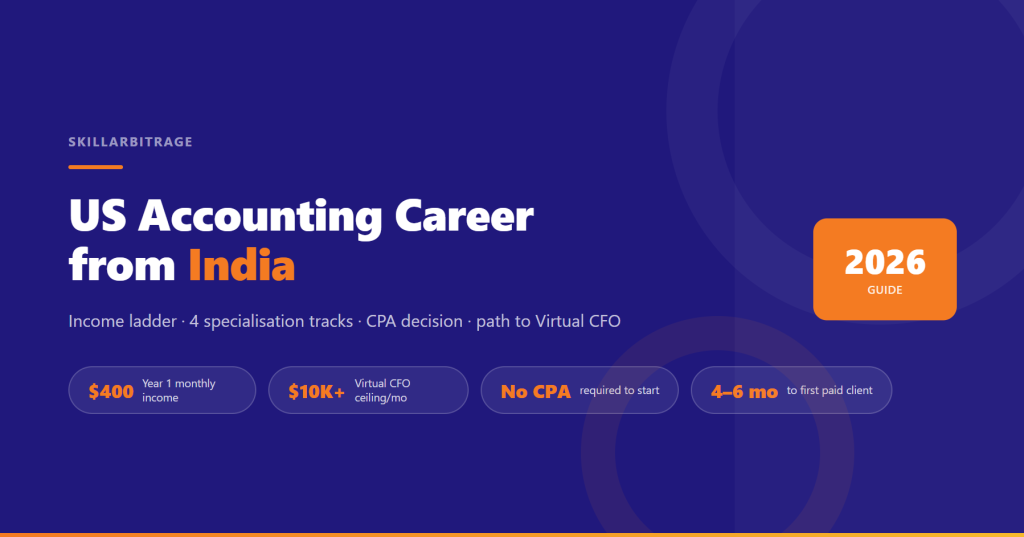

A US accounting career from India means providing bookkeeping, tax preparation, payroll, or financial advisory services to US-based businesses — earning in USD while working from India.
Entry-level professionals typically earn $400–800 per month in their first year. Senior specialists and Virtual CFOs earn $3,000–8,000 per month or more, without relocating.
A us accounting career from india bridges the income gap between domestic Indian accounting and the same work done for US clients is not a matter of skill. An accountant managing the books for an Indian SME and an accountant managing the books for a US e-commerce brand are doing work that requires comparable expertise.
The difference is the market they serve. Domestic accounting in India pays ₹20,000–50,000 per month for mid-level professionals. The same output delivered to a US client — in the same time zone overlap, with the same tools — pays $1,500–3,000 per month.
If you have already decided that a us accounting career from india path that the US path makes sense for you, this article is not about convincing you.
It is about showing you what the full career looks like — what you earn at each stage, which specialisation to choose based on your background, how long each milestone takes, and whether you actually need the CPA to build a career worth building.
From a US accounting specialist who transitioned from domestic practice after eight years: “The biggest mistake I see professionals make is treating this as a side hustle to try out. It is a career with a real income ladder. When I crossed $2,000 per month in my second year, I realised this was not supplementary income — this was a different profession with a different ceiling. The professionals who stagnate are the ones who never decide which track they want to own. Pick one. Get very good at it. The income follows.”
What a US Accounting Career from India Involves: Roles, Tasks & Daily Work
Most content about a us accounting career from india collapses four distinct professions into a single category and calls it “bookkeeping.” That conflation is where the confusion about income, entry requirements, and career trajectory starts.
The four tracks — bookkeeping, accounting, tax, and advisory — have different qualification barriers, different income ceilings, and suit different professional backgrounds. Understanding the distinction before you begin is the most important career decision you will make.
Bookkeeping: The Foundation of US Accounting
Within a US accounting career from India, bookkeeping is the foundation. It involves recording financial transactions, reconciling bank accounts, categorising expenses, and producing monthly reports for clients. Most US small businesses outsource this work because it is time-consuming and does not require a US-licensed professional to perform.
The work itself is well-defined, software-driven, and learnable in a few months. The income ceiling is real — generalist bookkeepers typically plateau around $2,000–2,500 per month without specialising — but it is the fastest entry point into the US market.
Accounting: Interpreting Financial Data
Accounting sits one layer above bookkeeping. It involves interpreting financial data, preparing more complex reports, handling accounts payable and receivable at scale, and supporting month-end close processes. US accounting firms and mid-sized businesses hire accountants for this work, often in full-time remote roles. The work requires a stronger understanding of US Generally Accepted Accounting Principles (US GAAP), business entity structures, and financial reporting standards. B.Com, M.Com, MBA Finance, CA Inter, and equivalent commerce graduates can enter this track directly.
Tax Preparation and Enrolled Agent Work
In a US accounting career from India, tax preparation and Enrolled Agent work forms the third track. This involves preparing US individual and business tax returns, representing clients before the IRS, and managing compliance. The Enrolled Agent credential — awarded by the IRS after passing a three-part examination — is the qualification that unlocks this track. No degree is required to sit the exam, and it is open to Indian professionals with a commerce background. This track has a higher income ceiling than generalist bookkeeping because the work is more regulated and carries professional liability.
Advisory and Virtual CFO Work
In a us accounting career from india, advisory and Virtual CFO work sits at the top of the ladder. It involves providing financial strategy, cash flow analysis, budgeting, and CFO-level guidance to US businesses that need the capability but not a full-time finance executive. US startups, D2C brands, and SaaS companies frequently engage Virtual CFOs on monthly retainers. This track is typically only accessible after several years of hands-on US accounting experience — you cannot credibly advise on strategy before you understand the financial mechanics deeply — but the income potential is the highest of the four.
| Track | Entry Point | Income Ceiling (Remote from India) | Key Qualification | Best Fit For |
|---|---|---|---|---|
| Bookkeeping (Generalist) | 3–6 months learning | $1,500–2,500/month | QuickBooks ProAdvisor (free) | B.Com freshers, career changers |
| Bookkeeping (E-Commerce Specialist) | 4–8 months learning | $2,000–3,500/month | QuickBooks + A2X + Shopify/Amazon | B.Com with tech aptitude |
| Accounting (General/Payroll) | 6–12 months learning | $2,500–4,000/month | US GAAP knowledge + payroll software | CA Inter, MBA Finance, M.Com |
| Tax / Enrolled Agent | 6–9 months (EA exam) | $3,000–6,000+/month | IRS Enrolled Agent credential | Commerce background, any level |
| Virtual CFO / Advisory | 3–5 years experience | $4,000–10,000+/month | Experience + trust + niche | CA, CPA, or experienced accountant |
In a us accounting career from india, the track you choose should match two things: the timeline to your first paid work and the income ceiling you are building toward. Someone who needs income in four months should start with bookkeeping and specialise later. Someone who already has five years of domestic accounting experience and understands financial statements should aim directly at the accounting or advisory track and compress the timeline significantly.

US Accounting Salary from India: Year-by-Year Income Ladder
Understanding salary progression is essential for anyone building a US accounting career from India.
The us accounting career from india income ladder is not a straight line, and most content about this topic either oversells the entry point or undersells the ceiling. The reality is that Year 1 income is modest by design — you are building skills, a portfolio, and credibility in a market that does not know you. Year 3 and Year 5 income is where the arbitrage becomes compelling. Understanding what each stage looks like helps you set realistic expectations and avoid making decisions based on either exaggerated promises or pessimistic generalisations.
Year 0–1: Building Skills and First Clients
In Year 0 to Year 1 of a us accounting career from india, the primary goal is not income — it is acquiring skills, completing your first paid engagements, and building evidence that you can deliver for a US client. The professionals who earn the most in Year 1 are those who arrive with strong foundational accounting knowledge and learn the US-specific tools quickly. Realistic monthly income from one to three clients in the first year runs $400–800 per month. This is not the ceiling; it is the base. The professionals who plateau here are those who do not specialise, do not increase rates, and do not actively pursue additional clients after landing the first one.
Year 1–2: Growing Your Client Base
By Year 1 to Year 2 of a us accounting career from india, a professional with three to five active clients on monthly retainers typically earns $1,200–2,500 per month. The work is more systematic at this stage because the processes are established. Clients return month after month because accounting is a recurring service — this is the structural advantage of the profession. At this stage, most professionals begin to see whether their current track has enough headroom, and those who chose bookkeeping generalist often decide to specialise in a niche (e-commerce, real estate, or specific software stacks).
Year 2–4: Specialist-Level Income
Between Year 2 and Year 4 of a us accounting career from india, a specialist with an established client base earns $2,500–4,000 per month. This is the stage where the rate per client increases materially — not because of inflation, but because the professional’s track record justifies it. A bookkeeper who has spent two years managing the accounts for US Amazon sellers can charge $800–1,200 per seller per month, compared to $300–500 at entry. The Enrolled Agent who passed the IRS examination after Year 1 is now earning during US tax season at $3,000–5,000 per month from a mix of return preparation and year-round advisory work.
Year 4+: Virtual CFO and Advisory Income
Year 4 and beyond in a us accounting career from india is where the Virtual CFO trajectory becomes accessible. Professionals who have spent several years building deep knowledge of specific US business models — SaaS recurring revenue, D2C brand economics, startup cash management — are positioned to move from transactional accounting to strategic advisory. US startups and SMEs typically pay Virtual CFOs $2,000–5,000 per month on retainer, and the total monthly income for a professional managing three to four such relationships runs $6,000–12,000 per month. This is not the common outcome in Year 2, but it is the realistic outcome in Year 5 for professionals who invest in developing advisory skills alongside their technical accounting work.
From an accounting professional who shifted from domestic practice to US remote work: “My first client paid $400 per month for basic bookkeeping. By the end of Year 2, I had six clients and was earning $3,100 per month. The shift happened when I stopped applying for bookkeeping jobs and started positioning myself as a QuickBooks specialist for US SaaS companies. Same skill, different niche. The rate doubled in eight months. The clients found me — I did not find them — because I was the only person in my Upwork search results who understood SaaS metrics and knew how to categorise deferred revenue correctly.”
| Stage | Monthly Income Range | What You Should Have Built | What Holds Professionals Back at This Stage |
|---|---|---|---|
| Year 0–1 (Entry) | $400–800/month | 1–3 clients, core software certified, portfolio sample | Generalist positioning, rate anxiety, one-time projects |
| Year 1–2 (Growth) | $1,200–2,500/month | 3–5 recurring monthly retainer clients, niche chosen | Not raising rates, not specialising, platform dependence |
| Year 2–4 (Specialist) | $2,500–4,000/month | Niche credibility, higher rates, referrals starting | Staying as executor, not developing advisory capability |
| Year 4+ (Senior/Advisory) | $4,000–10,000+/month | Virtual CFO relationships, retainers, direct clients | Not productising the service, underpricing advisory work |
US Accounting Specialisations: 4 Tracks and How to Choose
Choosing the right specialisation is the most important decision in your US accounting career from India.
In a us accounting career from india, the generalisation question — “should I be a generalist bookkeeper or specialise?” — has a clear answer: specialise as early as you can, but not before you understand the fundamentals. The income difference between a generalist bookkeeper and a niche specialist is not marginal; it is the difference between a ceiling of $2,000 per month and a ceiling of $5,000 per month or more, with the same number of clients.
E-Commerce Accounting Specialisation
Within a us accounting career from india, e-commerce accounting is currently the most in-demand specialisation for entry-level US accounting professionals from India. US-based Amazon sellers, Shopify brands, and multi-platform e-commerce businesses have accounting needs that are specific, software-driven, and poorly served by local US bookkeepers who do not understand platform settlement reports. Learning to reconcile Amazon or Shopify payouts using A2X, managing inventory cost accounting, and producing month-end reports for e-commerce clients takes three to five months of focused learning. The income ceiling for an e-commerce accounting specialist is $2,000–3,500 per month from four to six clients, and there is no shortage of clients.
Payroll Specialisation
In a us accounting career from india, payroll specialisation is the second track, often undervalued because it sounds administrative but is in practice highly technical. US payroll involves federal and state tax withholdings, employment classifications, FICA contributions, W-2 and 1099 management, and compliance with state-specific rules. Indian professionals who master a platform like Gusto, ADP, or Rippling can serve US SMEs that either cannot afford a full-time payroll administrator or have recently crossed the threshold where outsourcing makes financial sense. Payroll specialists earn $2,500–3,500 per month from a client base of ten to fifteen businesses, and the work is highly recurring and low-churn by nature.
The Enrolled Agent credential is the highest-credentialed path available to an Indian professional without a US degree or CPA. The IRS Special Enrollment Examination (SEE) has three parts: individual taxation, business taxation, and representation and practice. No degree is required to sit the exam, and the credential is a federal qualification — it is not state-restricted, unlike the CPA. Indian professionals who pass the EA exam and build a US tax client base earn significant seasonal income during the January–April US tax filing season, with some professionals earning ₹15–25 lakh during those four months alone. Year-round income from EA advisory work, IRS representation, and extension-period work extends the annual earning well beyond the tax season peak.
Virtual CFO Advisory Track
The highest tier of a us accounting career from india is Virtual CFO advisory, which is not a beginner track — it is the destination that the other three tracks build toward. US startups, D2C businesses, and SaaS companies engage Virtual CFOs because they need financial strategy, cash management, and board-ready reporting without the cost of a full-time CFO. The typical engagement is a monthly retainer of $2,000–5,000 per company. A Virtual CFO managing three to four client relationships earns $6,000–12,000 per month in a structure that does not scale linearly with hours. The entry requirement is not a certification; it is a track record of delivering accounting work for US businesses and enough domain knowledge to have an opinion about their financial strategy.
| Track | Time to First Income | Income Ceiling | Key Qualification | Best For |
|---|---|---|---|---|
| E-Commerce Accounting | 3–5 months | $2,000–3,500/month | QuickBooks + A2X | B.Com/M.Com, fast entry needed |
| Payroll Specialist | 4–7 months | $2,500–3,500/month | ADP/Gusto/Rippling | Commerce + HR background |
| Tax / Enrolled Agent | 6–9 months (exam) | $3,000–6,000+/month | IRS EA credential | Any commerce background |
| Virtual CFO / Advisory | 3–5 years from entry | $6,000–12,000+/month | Experience + niche trust | CA, CPA, experienced accountant |
Do You Need a CPA to Work in US Accounting from India?
The CPA question is the most common one professionals ask when starting a US accounting career from India.
The US Certified Public Accountant qualification is the most expensive, most time-consuming, and most debated credential in Indian professional circles. The debate usually goes wrong in one of two directions: either the credential is oversold as the only route to a serious US accounting career, or it is dismissed entirely in favour of faster alternatives. The reality is more useful — the CPA is not the entry ticket, but it is the ceiling-raiser.
What CPA Enables That No Other Credential Does
What CPA enables that no other credential does: a CPA can sign off on US financial statements, lead audit engagements, and represent clients in regulated contexts. In US public accounting firms, CPA is the minimum qualification for audit work and a requirement for senior advancement. If your goal is to work for a Big Four or mid-size US CPA firm in India — which pays ₹6–23 lakh per annum depending on experience — CPA is the qualifying standard. If your goal is to work for US clients directly as a remote specialist, CPA is not required.
The Enrolled Agent Alternative
The Enrolled Agent credential occupies an important middle position. An EA has a federal qualification from the IRS, unlimited rights to represent clients before any IRS office, and recognition across all US states without additional licensing requirements. The EA examination has three parts, takes six to nine months of structured preparation for most candidates, and requires no educational prerequisites. An EA working for US tax clients from India earns ₹10–25 lakh per annum at entry to mid-career levels, and senior remote EAs with an established client base earn ₹35–50 lakh or more — a range that competes directly with the CPA track for Indian professionals who remain India-based.
When to Pursue the CPA from India
When to pursue CPA: the right time to consider the CPA is after two to three years of active US client work, when your income from US accounting has crossed ₹20 lakh per annum and you have a clear reason to need the credential — whether that is audit work, corporate employment with a US firm, or the US immigration pathway. Pursuing CPA before you have established income from US accounting is expensive and carries the risk of spending two years and significant fees on a credential before you know whether the career trajectory is right for you.
The honest framing is this: CPA is the right qualification for specific goals. For general remote US accounting work — bookkeeping, payroll, tax preparation as a non-signing EA, and advisory work — the CPA is not required, and the income available without it is substantial. The decision should be driven by your specific career direction, not by the general assumption that credentials always unlock more income.
US Accounting Software Stack: Tools Indian Professionals Need
The right software stack is a non-negotiable foundation for any US accounting career from India.
One of the structural advantages of a US accounting career from India is that the tools are cloud-based, subscription-based, and fully accessible from anywhere in the world. The barrier is not geographic — it is familiarity with software that most Indian domestic accounting training does not cover. Building software competence is the fastest way to become employable, and in some cases, the certifications are free.
QuickBooks Online
QuickBooks Online is non-negotiable for anyone entering the US accounting market. Over 80% of US small businesses use QuickBooks as their primary accounting software, and a professional who cannot work fluently in QuickBooks will not get past the first screening call with most clients. Intuit offers a free QuickBooks ProAdvisor certification programme that takes two to four hours to complete and is recognised by US clients as a credibility signal. Every US accounting professional from India should hold this certification before approaching their first client.
Xero
Xero is the second software platform worth learning. While it has smaller US market share than QuickBooks, it is heavily used by SaaS companies and technology businesses, and it has a strong presence among UK-influenced US clients. Xero also offers free advisor certification, and the learning curve is shorter than QuickBooks because the interface is more intuitive for someone coming to US accounting fresh. Professionals who hold both QuickBooks and Xero certifications access a materially larger client pool.
A2X for E-Commerce Accounting
A2X is essential for e-commerce accounting specialisation. It automates the reconciliation of Amazon and Shopify settlement reports into QuickBooks or Xero, solving a problem that causes enormous pain for e-commerce business owners who cannot reconcile platform payouts with their bank statements. An accountant who can work with A2X for a US Amazon seller provides specific, verifiable value that a generalist bookkeeper cannot — and charges accordingly. A2X is not free, but the cost is typically passed to the client as part of the service.
Payroll Platforms: ADP, Gusto & Rippling
For payroll specialisation, ADP, Gusto, and Rippling are the three dominant platforms. Gusto is the most common choice for US SMEs because of its clean interface and integrated benefits management. ADP serves larger businesses. Rippling is growing quickly among tech-forward US companies. Gusto offers a free partner certification that takes a few hours and is worth completing before approaching payroll clients.
For the EA track, Drake Tax, Lacerte, and UltraTax are the professional tax preparation platforms used by US CPA firms. Access to these platforms for Indian professionals is typically through employment with a US firm or an outsourcing arrangement. The software is not the first barrier — the EA examination and the client relationship are.
| Tool | Purpose | Required For | Certification | Learning Time |
|---|---|---|---|---|
| QuickBooks Online | Core bookkeeping and accounting | All tracks | Free ProAdvisor | 2–4 weeks to proficiency |
| Xero | Bookkeeping (SaaS/tech clients) | Bookkeeping, accounting | Free Advisor cert | 1–2 weeks to proficiency |
| A2X | E-commerce settlement reconciliation | E-commerce track | No formal cert | 1–2 weeks |
| Gusto / ADP / Rippling | US payroll management | Payroll track | Free Gusto partner cert | 2–4 weeks to proficiency |
| Drake Tax / Lacerte | US tax return preparation | EA / tax track | Through employer or firm | 1–2 months for complex returns |
| Bill.com / Ramp / Brex | AP/AR management, spend analytics | Virtual CFO track | No formal cert | 1–2 weeks per platform |
How to Find US Accounting Clients from India
Client acquisition in a US accounting career from India is where most professionals building a US accounting career from India struggle initially.
The client acquisition question is where most content about US accounting from India provides the least useful guidance. Job board listings and Upwork are the most commonly cited sources, but they are only part of the picture — and they are not the path that leads to the highest-earning positions. Understanding the full spectrum of how Indian accounting professionals are finding and converting US clients helps you decide where to invest your time at each stage of your career.
Finding US Clients on Upwork
Upwork remains the most reliable entry point for a first client, and that is unlikely to change in the near term. The platform has a large volume of US small business owners and startup founders posting bookkeeping and accounting projects, many of whom prefer offshore professionals because the rate difference is material for a business managing cash carefully. The critical success factor on Upwork is not price — it is niche positioning. A profile that describes “QuickBooks bookkeeping for US e-commerce brands” receives far more relevant inquiries than a profile that says “experienced accountant, all industries, all software.” Specificity filters for the right clients and filters out the wrong ones.
Direct outreach to US CPA firms is the second channel, and it is more sustainable at mid-career than Upwork. US CPA firms with five to fifty professionals frequently need India-based staff for bookkeeping, tax preparation, and audit support. They know the quality of Indian accounting training and have established workflows for remote collaboration. The approach is outreach-based: identifying CPA firms in a target city or state, researching their service offering, and contacting the managing partner or operations director with a specific proposal about what you can do for their practice. This channel produces more stable, longer-term engagements than platform freelancing, and the rates are typically higher once a relationship is established.
LinkedIn for US Accounting Client Acquisition
LinkedIn has become a significant client acquisition channel for mid-career and senior US accounting professionals from India. The strategy that works is not posting about your services — it is creating content about US accounting topics that your target clients care about. An accountant who writes short posts about QuickBooks features, common bookkeeping errors that US e-commerce founders make, or how to read a cash flow statement attracts inbound enquiries from US business owners who see the content, assess the expertise, and reach out. This is a long-term channel — expect three to six months before it produces consistent leads — but the clients it generates tend to be higher-quality and more committed than platform clients.
From a US accounting professional who built a ten-client roster in eighteen months: “I started on Upwork at $15 per hour for basic QuickBooks work. After six months I had four clients and a clear sense of what kind of work I was good at — e-commerce brands. I rewrote my Upwork profile to be completely specific to Amazon and Shopify sellers. Within three months, my rate was $45 per hour and my roster was full. At that point I stopped taking Upwork clients and started reaching out directly to e-commerce accounting firms in the US. Now I work for three US firms and one direct client. The platform got me started. Direct relationships are where I stay.”
Niche Positioning as a Client Acquisition Accelerator
Niche positioning is the accelerator at every stage of client acquisition. An accountant who specialises in “QuickBooks accounting for US SaaS companies” or “payroll management for US healthcare staffing firms” is not competing with every other Indian bookkeeper on Upwork — they are the only option in a specific search. The narrower the niche, the more premium the rate the market will accept, because the client perceives that the professional understands their specific problems rather than offering generic services.
Building a US Accounting Practice from India: Beyond the First Client
Scaling a US accounting career from India beyond the first client requires systematic practice-building.
The structural difference between a US accounting professional with one client and one with a practice is not the number of clients — it is the business model. A single client is income. Five recurring retainer clients are a business with predictable monthly revenue, client diversification, and the ability to raise rates without losing your entire income if one client leaves. Building that structure deliberately, rather than accumulating clients opportunistically, is what separates the professionals who reach $4,000–6,000 per month from those who stay at $1,200–1,500.
The Retainer Model for US Accounting Clients
The retainer model is the financial architecture that makes US accounting from India sustainable and scalable. Monthly retainers — where the client pays a fixed amount each month for a defined scope of work — are standard in US accounting practice and are the mechanism that produces predictable income. The initial challenge is convincing a new client to commit to a retainer rather than a one-time project. The solution is to make the first engagement transactional (project-based), deliver excellent work, then propose a monthly retainer for ongoing support. Most clients who have experienced the value of good accounting work will convert to a retainer rather than re-hiring each month.
When and How to Increase Your Rates
Rate increases follow a natural timeline in US accounting practice. A professional who has served a client for twelve months, delivered consistently, and deepened their understanding of the client’s business has earned a rate increase — and most US small business clients expect it. The benchmark is an annual rate increase of 10–20% for retained clients, and a higher starting rate for all new clients acquired after the first year. The professionals who never raise their rates remain at Year 1 income regardless of how many years they have been working. The rate-raising conversation is not a negotiation — it is a statement, delivered with confidence, about the value you deliver.
Transitioning to Virtual CFO Advisory
The Virtual CFO transition happens when you have enough context about a client’s business to have opinions about their financial strategy, not just their financial records. This transition is built over time through client relationships where you consistently deliver more than pure accounting — flagging cash flow risks before they become problems, pointing out that a client’s pricing model is undermining their gross margin, or identifying that a client is paying for software subscriptions that are no longer generating revenue. These contributions are not bookkeeping; they are advisory. And when a client begins to rely on you for that perspective, the retainer reflects it.
What a US Accounting Career from India Looks Like in Practice
Here is a realistic day-to-day view of what a mature US accounting career from India looks like.
The mechanics of working as a US accounting professional from India are worth understanding before you commit to the career, because the practical realities — time zones, work patterns, communication norms — affect whether the career suits your life and not just your income goals.
US client work operates on US time, which means active communication happens in the overlap between Indian evening and US business hours. Working for US East Coast clients (New York, Boston, Miami) typically means availability between 6:30–10:30 PM IST. Working for US West Coast clients (Los Angeles, San Francisco, Seattle) pushes that to 11:30 PM–2:00 AM IST for real-time communication, though most bookkeeping and accounting work is asynchronous and does not require live availability. Most Indian professionals working for US clients schedule client calls for early US morning, which is late Indian evening, and do the execution work during Indian daytime. This is manageable but requires clear boundaries with clients about response time expectations.
The EA track has a pronounced seasonal pattern. January through April is US tax filing season — the period of maximum client demand, highest rates for tax return preparation, and the longest working weeks for tax professionals. The months from May through August are typically quieter. This seasonal structure suits professionals who want to earn intensively for four months and have lighter commitments the rest of the year, or who use the off-season to develop additional skills or acquire new clients.
For women in India, the US accounting career has structural characteristics that make it particularly well-suited to different life stages — flexible hours, location independence, no client-facing commute, and the ability to manage work around family commitments without sacrificing income. The career is also well-suited to returning from a career break, because the skills are verifiable and the market cares about demonstrated competence in specific software, not tenure at a specific firm. Professionals who have taken time away from work can re-enter through self-study, certification, and a portfolio engagement without needing to justify a gap in their CV.
The realistic timeline from zero to first paying client is four to six months for someone starting from scratch with a commerce education and committing eight to ten hours per week to learning. Professionals with existing accounting experience in India typically reach the first client in two to three months. The first six months are the hardest — income is low, the learning curve is real, and the client acquisition process feels uncertain. The professionals who push through that period and reach three to five recurring clients are the ones who discover that the career becomes increasingly easier and increasingly rewarding as the client base grows.
Disclaimer: This article is for informational and educational purposes only and does not constitute financial, tax, or legal advice. Income figures represent market ranges reported in publicly available sources and will vary based on individual experience, client type, specialisation, and effort. Regulatory requirements, certification rules, and platform policies are subject to change. For advice specific to your situation, consult a qualified professional. Information is current as of March 2026.
FAQs About US Accounting Careers from India
Here are the most frequently asked questions about building a US accounting career from India in 2026.
Can I pursue US accounting without a CA or CPA qualification?
Yes. The majority of US accounting work performed remotely from India — including bookkeeping, e-commerce accounting, payroll management, and Virtual CFO advisory — does not require a CPA licence. The Enrolled Agent credential, available to professionals without a degree requirement, covers US tax work and IRS representation. B.Com, M.Com, MBA Finance, and CA Inter graduates can enter the US accounting market through the bookkeeping and accounting tracks without any additional formal qualification.
What educational background do I need to start US accounting from India?
A commerce education — B.Com, BBA, M.Com, MBA Finance, or CA Inter — provides the foundational accounting knowledge required. The US-specific skills (US GAAP, tax filing structures, software platforms) are learned separately through structured courses and self-study. There is no regulatory requirement for Indian professionals to hold a US degree or licence to provide bookkeeping, payroll, or accounting services to US clients remotely.
How long does it take to earn my first dollar from US accounting?
For someone starting from scratch with a commerce background and dedicating eight to ten hours per week to learning, the realistic timeline is four to six months from beginning to first paid engagement. Professionals with existing accounting experience in India who focus on learning US-specific tools can reach their first client in two to three months. The learning investment is front-loaded — the ongoing work requires far less study time once the tools and workflows are established.
How much can I realistically earn from US accounting in India in Year 1?
A professional with one to three active clients on monthly retainers can realistically earn $400–800 per month in Year 1. This figure increases significantly in Year 2 as the client base grows and rates increase with demonstrated track record. The Year 1 income figure is not the ceiling — it reflects the reality that client acquisition and skill-building take time and that most professionals are still building their portfolio at this stage.
Which US accounting specialisation has the highest income ceiling from India?
Virtual CFO and financial advisory work has the highest income ceiling — $6,000–12,000 per month for professionals managing three to four client relationships on monthly retainers. However, this track requires several years of US accounting experience before it becomes accessible. For professionals building from entry level, the Enrolled Agent (tax) track has the highest income ceiling at the specialist level, with senior remote EAs earning ₹35–50 lakh or more annually including seasonal income.
When does the Virtual CFO income level become achievable?
Virtual CFO-level income typically becomes achievable after three to five years of active US accounting work, during which a professional has developed deep familiarity with specific US business models and built client relationships where financial strategy is part of the regular conversation. The transition from accounting executor to financial advisor is relationship-driven, not credential-driven — it happens when clients begin relying on your perspective, not just your technical work.
Do I need to buy US accounting software to work with US clients?
Not at the outset. QuickBooks ProAdvisor and Xero Advisor certifications are free and give professionals access to the software for their own learning. In most client engagements, the client holds the software subscription and provides the professional with access. For e-commerce accounting, A2X is typically charged to the client as part of the service. The upfront software cost for an Indian professional entering US accounting is close to zero.
What is the QuickBooks ProAdvisor certification and is it worth doing?
The QuickBooks ProAdvisor certification is a free online certification programme offered by Intuit that validates proficiency in QuickBooks Online. It takes two to four hours to complete and is widely recognised by US small business clients as a credibility signal. It is the single highest-return-per-hour investment a professional entering US accounting can make — completing it before approaching any client is straightforward, free, and materially improves the probability of being hired.
Should I pursue the US CPA exam to do US accounting from India?
The CPA is the right choice if your goal is audit work, employment with a US public accounting firm, or the US immigration pathway. It is not necessary for remote bookkeeping, payroll, or advisory work from India, and it is not required to earn at mid-to-senior income levels in those tracks. The most useful time to pursue CPA is after two to three years of established US client work, when you have income from the career and a specific reason to need the credential.
What is an Enrolled Agent and is it better than CPA for remote work from India?
An Enrolled Agent is a federally credentialled tax professional authorised by the IRS to represent clients in all tax matters before any IRS office. Unlike the CPA, the EA requires no degree and has no state-specific licensing requirements. For professionals who want to specialise in US tax work from India, the EA is a faster and more accessible credential than the CPA. It is not “better” in absolute terms — CPA has broader application — but for the specific goal of building a US tax practice from India, the EA is the more direct route.
How do I find my first US accounting client from India?
Upwork is the most reliable entry point. A profile specifically positioned for a niche — such as “QuickBooks bookkeeping for US e-commerce brands” — receives more relevant enquiries than a generalist profile. After establishing two to three clients and a track record, direct outreach to US CPA firms and LinkedIn content creation become the more sustainable channels for acquiring higher-value clients. The client acquisition strategy should evolve as your career progresses.
Is the market for Indian US accounting professionals saturated in 2026?
The generalist bookkeeping segment is competitive, and undifferentiated profiles on Upwork do face more competition than five years ago. However, the market for specialised US accounting professionals from India — particularly in e-commerce accounting, US tax preparation, payroll management, and Virtual CFO advisory — is not saturated. The US small business market is large, growing, and structurally inclined to outsource accounting functions. Professionals who specialise and position clearly continue to find demand without difficulty.





 Allow notifications