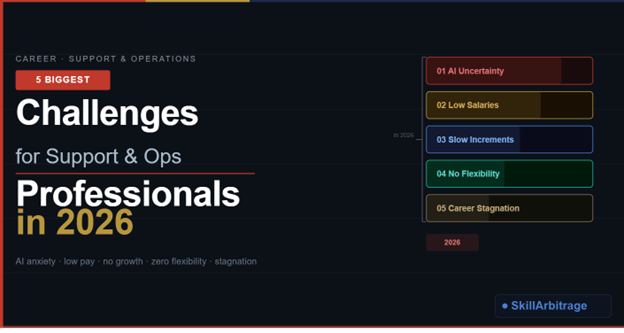

If you work in support or operations, 2026 is not an easy year to be in your shoes. AI is reshaping the industry faster than anyone prepared for, salaries haven’t moved meaningfully in years, and a real career path forward feels harder to see than ever.
Table of Contents
Challenge 1 – Uncertain future owing to AI
Nothing is generating more stress in support and ops right now than the uncertainty about AI. Every week brings a new headline: a company automating its call centre, a CEO announcing that AI will replace customer support roles, a round of layoffs tied to automation.
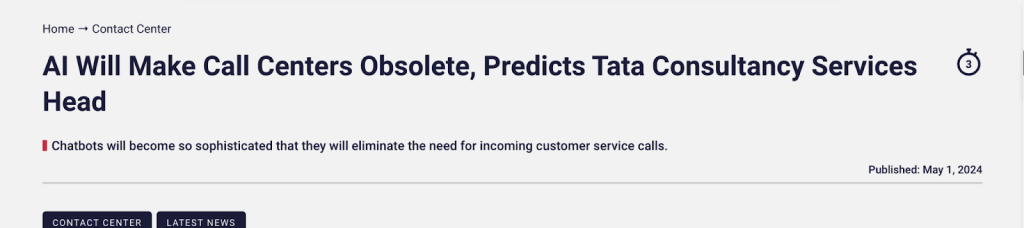
The fear is understandable. The TCS CEO has publicly stated that call centres could become obsolete within a year. Estimates suggest 85% of routine customer support jobs are under serious threat by 2026–27. For professionals who’ve spent years building their careers in this space, that’s a frightening headline to wake up to.
What the Data Actually Says About AI and Support Jobs
Operations and customer satisfaction professionals are worried:
- As per Gartner (2025), “In 2026, 80% of customer service and support organizations are expected to use generative AI…”
- AmplifAI (2026), Generative AI Statistics – Increase in trust among support leaders (70% trust AI more since 2024) and adoption metrics.
- IDC/Microsoft via MasterOfCode (2026) – AI adopters see 18% higher customer satisfaction and 250% ROI on average.
- Nielsen Norman Group via HatchWorks (2024) – Support agents using AI handled 13.8% more inquiries/hour in case studies.
- LivePerson (2025) – 91% of businesses are positive about AI for customer engagement; 96% believe GenAI will enhance interactions.
The pattern is consistent: companies that implement AI well don’t just fire their support teams they expect their support teams to operate AI-powered systems. That requires a different skill set, not an exit from the profession.
Challenge 2 – Low Salaries That Don’t Reflect the Value You Deliver
Support and operations is the backbone of every business. No company survives without happy customers. No product succeeds without operational infrastructure holding it together. And yet, support and ops remain among the most systematically underpaid functions in the corporate world.
The Real Numbers: What Support & Operations Professionals Earn in India
The salary reality is sobering:
- Entry-level support and ops roles typically start at Rs. 20,000 or less per month
- Professionals with 5 years of experience often still earn under Rs. 50,000 per month
- Even with 10+ years of experience, many professionals struggle to break the Rs. 1 lakh per month mark
- Meanwhile, peers in sales, marketing, and technology often with the same years of experience earn 50% to 3x more
The gap isn’t a coincidence. It’s a structural feature of how support and ops roles are valued or rather, undervalued in the industry.
Challenge 3 – Increments That Barely Beat Inflation
Even when promotions do come, the actual salary increase rarely changes the picture meaningfully. The average increment in support and ops roles typically runs under 10% and in a high-inflation environment, that’s barely keeping pace with the cost of living, not getting ahead of it.
In some years, there are no increments at all. A professional who joined at Rs. 20,000 five years ago may be earning Rs. 28,000–30,000 today. That’s not a career trajectory that’s a treadmill.
Challenge 4 – No Flexibility: Tied to Cities, Shifts, and Offices
The majority of well-paying support and operations roles are still concentrated in large metros like Mumbai, Bangalore, Hyderabad, Pune, Delhi NCR. If you don’t live in one of these cities, your options narrow sharply. And if you do relocate, a significant portion of the salary bump immediately disappears into rent and commuting costs.
For professionals with family obligations ageing parents, a partner’s career, children in school relocation is often simply not an option. This locks many talented professionals into lower paying local roles with limited upward mobility.
Challenge 5 – Stagnation: Working Hard With Nowhere to Go
Of all the challenges, this one may be the most demoralising. You show up every day. You solve problems. You handle difficult customers with patience. You hit your targets. And yet, nothing changes. The work is the same next month as it was last month. The role looks the same in year five as it did in year one.
Career progression in support and ops is often narrow team lead, then maybe a manager role, and then a ceiling that’s very hard to break through. The paths that exist in sales or marketing specialist roles, industry recognition, high-value consulting simply don’t have equivalents in traditional support career tracks.
The Bigger Picture: Why This Crisis Is Happening Now
These five challenges aren’t unrelated. They’re symptoms of a single underlying problem: support and operations has been structurally underinvested in for decades, and the arrival of AI has made that underinvestment suddenly and painfully visible.
Companies that didn’t invest in building strong, well-compensated support teams are now scrambling to automate. That automation is threatening the jobs of professionals who weren’t given the tools, training, or career paths to adapt. The education system hasn’t caught up. The MBA programmes aren’t addressing it. And most HR functions are treating it as a cost problem rather than a talent problem.

The result is a large population of skilled, experienced professionals who are genuinely valuable but who have been told, through pay and promotion decisions, that they aren’t.





 Allow notifications