
Many professionals hesitate to become independent directors due to fear of legal liability, but this concern is often overstated. Indian laws and regulations strongly protect independent directors unless there is clear evidence of wrongdoing. This guide explains the real risks, legal safeguards, and what you need to know before stepping into a board role.
Table of Contents
What Does the Law Actually Say About Independent Director Liability?
Under Indian law, an independent director owes fiduciary duties to the company and its shareholders. However, courts have consistently held that personal liability only arises when there is clear evidence of active wrongdoing or gross negligence.
Simply being on the board of a company that later becomes embroiled in controversy is not sufficient grounds for prosecution.
The 2020 MCA Circular: A Game-Changer for Independent Directors
In 2020, the Ministry of Corporate Affairs (MCA) issued a landmark circular that explicitly directed law enforcement agencies not to initiate proceedings against independent and non-executive directors unless there is strong, concrete evidence of their personal complicity in fraud.
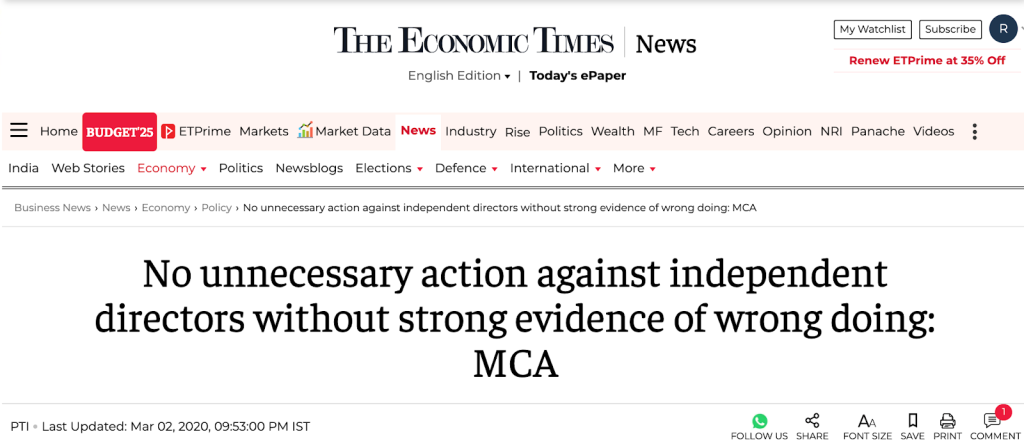
This circular was a direct response to the fallout from the PMC Bank case, where the arrest of an independent director triggered the resignation of approximately 1,500 independent directors across Indian companies within just 1–2 months, a near-crisis in corporate governance. The government recognized that such a chilling effect was unsustainable and acted decisively.
| Key Legal Protection, Current Rule of Law Police cannot register an FIR against an independent director unless there is clear, concrete evidence of their personal participation in the alleged fraud. This protection applies even if the company itself is under investigation. |
SEBI LODR Regulations: Oversight Obligations and Safe Harbor Provisions
SEBI’s Listing Obligations and Disclosure Requirements (LODR) Regulations, 2015, impose robust disclosure and oversight standards on listed company boards. Importantly, they also include safe harbor provisions that protect directors who act responsibly and in good faith.
What does acting in good faith mean in practice?
- Attending board meetings and engaging with agenda items diligently.
- Reviewing financial statements, audit reports, and compliance disclosures.
- Raising concerns, filing dissenting notes, or escalating issues when required.
- Resigning and reporting to regulators if governance failures cannot be corrected internally.
If you voted for a resolution that later turned out to be problematic, you are legally protected as long as you acted on the information reasonably available to you at the time and in good faith.
Landmark Corporate Cases: How Indian Courts Have Ruled
The most instructive data point on independent director legal liability in India is not a legal textbook, it is the real-world track record. Here is how some of India’s biggest corporate failures played out for independent directors:
The Satyam Scandal
Despite being one of the largest corporate frauds in Indian history, several independent directors of Satyam Computer Services were ultimately exonerated. Courts found that they had been systematically misled by management and had no personal involvement in the fraudulent activities.
The IL&FS Crisis
When the IL&FS group collapsed in 2018, independent directors came under scrutiny for oversight lapses. However, legal action focused predominantly on executive management. No definitive personal liability was imposed on independent directors, as the failures were found to be systemic rather than the result of individual malfeasance.
The Gensol / BlueSmart Case
In the more recent Gensol and BlueSmart controversy, independent directors chose to resign from the board. Notably, no regulatory investigation was initiated against them, because they had not participated in or endorsed the alleged misconduct.
| “Independent directors have not been investigated or arrested in any notable corporate case in the last five years.” |

[You can read the details here.]
How Regulators Are Evolving: Accountability With Protection
In 2022 and 2023, SEBI proposed and implemented stricter norms for the appointment and removal of independent directors to strengthen board independence. At the same time, regulators have supported broader D&O insurance coverage and explored giving independent directors a greater voice in governance decisions.
The trend is clear: regulators are calibrating a balance between holding boards accountable and not deterring qualified professionals from serving. Independent directors are being treated as partners in governance, not as proxy defendants for management wrongdoing.
D&O Insurance in India: Your Financial Safety Net
Directors and Officers (D&O) insurance provides an important additional layer of protection. A typical D&O policy in India covers:

- Legal defense costs arising from claims of negligence or breach of duty.
- Settlements and compensation in civil proceedings.
- Costs related to regulatory investigations.
D&O policies generally exclude coverage for acts involving fraud or criminal intent, which is consistent with the broader principle that honest, diligent directors are protected, while bad actors are not.
Before accepting a board seat, it is advisable to confirm that the company maintains adequate D&O coverage and to review the scope of that policy.
The Protective Powers You Have as an Independent Director
Independent directors are not passive participants on a board. Indian law gives you specific tools to protect yourself while fulfilling your governance responsibilities:
| Three Powerful Protections Available to You • Dissenting Notes : You can record your objection to any board resolution. That note becomes part of the official board record and creates a documented trail of your independent judgment. • Resignation : You are always free to exit a company whose governance you are uncomfortable with. The act of resignation itself signals concern to regulators and the market. • Whistleblower Role : The credible threat that you might report governance violations to regulators is a significant check on promoter behaviour, giving you real influence even without executive authority. |
10 Warning Signs to Evaluate Before Accepting an Independent Director Role
While the legal risks are limited, due diligence before joining a board remains essential. Here are ten red flags to look for:
1. Poor corporate governance : Lack of board diversity, absent audit/risk/nomination committees, or opaque decision-making.
2. Financial instability : Inconsistent financial statements, excessive debt, or poor cash flow management.
3. Ethical concerns : History of regulatory violations, legal disputes, or aggressive/questionable accounting practices.
4. Lack of strategic direction : Frequent strategy changes, short-termism, or absence of a long-term plan.
5. Weak risk management : No formal risk framework, or a management team that dismisses identified risks.
6. Poor board dynamics : A domineering CEO/Chairman who discourages open discussion, or habitually absent board members.
7. Inadequate succession planning : No leadership pipeline, or frequent unexplained changes at the senior level.
8. Regulatory and compliance issues : Active investigations, repeated compliance failures, or a track record of non-compliance.
9. Reputational risks : Persistent negative media coverage, or significant dissatisfaction among employees, customers, or investors.
10. Conflict of interest : Any pre-existing personal or professional conflicts that could compromise your independence.
| “Independent directors have been described as a ‘specially protected species’ under current Indian law, more protected than company employees or even promoters.” |
Frequently Asked Questions About Independent Director Legal Liability in India
Can an independent director be arrested in India?
Not without concrete evidence of personal participation in fraud. The 2020 MCA circular explicitly prohibits law enforcement from initiating proceedings against independent directors unless such direct evidence exists.
Are independent directors personally liable for company debts?
No. Independent directors are generally not personally liable for the financial obligations of the company. Liability can arise only in cases of proven personal fraud or gross negligence.
What is D&O insurance, and do I need it?
D&O (Directors and Officers) insurance covers your legal costs and potential settlements in civil proceedings related to your board role. It is strongly advisable to confirm that any company you join as an independent director maintains adequate D&O coverage before accepting the appointment.
What should I do if I suspect fraud at a company where I am an independent director?
Record a dissenting note immediately, consult legal counsel, and if necessary, resign and report the matter to the relevant regulator (SEBI, MCA, or the RBI as applicable). Acting quickly and transparently is your strongest protection.
The Bottom Line: Should Fear of Liability Hold You Back?
The evidence is clear. Indian courts, SEBI, and the MCA have built a legal framework that distinguishes between active wrongdoing and ordinary governance participation. Surveys of Indian corporate boards consistently show that independent directors report minimal instances of personal litigation or financial loss when proper governance procedures are followed.
The current legal environment makes the independent director role one of the most professionally protected positions in India’s corporate ecosystem. The fear of being held personally liable for decisions you did not make or frauds you did not participate in is not supported by either the law or the track record of enforcement.
What should actually occupy your attention is building the professional profile and governance competence that makes you a sought, after board candidate.




 Allow notifications