
Last verified: 2026-07-06
Somewhere in a co-working space in Gurugram right now, a seed-stage founder is staring at a founder’s agreement they downloaded from a US template site, unsure whether it will survive a single investor’s due-diligence pass. They do not want to hire a law firm. They cannot afford in-house counsel.
What they want is one competent person who can fix this in a week for a fixed fee, and yet the single hardest step in this whole market is still the first one: how to land your first startup client as a freelance legal professional. The demand is loud. The path to the first paying founder is quiet.
That gap is the opportunity, and it is bigger than most Indian legal professionals realise. Across 2025 and 2026, startups and firms (Indian and international alike) have kept unbundling their legal work, handing discrete tasks like contract drafting, compliance clean-ups, and legal research to freelance legal professionals instead of hiring full-time lawyers.
The rate spread is what makes this worth your attention. An India-based freelance legal professional commonly charges in the range of ₹1,500 to ₹8,000 an hour, or roughly ₹25,000 to ₹40,000 per contract, while the same output bills at USD 75 to 200 an hour in North America (freelance legal rates in India, 2026). Same skill. Very different invoice, depending on who is paying.
Why does that demand exist now, and why is it still unmet? Legal services got unbundled: buyers stopped paying for a full retainer when they only needed one document. India’s startup base ballooned faster than its supply of affordable, startup-fluent legal help.
And remote work stopped being a concession and became the default, which quietly opened US, UK, and Singapore founders to hiring an India-based freelancer they will never meet in person. The demand is real and rising. The bottleneck is not the work.
Here is the part almost nobody says out loud. Competent drafters are everywhere. Legal professionals who can find, pitch, price, close, and keep a startup client are rare. The scarce skill in this market is not legal knowledge; it is client acquisition.
That is where the earning gap actually sits, and it is why two people with identical LLBs can end up with wildly different incomes. One learned to draft. The other learned to draft and sell.
There is a catch, and it is the thing that keeps careful professionals stuck. In 2026, the Bar Council of India tightened its stance on legal advertising and directory-style solicitation, so the demand may be real, but how you are allowed to chase it is stricter than most freelancers assume.
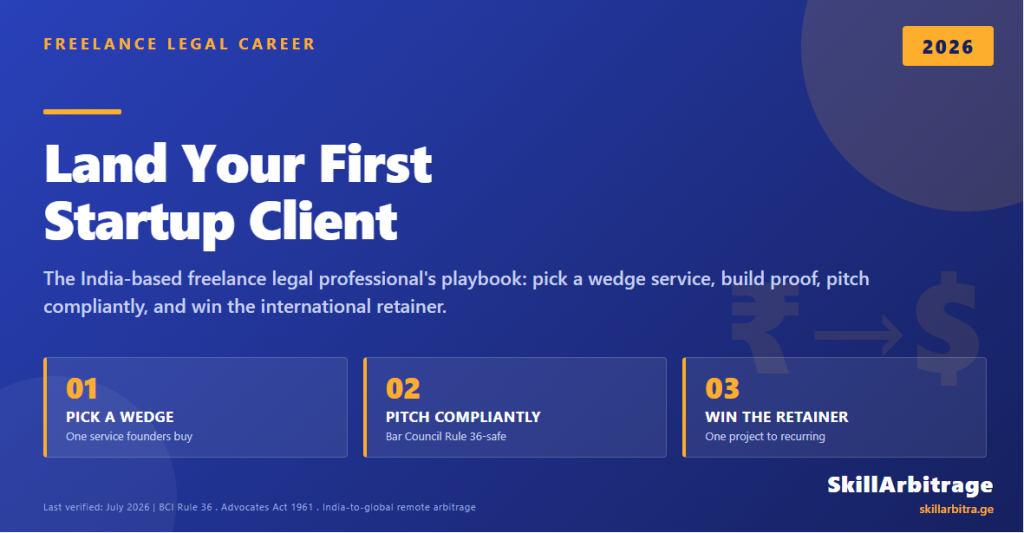
A freelance legal professional lands a first startup client by picking one wedge service a founder actually buys (a founder’s agreement, an IP assignment, or a SaaS contract), building visible proof through educational content rather than direct solicitation, reaching out to founders compliantly, scoping a small fixed-fee first project, and delivering fast enough to convert it into a retainer.
The rest of this guide walks that path in order, with the compliance guardrails competitors skip. You will not get “build a website and network” advice you have already read. You will get a Rule 36-safe, step-by-step route from zero to your first paying founder, and then to the retainer.
Why startups are the fastest first client for a freelance legal professional
Getting the very first client is the hardest sale you will ever make, because you have no track record to point to. So the smart move is to pick the easiest possible buyer for a first sale, and for a freelance legal professional, that buyer is a startup. Why a startup and not an established company or a law firm’s overflow work? Because a seed-stage startup buys the way you need your first client to buy: fast, on trust, and without a procurement committee.
Think about who actually says yes on the other side. A seed-stage startup has no in-house counsel, so there is no gatekeeper lawyer to impress. The founder is the decision-maker, which means one conversation can close a deal instead of three rounds of approvals.
Founders buy on trust and turnaround, not on the brand name over your door. And they almost always prefer a fixed fee they can budget over an hourly meter that makes them anxious. That combination (no gatekeeper, one decision-maker, speed over polish, fixed fee over meter) is exactly the profile of a first client you can realistically win with zero reputation.
What a seed-stage founder actually needs
A founder’s legal needs are narrower and more predictable than most freelancers assume. At the seed stage, the recurring asks are a founder’s agreement (who owns what, what happens if a co-founder leaves), an IP assignment (making sure the code and brand belong to the company, not to a contractor who once touched it), the basics of an ESOP so early hires can be granted equity, and the SaaS or vendor contracts the business signs to operate. Add a light privacy and compliance layer once the startup starts handling customer data for B2B deals, and you have covered most of what a seed-stage company will pay a freelancer for.

Here’s what that looks like in practice. A freelance legal professional in a tier-2 city like Indore or Coimbatore takes on a Bengaluru seed-stage founder who just raised an angel round and needs a co-founder agreement and clean IP assignments before the money hits the account. It is a two-document job, fixed fee, delivered in a week.
That founder does not care where the freelancer sits. They care that it is done right, done fast, and priced so it does not eat into runway.
Why founders choose a freelancer over a law firm
Founders reach for a freelancer over a firm for reasons that have very little to do with pedigree. A law firm quotes a retainer and a partner’s hourly rate; a freelancer quotes a fixed fee for the one document the founder actually needs this month. A firm assigns a junior associate who bills slowly; a freelancer picks up the phone the same day. For a company counting weeks of runway, responsiveness and price beat brand almost every time.
And this is the insight that reframes the whole career. The scarce asset here is not legal skill; it is business-development skill. Plenty of Indian legal professionals can draft a clean SaaS agreement. Very few can find the founder, earn the trust, price the job, and close it.
That is why a freelance consultant can build a client base faster than a same-age law-firm associate who is technically stronger but has never had to sell. The associate has clients handed to them. The freelancer has to manufacture demand, and that skill compounds.
What experienced freelancers know is that founders are not comparing you to a top-tier firm at all. They are comparing you to doing nothing, or to copy-pasting a template off the internet and hoping. Your real competition is inertia and a free download, not a senior partner. Once you internalise that, your pitch changes: you are selling certainty and speed, not prestige.
A question that comes up constantly in freelancing communities is whether startups are even worth targeting, given how little budget they have. It is a fair worry, and the answer is yes, with a caveat. A single seed-stage project may be small, but startups cluster in tight founder networks, convert to retainers, and refer generously when they trust you.
The first client is rarely the prize. The pipeline behind them is.
Where does this go wrong? Freelancers who treat a startup like a discounted version of a corporate client (heavy paperwork, slow turnaround, a menu of services) lose them fast. Founders want one problem solved, quickly, at a price they can approve without a board meeting. Match that, and you are the easy yes.
What to offer: pick a wedge service startups actually buy
The instinct when you start out is to advertise yourself as a full-service legal freelancer who can do anything a founder needs. That instinct costs you clients. A founder scanning for help does not want a generalist menu; they want the one person who clearly, obviously solves the specific problem in front of them right now. So you lead with a wedge: one sharply defined service that a startup actually buys, that you become known for first.
Why does a narrow wedge convert faster than “full-service”? Because specificity signals competence, and competence is what closes the trust gap when you have no reviews. “I draft founder’s agreements and IP assignments for seed-stage startups” lands harder than “I handle all your legal needs.” The first tells the founder you have done this exact thing before. The second sounds like everyone else.
The best wedge services for a first startup client
A handful of wedge services fit the seed-stage buyer almost perfectly. The founder’s agreement (co-founder equity splits, vesting, exit terms) is a near-universal first need. The IP assignment (making sure everything the company builds belongs to the company) is a due-diligence must-have that founders often discover they lack only when an investor asks.
SaaS and vendor contracts are the operational documents a growing startup signs constantly. And a privacy or compliance starter (a basic policy pack for a company that has started handling user data) is an increasingly common entry point as B2B buyers demand it.
You do not need to be able to deliver all four to start. You need one, done well, with a repeatable process behind it. This post is about acquisition, so it will not re-teach the craft.
For the actual anatomy of these documents, the governing-law choices, the AI tools that speed up first drafts, and the going rates, lean on our detailed breakdown of how to actually draft contracts for foreign clients and what to charge. Name the service here; learn the mechanics there.
Generalist versus specialist positioning for startup clients
So which wins, generalist or specialist? For landing the first client, specialist wins almost every time. A specialist is memorable and referable (“talk to the IP-assignment person”), while a generalist blends into a crowded field.
The mistake many freelancers make is thinking a narrow niche shrinks their market. In practice, it does the opposite: it makes you the obvious choice inside that niche, which is where referrals come from.
The nuance experienced freelancers add is that positioning and delivery are different things. You position narrowly to get hired, then you can deliver adjacent work once you are inside the relationship. Land the founder’s-agreement job, and the same founder will ask you about their vendor contracts next month. The wedge is the door, not the ceiling.
Which wedge builds a track record fastest
If you are choosing a first wedge purely to build a track record quickly, weigh volume against depth. Contract drafting (founder’s agreements, IP assignments, SaaS terms) is high-volume, repeatable, and easy to show as portfolio samples, which makes it the fastest track-record builder for most people. Compliance work is stickier and leads more naturally to retainers, but it takes longer to demonstrate. Legal research is useful but rarely a standalone first wedge, because founders do not usually buy research as a discrete product.
A common question in freelancing forums is whether to pick the wedge you are best at or the one the market buys most. Pick the overlap. The best wedge is the one where your competence and startup demand meet, not your favourite area of law that no founder is paying for.
The pitfall to avoid is offering the wedge and the full menu in the same breath. If your profile says “founder’s agreements, IP, SaaS, compliance, litigation support, notices, research, and more,” you have erased the wedge. Lead with one. Mention the rest only after you are hired.
Staying on the right side of Bar Council Rule 36 while you build a name
Here is the fear almost every Indian legal professional carries into freelancing and almost no competitor addresses: will marketing myself get me in trouble with the Bar Council? It is a legitimate worry, and ignoring it is how careful professionals either freeze up or accidentally cross a line. So before any outreach tactic, draw the bright line clearly, because everything downstream depends on staying on the right side of it.
The rule at the centre of this is Rule 36 of the Bar Council of India Rules, which prohibits an advocate from soliciting work or advertising, directly or indirectly. That rule sits under Section 49(1)(c) of the Advocates Act, 1961, the statutory provision that empowers the Bar Council of India to frame professional-conduct rules in the first place. In plain terms: if you are an enrolled advocate, you cannot advertise your legal services or chase clients the way a normal business would. That is the constraint you build your acquisition strategy around, not against.
What Rule 36 actually prohibits
Rule 36 targets solicitation and advertising, direct and indirect. Direct solicitation is the obvious stuff: a cold pitch that promises to take on a founder’s legal work, an ad for your services, a paid listing that markets you as a lawyer-for-hire. Indirect solicitation is the trap most people miss: getting yourself listed on a paid lead-generation directory, or dressing up an ad as “content” whose only real purpose is to funnel clients to you.
The test is not the format; it is the intent. If the primary purpose is to solicit work, it is a problem, regardless of how it is packaged.
What is still allowed: compliant reputation-building
Now for the part that actually lets you build a career. Rule 36 does not stop you from becoming known for being good at what you do. Publishing genuinely educational content (an explainer on what a founder’s agreement should cover, a breakdown of a common IP-assignment mistake) is reputation-building, not solicitation, as long as it informs rather than pitches.
Genuine professional networking (showing up in founder communities, answering questions, being useful) is allowed. Maintaining a factual, non-solicitation professional profile is allowed. Value-first outreach that shares something useful, rather than begging for work, sits on the right side of the line.
The distinction that keeps you safe is simple to state and easy to forget: you may build a reputation, but you may not solicit. Educate, network, and be visibly competent. Do not advertise, and do not pay a directory to market you as a lawyer.
In practice, what experienced practitioners flag is the direction of enforcement. In 2026, the Bar Council of India tightened its posture on legal advertising and directory-style solicitation, and lead-generation directories became a live source of professional-misconduct risk rather than a grey-area convenience. The second-order effect is important: freelancers who built their pipeline on paid directory listings now carry both a compliance risk and a platform-dependence risk, while those who built owned credibility (their own content, their own network) are insulated from both. Directory dependence has quietly turned from a shortcut into a liability.
Do you even need Bar Council enrolment for non-litigious freelance work?
A genuinely important nuance: not every freelance legal professional is an enrolled advocate, and the rules are not identical for everyone. Rule 36 binds enrolled advocates. A legal consultant or non-litigating professional who is not enrolled with a Bar Council, and who does not appear in court or hold themselves out as an advocate, generally has more latitude in how they market advisory and drafting services.
This is a real strategic fork, and it deserves careful thought rather than a blanket assumption. If you are an enrolled advocate, you are bound by Rule 36 regardless of whether your client sits in Mumbai or Manhattan. If you operate purely as a non-advocate legal consultant, your marketing constraints differ, though you should confirm your exact position before you act on it.
The point most guides skip: your professional status changes your compliant-acquisition playbook, so decide which you are before you design your outreach. And whichever you are, remember the reach of the rule. An enrolled Indian advocate serving a US founder is still bound by Indian conduct rules; the client’s location does not switch off Rule 36.
Can you list on JustDial or legal directories?
This is the question that trips up the most people, so let’s be direct. A JustDial-style listing or a paid legal-services directory that markets you as a lawyer-for-hire is exactly the kind of indirect solicitation Rule 36 targets, and with the 2026 tightening, it is a poor bet for an enrolled advocate. It is not worth the misconduct exposure to save yourself some outreach effort. Build owned credibility instead: your own educational content, your own network, and a professional profile that states who you are without advertising what you will sell.
And the final trap in this section, one founders themselves create: the request for free advice. Founders will happily extract an hour of “quick questions” that is really a free consultation. Being useful in a community is compliant reputation-building; letting a founder mine you for unpaid work is neither compliant strategy nor sustainable. Draw the line where value-first generosity ends and unpaid delivery begins, and hold it.
Building proof before you have a single client
The chicken-and-egg problem stops most freelancers before they start: you need proof to get clients, but you need clients to get proof. It feels like a locked door. It is not. You can manufacture credible proof from zero, without ever having had a paying client, and doing so is often what separates the freelancer who lands a first startup client in two months from the one still waiting after a year.
Portfolio pieces you can create with zero client work
Proof does not require a client; it requires artefacts. Create sample documents you fully own: a clean, annotated founder’s agreement template, a model IP-assignment clause set, a redline of a deliberately flawed SaaS contract that shows how you think. Write a teardown of a publicly available contract, walking through what you would change and why.
Publish a short series of educational posts that explain a founder’s legal blind spots. None of this breaches Rule 36 (it educates, it does not solicit), and all of it demonstrates competence a founder can evaluate before they hire you.
These are the same track-record-building fundamentals that apply to any remote career: you build evidence of capability before anyone pays you for it, and you make that evidence easy to find. If you want the broader playbook for building proof from scratch, our guide on building a track record for remote work covers the portfolio-from-zero approach that underpins this whole step.
Building trust with no testimonials yet
No reviews, no logos, no testimonials. How do you build trust anyway? You substitute demonstrated competence for social proof.
A founder who reads your teardown of a founder’s-agreement pitfall gets more signal about your ability than a five-star rating from an anonymous client ever could. Specificity is your trust engine: the more precisely you show you understand a seed-stage founder’s actual problems, the less you need someone else to vouch for you.
What experienced freelancers know is that the first testimonial is the hardest and the last one you will ever struggle for. Deliver one project well, ask for a short written note, and the social-proof problem largely solves itself. Until then, your published thinking is your testimonial. Let it do the work.
LinkedIn content versus guest posts for credibility
Where should you publish? For reaching founders directly, LinkedIn content usually beats legal-blog guest posts, because that is where founders actually spend their attention, and because the format rewards consistency. A steady stream of short, useful posts about startup legal blind spots builds recognition faster than one guest article on a legal-education site that founders never read. Guest posts have their place for authority and backlinks, but if you have to choose one channel to start, choose where your buyer already is.
This ties directly back to the compliance line. LinkedIn content that educates is Rule 36-safe reputation-building; the same channel used to directly pitch and solicit is not. The medium is fine. The intent is what you police.
The pitfall to preview here (full pricing comes later) is treating the first project as a proof-generation exercise you should therefore give away for free. Free and full-rate both send the wrong signal in different ways. There is a smarter middle path, and the pricing section works through exactly how to choose it.
Finding and reaching startup founders (without breaking Rule 36)
You have a wedge and you have proof. Now you have to get in front of founders, and this is where Rule 36 and practical strategy have to work together rather than fight. The good news is that the compliant channels are also the effective ones. Where founders actually gather rewards value-first presence, which is precisely what the rules allow.
Where to find startup founders to reach out to
Founders are not hiding; they cluster in predictable places. Startup accelerators and incubators concentrate seed-stage founders who have just raised and suddenly need legal help. Founder communities on Slack and Discord, startup-focused LinkedIn circles, and local startup meetups are where they talk shop and ask for recommendations.
Platform marketplaces (Upwork and dedicated legal-freelance platforms) are where founders actively searching for legal help post work. Your job is to be present and useful in a few of these, not thinly spread across all of them.
Solo direct outreach versus a legal-freelance platform for the first client
Should you do solo outreach or join a platform for the very first client? Both work, and they suit different temperaments. Platforms like Upwork, EsquireX, LawClerk, UpCounsel, Truelancer, and Legal Lancer put you in front of founders who are already looking to hire, which shortens the trust conversation, though you compete on price and give up a cut.
Solo direct outreach through communities and LinkedIn is slower to start but builds owned relationships and higher margins. For a first client with zero track record, a platform can be the faster route to a paid project you can then turn into a portfolio piece and a testimonial.
A question that surfaces often is how long the first client actually takes. Honestly, it varies from a few weeks to a few months, depending on how consistently you show up and how sharp your wedge is. The freelancers who compress that timeline are the ones who combine a platform presence (for immediate demand) with community visibility (for the higher-value direct clients that come later).
Writing outreach that converts and stays compliant
This is the gap no competitor fills: what does compliant, effective outreach actually look like? The principle is value-first, not solicitation-first. You do not open with “I offer legal services, hire me.” You open with something genuinely useful to that specific founder, and you let the relationship form.
A compliant cold LinkedIn or email note looks like this in shape: you reference something real about the founder’s company, you point to a specific legal blind spot they may not have noticed (a missing IP assignment before a raise, say), you share a brief, genuinely useful observation, and you offer to be a resource, without pitching a package or promising to take their work. A warm-intro ask is even simpler: you ask a mutual contact to connect you because you have something useful for the founder, not because you are hunting for clients. A founder-community pitch is not a pitch at all; it is consistently answering questions well until founders ask you, unprompted, whether you take on work.
The line that keeps this safe: inform and be useful, do not advertise and do not solicit. When a founder responds to your usefulness by asking about your services, answering them is not solicitation. You did not chase; they came to you. That distinction is the whole game.
Why founders ghost you after a proposal, and how to fix it
The most common freelancer complaint is the ghost: you send a proposal, and the founder vanishes. It is rarely rudeness. Usually the proposal was too big, too vague, or too slow.
Founders ghost when a proposal reads like a firm’s engagement letter (long, hedged, expensive) instead of a clear one-line problem, a fixed price, and a delivery date. The fix is to make saying yes trivially easy: scope one specific deliverable, quote one fixed fee, name one turnaround time, and stop there.
The mistake we see most often is proposing a relationship when the founder wanted a transaction. They do not want to marry you yet; they want one document done. Sell the small, concrete first project. The relationship follows delivery, not the other way around.
Pricing your first startup engagement
Pricing with zero track record is where most freelancers either panic and give the work away or overprice and get ghosted. The trick is to understand what a seed-stage founder is actually buying (certainty, speed, and a number they can budget) and price to that, not to your insecurity. Get this right and the first project pays for itself many times over, because it opens the retainer. Get it wrong and you either signal low quality or price yourself out.
The first-engagement move that works is the small, well-scoped, fixed-fee first project. Not free. Not your full multi-document rate. One clearly defined deliverable at a fair fixed fee, priced so a cash-strapped founder can say yes without a board meeting, and scoped so tightly that you cannot get dragged into unpaid extras.
It is a loss-leader in the sense that it is a doorway, not your best margin, but it is a paid doorway, which matters more than most people realise.
Fixed fee versus hourly versus retainer for a seed-stage startup
For a first startup engagement, the pricing model matters as much as the number. A fixed fee suits a single, well-defined deliverable at the pre-seed or seed stage, because it gives the founder budget certainty, and it is almost always the right call for a first project. Hourly suits ongoing or genuinely unpredictable work, but founders resist an open meter, so it is a poor first-project choice.
A monthly retainer suits the phase after you have delivered once and earned trust, when recurring compliance work justifies a standing fee. The sequence is the strategy: fixed-fee first project, then retainer, rarely hourly for a first-timer.
Should you discount the first project? Free versus discounted versus full-rate
The free-versus-discounted-versus-full-rate question has a clear answer for building a track record: charge a fair, possibly modest, fixed fee, not free and not full premium. Free work signals that your work is worth nothing and attracts founders who will never pay; it also removes the founder’s skin in the game, which makes them worse clients. A slight, honest first-project rate keeps the engagement real, gives you a paid portfolio piece and a testimonial, and leaves room to move to full rate once you have proof. Our recommendation is to price the first project to be an easy yes, not an insult to your own work.
Explaining your price to a budget-anxious founder
Founders often flinch at legal fees because their reference point is a law firm’s quote. Reframe it. You are not competing with a firm’s retainer; you are the affordable, fast alternative to either overpaying a firm or risking a botched DIY template. When a founder says lawyers are expensive, agree, then position yourself as the exception: fixed fee, fast turnaround, no partner markup.
You are also, frankly, competing with cheap freelancers who underprice, and the way to win there is not to race them to the bottom but to make your specificity and reliability visible, because founders who have been burned by a cheap, careless freelancer pay a premium for certainty.
The practical reality is that a founder’s budget objection is usually a value objection in disguise. They are not saying they have no money; they are saying they are not yet sure you are worth it. Answer the value question (with your wedge, your proof, and a tightly scoped deliverable) and the price objection often dissolves.
Cash-only or equity-optional for a first client?
Founders sometimes offer equity instead of, or on top of, cash, especially when runway is tight. For a first client, our recommendation is straightforward: take cash. Equity is illiquid, often worth nothing, and it entangles you in a company you barely know.
Cash pays your bills and proves the client can actually transact, which is itself a useful filter. Equity-optional arrangements can make sense later, with clients you know well and believe in, but a first engagement is not the time to bet your billable hours on a cap-table sliver.
Here is where the arbitrage decision becomes concrete. The same ₹25,000-to-₹40,000 contract you might deliver domestically is worth several times more to an international founder paying in dollars, which is why the freelancers who crack this are often professionals in tier-2 cities already earning dollar-scale incomes on the same skill set (see how professionals in tier-2 cities are earning dollar-scale incomes). Price your first Indian engagement to build a track record; price your first international one to the market it actually serves.
Landing international startup clients from India
The arbitrage thesis is the reason this whole path is worth the effort. Legal work you deliver for ₹25,000 domestically can command the equivalent of USD 2,000 or more when the buyer is a US, UK, or Singapore startup, because their reference price is a local lawyer billing USD 75 to 200 an hour. Same deliverable, same you, a very different invoice. Bridging India-based supply to that international demand is where a freelance legal career stops being a side income and starts being a real one.
That bridge did not always exist. The reason it does now is worth a beat of history. Between 2020 and 2023, remote professional services went from a reluctant exception to the normal way global companies buy help, and that shift quietly opened US, UK, and Singapore founders to hiring an India-based legal freelancer they would never meet.
Before that, geography was a barrier. Now it is a rounding error, and the freelancers who noticed early are the ones billing in dollars today.
Domestic Indian versus international startups: which first client is easier
Which is the easier first client, a domestic Indian startup or an international one? For most people, a domestic startup is the easier first sale (shared context, no time-zone or payment friction, easier trust), while an international startup is the more valuable one. The sensible sequence for many freelancers is to win a domestic first client to build proof and confidence, then use that track record to reach for international clients where the rates are multiples higher. That said, if your wedge and proof are strong, there is no rule saying you cannot start international; plenty do.
Where international founders look for freelance legal help
International founders find freelance legal help in three main places, and they behave differently. Upwork and general marketplaces are where price-sensitive founders search, so you compete on rate but get volume and reviews. Dedicated legal platforms (EsquireX, LawClerk, UpCounsel) attract founders who specifically want vetted legal freelancers and will pay more for that assurance.
Direct outreach and referrals through founder communities reach the highest-value clients but take the longest to build. Matching the channel to the client you want is half the battle: marketplaces for your first reviews, direct relationships for your best margins.
Getting paid by an international startup from India
The one genuinely technical wrinkle in international work is payment: how do you get paid across borders, cleanly and compliantly? Keep it simple here, because the mechanics (invoicing foreign clients, payment rails, currency, and the rate detail) are covered thoroughly in our companion guide on drafting and pricing work for foreign clients, linked earlier in this post. The short version: agree the currency and payment method before you start, use a platform or a clean cross-border payment rail, and invoice professionally. Do not let payment friction be the reason a landed international client becomes a headache.
The pitfall to watch is treating an international first client exactly like a domestic one. Time-zone overlap, clear deliverable-based scope, and confident English-language communication are not optional niceties; they are what makes a founder in San Francisco comfortable hiring someone in Surat. Position those strengths deliberately, and the distance stops mattering.
Turning your first startup client into repeat work and a retainer
Landing the first client is the milestone everyone chases, but the money is in what happens next. A first startup project delivered well is not an endpoint; it is the opening of a relationship that, handled right, becomes recurring revenue and a referral engine. The freelancers who understand this out-earn equally skilled peers who treat every project as a one-off, because they are building an asset instead of chasing the next transaction.
The follow-on offer: from one project to a monthly retainer
The natural upsell after a first project is a monthly retainer, and the smoothest bridge to it is ongoing compliance work. Once you have delivered a founder’s agreement, the founder still needs vendor contracts reviewed, employment and IP docs kept clean, and basic compliance maintained as they grow. Package that as a modest monthly retainer, and you convert a one-time fee into predictable income. The pitch is simple: “you’ll keep needing small legal things done; let me handle them on a standing basis so you don’t have to find someone new each time.”
This is also where the market is heading, which strengthens the case. As B2B buyers increasingly demand vendor compliance and certifications before they sign, startups are pushed toward maintaining ongoing compliance rather than fixing it in a panic before each deal. Early signals suggest compliance-as-a-retainer will keep growing as a freelance model, which means the retainer you build today sits in front of a rising tide of demand, not a shrinking one.
Managing scope creep without losing the client
The threat to a fixed-fee project is scope creep: the founder keeps adding “one small thing,” and your fixed fee quietly becomes an hourly rate of near zero. The fix is a written scope from the start, stated plainly, that says what the fee covers and what counts as additional work. This is not about being rigid; it is about being clear, and clarity actually protects the relationship. When a founder asks for something outside scope, you do not refuse; you say “happy to, that’s a small add-on,” which keeps you paid and keeps them served.
What experienced freelancers know is that scope creep is a communication failure, not a client failure. Founders are not trying to exploit you; they genuinely do not know where the boundary is unless you draw it. Draw it kindly and early, and most scope-creep problems never start.
Asking your first client for a referral
The single highest-return action after a good delivery is asking for a referral, and it is the one most freelancers skip out of awkwardness. Founders know other founders; a happy first client sits inside a tight network of exactly the people you want to reach. The ask is simple and specific: “if you know another founder who needs their founder’s agreement or IP sorted, I’d appreciate an introduction.” Timed right (just after you have delivered something they are pleased with) it converts remarkably often.
And here is the compounding insight that ties this whole guide together. Because startups refer within dense founder networks and convert to retainers, the first well-served client is worth far more than a single project fee. One well-served founder can generate a retainer plus two referrals, each of which can do the same.
Mispricing or under-serving that first client does not just cost you one job; it forfeits an entire compounding pipeline. The first client is a seed, not a sale.
A question freelancers ask constantly is whether this work is stable income or just occasional gigs. The honest answer is that it starts as gigs and becomes stable precisely through this mechanism: retainers plus referrals turn a string of one-offs into a book of recurring clients. Stability is not given; it is built, one well-served first client at a time.
The future of freelance legal work: why acquisition is the durable skill
Where is all this heading, and what should you actually invest in learning? The clearest signal is that AI is compressing the drafting task itself. First-draft contracts, standard clauses, and routine research that once took hours now take minutes when a freelancer pairs a legal-drafting tool with their own judgment. That is not a threat to be feared; it is a shift in where your value sits, and understanding it early is a genuine advantage.
As AI absorbs the mechanical part of the work, the freelancer’s edge moves from typing speed to judgment, positioning, and the client relationship. Business development becomes the moat, because the thing AI cannot do is find the founder, earn their trust, scope the right engagement, and keep the relationship warm enough to renew. The professionals who thrive in the next few years will not be the fastest drafters; they will be the best acquirers of clients, using AI to deliver faster while they compete on relationship and judgment. The tooling side of this shift (which AI drafting tools matter and how they change the work) sits in our companion guide on contract work for foreign clients; the takeaway for this guide is narrower and sharper: the durable skill is acquisition.
Two more signals point the same way. Compliance-as-a-retainer is likely to keep growing as B2B buyers demand vendor compliance, which rewards freelancers who can land and retain rather than just draft. And the Bar Council’s continued attention to the line between reputation-building and solicitation means the freelancers who master compliant acquisition (the exact playbook in this guide) get a durable edge over those who cut corners and eventually pay for it.
The market is quietly rewarding the professional who learned to sell cleanly. That is the skill worth building.
Common mistakes freelance legal professionals make with their first startup client
Most first-client failures are not skill failures; they are avoidable strategic mistakes, and knowing them in advance is cheaper than learning them the hard way. Each of the mistakes below has a clean recovery action, so treat this as a pre-flight checklist rather than a list of regrets.
The most damaging mistakes cluster into a short, recognisable set:
- Chasing clients through paid directories or salesy solicitation, which risks Rule 36 misconduct exposure. Recovery: build owned credibility (content, network, a non-solicitation profile) instead.
- Giving away unlimited free advice to founders who are happy to extract it. Recovery: be useful in public, but convert real work into a scoped, paid engagement.
- Underpricing to the point of signalling low quality. Recovery: charge a fair fixed fee and compete on specificity and reliability, not on being the cheapest.
- Working with no written scope, which lets a fixed fee bleed into unpaid extras. Recovery: write the scope down before you start, and price add-ons transparently.
- Pitching a full service menu instead of one sharp wedge. Recovery: lead with a single, memorable service and expand only after you are hired.
- Treating the first client as one project instead of a pipeline, forfeiting the retainer and the referrals. Recovery: ask for the referral and pitch the retainer once you have delivered well.
- Building the entire pipeline on a single platform, which stacks platform risk on top of compliance risk. Recovery: diversify across a platform plus owned channels so no single dependency can sink you.
The pattern underneath all seven is the same. Freelancers who treat acquisition as an afterthought make these mistakes; freelancers who treat acquisition as the core discipline avoid them. Which is, once more, the whole thesis of this guide.
Your first-startup-client checklist
Use this as a quick-reference sequence. It mirrors the acquisition flow from wedge to retainer, so you can run it start to finish or drop back in wherever you are stuck.
- Pick one wedge service a founder actually buys (founder’s agreement, IP assignment, SaaS contract, or a compliance starter).
- Build visible proof from zero: sample documents, a contract teardown, an educational post series you fully own.
- Confirm your Rule 36-safe channels: educate and network, never advertise or use paid solicitation directories.
- Find founders where they gather: accelerators, founder Slack and Discord communities, LinkedIn, and legal-freelance platforms.
- Reach out value-first: reference something real, share a genuine insight, offer to be a resource, do not pitch a package.
- Scope a small, specific first project with a written scope so it cannot creep.
- Price it as a fair fixed fee (not free, not your full premium) that a founder can approve without a board meeting.
- Deliver fast and cleanly, because turnaround is what founders remember and refer on.
- Ask for a referral while the founder is pleased, using a specific, low-friction ask.
- Pitch the monthly retainer as ongoing compliance support to convert one project into recurring income.
Frequently asked questions
How do I get my first client as a freelance legal professional?
Pick one wedge service a startup buys, build proof through educational content and sample work, and reach out to founders in a value-first, Rule 36-compliant way. Scope a small fixed-fee first project so the founder can say yes easily, deliver it fast, and use the result as your first portfolio piece and testimonial. The first client is a sale you engineer, not one you wait for.
How do freelance lawyers find startup clients?
They go where founders already are: startup accelerators, founder communities on Slack and Discord, startup-focused LinkedIn, local meetups, and legal-freelance platforms. Direct marketplaces get you your first paid reviews, while community presence and referrals reach higher-value clients over time. The most reliable path combines a platform for immediate demand with consistent, useful visibility for the better long-term clients.
Where do startups look for freelance legal help?
Founders search on general marketplaces like Upwork, on dedicated legal platforms such as EsquireX, LawClerk, and UpCounsel, and increasingly through referrals inside their own founder networks. A founder who trusts one freelancer will often ask that person first and refer them onward, which is why one well-served client compounds. Being visible on a platform and referable inside a network covers both channels.
How do I get legal clients with no experience or track record?
Manufacture proof before you have clients: annotated sample documents, a teardown of a public contract, and a short educational post series that shows how you think. Demonstrated competence substitutes for testimonials, and a tightly scoped, fairly priced first project lowers the founder’s risk of hiring an unknown. Deliver that one project well, and the track-record problem largely solves itself.
Do I need to be enrolled with a Bar Council to do freelance non-litigious legal work?
Rule 36 and the Advocates Act framework bind enrolled advocates specifically. A non-enrolled legal consultant who does not appear in court or hold themselves out as an advocate generally has more marketing latitude for advisory and drafting work. Your exact position depends on your status and the services you offer, so confirm where you stand before you design your outreach, and consult a qualified professional if you are unsure.
Do I need a website, or is LinkedIn enough?
For most freelance legal professionals starting out, LinkedIn is enough, because that is where founders spend attention and where consistent, educational content builds recognition. A simple professional profile that states who you are (without advertising services in a way that risks Rule 36) is more valuable early than a full website. Add a website later if you want a content home; do not let building one delay your first client.
How do I write a cold email or LinkedIn message to a founder without sounding salesy?
Lead with something genuinely useful and specific to that founder’s company (a legal blind spot they may have missed), share a brief insight, and offer to be a resource rather than pitching a package. Do not promise to take their work or advertise your services, which keeps you on the right side of Rule 36. When your usefulness prompts them to ask about your services, answering is fine, because they came to you.
What should I charge a startup for my first legal project?
Charge a fair, well-scoped fixed fee, neither free nor your full premium rate, priced so a cash-strapped founder can approve it without a board meeting. Domestic first engagements often sit around the ₹25,000 to ₹40,000-per-contract band, while international clients pay multiples of that for the same deliverable. Price to build a track record domestically and to the market internationally.
Fixed fee versus hourly versus retainer: what works for startups?
A fixed fee works best for a first, well-defined project, because founders want budget certainty and resist an open hourly meter. Hourly suits ongoing or unpredictable work but is a poor first-project choice. A monthly retainer is the natural next step after you have delivered once and earned trust, converting one-off work into recurring income.
Should I lower my rates to land the first client?
A modest first-project rate is fine and often smart; free or rock-bottom pricing is not, because it signals low quality and attracts founders who will never pay well. The goal is an easy yes that still respects your work, plus a paid portfolio piece and a testimonial. Move to your full rate once you have proof, rather than anchoring yourself to a discount permanently.
Is it legal for an Indian advocate to advertise or solicit clients?
No. Rule 36 of the Bar Council of India Rules, framed under Section 49(1)(c) of the Advocates Act, 1961, prohibits an enrolled advocate from soliciting work or advertising, directly or indirectly. You may build a reputation through genuine education and networking, but you may not advertise your services or pay a directory to market you. This is guidance, not legal advice; confirm your obligations with your Bar Council.
Will cold outreach breach Bar Council solicitation rules?
It depends entirely on how you do it. Outreach that directly pitches your services or promises to take a founder’s work risks being indirect solicitation under Rule 36. Outreach that leads with genuine value and offers to be a resource, without advertising a package, stays on the safe side. The test is intent: inform and be useful, do not sell.
Which platforms should a freelance legal professional use?
For international work, Upwork and dedicated legal platforms like EsquireX, LawClerk, and UpCounsel put you in front of founders actively hiring. Domestically, platforms such as Truelancer and Legal Lancer host freelance legal work. Use a platform for early demand and reviews, then build owned channels (content and referrals) for higher-margin direct clients so you are never dependent on one source.
Generalist versus specialist: which lands startup clients faster?
A specialist lands startup clients faster, because a sharply defined wedge (“I draft founder’s agreements and IP assignments for seed-stage startups”) is memorable and referable, while a generalist blends into a crowd. Narrow positioning does not shrink your market; it makes you the obvious choice inside your niche. You can deliver adjacent work once you are hired, but you get hired on the wedge.
How do I get international (US, UK, Singapore) startups as an Indian freelance lawyer?
Build a track record (often on a domestic first client), then position yourself where international founders look: Upwork, dedicated legal platforms, and founder communities. Lead with a clear wedge, proof of competence, time-zone overlap, and confident English communication, which is what makes a foreign founder comfortable hiring remotely. The rates are multiples of domestic work, which is the core of the India-to-global arbitrage.
How do I get paid by an international startup from India?
Agree the currency and payment method before you start, use a platform or a clean cross-border payment rail, and invoice professionally. Keeping payment terms clear up front prevents a landed client from turning into a collections headache. The detailed mechanics of invoicing and pricing foreign work are covered in our guide on drafting and pricing for foreign clients.
Is freelance legal work stable income or just occasional gigs?
It starts as occasional gigs and becomes stable through retainers and referrals. A well-served first client converts into recurring compliance work and introduces you to other founders, which is how a string of one-offs turns into a book of steady clients. Stability is built deliberately by serving the first client well, not something the market hands you at the start.
This article is for educational purposes only and does not constitute professional, financial, legal, or immigration advice. Bar Council conduct rules, freelance rates, and platform terms change and vary by jurisdiction and individual circumstance. Before acting on any client-acquisition tactic, confirm your obligations under the applicable Bar Council rules and consult a qualified professional for guidance specific to your situation.





 Allow notifications