
Global professors are drowning in deadlines and they are actively looking for reliable writers in India to help. Academic writing is no longer just a side gig for a handful of English literature graduates. In 2026, it is one of the fastest growing freelance career paths for Indian professionals with strong research, writing, and analytical skills.
Table of Contents
Why Academic Writing Is One of the Best Freelance Opportunities for Indians in 2026
The numbers are striking. The world’s top 2,500 R&D firms invested over €1.3 trillion in research in 2022 alone. Professors at most universities are required to publish one to two papers per year just to retain their positions. Grant funding deadlines are fixed and brutal.
All of this creates an enormous, recurring demand for skilled research and writing support work that is routinely outsourced to freelancers in India and similar markets. Unlike many freelance categories, academic writing rewards depth over speed, and Indian professionals with strong subject knowledge are extremely well-positioned to serve this market.
“The opportunity isn’t just in writing. It’s in becoming a trusted research partner to professors and institutions who publish year after year.”
1. Literature Reviews and White-Space Mapping
Literature reviews are among the most in-demand academic writing tasks globally. Professors and research teams need help understanding what has already been published on a topic, where ideas overlap, and crucially what gaps still exist for new research.
Delivering a well-structured literature review with identified white spaces can genuinely accelerate a professor’s next research proposal. That makes this task both valuable and recurring.
How to Find Literature Review Work
- Go to GoogleScholar and search for a topic in your area of interest
- Filter results to the last 3–5 years to identify active researchers
- Open recent papers and note the author’s name, email, and university affiliation
- Alternatively, visit foreign university websites and browse faculty profiles directly most are publicly listed with contact details
- Search for the author on LinkedIn to understand their broader research interests
- Send a personalised outreach email (see sample below)
Sample outreach email:
“Subject: Follow-up research support on your recent publication
Dear Dr. [Last Name],
I recently read your paper on ______, published in __________, and found the approach particularly interesting, especially [one specific insight or method].
I work as a research assistant and academic writer in __________, based in India. I support researchers with tasks such as structured literature reviews, data organisation and analysis, visual representations, and manuscript preparation.
I noticed that your study focuses on ________ and wondered whether you are planning any follow-up work, extensions, or comparative research. If helpful, I would be glad to support you with background research, literature synthesis, or preliminary data work to reduce your workload.
Please feel free to let me know if this would be useful. I would be happy to share a brief sample of similar work if needed.
Kind regards,
[Your Name] “
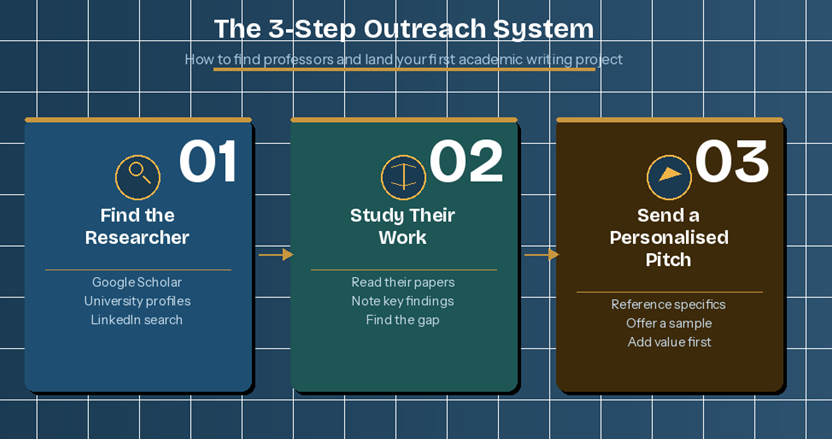
That’s how you start meaningful conversations. Not by asking for work, but by adding value first.
2. Manuscript Drafting and Co-Authorship Support
Professors are required to publish but often lack the time or bandwidth to turn raw data and ideas into polished academic prose. They need reliable collaborators who can take their notes, datasets, and rough frameworks and draft complete manuscript sections.

When you deliver strong work here, you are frequently credited as a co-author or research assistant building a public academic track record that makes every future pitch easier.
How to Find Manuscript Drafting Work
- Use the same outreach approach as for literature reviews
- In your follow-up, reference a specific technique or finding from their recent paper and suggest how a complementary angle could strengthen a new study
- Platforms like Kolabtree and ResearchGate are also active marketplaces for this type of collaboration
3. Journal Formatting and Stylesheet Compliance
Every journal has its own stylesheet, citation format, and submission requirements. A formatting error in the wrong place is one of the top reasons manuscripts are desk-rejected without even reaching peer review. Professors who are juggling multiple submissions will gladly outsource this work.
How to Find Journal Formatting Work
- Target authors whose papers are listed as ‘under review’ or ‘revise and resubmit’ they are actively in the submission cycle and need fast turnaround
- Offer a one-time service package: stylesheet compliance check, reference audit, and full submission pack preparation
- This is also an excellent upsell once you have completed a literature review for a client
4. Pre-Submission Peer Review and Manuscript Critique
Once you have built a track record, you can offer peer-review-style feedback on draft manuscripts checking the logic of arguments, identifying methodological weaknesses, and suggesting structural improvements. Academics in Western countries are accustomed to paying for professional pre-submission review services.
How to Find Peer Review Work
- Target junior faculty and post-doctoral researchers on LinkedIn or ResearchGate they are most likely to seek external feedback before senior colleagues review their work
- Offer one free sample critique page to demonstrate your editing depth and academic judgment
5. Grant Proposal Writing
Grant writing is arguably the highest-paying segment of academic freelance work. Clients in this category researchers applying for funding from bodies like the NSF, NIH, or Wellcome Trust regularly pay $75 to $150 per hour for strong proposal writers. A single grant proposal can run to dozens of pages, and the stakes are extremely high.
How to Find Grant Proposal Work
- Search on Google Scholar or LinkedIn for professors whose work mentions ‘funded by NSF’ or ‘funded by NIH’ — these researchers are already in the grants system and regularly apply for more
- Email them offering targeted help with specific sections: Specific Aims, Budget Justification, Significance, or Innovation
- Monitor grants.gov for open funding calls and identify researchers working in those areas
6. Primary Field Surveys and Cross-Cultural Validation
Foreign researchers particularly in the US and Europe frequently want to test their theories against Indian data but have no practical way to collect it themselves. Indian research assistants can design surveys, manage data collection across regions, compile and clean the dataset, and even conduct initial statistical analysis using AI tools.
This is a genuinely differentiated service that only people based in India can offer effectively.
How to Find Survey and Validation Work
- Search Google Scholar for global authors studying India-related topics: poverty in developing economies, education policy, urban migration, public health infrastructure
- Offer to design and run a pilot survey and deliver an analysed, visualised dataset as a proof-of-concept
7. Transcription, Data Coding and Qualitative Analysis
Researchers in sociology, public health, education, and the social sciences often have hours of interview recordings, field notes, or open-ended survey responses that need to be transcribed, coded, and summarised. Today, AI tools have made this work faster and more accurate than ever but human judgment is still needed to apply the right analytical framework.
How to Find Transcription and Coding Work
- Look for active research projects in fields that rely heavily on qualitative methods: sociology, public health, education, development economics
- Offer to deliver a fully coded dataset with a summary table of themes as a sample deliverable
- Platforms like Upwork and Freelancer list these projects regularly
8. Research Amplification — Social Media, Podcasts, and Books
Professors increasingly want to influence public policy and opinion, not just academic peers. But they rarely have time to translate their research into accessible content. You can help them build a LinkedIn presence, get invited onto podcasts, and even support the writing of a popular non-fiction book based on their work.
How to Find Research Amplification Work
- Identify professors who are already somewhat active on LinkedIn or X (formerly Twitter) -they are the most receptive
- Draft a sample post or tweet thread based on one of their published papers and send it to them as a free demonstration
- Remember: add value first, ask for the engagement second
9. Technical and Scientific Writing for Corporate R&D and Deep-Tech Startups
Academic writing skills translate directly to corporate research environments. R&D departments at top global firms need writers who can document innovations, produce technical whitepapers, write product manuals, and create internal research reports. With €1.3 trillion invested in R&D by the world’s top firms in 2022 alone, this segment pays premium rates for the right writer.
How to Find Technical Writing Work
- Search for ‘deep-tech startups’ on LinkedIn and filter by location-US, UK, Germany, and Singapore are strong markets
- Use startup accelerator directories like Y Combinator and Dealroom to identify active companies with funded R&D
- Use Apollo.io to find the right contact at each company typically the R&D lead, CTO, or Head of Product
- Use directories like Clutch and Owler to identify established firms with documentation needs
- Pitch to founders or R&D leads directly: offer a sample whitepaper, grant draft, or case study on their core product or research
10. Freelance Agency Projects — Research and Editing Firms
Established academic services agencies like Cactus Communications, Enago, and Crimson Interactive already serve thousands of global clients and they constantly need reliable freelance writers and editors to fulfil projects. Working with an agency is one of the fastest ways to build a verifiable track record, especially when you are just starting out.
How to Find Agency Work
- Apply directly to the freelance pools maintained by Cactus, Enago, and Crimson Interactive all three have active freelancer onboarding programmes
- Attach sample edits or manuscripts and be specific about your subject matter expertise
- Treat agency work as a track record accelerator testimonials from reputable agencies open doors to higher paying direct clients
How to Run Your Outreach and What to Expect
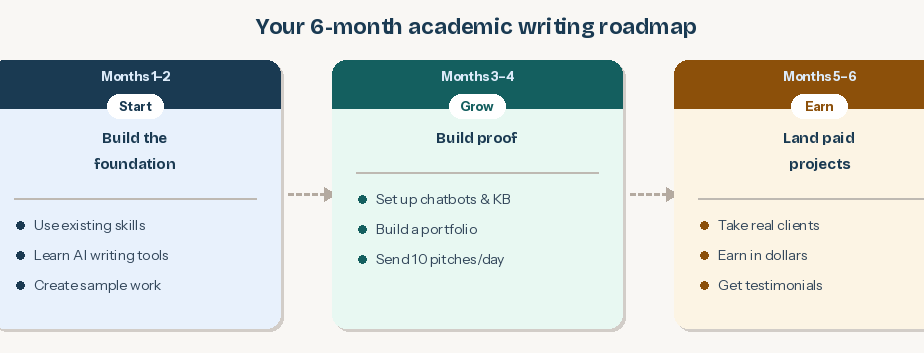
You may not land work on your first few attempts and that is completely normal. What separates successful academic writers from those who give up is a consistent, well-structured outreach strategy.
Here is a simple framework:
- Send pitches to 10 potential clients every day
- Personalise each message reference their actual published work
- Offer a sample or a small free deliverable to demonstrate quality
- Follow up once after 7–10 days if there is no reply
- Track your outreach in a simple spreadsheet
With this approach, landing your first paid client within the first month is achievable. As you refine your pitch and build your portfolio, your conversion rate improves rapidly eventually, one in three outreach messages can result in a conversation




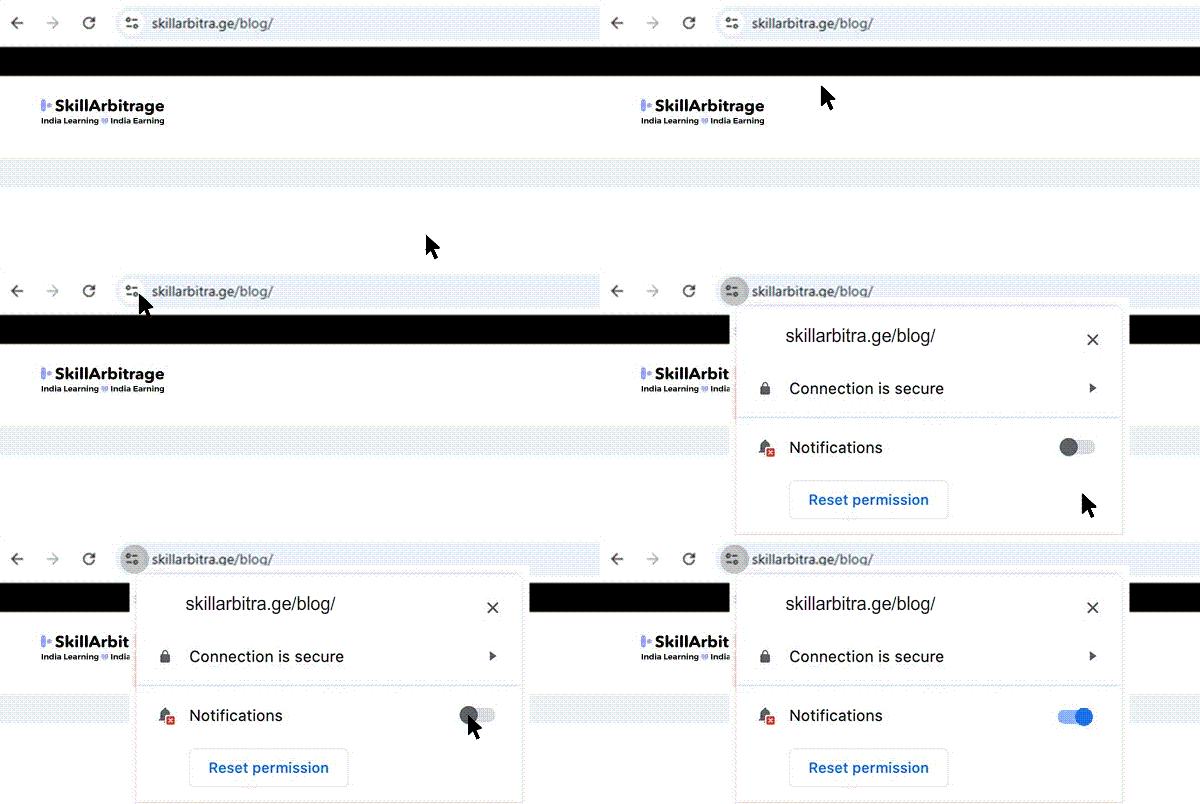
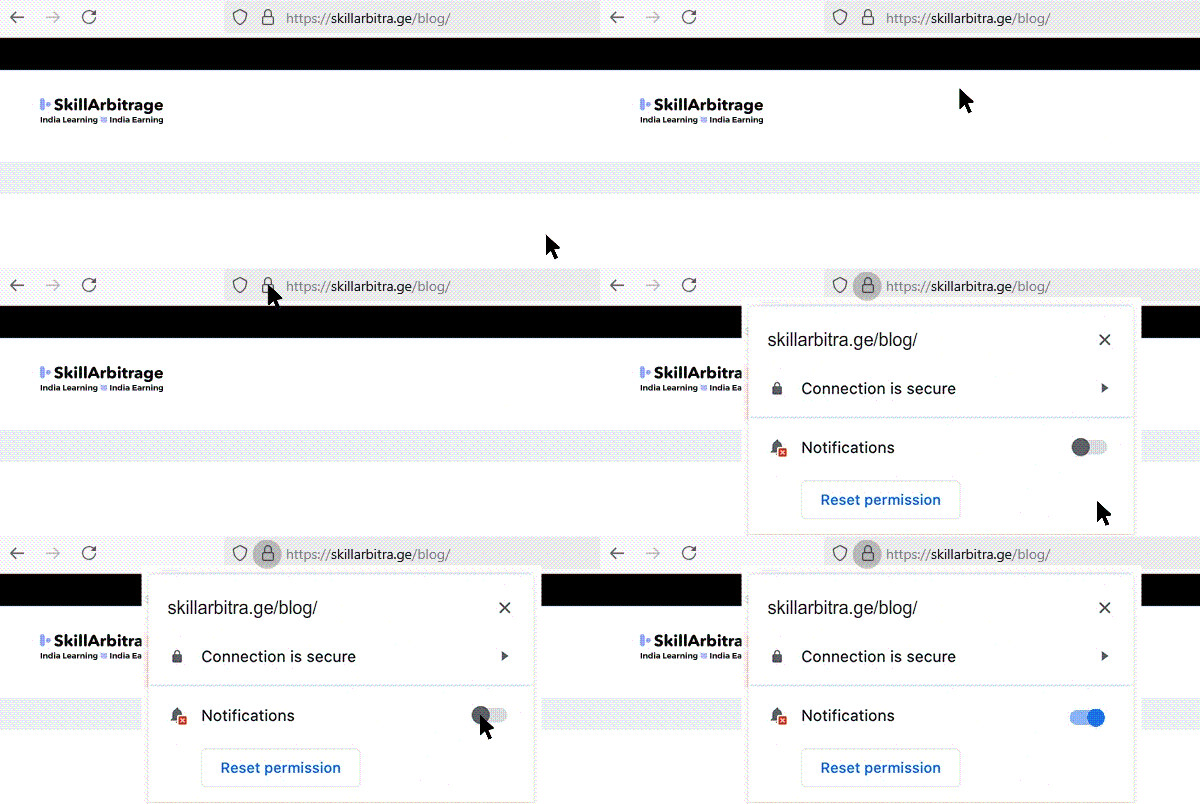
 Allow notifications