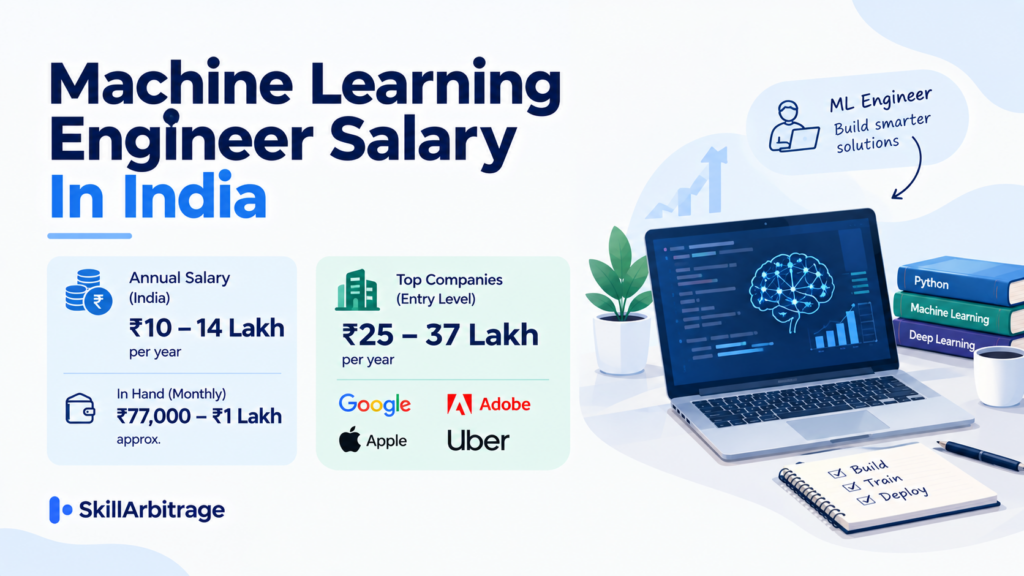

The machine learning engineer salary in India runs from about ₹10 lakh to ₹14 lakh a year, which is roughly ₹77,000 to ₹1,03,000 a month in hand. That range comes from three trackers that publish the figure with a sample and a date: Payscale’s ₹10.2 lakh average base, Indeed’s ₹11.6 lakh and AmbitionBox’s ₹12.6 lakh to ₹13.9 lakh. Freshers start nearer ₹6 lakh, and entry level at Google, Adobe, Apple and Uber pays ₹25 lakh to ₹37 lakh in total compensation, between 22% and 37% of it in stock.
The averages also compress a wide spread: Payscale’s tenth percentile sits at ₹3.62 lakh a year and its ninetieth at ₹30 lakh. The monthly figure is the one most offers leave out, and it isn’t the annual package divided by twelve. Employer provident fund and the gratuity provision sit inside cost to company without ever reaching a bank account, and the provident fund ceiling moved on 17 September 2026, so most monthly figures published before that date now overstate take-home.
The trackers also measure different things. Payscale reports base salary, Indeed reports pay advertised in job postings and AmbitionBox reports self-reported cost to company, so every figure below names its source and its basis. The four big-tech companies are compared by level rather than by years, because that’s how they set pay.
Machine learning engineer salary in India per month
The machine learning engineer salary in India per month comes to about ₹77,000 to ₹1,02,900 in hand on the market-wide figures, which cover one to six years of experience, and income tax takes almost none of it under the new regime.
Three trackers publish an India figure for the title, and they agree more closely than salary trackers usually do:
| Tracker | Annual figure | What it measures | Sample | Updated |
|---|---|---|---|---|
| Payscale | ₹10,22,861 average | Base salary | 232 profiles | 11 Jul 2026 |
| Indeed | ₹11,56,435 average | Pay in job postings, past 36 months | 50 salaries | 27 Sep 2026 |
| AmbitionBox | ₹12.6 lakh to ₹13.9 lakh typical, 1 to 6 years | Self-reported cost to company | about 9,800 salaries | 5 Oct 2026 |
The highest figure sits about a third above the lowest, which is narrow for this kind of data. Part of that gap comes from the basis: a base-salary figure sits below a cost-to-company figure, which also counts the employer’s provident fund and gratuity. AmbitionBox carries by far the largest sample, so it anchors the bands in this article.
Converting any of these figures to a monthly number takes four stated assumptions. Basic pay is taken at 50% of cost to company, provident fund at 12% of basic capped at the ₹25,000 wage ceiling, the gratuity provision at 4.81% of basic, and professional tax at ₹200 a month, with the new tax regime applied throughout.
Worked on Indeed’s average: a ₹11,56,435 package gives basic pay of ₹48,185 a month, so employer provident fund takes ₹36,000 a year and the gratuity provision takes ₹27,812. Gross salary is ₹10,92,623, or ₹91,052 a month. Deduct ₹3,000 of employee provident fund and ₹200 of professional tax, and ₹87,852 arrives. Dividing the package by twelve would have suggested ₹96,370, which is about ₹8,500 a month too high.
Income tax is absent from that sum for a reason that many salary pages still miss. Under the Income Tax Act 2025, which governs income from 1 April 2026, the new-regime slabs in section 202 start with nil tax up to ₹4 lakh, the section 156 rebate wipes out the tax on taxable income up to ₹12 lakh, and section 19 gives salaried taxpayers a ₹75,000 standard deduction. Together they mean a salaried person pays nothing until gross salary passes ₹12.75 lakh. Under the structure above, that’s a package of about ₹13.4 lakh, so the whole market band up to AmbitionBox’s midpoint is tax-free, and tax only starts near its upper end.
The deduction that did move is provident fund. Through notification S.O. 5109(E) of 17 September 2026, the Ministry of Labour and Employment raised the wage ceiling from ₹15,000 to ₹25,000 a month, which lifted the maximum employee contribution from ₹1,800 to ₹3,000. Any package with basic pay of ₹25,000 or more takes the full effect, ₹1,200 on each side, or ₹2,400 a month out of in-hand. In practice that covers almost every machine learning engineer salary, since basic crosses ₹25,000 at a package of about ₹6 lakh.
Industry moves the band more than city does. AmbitionBox puts IT services and consulting at ₹10.6 lakh to ₹11.7 lakh from 4,000 salaries, against ₹17.9 lakh to ₹19.8 lakh in software product companies (840 salaries) and ₹18.2 lakh to ₹20.8 lakh in internet companies (415). Employer spread is wider still: TCS sits at ₹6.6 lakh to ₹7.5 lakh, Quantiphi at ₹12.3 lakh to ₹13.6 lakh and Qualcomm at ₹22.1 lakh to ₹30.8 lakh.
City differences are smaller. Bengaluru leads at ₹13.5 lakh to ₹14.9 lakh from 2,600 salaries, followed by Hyderabad at ₹12.5 lakh to ₹13.8 lakh, with Mumbai and Chennai both at ₹11 lakh to ₹12.2 lakh and Pune at ₹10.3 lakh to ₹11.4 lakh. The same per-month method applied to a neighbouring role sits in the data analyst salary in India per month breakdown, and the comparison is useful: a machine learning engineer at one to three years already sits above the data analyst’s typical band of ₹6.5 lakh to ₹7.2 lakh.
Fresher vs 2 years of experience
A fresher machine learning engineer earns about ₹6 lakh a year, or ₹42,300 a month in hand, against ₹9.2 lakh to ₹10.2 lakh at two years, or ₹68,600 to ₹76,750 a month. The first two years add roughly ₹26,000 to ₹34,000 a month.
Fresher machine learning engineer salary in India
The fresher machine learning engineer salary in India is the least documented number in this field, because the job title barely exists at zero experience. AmbitionBox, with about 9,800 salaries for the title, has no row at all for nought to one year: its bands start at one to three years. Freshers are recorded under other titles instead.
The best-sourced fresher figure is Payscale’s entry-level average of ₹5,96,082 a year in total compensation, for under one year of experience, from 39 salaries. At the stated structure that’s about ₹42,300 a month in hand, with ₹2,980 going to provident fund, which is close to the new ₹3,000 cap even at this level.

Below that sits the internship band. AmbitionBox records machine learning interns at ₹2.7 lakh to ₹3.1 lakh a year in their first year, from 752 salaries, or about ₹22,500 to ₹25,800 a month before any deduction. The adjacent title “AI ML engineer” does show a nought-to-one-year band, but it rests on three salaries, which is too few to treat as a range.
At the top end, AmbitionBox lists Google machine learning engineers with under a year of experience at ₹22.6 lakh to ₹33.4 lakh, from 10 salaries. That’s the ceiling of the fresher market rather than its centre, and it arrives as a level-based package with stock attached.
A common fresher error is reading a “₹6 LPA” offer as ₹50,000 a month. Employer provident fund and gratuity come out before gross salary is even calculated, so the account sees about ₹42,000. For candidates still choosing a route into the field, the bar for entry differs widely by programme, as the breakdown of data science course eligibility shows, and many start in analytics roles first, the path covered in becoming a remote data analyst from India.
Salary at 2 years of experience
The salary at 2 years of experience falls inside AmbitionBox’s one-to-three-year band of ₹9.2 lakh to ₹10.2 lakh, from 5,100 salaries, the best-sampled row for the title. That converts to ₹68,600 to ₹76,750 a month in hand, still with no income tax.
Payscale’s early-career figure, for one to four years, is lower at ₹8,40,657 from 156 salaries, or about ₹62,150 a month. The two don’t conflict so much as measure different groups: Payscale’s 156 profiles against AmbitionBox’s 5,100, and Payscale’s total pay against AmbitionBox’s cost to company, which also counts the employer’s provident fund and gratuity.
Title moves the band at this stage almost as much as employer does. AmbitionBox puts “AI ML engineer” at one to three years at ₹11.5 lakh to ₹12.7 lakh, from 4,600 salaries, about ₹2.3 lakh to ₹2.5 lakh a year above the plain “machine learning engineer” band for the same experience. At Google, the one-to-three-year band is ₹25.5 lakh to ₹37.9 lakh from 30 salaries, and one recent report puts a two-year engineer there at ₹35.8 lakh.
Demand is drifting toward generative AI work, which is likely to widen that title gap. AmbitionBox lists generative AI as a required skill across about 4,300 open roles for this profile, against 40,500 for Python, so it’s still a minority requirement, but it’s the one tied to the higher-paying titles. The generative AI skills for working professionals guide covers what those roles ask for.
Monthly in-hand, by stage Conversion assumes basic pay at 50% of the package, provident fund at 12% of basic capped at the ₹25,000 ceiling raised on 17 September 2026, gratuity provision at 4.81% of basic, professional tax at ₹200 a month, and the new tax regime. Google bar not drawn to scale. Sources: AmbitionBox machine learning engineer and machine learning intern salary pages (5 October 2026); Payscale India (11 July 2026); Indeed India (27 September 2026); levels.fyi Google India (5 October 2026). Income-tax Act, 2025, sections 19, 156 and 202. Notification S.O. 5109(E) of 17 September 2026.
ML engineer salary at Google, Adobe, Apple and Uber
ML engineer salary at Google, Adobe, Apple and Uber starts at ₹25 lakh to ₹37 lakh a year in total compensation at entry level, according to levels.fyi’s India data, which is two to three times the market band. Levels.fyi files machine learning engineers under each company’s software engineer levels, so the level, not the job title, sets the number.
| Company | Entry level | Total | Base | Stock a year | Bonus | Monthly in-hand from base |
|---|---|---|---|---|---|---|
| L3 | ₹36.0 lakh | ₹25.2 lakh | ₹9.55 lakh | ₹1.25 lakh | ₹1,73,850 | |
| Adobe | P10 | ₹25.0 lakh | ₹16.7 lakh | ₹6.29 lakh | ₹1.97 lakh | ₹1,20,250 |
| Apple | ICT2 | ₹36.9 lakh | ₹22.5 lakh | ₹13.6 lakh | ₹0.87 lakh | ₹1,57,600 |
| Uber | Level 3 | ₹37.1 lakh | ₹27.7 lakh | ₹7.99 lakh | ₹1.45 lakh | ₹1,88,100 |
All four figures are levels.fyi medians for India, updated 5 October 2026. Google’s and Uber’s stock column is first-year stock and their bonus column includes the sign-on payment. The in-hand column applies the same structure as the market band to base salary only, since stock and bonus don’t arrive monthly.
One level up, the gap widens fast. Google’s L4 median is ₹81.6 lakh, Apple’s ICT3 and Uber’s level 4 both sit at ₹72.1 lakh, and Adobe’s P20 is ₹34.9 lakh. Adobe’s ladder starts lower and climbs more slowly over its first two levels.
Stock is the part of these offers that’s easiest to misread. All four grant restricted stock units that vest over four years, but on different schedules: Google vests 38%, 32%, 20% and 10%, Uber 35%, 28%, 22% and 15%, and Adobe and Apple 25% each year. Front-loaded schedules make the first year look richer than the fourth, and the units are taxed as salary.
Section 17(1)(d) of the Income Tax Act 2025 treats shares allotted by an employer as a perquisite, valued at their fair market value on the exercise date less anything the employee paid, and since restricted stock units carry no price and convert to shares on vesting, the tax falls in the year they vest, at whatever the shares are worth then. So the rupee value moves with both the share price and the exchange rate.
Joining bonuses inflate the first-year figure further. Levels.fyi’s India pages put the median signing bonus for software engineers at about ₹6 lakh at Uber, ₹4.9 lakh at Adobe and ₹2.5 lakh at Apple, paid once and separately from the recurring annual bonus. So an offer letter’s first-year total, read against a front-loaded vesting schedule, can sit well above what the same job pays in its third year, and the like-for-like comparison between two offers is base salary plus a single year’s average vesting.
Income tax becomes the main monthly deduction at this level, the reverse of the market band. On base salary alone it runs from about ₹9,300 a month at Adobe P10 to about ₹31,000 at Uber, while provident fund stays capped at ₹3,000.
AmbitionBox offers a cross-check, with thin samples. Google machine learning engineers report ₹32.6 lakh to ₹42.7 lakh from 96 salaries, rated high confidence. Adobe shows ₹37.2 lakh to ₹52.9 lakh from 15 salaries, all at three to eight years, Apple ₹40.8 lakh to ₹58.9 lakh from 16, and Uber ₹36.3 lakh to ₹52.4 lakh from just four salaries, which AmbitionBox itself rates low confidence. AmbitionBox has no fresher row for Adobe or Uber, so for those two the levels.fyi entry level is the only published starting point.
The trade-off between the two markets is clear in monthly terms. The wider market pays about ₹68,600 to ₹1,05,000 a month from the second year to the sixth, all of it fixed cash and almost all of it untaxed. The four big-tech companies pay ₹1.2 lakh to ₹1.9 lakh a month in cash at entry, plus stock worth ₹6 lakh to ₹14 lakh a year that arrives on a schedule, is taxed on arrival and moves with the share price. The level offered decides which of those numbers applies far more than the years of experience do.
FAQs
Who earns more in India, an AI engineer or an ML engineer?
AI engineers earn slightly more at matched experience on AmbitionBox data. At one to three years the AI engineer band is ₹10.4 lakh to ₹11.5 lakh against ₹9.2 lakh to ₹10.2 lakh for machine learning engineers, and at three to six years it’s ₹15.3 lakh to ₹16.9 lakh against ₹13.1 lakh to ₹14.5 lakh. The AI engineer sample is smaller, at 5,000 salaries against 9,800, so the gap is indicative rather than firm.
Is an ML engineer paid more than a data scientist in India?
Data scientists sit higher on AmbitionBox’s figures, which draw on a much larger sample of 61,400 salaries. The data scientist band is ₹11.3 lakh to ₹12.5 lakh at one to three years and ₹15 lakh to ₹16.6 lakh at three to six, against ₹9.2 lakh to ₹10.2 lakh and ₹13.1 lakh to ₹14.5 lakh for machine learning engineers. The gap is about ₹2 lakh a year at both bands.
How much does an ML engineer earn after 5 years in India?
AmbitionBox puts machine learning engineers with three to six years of experience at ₹13.1 lakh to ₹14.5 lakh a year, from 4,600 salaries. That’s about ₹1,00,350 to ₹1,05,150 a month in hand, and it’s the band where income tax first applies. Beyond six years AmbitionBox shows only its own estimate rather than reported salaries, so no firm figure exists yet.
Does Google pay ₹1 crore to ML engineers in India?
Crore-level pay at Google India starts at the senior level. Levels.fyi puts the L5 senior software engineer median at ₹1.29 crore a year, made up of ₹64.4 lakh base, ₹56.4 lakh first-year stock and ₹8.25 lakh bonus and sign-on, with L6 at ₹2.17 crore. Close to half of that figure is stock, so the cash salary itself stays well under ₹1 crore.
References
Salary data
- Machine Learning Engineer salaries in India. AmbitionBox. Typical band ₹12.6 lakh to ₹13.9 lakh for one to six years from 9,800 self-reported salaries, experience, city, industry and employer bands, updated 5 October 2026. Company pages for Google (96 salaries, 1 August 2026), Adobe (15, 26 September 2026), Apple (16, 16 September 2026) and Uber (4, 10 January 2026), and the Machine Learning Intern, AI ML Engineer, AI Engineer and Data Scientist profiles, read 5 October 2026
- Machine Learning Engineer Salary in India. Payscale. Average base ₹10,22,861 from 232 profiles, entry-level average ₹5,96,082 from 39 salaries and early-career average ₹8,40,657 from 156, updated 11 July 2026
- Machine learning engineer salary in India. Indeed. Average ₹11,56,435 a year from 50 salaries in job postings over the past 36 months, updated 27 September 2026
- Google Software Engineer Salaries in India, with the equivalent Adobe, Apple and Uber India pages. levels.fyi. Median total compensation, base, stock and bonus by level, and vesting schedules, updated 5 October 2026
Provident fund, tax and stock
- Notification S.O. 5109(E) of 17 September 2026, Ministry of Labour and Employment, under Chapter III of the Code on Social Security, 2020. Wage ceiling raised from ₹15,000 to ₹25,000 a month and employee contribution ceiling from ₹1,800 to ₹3,000
- Employees’ Provident Funds and Miscellaneous Provisions Act, 1952, and Payment of Gratuity Act, 1972. Contribution at 12% of basic pay, and the gratuity formula of basic ÷ 26 × 15 behind the 4.81% provision
- Income-tax Act, 2025, sections 19, 156 and 202, read on the Income Tax Department’s bare Act pages, 6 October 2026. Section 202(1): nil up to ₹4,00,000, then 5%, 10%, 15%, 20%, 25% and 30% in ₹4 lakh steps. Section 19(1), Table Sl. No. 2: standard deduction of ₹75,000 where tax is computed under section 202(1). Section 156: rebate of up to ₹60,000 on income up to ₹12,00,000, with marginal relief above it. Section 202(2) disallows the professional-tax deduction under the new regime
- Income-tax Act, 2025, section 17(1)(d) and the definitions in section 17, read 6 October 2026. Specified security or sweat equity shares allotted by a current or former employer free or at a concession are a perquisite, valued at fair market value on the date the option is exercised, less the amount the employee paid
This article is for informational and educational purposes only and isn’t professional, financial or tax advice. Salary figures, provident fund rules and tax slabs change, and every monthly figure here depends on how a specific employer structures a package. Verify current figures with the source, and consult a qualified professional before acting on a salary or tax decision.





 Allow notifications