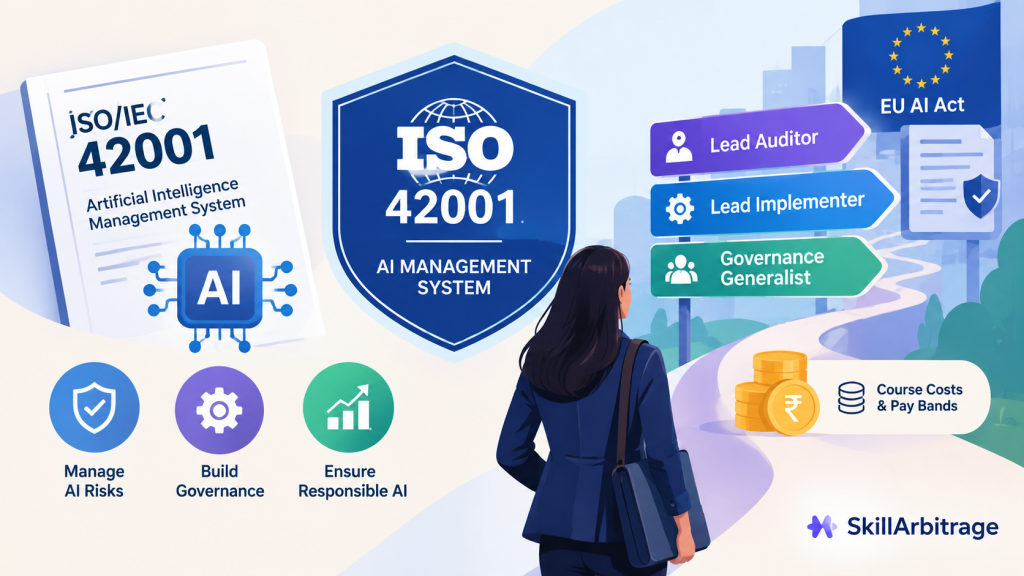

ISO 42001 certification is something an organisation earns, not something you can hold personally. ISO/IEC 42001:2023 sets out the requirements for an artificial intelligence management system, and an accredited certification body audits a company against it and issues the certificate to that company. What you can hold is a training-body credential that qualifies you to implement or audit one of those systems, plus a logged count of hours. Get that distinction right before you spend anything, because it decides which course you buy and what you are entitled to claim on your profile.
The standard is young, and so is everything around it. ISO published it in December 2023 as the first AI management system standard, and the companion document that tells certification bodies how to audit against it, ISO/IEC 42006:2025, only arrived in July 2025. The credential market has therefore run ahead of the certified population, which is exactly where both the opportunity and the risk sit.
Timing is the other half of this. The EU AI Act’s main body of obligations became applicable on 2 August 2026, and its Article 17 puts a documented quality management system on every provider of a high-risk AI system. Indian teams building or supplying AI into Europe are being asked for that evidence now, and the supply of people who can produce it is thin.
So you’re early. That’s uncomfortable, and it’s also the entire reason this is worth your time.
Money-wise, the entry points are narrower than the noise around them suggests. A five-day lead auditor course in India runs at INR 55,000 before tax, the governance-side exam and training package lands near USD 2,000, and if you already carry a lead auditor certificate in another standard there is a three-day conversion route instead of a full course.
What ISO 42001 certification covers
The certificate attaches to a management system inside an organisation and to a defined scope within it, never to an individual. The standard says so in its own scope: it “specifies the requirements and provides guidance for establishing, implementing, maintaining and continually improving an AI (artificial intelligence) management system within the context of an organization”, and it applies to “any organization, regardless of size, type and nature, that provides or uses products or services that utilize AI systems”. Fifty-one pages, edition 1, developed by ISO/IEC JTC 1/SC 42, priced at CHF 225 from the ISO store.
Read the clause list before you read any course brochure. Clause 4 covers the context of the organisation, clause 5 leadership, clause 6 planning and clause 7 support, and clause 8 is where the AI-specific work actually sits: AI risk assessment at 8.2, AI risk treatment at 8.3, and AI system impact assessment at 8.4. Everything else is the harmonised structure ISO applies across its management system standards, which ISO/IEC 42001 states outright in its introduction. If you’ve worked an ISO 27001 programme, clauses 4 through 7 will read like a language you already speak, and that overlap is worth real money to you.
Budget for two documents, not one. ISO/IEC 42001 carries a single normative reference, ISO/IEC 22989:2022 on AI concepts and terminology, and a normative reference is not background reading: its definitions are part of the requirements. ISO also sells ISO/IEC 42001 and ISO/IEC 27001:2022 together as a package at CHF 340 rather than CHF 380 separately, which is worth knowing before you buy either one on its own.
One fact catches almost everybody out. ISO itself certifies nobody: “ISO does not perform certification or issue certificates, and it does not permit anyone to use the ISO logo in connection with certification,” per its own guidance on certification. The certificate comes from an independent certification body, and accreditation is the separate step in which a national accreditation body confirms that the certification body is competent to issue it. Both are checkable through the IAF CertSearch database (the former roles of the IAF and ILAC now sit with Global ACI).
So how do you test a claim before any money moves? Put one question to the provider in writing: “Which accreditation body accredits you for ISO/IEC 42001 certification, and what is your accreditation number? If you are a training provider rather than a certification body, please confirm that in writing.” A training-only provider has no accreditation number for certification, which is perfectly legitimate, but it should say so rather than let the ambiguity sell the course.
Certificates do already exist in the wild. Microsoft lists GitHub Copilot, Microsoft Copilot, Copilot Studio, Microsoft Foundry and Security Copilot as in scope for ISO/IEC 42001 certification, with the certificates and audit reports on its Service Trust Portal. And it states the part buyers routinely miss: using a certified service doesn’t certify you, because you still have to engage an assessor for the controls and processes inside your own organisation.
That gap is the advisory work (and it’s the single most reliable opening line in a pitch to a company already running a certified AI vendor). For the regulatory backdrop, our breakdown of the EU AI Act risk levels sets out which systems attract the heaviest duties.
Choose your ISO 42001 credential route
Choose by the work you expect to be paid for, because implementing and auditing are different jobs with different ladders and different buyers. Three routes are realistically open to an Indian professional today, and none of them costs more than a mid-range laptop. So which one fits?
The implementer route
You build the system. PECB’s ISO/IEC 42001 Lead Implementer scheme runs four rungs: Provisional Implementer needs only the exam and a signed code of ethics, Implementer needs two years of professional experience with one of them in AI management and 200 hours of project activities, Lead Implementer needs five years with two in AI management and 300 project hours, and Senior Lead Implementer needs ten years with seven in AI management and 1,000 hours.
What counts as a qualifying hour is defined rather than assumed, which helps when you’re building a log from scratch. PECB names seven activities: drafting an AIMS implementation plan, managing implementation projects, implementing the AIMS, managing documented information, implementing corrective actions, monitoring AIMS performance, and managing an implementation team. Consulting hours that don’t map to one of those seven won’t carry you up a rung.
The auditor route
You assess somebody else’s system. BSI runs its ISO/IEC 42001:2023 Lead Auditor course in India as a five-day virtual classroom at INR 55,000 excluding tax, with sessions scheduled roughly monthly. The PECB equivalent is also five days, with the certification exam sitting on day 5: three hours, seven competency domains, 31 CPD credits, one free retake inside 12 months, and both the exam and certification fees folded into the course price. Its only stated prerequisite is a fundamental understanding of ISO/IEC 42001 and AI principles.

Already hold a lead auditor certificate in another standard? BSI sells a three-day conversion course at GBP 1,965 plus VAT, and it is explicit that “delegates must have a current lead auditor certificate in another management system standard”. If you already carry ISO 27001, that’s your cheapest credible door in.
And if you don’t, that prerequisite is the thing to go and get first, because it is useful on its own and it unlocks the short route later. SkillArbitrage runs a six-month training programme in information security (ISO 27001) and privacy information management systems (ISO 27701) at lead implementer and lead auditor level, priced at INR 60,000 and built for information security managers, risk and compliance officers, internal and external auditors and data protection officers. That is the same population ISO/IEC 42001 is now recruiting from, and clauses 4 through 7 carry across almost unchanged.
One cheaper first step exists if you want to test the water before committing five days. PECB runs an ISO/IEC 42001 Foundation course alongside the implementer and auditor tracks, and it puts no hours on your log, but it does tell you whether the subject holds your interest before you spend real money on it.
The governance generalist route
You advise across frameworks rather than certify against one. The IAPP’s Artificial Intelligence Governance Professional exam costs USD 799 for non-members and USD 649 for members, runs 100 questions over 2.75 hours with a 15-minute break, and must be sat within a year of purchase through a Pearson VUE centre or its remote OnVue service. The term is two years, renewal takes 20 continuing education credits, and non-members pay a USD 250 maintenance fee at recertification. Official training adds USD 1,195, membership USD 295, and the practice exam USD 60.
Worth flagging: the AIGP is not an ISO credential and never audits anything. It’s framework-agnostic (it covers AI law, the AI life cycle and governance practice rather than one standard), which makes it the better buy if your work is advisory rather than assurance.
Experience requirements behind the credential
Passing the exam is the cheap part of this, and the hours are the actual gate.
On PECB’s auditor ladder the Provisional Auditor grade asks for no experience at all beyond the exam and a signed code of ethics. Auditor asks for two years of professional experience with one year of it in AI, plus 200 hours of audit activities. Lead Auditor asks for five years with two in AI and 300 audit hours. Senior Lead Auditor asks for ten years with seven in AI and 1,000 hours.
Notice which column is the binding one. The general audit-hour mechanics are the same ones we set out in our guide to the ISO 27001 lead auditor course and career path, and if you’re coming from information security you’ve probably banked some of those hours already. But the AI years are the column you can’t shortcut. Two years of AI work experience for the Lead Auditor grade is a real bar for someone whose background is entirely infosec (and it’s the reason a lot of people stall at Provisional for longer than they expected).
The application itself is documentary and it is checked. PECB requires two professional references who have worked with you professionally and who are neither your subordinates nor your relatives, and it inspects the project or audit log against the hours claimed. Certifications then run for three years, maintained by CPD hours plus an annual maintenance fee, and missing either triggers a 12-month suspension during which you cannot promote the credential.
Plan the exam itself around its result timing, which is slower than most candidates expect. Online multiple-choice results come back instantly, paper-based multiple-choice takes two to four weeks, and essay-type exams take three to eight. There’s no cap on retakes, only minimum gaps between them, and a failed attempt comes back with the domains you underperformed in. If you disagree with the marking you have 30 days to ask for a re-evaluation, and another 30 to appeal after that.
The logistics are worth five minutes of your attention too, because they are where avoidable failures happen. You schedule either online through the PECB Exams application or on paper through the authorised partner that ran your course, and on the day you’re expected 30 minutes early with a national ID card, driving licence or passport. Turn up late and you get no extra time, and you may not be seated at all.
Apply for the rung you can actually evidence today rather than the one you want. Credentials upgrade later from your own dashboard once the hours are there, so starting at Provisional Auditor and moving up costs you nothing beyond the upgrade fee. And if the certification department comes back asking for more documentation and you miss its deadline, it validates on whatever you filed first, which can end in a downgrade decided for you.
So where do the first AI audit hours come from when barely anyone is certified yet? Internal audits inside your own employer’s AI programme, and second-party audits of suppliers and subcontractors, which BSI names as work its five-day course explicitly equips you for. Both are reachable without a certification body’s approval. The mistake we see most often is logging the work too vaguely to survive review.
Write the entry so it maps to a clause and a date. Something like: “Internal audit, AIMS scope: customer-support LLM assistant. Clauses 8.2 and 8.4 audited against the AI risk assessment and AI system impact assessment records. 14 hours across 3 days, 11-13 March, lead auditor role, 2 nonconformities raised, closing meeting minuted.”
That survives a certification department’s review. “Advised on AI governance, 40 hours” does not.
| Credential | Professional experience | Of which in AI | Audit activities |
|---|---|---|---|
| Provisional Auditor | None | None | None |
| Auditor | Two years | One year | 200 hours |
| Lead Auditor | Five years | Two years | 300 hours |
| Senior Lead Auditor | Ten years | Seven years | 1,000 hours |

ISO 42001 and the EU AI Act
ISO/IEC 42001 is not a harmonised standard under the EU AI Act, and holding it gives a provider no presumption of conformity. This is the single most misstated point in the training market, and getting it right is a large part of why an employer would pay you rather than the next candidate.
The duty itself comes from Article 17(1) of Regulation (EU) 2024/1689: “Providers of high-risk AI systems shall put a quality management system in place that ensures compliance with this Regulation. That system shall be documented in a systematic and orderly manner in the form of written policies, procedures and instructions.” Article 40(1) then confines the presumption of conformity to harmonised standards “the references of which have been published in the Official Journal of the European Union”. ISO/IEC 42001 has no such reference, so it is evidence of a managed system rather than a legal shortcut.
So which document does target the AI Act? EN 18286, “Artificial intelligence, Quality management system for EU AI Act regulatory purposes”, adopted in 2026 by CEN and CENELEC as the first harmonised European standard for AI Act regulatory purposes. It covers the quality management system required of providers of high-risk AI systems. When a client asks which document to build against for Europe, that’s the honest answer, and ISO/IEC 42001 is the global management layer you run alongside it (the two are complementary, not alternatives, which is a distinction worth making early in any engagement).
The dates decide how urgent any of this is for a given client. Under Article 113 the Regulation applies from 2 August 2026, Chapters I and II applied from 2 February 2025, Chapter V on general-purpose AI models and Chapter XII on penalties applied from 2 August 2025 (Article 101 excepted), and Article 6(1) with its corresponding obligations applies from 2 August 2027. So the high-risk classification rule in Article 6(1) is still ahead of us, which means a client’s window for building the quality management system is open now and closing. That staggering is the single most useful thing you can explain to a nervous client, because it tells them which duties already bite and which they still have runway on.
On the assurance side, ISO/IEC 42006:2025 sets additional requirements on top of ISO/IEC 17021-1 for bodies that audit and certify AI management systems, running to 31 pages with a clause 7.1 devoted to competence of personnel. ANAB accredits certification bodies against both documents under its Accreditation Rule 59. And that clause 7.1 is precisely why your logged hours matter: a certification body can’t put you on an audit team it can’t evidence your competence for. Before any of this becomes billable, though, check whether your client is actually in scope: our answer to whether the EU AI Act applies to Indian companies sets out the extraterritoriality test.
Pay bands and where the roles sit
Half of the professionals working in privacy and AI governance earn more than USD 169,700, according to the IAPP’s 2025-26 Salary and Jobs Report, which surveyed more than 1,600 people across over 60 countries in March and April 2025. Those working solely in AI governance rather than across both domains sit lower, with half earning less than USD 151,800. Inside the technology sector the report puts legal and compliance roles at USD 205,000 and technical AI governance roles at USD 221,000.
Treat those as global figures, because that is exactly what they are: US dollars, across sixty-odd countries, with the report’s own regional cuts running to North America and Europe. No equivalent India benchmark exists for ISO 42001 titles yet, for the simple reason that too few Indian professionals hold the credential for a salary aggregator to have a sample. Anyone quoting you a precise Indian figure for an “ISO 42001 lead auditor” today is estimating.
Two secondary findings in the same report are worth more to you than the headline. At least 77% of respondents held one IAPP certification and 39% held several, which tells you the market in this niche reads credentials rather than self-description. And almost seven in ten received a bonus, rising to 72% in North America and 67% in Europe, so the base salary understates what the roles actually pay.
So what’s the defensible Indian anchor? The adjacent role you’d be moving from. Payscale puts the average for an information security manager in India at INR 1,913,349, on a range from INR 685,000 to INR 4,000,000, from 73 salary profiles last updated on 27 June 2026 (a thin sample, so read the range rather than the average).
But the realistic near-term play isn’t a new job title at all. It’s the same title with AI governance scope attached, priced at the top of that existing band.
One structural rule decides which career you’re actually building, and it’s easy to miss until it bites. BSI states it plainly: as an accredited certification body it “cannot offer certification to clients where they have also received consultancy from another part of the BSI Group for the same management system”, and it won’t consult for clients seeking certification from it either. That isn’t a BSI house rule. ISO/IEC 42006 gives management of impartiality its own clause, 5.2, on top of the requirements accredited bodies already carry under ISO/IEC 17021-1.
There’s a third employer most people overlook, and right now it may be the easiest one to reach. Certification bodies themselves have to staff up before they can sell AIMS audits at all, because ISO/IEC 42006 obliges them to evidence personnel competence for the scheme. Accreditation bodies and peer assessors use that same document to check those minimum competence requirements, so a body adding ISO/IEC 42001 to its scope has to be able to name the people behind it. Applying to accredited bodies directly is a shorter path than waiting for a client-side role to be advertised, and ANAB publishes a searchable directory of the accredited bodies to work through.
So you pick a side per client, permanently. Consultants build and document the AIMS, charge project fees, and can never sign the certificate. Third-party auditors sign certificates, work through an accredited body, and cannot have touched the build. Our guide to the third party risk management career path covers the adjacent route, where you audit suppliers for a buyer rather than certify anyone, and the impartiality rule does not apply because nothing is being certified.
FAQs
Can an individual be ISO 42001 certified?
No individual certification to ISO/IEC 42001 exists, because the standard specifies requirements for a management system within an organisation. What individuals hold is a training-body credential, such as PECB Certified ISO/IEC 42001 Lead Auditor or Lead Implementer, which evidences competence to work on such a system. Describing yourself as “ISO 42001 certified” on a profile misstates what the certificate is and experienced buyers notice.
Do you need ISO 27001 before ISO 42001?
Nothing in ISO/IEC 42001 requires a prior ISO 27001 certification, and the standard applies to any organisation using or providing AI systems. In practice the overlap is heavy, since both use ISO’s harmonised structure across clauses 4 to 7. That overlap is also commercial: BSI’s three-day conversion course is only open to delegates already holding a current lead auditor certificate in another management system standard.
How long does organisational ISO 42001 certification take?
Timelines depend on the scope and the certification body rather than on a fixed rule, and ISO/IEC 42006:2025 sets the requirements the body must meet in planning and conducting the audit. What you can plan around is the sequencing: the AI risk assessment, risk treatment and AI system impact assessment records required under clauses 8.2 to 8.4 have to exist and have been operating before an audit can evidence them.
Is ISO 42001 recognised in India?
Recognition runs through accreditation rather than through any Indian statute, so an ISO/IEC 42001 certificate issued by an accredited certification body carries the same weight in India as anywhere else. Verify any certificate through the IAF CertSearch database. Indian demand is currently pulled by export clients and by EU AI Act exposure rather than by a domestic mandate, which is worth saying plainly to anyone selling you urgency.
References
- International Organization for Standardization, ISO/IEC 42001:2023, AI management systems. https://www.iso.org/standard/81230.html
- International Organization for Standardization, ISO/IEC 42006:2025, Requirements for bodies providing audit and certification of artificial intelligence management systems. https://www.iso.org/standard/44546.html
- International Organization for Standardization, Certification and conformity assessment. https://www.iso.org/certification.html
- EUR-Lex, Regulation (EU) 2024/1689 (Artificial Intelligence Act), Articles 17, 40 and 113. https://eur-lex.europa.eu/eli/reg/2024/1689/oj/eng
- CEN and CENELEC, EN 18286, Quality management system for EU AI Act regulatory purposes, 2026. https://www.cencenelec.eu/news-events/news/2026/en-in-the-spotlight/2026-07-30-ai-quality-management/
- ANAB, ISO/IEC 42001 Artificial Intelligence Management Systems accreditation. https://anab.ansi.org/accreditation/iso-iec-42001-artificial-intelligence-management-systems/
- International Accreditation Forum, IAF CertSearch certificate verification database. https://www.iafcertsearch.org/
- PECB, PECB Certified ISO/IEC 42001 Lead Auditor, certification requirements. https://pecb.com/pdf/brochures/4/iso-iec-42001-lead-auditor-4p.pdf
- PECB, ISO/IEC 42001 Lead Implementer candidate handbook, version 1.5. https://pecb.com/pdf/candidate-handbooks/pecb-candidate-handbook-iso-iec-42001-lead-implementer.pdf
- PECB, ISO/IEC 42001 Lead Auditor training course. https://pecb.com/en/education-and-certification-for-individuals/iso-iec-42001/iso-iec-42001-lead-auditor
- BSI, ISO/IEC 42001:2023 Lead Auditor Training Course, India. https://www.bsigroup.com/en-IN/training-courses/isoiec-420012023-lead-auditor-training-course/
- BSI, ISO/IEC 42001 Artificial Intelligence (AI) Lead Auditor Conversion Course. https://www.bsigroup.com/en-GB/training-courses/isoiec-42001-lead-auditor-conversion-training-course/
- IAPP, AIGP exam, format, fees and maintenance. https://store.iapp.org/aigp-exam/
- Microsoft, ISO/IEC 42001:2023 Artificial Intelligence Management System Standards, 2026. https://learn.microsoft.com/en-us/compliance/regulatory/offering-iso-42001
- IAPP, Salary and Jobs Report 2025-26, published 3 August 2025. https://iapp.org/resources/article/salary-survey-summary/
- Payscale, Information Security Manager salary in India, updated 27 June 2026. https://www.payscale.com/research/IN/Job=Information_Security_Manager/Salary
This article is for informational and educational purposes only and does not constitute professional, legal, or career advice. Certification requirements, course fees, and regulatory dates change. Verify current details with the issuing body, the certification body, or a qualified professional before acting on any of them.




 Allow notifications