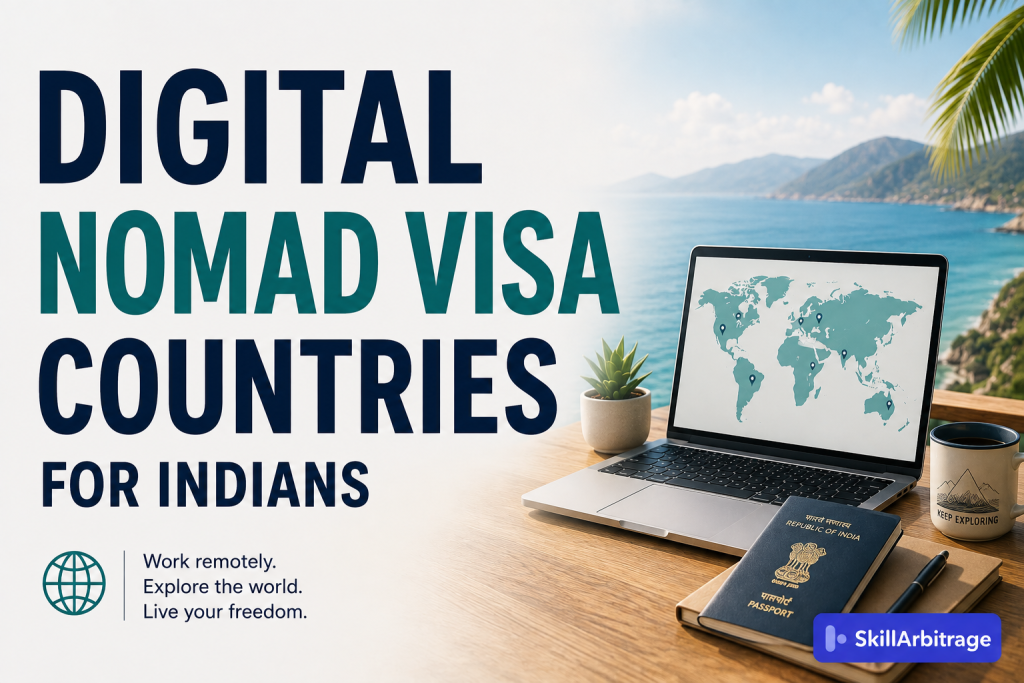

A digital nomad visa is a residence permit that lets a foreign national live in a country while working remotely for an employer or clients based outside it. Six of them are open to an Indian passport holder on the same terms as everyone else: the United Arab Emirates, Thailand, Indonesia, Portugal, Spain and Croatia. Each sets an income floor or a bank-balance floor, and none permits work for a local employer or local clients. Japan runs one of the better-known schemes, and India does not appear on its eligible-nationality chart at all.
This article sets out who a digital nomad visa is for, which countries accept Indian applicants, what each one demands in income, and how the days abroad land on Indian tax residence.
The distinction that matters runs in two directions. A tourist visa permits the stay but not the work. A work visa permits the work, but it ties the holder to a local employer and puts them inside the local labour market.
A nomad visa sits between the two: lawful residence, foreign income, and no access to local hiring. That middle position is the whole design, and it explains almost every condition attached to these permits. Governments wanted the spending without opening a job to a foreigner, so they license the residence and fence off the labour market.
Most pages ranking for this search predate the 2026 revisions. Croatia’s threshold has climbed by more than half since 2022, Spain’s moves whenever the Spanish minimum wage does, and Portugal’s is pegged to a wage that was reset for this year. Every figure below carries its source and the date it was checked.
Who a digital nomad visa is for
A digital nomad visa is for someone whose income already arrives from outside the country they want to live in. That is two tests rather than one, and the second is where applications fail quietly, because most readers never notice there was a second test to pass.
Start with the money, because it is the one that disqualifies people fastest. The monthly floors run from about 2,849 euros in Spain to 3,680 euros in Portugal, with the UAE asking 3,500 US dollars and Indonesia asking 60,000 dollars across a year. In rupees that is roughly 3.15 lakh to 4.07 lakh a month, every month, evidenced rather than asserted.
So the honest first question is not which country to pick. It is whether the number on your last six payslips clears that bar. Income is also not the only financial test: Portugal’s portal requires means covering at least twelve months for a residency application rather than the length of the trip, so the applicant is evidencing a year of solvency rather than a good quarter.
Now the second test, and this is the part that catches people. Every one of these schemes asks where the money comes from, and it is completely indifferent to how much of it there is. Croatia’s Ministry of the Interior defines a digital nomad as a third-country national working through communication technology for a company that is not registered in Croatia, and who does not provide services to employers in Croatia.
Indonesia asks for an employment contract with a company established outside Indonesian territory. The test is the host country, not India.
That distinction cuts in the applicant’s favour more often than people expect. An Indian employer qualifies. Indian clients qualify.
A Bengaluru company paying you in rupees while you sit in Lisbon satisfies the location test perfectly well, because the company is outside Portugal. What breaks the visa is picking up a client in the country you have moved to.
Japan’s immigration guidance happens to give the clearest published statement of what a nomad is actually permitted to do, even though Indians cannot use that particular scheme. It names two activities. The first is working remotely, under an employment contract with a foreign corporation, on the business of that foreign establishment. The second is providing services for a fee, or selling goods, to persons located in a foreign country, and it names the manager of a foreign company and the sole proprietor as the examples.
Read those two categories again and you have the reader profile in one line. Salaried remote employees of a foreign or Indian company, and independent contractors billing overseas clients. Those are the two groups these visas were drafted for.
Who they are not for is worth stating just as plainly. Anyone below the income floor, whatever their skill. Anyone hoping to arrive first and find local work afterwards, because that is the one thing every scheme forbids.

And anyone whose earnings are real but lumpy, which is a genuine risk for freelancers. Thailand wants salary slips or income proof covering six months, and Croatia asks for regular income proof rather than a single healthy month. Frankly, this gets overlooked.
A freelancer who bills 5 lakh in March and nothing in April has the income and still fails the evidence test. The fix is unglamorous and takes two quarters: move clients onto monthly retainers, invoice on a fixed date, and let the bank statement show a rhythm before the file goes in. Retainer income photographs better than project income, even when the project income is larger.
Family changes the arithmetic, and it changes it upward. Portugal’s consular portal sets means of subsistence against a 2026 minimum monthly salary of 920 euros, counting 100% for the first adult, 50% for a second adult, and 30% for each dependent child. Spain adds 75% of its minimum wage for the first dependant and 25% for each additional one. The UAE takes a different route and lets the visa holder sponsor family for the same one-year period, and Thailand carries a dependant category for a spouse and children under twenty, assessed against the main holder’s income.
The practical reality is that the applicants who clear these thresholds are already billing in dollars or euros before they start thinking about relocating. That is work like remote cybersecurity roles, remote SDR jobs for US employers, freelance Power BI contracts, or virtual assistant work for US clients. The visa follows the income. It never creates it.
Digital nomad visa countries Indians can apply to
The digital nomad visa countries open to Indian applicants fall into two groups. Three sit within a short flight of India and assess the applicant on income or on a bank balance. Three sit in Europe and run as national long-stay visas, which for a visa-required nationality like India means a consular file rather than an online form.
The nearest is the United Arab Emirates. Its virtual work residence visa asks for proof of monthly income of no less than 3,500 US dollars or the equivalent in another currency, runs for one year, and is renewable. Entry is self-sponsored, and the holder can sponsor family for the same period. Evidence of employment with an entity outside the UAE, proof that the work is performed remotely, and valid health insurance complete the file, against a residence permit fee of 200 dirhams plus a set of small statutory charges.
Thailand’s Destination Thailand Visa is the most document-heavy of the six. The Royal Thai Ministry of Foreign Affairs checklist asks for a three-month bank statement closing at no less than 500,000 baht, six months of salary slips, a foreign employment contract and a company registration certificate (both authenticated by the embassy of the country where the company sits), and a professional portfolio evidencing remote or freelance status. Indian applicants have filed through Thailand’s electronic visa system since 1 January 2025. Spouses and children under twenty apply under a separate dependant category on the same financial evidence.
Indonesia sets the highest income bar and the lightest procedure. The Directorate General of Immigration requires proof of salary or earnings of at least 60,000 US dollars a year on its E33G remote worker visa, three months of statements holding a minimum of 2,000 dollars, and an employment contract with a company established outside Indonesian territory. No sponsor or guarantor is required, which is unusual, and the whole file goes through an account on the immigration department’s own e-visa portal rather than through a consulate. The visa itself is valid for 90 days from issue, the stay runs a year, and the permit can be extended or converted into another category.
Europe’s three work differently from each other, and the differences matter more than the headline numbers. Portugal’s D8 fixes its floor at four times the national minimum wage, and the consular portal puts that wage at 920 euros for 2026. Worth flagging what the visa actually is: a residence visa valid four months with two entries, during which the holder has to apply to AIMA for the residence permit itself. The visa is the door, not the room.
Spain’s international teleworking visa runs at 200% of the statutory minimum wage. Croatia publishes a flat euro figure instead, grants eighteen months and no more, and allows a six-month extension only where the first grant was shorter.
Croatia has applied the Schengen acquis in full since 1 January 2023, so its national long-stay visas are type D documents issued through Croatian missions. Indian applicants file at visa centres in New Delhi, Mumbai, Kolkata, Chennai, Hyderabad and Bengaluru.
The ministry names three application channels: its own online nomad platform, a diplomatic mission or consulate, and the competent police administration for someone already lawfully in Croatia and visa-exempt. For an Indian passport holder starting from India, the consular route is the live one. An extension request, where one is available at all, has to be filed no later than sixty days before the current stay expires.
Then there’s Japan, and this is where the round-ups go wrong. The Immigration Services Agency publishes a closed chart of nationalities eligible for the digital nomad designated-activities status. It runs to roughly fifty countries and regions, from Australia through to Uruguay.
India is on neither the main list nor the spouse-and-child list. So why do so many round-ups still name Japan as an option for Indians? Because they copy the scheme and skip the chart.
Worth knowing what eligible nationals actually receive, because it is thinner than the coverage suggests. The official Q&A caps the stay at six months, rules out renewal, and issues no residence card, since holders are not treated as mid-term or long-term residents. Employment with a Japanese company or individual is barred outright. A returning nomad can re-enter only once six months have passed since departure.
Income thresholds and tax days abroad
Income thresholds run from roughly 2,849 euros a month in Spain to 3,680 euros a month in Portugal, with the UAE’s 3,500 dollars between them. Rupee equivalents below use the Federal Reserve H.10 rates of 14 August 2026: 95.43 rupees to the dollar, 33.12 baht to the dollar, and 1.1581 dollars to the euro. They will move, and the euro figures move independently as each country resets its minimum wage.
| Country | What has to be shown | Approximate rupee value |
|---|---|---|
| Spain | EUR 2,849 a month | INR 3.15 lakh a month |
| UAE | USD 3,500 a month | INR 3.34 lakh a month |
| Croatia | EUR 3,622.50 a month, or EUR 43,470 banked for twelve months | INR 4.00 lakh a month, or INR 48 lakh |
| Portugal | EUR 3,680 a month | INR 4.07 lakh a month |
| Thailand | THB 500,000 closing balance, held three months | INR 14.4 lakh |
| Indonesia | USD 60,000 a year, plus USD 2,000 held | INR 57.3 lakh a year |
Croatia is no longer the cheap European entry it used to be. Pages still quoting 2,300 euros a month are carrying a 2022 figure, against the Ministry of the Interior’s current 3,622.50, or a lump sum of 43,470 euros for twelve months and 65,205 euros for eighteen. That is a rise of more than half in four years, and it moved Croatia from the budget option to one of the two most expensive on this list.
Spain’s number is arithmetic rather than a published visa figure, which is why two different numbers circulate for it. Royal Decree 126/2026 set the minimum wage at 1,221 euros a month across fourteen payments, or 17,094 euros a year. Double the annual figure, divide by twelve, and the requirement lands near 2,849 euros. Doubling the monthly wage instead gives 2,442 euros, and that route is wrong because it ignores the fourteenth payment.
Here’s what the evidence pack looks like in practice.
- Passport valid six months beyond the travel date, plus a copy of the biodata page.
- Three months of bank statements in the applicant’s own name, closing at or above the threshold.
- Six months of salary slips or client invoices, showing income as regular rather than as one transfer.
- The employment contract or employment certificate, authenticated by the embassy of the country where the company is registered.
- The company’s registration certificate or business licence, authenticated the same way.
- A professional portfolio evidencing remote, freelance or foreign talent status.
- Health insurance valid in the destination country.
Point four is where files stall. Embassy authentication is a separate queue with its own turnaround, and it cannot start until the employer signs. Our recommendation is to open that step first and assemble everything else while it runs, rather than treating it as the last box to tick.
The days abroad carry a tax consequence that no visa page mentions. Under section 6 of the Income Tax Act, 2025, which governs residential status for tax years beginning on or after 1 April 2026, an individual is resident in India on 182 days or more in the tax year, or on 60 days combined with 365 days across the preceding four. There is a relaxation for an Indian citizen who leaves India for employment abroad, who is tested only on the 182-day limb.
But leaving is not the same as escaping. An Indian citizen whose income other than from foreign sources exceeds 15 lakh rupees, and who is not liable to tax in any other country, is deemed resident in India.
So does a zero-tax destination produce a zero-tax year? Not for a citizen in that position, and the mistake we see most often is treating the visa as the tax answer. The visa governs where you may lawfully sit. It says nothing about who taxes you.
Treaty relief, where it applies, runs on its own count rather than on the visa’s. Japan’s guidance is explicit that remuneration is exempt only where the conditions of the applicable tax convention are met, and that those conditions usually include a stay of 183 days or less in the taxable year or in any consecutive twelve-month period.
One rule holds across all six schemes, and it is the same rule the second test in the first section turns on. Thai visa holders cannot obtain a work permit, work for a Thailand-registered company, or freelance for Thai clients. Croatia bars services to employers in Croatia.
Japan bars employment or contractor agreements with Japanese companies and individuals. The income has to originate outside, and it has to keep originating outside for as long as the permit runs.
Sources: UAE government portal; Royal Thai Ministry of Foreign Affairs DTV checklist; Directorate General of Immigration, Indonesia; Ministry of the Interior, Croatia; Real Decreto 126/2026 (BOE); Immigration Services Agency of Japan; Income Tax Department, India. Rupee values converted at Federal Reserve H.10 rates of 14 August 2026 and will move with the exchange rate.

Frequently asked questions
Can an Indian work remotely while on a tourist visa?
Not in the countries that have published a separate remote-work category, which is the point of creating one. Thailand issues its Destination Thailand Visa for remote workers and freelancers specifically, and Croatia writes the nomad’s status into its own definition.
Does a digital nomad visa lead to permanent residence?
That depends on how the country classifies it. Portugal issues the D8 as a residence visa, so it opens into a residence permit granted by AIMA. Croatia’s is a temporary stay capped at eighteen months, and Japan’s produces no residence card. Check the classification before counting years.
Is health insurance compulsory on these visas?
On several it is an explicit condition rather than a recommendation. The UAE requires health insurance valid in the country, and Croatia lists proof of health insurance among the documents attached to the request for temporary stay. Budget for it as a fixed cost, not an optional extra.
How soon after approval do you have to travel?
Sooner than most applicants plan for. Portugal’s residence visa is valid four months and permits two entries, and the residence permit application has to follow inside that window. Indonesia’s E33G is valid 90 days from issue. Approval starts a clock rather than stopping one.
References
- Government of the United Arab Emirates, Residence visa for working outside the UAE.
- Ministry of Foreign Affairs of the Kingdom of Thailand, Checklist of Destination Thailand Visa (DTV).
- Directorate General of Immigration, Republic of Indonesia, E33G remote worker visa.
- Ministry of Foreign Affairs of the Portuguese Republic, means of subsistence for national visas.
- Ministry of the Interior of the Republic of Croatia, Temporary stay of digital nomads.
- Boletin Oficial del Estado, Real Decreto 126/2026 de 18 de febrero, fixing the Spanish minimum wage for 2026.
- Immigration Services Agency of Japan, eligible nationalities chart and digital nomad Q&A.
- Income Tax Department, Government of India, residential status under section 6.
- Board of Governors of the Federal Reserve System, H.10 Foreign Exchange Rates, observations of 14 August 2026.
This article is for informational and educational purposes only and does not constitute immigration, tax, legal or financial advice. Thresholds and rules change without notice. Verify current requirements with the issuing authority or a qualified professional before acting.





 Allow notifications