
Last verified: 2026-07-22
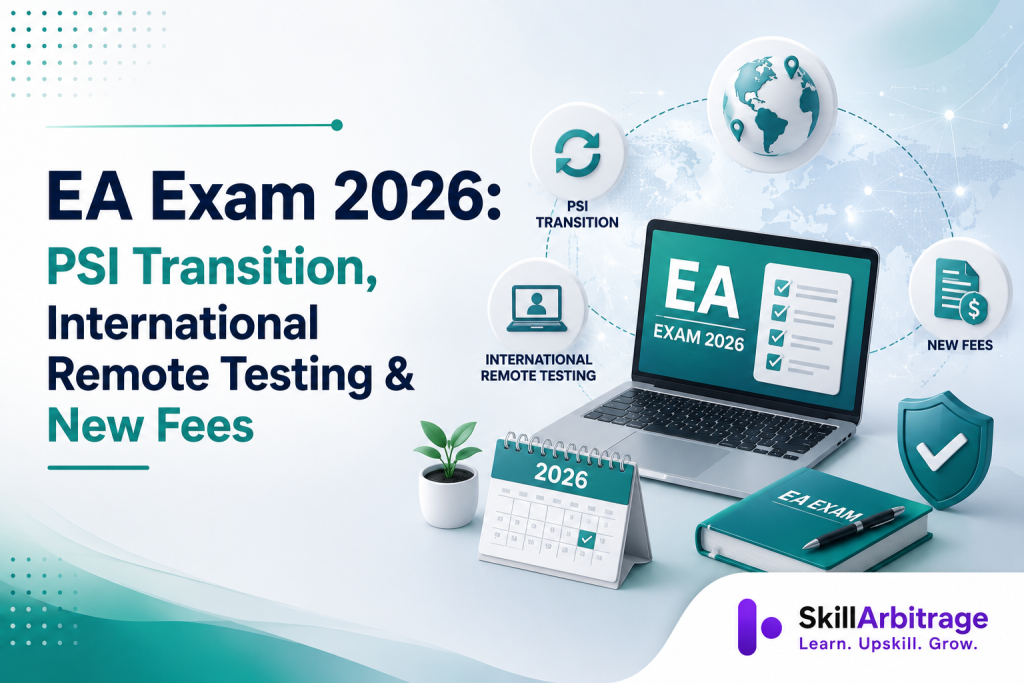
The EA exam 2026 cycle brings the three biggest administrative changes the Enrolled Agent credential has seen in years: a new testing vendor, a fee increase, and remote testing that finally opens the exam to international candidates from home. Effective March 1, 2026, the IRS Special Enrollment Examination (SEE) is no longer run by Prometric. PSI Services now develops and delivers it, the fee rose to 317 dollars per part, and international candidates can sit all three parts by remote proctoring rather than travelling to a test centre. The exam content, the three-part structure, and the credential itself have not changed.
This article sets out what actually changed in the EA exam 2026 cycle, and, more usefully, what you should do about each change.
For a lot of Indian candidates, this is the update they were waiting for. The Enrolled Agent credential is the highest one the IRS grants, and it lets the holder represent US taxpayers before the IRS from anywhere, which is exactly why it has become a route into remote US tax work without leaving India. Two of the 2026 changes touch the things that mattered most to that audience: how you physically sit the exam, and what the whole thing costs.
So the news is mostly good, with a few sharp edges. Remote testing removes the old travel problem. The fee went up, the cancellation rules are stricter than most people expect, and the registration paperwork for anyone without a US Social Security Number takes longer than the exam prep newbies budget for. Get those three details right and the rest is straightforward.
The EA exam 2026 changes come down to three things. The IRS replaced Prometric with PSI Services effective March 1, 2026. The fee rose from 267 dollars to 317 dollars per part. And PSI added remote online proctoring, so US candidates can test at a centre or remotely, while international candidates test remotely only, starting September 1, 2026. The exam itself, three parts of 100 questions each, is unchanged, and existing Prometric appointments stay valid through February 28, 2026.
What changed in the EA exam for 2026
Three things changed in the EA exam for 2026, and everything else stayed put. The vendor is new, the fee is higher, and remote proctoring is now available to candidates who used to be locked out of it. So what has not changed? Almost everything to do with the exam itself, which is why knowing the difference keeps you from over-preparing for a syllabus overhaul that simply is not in this update.
The three changes that matter
The first change is the vendor. Effective March 1, 2026, the IRS SEE is no longer developed or administered by Prometric, and PSI Services took over the full program: scheduling, exam development, secure delivery, and results.
The second is cost. The testing fee moved to 317 dollars per part, up from 267 dollars in the previous cycle. Across all three parts that is 951 dollars in exam fees alone, before you count the smaller charges that surround it.
The third, and the one that reshapes access, is remote testing. PSI offers remote online proctoring in both the US and internationally. US candidates can pick a test centre or a remote session. International candidates test remotely only, with scheduling and testing set to begin September 1, 2026. For anyone outside the US, that is the headline.
What did not change
Plenty stayed exactly the same, which is worth saying plainly because rumour tends to fill the gap during a vendor switch. The exam is still three parts: Individuals, Businesses, and Representation, Practices and Procedures. Each part still holds 100 questions. The credential is identical, and so are the unlimited representation rights that come with it.
The annual rhythm is also intact. Testing runs from July through the end of February, and the exam is still pulled offline in March and April each year while it is updated. So if you were preparing for the 2025 content structure, the ground under your prep has not shifted. What changed is the machinery around the exam, not the exam.
The Prometric to PSI transition
The Prometric to PSI transition is an administrative handover, not a change to what the exam asks of you. From March 1, 2026, PSI owns the candidate experience end to end, and the practical effect is a new website to register on, a new scheduling system, and a new set of test-day rules to read before you show up. Does that mean your study plan needs a rethink? No. It means your logistics do.
What PSI now runs
PSI took over comprehensive support for the EA-SEE program, which covers scheduling appointments, developing and maintaining the exam, delivering it securely, supporting candidates, and reporting results. In plain terms, every touchpoint that used to route through Prometric now routes through PSI. The company began providing program support in May 2026, with candidate-facing access to testing rolling out from July 2026.
The scale is not small. PSI says it will use a network of over 550 high-security test centres across the US from July 2026, alongside remote proctoring. For a US candidate, that generally means more location options, not fewer.
The security model
PSI has leaned on security as its selling point, and one detail stands out. The company states that all PSI personnel who access sensitive candidate data are US citizens who have completed background screening. For an exam that certifies people to practise before the IRS, that framing is deliberate, and the IRS described the partnership as delivering a secure and candidate-centred testing experience.

Why does this matter to you? Mostly because it signals how strict the identity and proctoring checks will be, especially for remote sessions. Plan for tight verification rather than a casual login.
If you already booked with Prometric
Here is the one transition detail that stops people mid-panic. If you already hold an appointment with Prometric, it remains valid through February 28, 2026, the close of the final pre-PSI testing window. You do not need to rebook a valid Prometric appointment onto PSI just because the vendor changed.
The cleaner mental model is a hard cutover at the end of February 2026. Sit any existing Prometric appointment on or before February 28, 2026, and schedule anything after that, once the new window opens, through PSI. If your part falls in the awkward gap around the changeover, check the carryover rules in the structure section below, because the IRS built in a short extension for exactly that situation.
International remote testing for the enrolled agent exam
International remote testing is the single change in the EA exam 2026 cycle that widens who can realistically sit it. Under the new setup, remote online proctoring is available in both the US and internationally, and there is no in-person international testing at all. For a candidate in India, the enrolled agent exam is now something you take from a room in your own home, not something that requires a trip to one of a handful of cities.
Who tests remotely, and from where
US candidates get a choice: sit at one of PSI’s test centres, or take the exam remotely. International candidates have one route, remote proctoring, and the scheduling and testing for that route begins September 1, 2026. So can you test the day the US window opens? Not if you are abroad. That start date is later than the US window, which opened on July 1, 2026, so international candidates plan around September, not July.
This is a real shift in access. The exam did not get easier. It got reachable, which for many capable candidates was the actual barrier.
The old India reality versus the new one
Under the previous vendor, sitting the SEE from India meant booking a physical seat, and older guides still floating around the web reference test centres in a short list of metros. That worked if you lived near one and could take a day out to travel and test. It did not work well for everyone else.
Remote proctoring rewrites that. You schedule a session, you sit it from a compliant room, and the travel cost drops to zero. If you’re weighing whether the credential is worth it now that the access problem is gone, our breakdown of the ROI of the Enrolled Agent certification for an Indian professional runs the earnings maths, and the wider US accounting career path from India shows where the EA fits among the other tracks.
What remote proctoring actually requires
Remote testing comes with rules that are stricter than a normal video call, and reading them beforehand saves a forfeited fee. You test in front of a camera and cannot leave its view during the exam. Unscheduled breaks are not allowed on the remote format at all, so the two scheduled breaks are your only pauses. And you take notes on an on-screen electronic whiteboard rather than paper, because scratch paper is not permitted for remote sessions.
Identity checks are tight, too. One specific catch worth flagging: a military ID is not accepted as valid identification if you’re testing remotely, even though it can be fine in other contexts. The practical reality is that most remote-testing problems are environment problems, not knowledge problems: a second face in the room, a phone within reach, a poor camera angle. Set the room up properly and the format is genuinely convenient.
New EA exam fees for 2026
The new EA exam fee for 2026 is 317 dollars per part, paid to PSI at the time you schedule each appointment. Up from 267 dollars in the prior cycle, that is a 50-dollar jump on every part, or 150 dollars across the full exam. Sit all three parts once and you are looking at 951 dollars in test fees. But is that the real cost? Not quite, because the cancellation rules and a couple of surrounding charges catch first-timers out.
The money rules most candidates miss
The fee rules under PSI are stricter than many candidates assume, and they are where money quietly disappears. Testing fees are generally not refundable or transferable, with only very limited exceptions such as the death of the candidate or a duplicate registration. So treat the fee as spent the moment you schedule.
The timing rule is the one to memorise. You can cancel and get the fee back only if you make that request at least 48 hours before your appointment. Cancel inside that 48-hour window, or simply not show up, and the full 317 dollars is gone, and you have to pay another full fee to rebook. Rescheduling to a new date is a separate process: you contact PSI to move the appointment, and you must wait at least 24 hours before rebooking the same part. None of this is punitive by exam-industry standards, but it rewards candidates who book only when they are genuinely ready to sit.
The total cost, not just the exam fee
The exam fee is the biggest number, but it is not the only one, and budgeting for the exam alone is how people get surprised. Two other charges bracket the process. Before you can register, you need a Preparer Tax Identification Number (PTIN), which carries a 2026 fee of 18.75 dollars. After you pass all three parts, you apply for enrollment on Form 23, which costs 140 dollars.
Add it up and a clean, first-attempt run costs 951 dollars for the three exam parts, plus the 18.75-dollar PTIN and the 140-dollar enrollment, so roughly 1,110 dollars in official fees. That figure ignores study materials, retakes, and any currency and bank charges on an international payment, all of which are real. Our recommendation is to budget for at least one retake somewhere across the three parts, because a single 500-scaled-score miss on one part is common and adds another 317 dollars.
How to register for the 2026 EA exam
Registering for the 2026 EA exam is a two-step sequence: get a PTIN first, then schedule with PSI. Can you skip ahead and book the exam while the paperwork catches up? No, the order is not optional. The IRS requires a valid PTIN before you can register for the exam, and for candidates outside the US the PTIN step is the one with the longest lead time, so it is the one to start early.
Step one, get your PTIN
The PTIN is a hard prerequisite, and how you get it depends on whether you have a US Social Security Number. If you do, the online PTIN application at the IRS site takes about 15 minutes, and you walk away with the number the same session. That is the easy path, and it is the one most US candidates take without thinking about it.
If you do not have and are not eligible for a US SSN, which describes most candidates applying from India, the process is different and slower. You apply on paper: Form W-12 (the PTIN application) together with Form 8946, the supplemental form for foreign persons without an SSN, plus the identity and foreign-status documents those forms require. There is no online option on this route, and the IRS takes roughly six weeks to process a paper PTIN application. That six weeks is the single most underestimated part of the whole timeline. Start it before you finish your prep, not after.
Step two, schedule with PSI
With a PTIN in hand, you schedule through PSI, choosing a test centre or a remote session (remote only, if you are international). You can take the parts in any order you like, so most candidates lead with the part they feel strongest on to bank an early pass. Each part can be attempted up to four times within a single testing window, which gives real room to recover from a bad day without waiting a year.
One planning note tied to registration: your PTIN has to stay current. PTINs are renewed annually by December 31 for the following year, so if your exam attempts straddle a year boundary, keep the renewal on your calendar. A lapsed PTIN mid-process is an avoidable headache.
EA exam structure, scoring, and testing window
The EA exam structure and scoring carried over almost entirely into 2026, with the visible changes landing on exam day and the score report rather than the syllabus. You still face three parts of 100 questions each, but the way the test day is broken up and the way your result is expressed both look different under PSI. Here is what that actually looks like when you sit down.
The three parts and the question mix
The exam is three separate parts, taken and passed independently: Part 1 Individuals, Part 2 Businesses, and Part 3 Representation, Practices and Procedures. So how much of what you answer actually counts? Each part contains 100 questions, of which 85 are scored and 15 are experimental questions that do not count toward your result, though you cannot tell which is which. Each part runs 3.5 hours of testing time inside a four-hour appointment that also covers a tutorial, a survey, and your breaks. For a fuller walk-through of the syllabus and structure, this iPleaders guide to the IRS Enrolled Agent exam eligibility, structure and preparation is a solid companion read.
The new exam-day format
Exam day is now split into three sections with two scheduled breaks between them, and the breaks come with a rule that surprises people. The sections run questions 1 to 34, then 35 to 67, then 68 to 100. After you finish and confirm a section, the exam clock stops and you are offered a 10-minute break, but once you have submitted a section you cannot go back into it. The breaks are optional: you can decline and keep testing if you would rather push through. Just know that the door on each section closes behind you, so review before you confirm, not after.
How scoring works in 2026
Scoring moved to a scaled system, and the number to know is 500. Your raw performance is converted onto a scale that runs from 200 to 800, and the IRS set the passing score at 500. A pass report is blunt in a helpful way: it shows a passing designation and no score at all, because every score above the line is treated the same. A fail report shows a scaled score between 200 and 500, plus diagnostic feedback pointing to the areas to shore up before your next attempt. If you have read older guidance quoting a passing score of 105 on a 40-to-130 scale, that scale retired with the vendor change.
The 2026 testing window and how long a pass lasts
The window is fixed and the blackout is predictable. Domestic testing runs July 1, 2026 through February 28, 2027, international testing opens September 1, 2026, and the exam is unavailable in March and April each year while it is refreshed. Once you pass a part, that pass carries over for three years from the date you passed it, and you need all three parts passed inside that window. Worth flagging for anyone caught right on the changeover: the IRS built a short carryover extension into the transition. Domestic candidates whose parts were set to expire between May 1 and June 30, 2026 get two extra months, and international candidates whose parts expire between May 1 and August 31, 2026 get four. If you are testing from India, it is that international four-month cushion that applies to you.
What EA candidates should do now
The right move for most EA candidates right now is to start the PTIN clock and pick your testing format before you worry about anything else. The 2026 changes reward planning and punish improvisation, mostly through the six-week PTIN wait and the 48-hour cancellation rule. So what does a sensible sequence look like?
A short decision path
Start with the PTIN, today if you can, because it gates everything else and, on the no-SSN route, takes about six weeks. While that processes, decide your format: a PSI test centre or a remote session for US candidates, remote only for international ones, remembering that international scheduling opened on September 1, 2026. Then budget the real number, around 1,110 dollars in official fees for a clean run, plus materials and a likely retake. Only when you’re genuinely ready for a given part should you schedule it, since the fee is non-refundable and books against a hard 48-hour cancellation line.
The mistake we see most often is candidates treating scheduling as a commitment device, booking a date to force themselves to study. Under these fee rules, that is an expensive motivator. Prepare first, book second.
Where to confirm the current rules
Rules during a vendor transition can shift, so verify against primary sources rather than year-old blog posts, including this one. The two that govern everything are the IRS Become an Enrolled Agent page and PSI’s SEE Candidate Information Bulletin, which is the authoritative source for fees, breaks, scoring, and the remote-testing rules. If a detail here and a detail on those pages ever disagree, believe the IRS and PSI. The credential is worth the diligence: it is a genuine, portable route into US tax work, and the 2026 changes made it easier to reach, not harder to hold.
Frequently asked questions
Who administers the EA exam in 2026? PSI Services. Effective March 1, 2026, the IRS Special Enrollment Examination is no longer developed or administered by Prometric, and PSI took over the full program: scheduling, exam development, secure delivery, and results reporting. Candidate-facing access to PSI testing rolled out from July 2026. If you held a valid Prometric appointment, it remained valid through February 28, 2026, so there was a clean cutover rather than an overnight switch.
Can I take the EA exam remotely from India? Yes. For the 2026 cycle, international candidates test by remote online proctoring only, with scheduling and testing beginning September 1, 2026. There is no in-person international testing. You sit the exam from a compliant room in front of a camera, with tight identity checks, no unscheduled breaks, and an on-screen electronic whiteboard instead of scratch paper. This is the change that removed the old need to travel to a physical test centre.
How much does the EA exam cost in 2026? The testing fee is 317 dollars per part, up from 267 dollars, paid to PSI when you schedule. All three parts total 951 dollars in exam fees. Beyond that, budget 18.75 dollars for the required PTIN and 140 dollars for the Form 23 enrollment application after you pass, which brings official fees to roughly 1,110 dollars for a first-attempt run, before study materials, retakes, and any currency or bank charges.
Do I need a PTIN before I can register? Yes, a valid PTIN is required before you can register for the SEE. If you have a US Social Security Number, the online application takes about 15 minutes. If you do not, which applies to most candidates in India, you apply on paper using Form W-12 plus Form 8946 with the identity and foreign-status documents they require, and wait roughly six weeks for processing. That lead time is the main reason to start the PTIN step early.
What is the passing score on the EA exam now? The exam is scored on a scaled range from 200 to 800, and the IRS set the passing score at 500. A pass report simply shows a passing designation with no number, since all scores above the line are treated equally. A fail report shows a scaled score between 200 and 500 along with diagnostic feedback on weak areas. The older 105-on-40-to-130 scale is no longer in use, so ignore guidance that still quotes it.
Is my existing Prometric appointment still valid? Yes, if it was booked before the transition it remained valid through February 28, 2026, the last day of the pre-transition testing window. You did not need to move a valid Prometric appointment onto PSI. Anything scheduled after the changeover goes through PSI under the new fee and format. If your part was set to expire right around the changeover, the IRS granted a carryover extension: two months for domestic parts expiring between May 1 and June 30, 2026, and four months for international parts expiring between May 1 and August 31, 2026.
How many times can I take each part? Each part can be attempted up to four times within a single testing window, and you can take the three parts in any order. Most candidates lead with their strongest part to bank an early pass. Because a passing score carries over for three years, you have room to space the parts out, but you still need all three passed inside that three-year window.
What are the 2026 testing dates? Domestic testing runs July 1, 2026 through February 28, 2027. International remote testing opens September 1, 2026 and also runs through February 28, 2027. The exam is not offered in March and April each year, when it is taken offline and updated. Plan your attempts around that annual blackout, particularly if you are aiming to finish all three parts before a carryover deadline.
Does the EA credential or exam content change under PSI? No. The vendor changed, the fee rose, and remote testing expanded, but the credential and its unlimited representation rights are identical, and the three-part structure with 100 questions each is unchanged. The syllabus follows the same content outlines. What changed is the logistics around the exam, the registration site, scheduling, test-day format, and scoring presentation, not the tax knowledge the exam tests.
References
Official and primary sources
- Important update: Testing vendor transition (Prometric to PSI): Internal Revenue Service
- Become an Enrolled Agent: Internal Revenue Service
- Enrolled Agents: Frequently Asked Questions: Internal Revenue Service (fee, carryover period and transition extension, $140 enrollment)
- IRS SEE candidate page and Candidate Information Bulletin: PSI Services (fee, scoring, breaks, remote-testing and cancellation rules)
- PSI Selected by U.S. Internal Revenue Service to Deliver Enrolled Agent Exam Program: PSI Services, press release
- Enrolled Agent Special Enrollment Examination User Fee Update: Federal Register (the $317 per-part fee)
- Instructions for Form W-12, IRS Paid Preparer Tax Identification Number (PTIN) Application: Internal Revenue Service (PTIN and Form 8946 route for foreign applicants)
This article is for informational and educational purposes only and does not constitute professional, tax, accounting, or immigration advice. EA exam rules, fees, and testing logistics are being updated during the 2026 vendor transition; verify the current position on the IRS Become an Enrolled Agent page and PSI’s SEE Candidate Information Bulletin before scheduling or paying. Related reading: IRS Enrolled Agent exam: eligibility, structure and preparation guide (iPleaders).





 Allow notifications