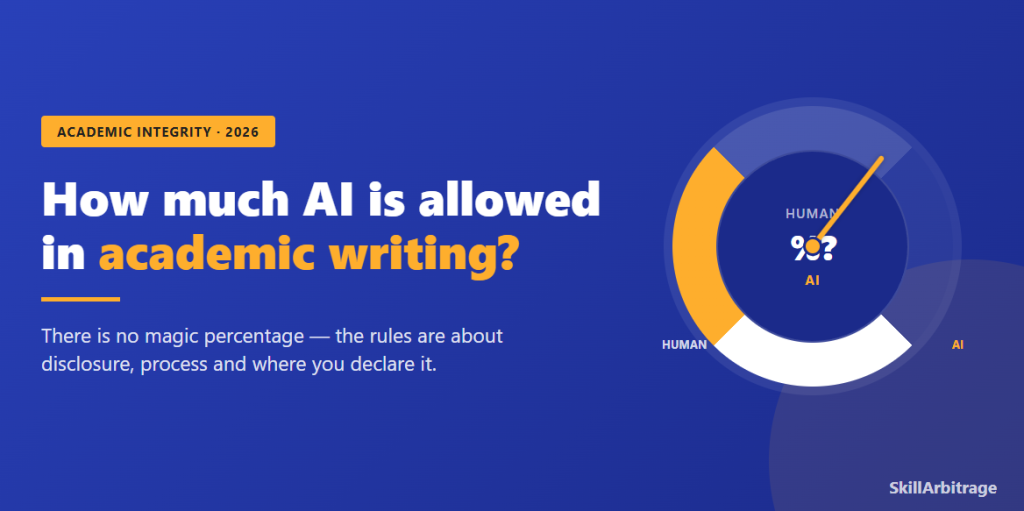

Turnitin’s own data tells the story faster than any policy memo. As of early 2026, roughly 14.8% of English-language student submissions run through the tool contained 80% or more AI-generated writing, up from an average of 3.3% in 2023. That’s a near five-fold jump in three years. And it reset the single most important question students and researchers now ask: how much AI is allowed in academic writing, before it tips from help into misconduct?
That surge is exactly why 2023 to 2026 became a scramble of policy rewrites. Nature, Science, Elsevier, JAMA and the medical-editor associations pushed out rapid statements. Universities bolted AI clauses onto integrity codes that had barely mentioned software a year earlier. The question in student forums quietly changed shape too. It stopped being “can I use AI at all?” and became “how much, and where do I say so?”
Here’s the part most guides skip: the danger doesn’t only run one way. Yes, leaning too hard on a chatbot can sink a thesis. But genuinely human work gets flagged as machine-written too, and that risk falls hardest on non-native English writers. Picture an ESL researcher in Pune whose original methods section came back stamped “likely AI” by a detector, with no draft trail to prove otherwise. The tool was wrong. The consequences were still real.
Now flip that same pressure into an opportunity, because that’s where this gets interesting. An India-based research-support writer who learned to use AI openly, disclose it in the exact spot each publisher demands, and keep a clean version history started winning repeat contracts from UK and Australian PhD candidates, precisely when less careful competitors watched their clients’ papers get desk-rejected over AI questions. Same tools. Different discipline around disclosure. One of them looked trustworthy to a nervous international client, and trust is what gets the next invoice paid.
So if you’re an Indian scholar submitting a thesis, a master’s student staring at an assignment brief, or a writer serving global universities, the rules aren’t a single number you can memorise. They depend on who’s judging, what document you’re submitting, and where you place your disclosure. This post gives you the whole map, publisher by publisher and regulator by regulator, plus copy-paste templates so you disclose in the right place the first time.
There’s no universal “acceptable AI percentage” in academic writing. Most journals and universities permit AI for brainstorming, outlining, and language or grammar polishing (often without disclosure for pure copy-editing), but they require you to disclose any generative use, prohibit listing AI as an author, and hold the human author fully accountable for everything submitted.
What follows shows exactly who sets which rule, where each publisher wants your disclosure written, what India’s UGC framework means for a thesis, and why chasing a “safe” Turnitin score misreads how integrity decisions actually get made.
How much AI is actually allowed in academic writing in 2026?
Ask ten students and you’ll hear ten numbers: 10%, 15%, 20%, “under a quarter is fine.” None of those numbers comes from a rule. They come from vendor blogs and detector dashboards, and confusing the two is how people talk themselves into trouble. So before the publisher tables and the India regulations, let’s settle the core question honestly.
The reason “how much?” replaced “can I?” is simple. Once generative AI became ordinary, a blanket ban stopped being enforceable or even sensible, so institutions shifted to governing use and disclosure instead of pretending the tools didn’t exist. That shift is what created the grey zone every scholar is now trying to read.
The honest answer: there’s no universal AI percentage
There is no official body, anywhere, that sets a numerical cap on AI content in academic work. Not the Committee on Publication Ethics, whose position on authorship and AI tools is the baseline most journals defer to. Not Turnitin, whose own guidance says its AI score should not be the sole basis for any disciplinary decision. When you see “under 20% is generally safe,” read it as a folk heuristic, not a policy. It describes how some graders react to a detector reading. It is not a threshold anyone official has published.
What experienced integrity officers know is that the real unit of judgement isn’t a percentage at all. It’s process and accountability. Did you do the thinking? Can you show your working? Did you disclose where a tool contributed generated content? A paper that’s 5% machine text passed off as original human analysis is a bigger problem than a well-disclosed language polish across the whole document.
A common question in scholar communities runs like this: “if there’s no official number, why does my university’s plagiarism software show an AI percentage at all?” Because a score and a rule are different objects. The software estimates how much of your text pattern-matches AI writing. Your institution’s policy, written separately, decides what (if anything) that estimate means for you. The pitfall is assuming one global rule governs everyone. It doesn’t, and treating a detector’s number as the law is the fastest way to misjudge your own risk.
What AI use is generally allowed versus prohibited
Across the major publishers and most university codes, a workable three-band picture emerges. Some uses are broadly permitted, some sit in a grey zone that depends on disclosure, and some are high-risk almost everywhere.
Generally permitted: using AI to brainstorm angles, build an outline, run a literature search, or polish grammar and phrasing. Grey zone (disclose, and check your specific policy): paraphrasing sources through a tool, or generating draft literature-review prose you then verify and rewrite. High-risk or prohibited: generating your core arguments, results, or interpretations and presenting them as your own; listing AI as an author; and submitting undisclosed generative text where disclosure is required.
Think of it this way. AI as a research assistant that helps you think and tidy is usually fine. AI as a ghost-author that does the intellectual work is where lines get crossed. That distinction, not a percentage, is what “how much is allowed” really turns on.
How academic AI policy evolved from 2023 to 2026
This landscape didn’t exist three years ago. Before 2023, there were essentially no formal AI-writing policies, because the use was negligible. Then the late-2022 arrival of consumer chatbots forced everyone’s hand within months. Through early 2023, Nature and Springer, Science, Elsevier, JAMA and the World Association of Medical Editors issued fast, near-identical statements: an AI tool can’t be an author, because it can’t take responsibility for the work. COPE published its authorship-and-AI position in the same window, and the sector converged on a shared model, disclose generative use, exempt routine copy-editing.

What’s happened since is refinement rather than reversal. Publishers agreed on the principles but split on the mechanics, especially where you write your disclosure, which is the exact detail the publisher comparison covers below (see Elsevier’s generative-AI writing policy). If you want a sense of how fast the surrounding field is moving, and the broader opportunities opening up for academic writers in 2026, the policy churn is a signal: rules this new reward the people who actually read them.
Coursework, thesis, and journal papers follow three different rulebooks
Most of the panic in student forums comes from mixing up three separate regimes. The rule that governs a first-year essay is not the rule that governs a doctoral thesis, and neither is the rule that governs a journal submission. Apply the wrong one and you either over-worry or, worse, breach a policy you didn’t know applied.
So which rulebook governs which document? The short version: your professor and university set coursework rules, a mix of institutional integrity regulation and formal submission checks governs a thesis, and the target publisher’s policy governs a journal manuscript. Here’s the compact version before we take each in turn.
| Document type | Who sets the rule | Typical disclosure requirement | Main risk |
|---|---|---|---|
| Coursework and assignments | Your professor and university policy | A disclosure line or acknowledgment, if the module asks for one | Undisclosed generative text; breaching a course-specific ban |
| Dissertation or thesis | University integrity regulation plus submission software | An AI-use acknowledgment, plus evidence of your own process | Misconduct finding; in serious cases, degree consequences |
| Journal manuscript | The target publisher (COPE-aligned) | A formal declaration in the publisher’s required location | Desk rejection or retraction for non-compliant disclosure |
Student coursework and assignments: what universities actually allow
For everyday coursework, the governing rule is whatever your professor and university say, and that varies by module. Many programmes now permit AI for brainstorming, outlining and language help, and ask you to add a short acknowledgment line if you used it. Some courses ban it outright for a specific assessment (an in-class writing test, say). Others are silent, which is not the same as permission.
In practice, the safest read is: check the assignment brief first, the module handbook second, and if both are silent, ask the instructor in writing. That written reply is itself protection. A common Quora worry is whether using AI to paraphrase a source counts as cheating. Often yes, if it hides that the ideas and phrasing came from a tool rather than from your own engagement with the source. Paraphrasing to dodge a similarity check is exactly the move integrity offices are trained to spot.
Dissertations and theses: stricter and process-evidenced
A thesis raises the stakes because it’s assessed as sustained, original scholarship, and because it usually runs through institutional submission software. Here the expectation isn’t only “disclose your AI use.” It’s “be able to show the work is yours.” That’s why keeping your draft history, notes and version logs matters more at this level than anywhere else.
Can you be expelled for using AI in a dissertation? The honest answer: undisclosed heavy generative use, treated as passing off machine work as your own, can trigger a misconduct process, and in serious proven cases the consequences reach the degree itself. But disclosed, assistive use, with a clear acknowledgment and a defensible process, is a different situation entirely. The mistake we see most often is students hiding modest, legitimate AI help out of fear, then having no version trail when a detector flags a passage. Disclosure plus evidence beats silence plus a clean-looking draft.
Journal manuscripts: the formal-declaration regime
Once your work heads to a journal, the rulebook changes owner again. Now the target publisher’s policy governs, and disclosure becomes a formal declaration in a specific place, not a casual footnote, in line with the COPE position on authorship and AI tools. An Indian master’s student writing coursework and a PhD candidate submitting to a journal are playing by different rules even if the underlying tool use is identical.
The catch for anyone moving from student work into publishing: the habits that pass in coursework won’t automatically satisfy a journal, which wants the tool named and the disclosure placed exactly where its policy dictates. That’s the regime the next section maps in full, and getting the location right is where most first-time authors slip. How each publisher differs is where we turn now.
Journal and publisher AI policies compared
Every vendor blog tells you “journals require AI disclosure” and then stops, which is useless at the moment you actually need it. The decision-critical detail isn’t whether to disclose. It’s where, because the required location differs by publisher, and disclosing in the wrong section can itself make your submission non-compliant.
So where does each major publisher want your AI disclosure, and what do they agree on? They converge on two rules and diverge on placement. Here’s the side-by-side, sourced to each publisher’s own policy.
| Publisher | Can AI be an author? | Where to disclose generative use | Copy-editing exempt? | Must name tool + version? |
|---|---|---|---|---|
| COPE (baseline) | No | Materials and Methods | Yes, if use is generative-disclosed | Name the tool |
| Nature / Springer | No | Methods | Yes, AI copy-editing exempt | Document the LLM use |
| Elsevier | No | Separate “Declaration of Generative AI” statement above the references | Yes, grammar and spelling checks | Declare tool and purpose |
| Taylor & Francis | No | Acknowledge within the paper | Language use permitted, but acknowledge | Yes: tool, version, and how or why (strictest) |
| IEEE | No | Acknowledgments section | Grammar editing (disclosure recommended) | Identify the system and the affected sections |
Can AI be listed as an author? The one universal rule
On this point the entire field agrees: an AI tool cannot be a named author (COPE). The reasoning, stated plainly by COPE, ICMJE and the medical-editor associations, is that authorship carries accountability, and a language model can’t be accountable, can’t approve a final version, and can’t declare conflicts of interest. The human authors remain fully responsible for accuracy, including anything a tool helped produce.
Why does this rule sit at the centre of every policy? Because author-accountability is the load-bearing beam of research integrity, and once you accept that AI can’t hold responsibility, the “no AI author” rule follows automatically. A recurring Reddit question is which journals outright reject papers over AI use. The more accurate framing: journals reject papers over undisclosed or irresponsible AI use, not over the mere fact that a tool was involved and properly declared.
Where each publisher requires disclosure
Look closely at the table and the divergence jumps out. Nature and Springer, following the COPE baseline, want generative AI use documented in the Methods section. Elsevier takes a different route: a dedicated “Declaration of Generative AI and AI-assisted technologies in the writing process” statement placed just before the reference list. IEEE wants it in the Acknowledgments and asks you to identify both the system and the affected sections. Taylor & Francis is the strictest on naming, expecting the tool, its version, and an explanation of how and why it was used.
Here’s what that means for an Indian author choosing a target journal. The disclosure you’d write for a Springer title, tucked into Methods, is filed in the wrong place for an Elsevier journal, which wants a standalone declaration above the references. Match the location to the publisher before you submit, not after a reviewer queries it. Getting the words right but the placement wrong is a genuinely common, and entirely avoidable, non-compliance.
What’s exempt: grammar and copy-editing
Good news that calms a lot of anxiety: routine language help usually needs no declaration. Nature and Springer treat AI-assisted copy-editing as exempt from disclosure, and Elsevier says the same for tools used only to improve grammar, spelling and readability. The line sits at the difference between editing your words and generating content or ideas. Fixing your English is generally fine and unremarked; producing new argument or text is what triggers the disclosure duty.
Where’s the boundary in practice, though? If a tool rewrote your clumsy sentence into a cleaner one, that’s editing. If it wrote the sentence’s substance for you, that’s generation, and generation gets disclosed. When you’re unsure which side you’re on, disclose. Over-disclosure costs you nothing; under-disclosure can cost you the paper.
AI in peer review and for methods or literature review
One prohibition catches researchers off guard. Running someone else’s unpublished manuscript through a public AI tool during peer review breaches confidentiality, and publishers including IEEE warn against it explicitly. The manuscript you’re reviewing isn’t yours to feed into a system that may retain it. If you provide research-support services, this is also a client-trust issue worth being able to explain; some writers formalise it as part of offering pre-publication peer-review support to researchers.
Can you use AI to draft a literature review or methods text? Cautiously, and with disclosure, yes, provided you verify every claim and citation the tool produces, because models fabricate references convincingly. The pitfall isn’t the drafting. It’s trusting the output. A fabricated citation that slips into your methods is your error to answer for, not the tool’s.
| Publisher | AI as author? | Where to disclose | Copy-editing exempt? | Must name tool + version? |
|---|---|---|---|---|
| COPE (baseline) |
No | Materials & Methods | Yes, if generative use is disclosed | Name the tool |
| Nature / Springer | No | Methods | Yes, AI copy-editing exempt | Document the LLM use |
| Elsevier | No | Separate “Declaration of Generative AI” above the references | Yes, grammar & spelling checks | Declare tool + purpose |
| Taylor & Francis | No | Acknowledge within the paper | Language use permitted, but acknowledge | Yes — tool + version + how/whySTRICTEST |
| IEEE | No | Acknowledgments section | Grammar editing (disclosure recommended) | Identify the system + affected sections |
AI rules for Indian scholars: UGC, AICTE, and DrillBit
Everything above is international, and that’s the gap Indian scholars keep falling into. Nature, Elsevier and IEEE are non-India bodies. But if you’re submitting a PhD thesis at an Indian university, a different layer governs you first, and almost nobody writes about it clearly. So what actually applies to an Indian scholar?
| Framework | Body | What it governs | AI relevance |
|---|---|---|---|
| Plagiarism Regulations, 2018 | University Grants Commission (UGC) | Academic integrity and plagiarism across Indian higher-education institutions | Unacknowledged AI text can be treated as plagiarism by analogy |
| “Year of Artificial Intelligence,” 2025 | AICTE | AI adoption and implementation across affiliated technical institutions | Institutional push toward AI use, and toward governing it |
| DrillBit-Extreme | Detection vendor / submission infrastructure | Similarity and AI-content indicators at submission | Generates an AI-content signal, not a verdict |
UGC Plagiarism Regulations 2018 and unacknowledged AI
The governing framework for every Indian PhD thesis is still the UGC (Promotion of Academic Integrity and Prevention of Plagiarism in Higher Educational Institutions) Regulations, 2018. It predates generative AI, so it doesn’t name chatbots. What it does do is treat presenting others’ work or words as your own, without acknowledgment, as plagiarism, and unacknowledged AI-generated text falls into that logic by analogy.
Be careful here, and this is where we’d urge precision: there is no explicit UGC numeric cap on AI content, and inventing one would mislead you. The regulation is built around unacknowledged copying, not an “AI percentage.” Can Indian students use ChatGPT for assignments legally? Nothing forbids the tool itself; the risk is submitting its output as your own unacknowledged work, which is the exact conduct the 2018 framework treats as an integrity breach. Frame your compliance around disclosure and originality, not around hitting a magic number.
AICTE’s 2025 Year of Artificial Intelligence directive
On the institutional side, AICTE declared 2025 its “Year of Artificial Intelligence,” pushing affiliated technical institutions to build AI into teaching and operations. That matters for your context because it signals official momentum, integrity rules are being read against a backdrop where AI use is encouraged, not banned. The direction of travel is “use it well and account for it,” not “avoid it.”
What does that leave a scholar to do today? Treat AICTE’s stance as institutional encouragement of AI literacy, and treat the UGC integrity framework as the line you must not cross. The two aren’t in tension: use the tools, disclose the generative parts, keep your process defensible.
DrillBit-Extreme in India’s PhD-submission pipeline
At the submission stage, many Indian institutions now run theses through DrillBit-Extreme, a detection tool widely used in Indian PhD-submission workflows that produces both a similarity report and an AI-content indicator. So does DrillBit “detect AI”? It generates an AI-content signal, the same probabilistic kind any detector produces, and that signal is an input for a human committee, not a verdict.
The pitfall for a candidate in Delhi or a tier-2 city is the same one that trips up authors globally: treating that AI indicator as proof of guilt or innocence. It’s neither. Assuming a global journal’s rule protects you at your Indian university, or vice versa, is the other half of the trap. Two layers apply; read both. Why the indicator shouldn’t be read as a verdict is the whole point of the percentage-myth section next.
The “acceptable AI percentage” myth: what Turnitin actually says
Half the search results for this topic chase a number. 10% here, a discipline-by-discipline table there, “keep it under 20%” everywhere. The trouble is that the number-chasing misreads the one source that actually matters, the detector vendor itself. So what does Turnitin really say about its own score?
Why there’s no official “safe” AI percentage
Turnitin’s own guidance is explicit that the AI writing indicator should not be used alone to make a disciplinary decision, and that scores in the lower band (under 20%) are shown with a caveat because they’re less reliable. Read that carefully. The company that built the detector is telling institutions not to treat its number as proof. So when a blog assures you “under 20% is safe,” it’s not quoting a rule; it’s misdescribing a reading the vendor itself flags as noisy.
There’s no official “safe” percentage because the score was never designed to be a pass mark. It’s an estimate meant to prompt a human to look closer. Treating it as a threshold is like treating a smoke-alarm chirp as a fire report.
AI score versus similarity score: not the same thing
This confusion sinks a lot of students, so let’s separate the two clearly. The similarity score estimates how much of your text matches existing published sources, that’s a plagiarism-adjacent signal. The AI score estimates how much of your text reads like AI-generated writing. A high similarity score and a high AI score mean different things and call for different responses.
Does one detector’s score match another’s? Frequently not. Different tools use different models and produce different readings on the same document, which is exactly why no single score deserves to be treated as fact. If a friend’s essay scores 8% on one tool and 35% on another, that’s not a contradiction to resolve; it’s a reminder that these are estimates, not measurements.
How institutions actually decide misconduct
Picture an Indian student who opens a report, sees 22% AI, and spirals. What actually happens next at a well-run institution isn’t automatic punishment. A responsible integrity process treats the detector score as one input, then weighs context: your draft history, your ability to discuss the work, the specifics of the flagged passages. Score alone, in policy-aligned practice, does not decide guilt.
How do universities actually decide misconduct, then? Through a process that combines signals with judgement, which is precisely why your version history and your capacity to defend your own methods matter so much. The pitfall is treating a detector score as courtroom evidence. It isn’t, and staking your defence, or your accusation, on a single number gets the whole thing wrong.
When detectors get it wrong: false positives, ESL and neurodivergent bias
The risk cuts both ways, and this half gets far less attention than it deserves. Detectors don’t only miss AI text; they also flag genuinely human writing, and they do it unevenly. For an India-primary audience writing in English as a second or third language, this isn’t abstract. It’s the exact scenario most likely to go wrong.
Why AI detectors falsely flag non-native English writers
AI detectors work by spotting statistical regularity, text that’s fluent, evenly structured and low in surprising word choices reads as “AI-like” to them. The problem is that non-native English writers often produce exactly that profile, because they lean on carefully learned, conventional phrasing rather than idiomatic flourish. A widely cited Stanford University study (2023) found that leading detectors misclassified more than 61% of non-native English (TOEFL) essays as AI-written, while almost never misflagging essays by native speakers, and similar fairness concerns have since been raised for some neurodivergent writers. The tool isn’t reading intent; it’s reading style, and it mistakes a certain kind of careful English for a machine.
Why did Turnitin flag my original writing? Often for this reason: your prose was clean and conventional, and the model over-read that as generated. It’s a documented failure mode, not a sign you did anything wrong. That AI detectors flag genuinely human writing more often than most realise is worth internalising before you ever face an accusation.
What to do if your original work is wrongly flagged
If you’re wrongly flagged, the single most powerful thing you can produce is evidence of process. Keep your draft history, your notes, your outlines, and your version logs, because a chain of drafts showing the work take shape is hard to argue against. Editors that support version history (or a document with visible revision timestamps) effectively build your defence for you as you write.
Can you appeal a false AI-detection accusation? Yes, and you should, calmly and with evidence. Present your drafts, offer to discuss the work, and point (politely) to the detector vendor’s own caveat that its score isn’t proof. The one pitfall that leaves you exposed is having no process trail at all, a single clean final file, and nothing showing how you got there. Fix that habit now, before you need it.
When the ESL disadvantage flips into a market
Now for the reframe, and it’s a genuinely useful one. Because detectors over-flag non-native English, the writers who can demonstrate a clean human process and disclose AI use correctly become more valuable to international clients, not less. The very bias that looks like a disadvantage creates a premium for trustworthy, transparent work. An India-based writer who hands a UK academic a paper with a defensible version history and a correctly located AI declaration is offering something anxious clients will pay for: peace of mind.
That’s not wishful thinking; it tracks a real market. The demand for skilled academic writers is still climbing despite AI, and the differentiator is increasingly how you handle disclosure and process, not just how you write. What experienced freelancers in this space are realising is that “AI-transparent” writing is becoming a hireable competency. The skill isn’t avoiding AI. It’s using it in the open, provably.
How to use AI in academic writing ethically and disclose it correctly
Uncertainty is what paralyses people here, so this section turns the fear topic into an action path: the ethical rules, then two copy-paste templates you can adapt. Ready to make this concrete?
The rules of ethical AI use for students and researchers
Four principles cover almost every situation. First, you stay accountable: every fact, citation and claim is yours to verify, whatever produced the draft. Second, disclose generative use, the moment AI generated content or ideas (not just fixed grammar), say so. Third, keep your drafts, so you can show the work is yours. Fourth, verify everything, because models invent plausible-looking references and quotes.
Can you use ChatGPT if you edit it heavily? Heavy editing of AI-generated substance doesn’t erase the disclosure duty; if the ideas or text originated with the tool, that’s generative use, and you disclose it regardless of how much you polished afterward. The mistake we see most often is treating “I rewrote it a lot” as a loophole. It isn’t. Should you keep drafts to prove your work is human? Yes, unreservedly, it’s the cheapest insurance in academic writing.
Copy-paste disclosure template: journal manuscript
Adapt this to your target publisher’s required location (Methods for Nature and Springer, a separate declaration above the references for Elsevier, the Acknowledgments for IEEE, per the comparison table above). Name the tool, and for the strictest publishers add the version and the reason for use.
During the preparation of this work, the author(s) used [tool name and version] in order to [specific purpose, for example: improve language and readability / assist with outlining]. After using this tool, the author(s) reviewed and edited the content as needed and take(s) full responsibility for the content of the publication.
For a Taylor & Francis or IEEE submission, expand it to name the exact sections affected and explain how and why the tool was used, since those policies ask for the fullest account.
Copy-paste disclosure template: university dissertation
For a thesis or coursework, follow your university’s specific wording if it provides one; otherwise this general acknowledgment works, and pair it with retained draft history, in keeping with the COPE position on authorship and AI tools.
I acknowledge the use of [tool name and version] to [purpose, for example: brainstorm the structure of this chapter / check grammar and clarity]. All research, analysis, arguments and conclusions in this [thesis/assignment] are my own, and I take full responsibility for the final content. Draft and revision history is available on request.
Will disclosing AI hurt your chances? Honest disclosure of legitimate, assistive use is what the policies ask for; it protects you and signals integrity, whereas concealment is the thing that actually sinks submissions. This kind of client-ready discipline is exactly what separates India-based academic writers earning per-project rates from global clients from those competing on price alone.
What’s coming next for AI declarations
The direction over the next few years looks fairly clear. Expect submission systems to move toward structured, machine-readable AI-declaration fields, so disclosure becomes a form you fill rather than a sentence you compose. Early signals also point to detector scores being de-emphasised in favour of process evidence, draft history, oral defence, version logs, as integrity offices absorb the reliability limits. And a dedicated UGC or AICTE AI notification, moving India from “plagiarism-by-analogy” toward explicit AI rules, is plausible within the next year or two. None of that is guaranteed, but professionals in the field expect the trend toward transparent, structured disclosure to hold.
Frequently asked questions
1. Is using AI in academic writing considered cheating? Not inherently. Using AI to brainstorm, outline or polish language is widely permitted, often with a disclosure line. It becomes misconduct when you present AI-generated substance as your own original work, or fail to disclose generative use where your institution or publisher requires it.
2. Do I need to disclose AI if it only fixed my grammar? For most journals and universities, no, pure grammar, spelling and readability edits are treated as exempt copy-editing (see Nature / Springer Nature’s AI policy). The duty to disclose kicks in when the tool generated content or ideas, not when it merely tidied your existing words. When unsure, disclose anyway.
3. How much has AI use in academic writing grown since 2023? Sharply. Turnitin data indicates that student submissions containing 80%+ AI-generated writing rose from an average of 3.3% in 2023 to about 14.8% in early 2026. That surge is what drove the wave of publisher and university policy updates.
4. Can AI be listed as an author on a journal paper? No. Every major publisher and integrity body prohibits it, because authorship requires accountability that a tool can’t hold (COPE). Human authors remain fully responsible for the whole paper, including any AI-assisted parts.
5. Do I need to disclose AI used only for grammar or copy-editing in a journal? Generally no. Nature and Springer, Elsevier and others exempt AI-assisted copy-editing from formal disclosure. Generative use, drafting content, ideas or analysis, is what must be declared in the publisher’s required location.
6. Do I have to name the AI tool and version in my disclosure? It depends on the publisher. COPE and Springer Nature ask you to name the tool and document its use; Taylor & Francis is strictest, wanting the tool, its version, and how and why it was used. Check your target journal’s exact requirement.
7. Is 10% AI writing acceptable? There’s no official rule that makes 10%, or any figure, “acceptable.” Percentages come from detector dashboards and vendor blogs, not from policy. What matters is whether you disclosed generative use and did the intellectual work yourself, not the number on a report.
8. What happens if my essay has 30% AI detected? A detector reading isn’t a verdict. A policy-aligned institution treats it as one input, then reviews context, your drafts, the flagged passages, and your ability to discuss the work. Keep your version history so you can respond with evidence rather than panic.
9. Do I have to tell my professor I used AI? If your course or assignment asks for disclosure, yes, and many now do. If the brief is silent, ask in writing; that reply protects you either way. Concealing legitimate use is riskier than a straightforward acknowledgment.
10. What’s the ethical way to use AI as a student? Stay accountable for every claim, disclose any generative use, keep your drafts, and verify everything the tool produces. Use AI to think and tidy, not to ghost-write your arguments. That line keeps assistive use firmly on the right side of integrity.
11. Will disclosing AI hurt my chances of acceptance? Disclosing legitimate, assistive use is what the policies ask for, and it signals integrity rather than weakness. Concealment is the real risk: undisclosed generative use is what triggers desk rejections and misconduct findings, not an honest declaration.
12. What are the UGC guidelines on AI in PhD theses? The UGC Plagiarism Regulations, 2018 remain the governing framework, and they treat unacknowledged use of others’ work or words as plagiarism (UGC, 2018). There’s no explicit UGC numeric AI cap; unacknowledged AI text is handled by analogy to plagiarism, so disclosure and originality are what protect you.
13. Does DrillBit detect AI content in Indian PhD submissions? DrillBit-Extreme, widely used by Indian universities at submission, produces both a similarity report and an AI-content indicator. That indicator is a probabilistic signal for a human committee to weigh, not a definitive verdict. Treat it the way you’d treat any detector score: as an input, not proof.
14. Does Turnitin detect AI writing accurately? Imperfectly. Turnitin itself cautions that its AI score shouldn’t be the sole basis for discipline, and that lower-band scores are less reliable. It’s a signal to prompt a closer human look, not a measurement of guilt.
15. What Turnitin AI score is safe or too high? There’s no official “safe” score, and framing it that way misreads the tool. The vendor flags low scores as unreliable and warns against using the number alone. Your defence is process evidence and disclosure, not a target percentage.
16. Do AI detectors falsely flag ESL or non-native English writers? Yes. A widely cited Stanford University study (2023) documented much higher false-positive rates for non-native English writers, and similar fairness concerns have been raised for some neurodivergent writers, because clean, conventional phrasing reads as “AI-like”. Keeping draft history is the strongest safeguard if you’re wrongly flagged.
17. What do universities allow students to use AI for? It varies by institution and module, but commonly permitted uses include brainstorming, outlining, literature searching and language polishing, often with a disclosure line. Generating core arguments or submitting undisclosed AI text is where policies push back. Always check your specific course brief first.
18. Can AI write figures, code, or data analysis, is that allowed? Sometimes, with disclosure and full verification. If AI helped generate code, figures or analysis, most publishers expect you to document that use and confirm the results are correct and reproducible. You remain responsible for the integrity of every output, whoever or whatever produced the first draft.
References
Official guidance & regulations
- AICTE inputs on Artificial Intelligence: 2025 “Year of Artificial Intelligence”. All India Council for Technical Education (AICTE).
- Authorship and AI tools: COPE position statement. Committee on Publication Ethics (COPE), 2023.
- Defining the Role of Authors and Contributors (AI-assisted technology). International Committee of Medical Journal Editors (ICMJE).
- The use of generative AI and AI-assisted technologies in writing for Elsevier. Elsevier.
- Author guidelines for Artificial Intelligence (AI)-generated text. IEEE.
- Artificial Intelligence (AI): editorial policies. Springer Nature / Nature Portfolio.
- AI policy. Taylor & Francis.
- UGC (Promotion of Academic Integrity and Prevention of Plagiarism in Higher Educational Institutions) Regulations, 2018. University Grants Commission, India.
- WAME recommendations on chatbots and generative AI in relation to scholarly publications. World Association of Medical Editors (WAME), 2023.
Data & research
- Turnitin: Data on transparency about AI use (share of student submissions with 80%+ AI writing). Turnitin, 2026.
- Turnitin: Using the AI Writing Report. Turnitin.
- GPT detectors are biased against non-native English writers. Stanford University, Patterns (Cell Press), 2023.
This article is for educational purposes only and does not constitute professional, financial, legal, or academic-integrity advice. AI policies differ by journal, university, and regulator, and they change frequently. Confirm the exact, current AI policy of your own target journal, university, or regulator before acting. For guidance specific to your situation, consult a qualified professional.



 Allow notifications