
Last verified: July 2026
A finance graduate in India in 2026 is choosing between M&A vs private equity at the exact fork the whole industry is standing at. In the same year, two engines of the same finance economy roared on completely different logics. Strategic mergers and acquisitions hit record territory: roughly $60.2 billion in strategic M&A across 963 deals, up about 41% year on year, according to the Grant Thornton Bharat Annual Dealtracker.
A separate tracker read the same market differently: Bain & Company put India’s 2025 strategic M&A at roughly $113 billion, up about 42% year on year, on its own methodology. Both figures are real. They come from different trackers measuring the deal market on different definitions, which is exactly the kind of nuance that gets flattened in career advice.
Meanwhile the investing side ran quieter but deep. Private equity and venture capital deployed roughly $36 to $37 billion across more than 1,500 deals, per the pattern tracked in Bain & Company’s India Private Equity Report, with capital tilting hard toward sub-$100 million mid-market buy-and-build. So one engine got louder and one got more selective. And the person deciding which side to work on is you.
Here’s the thing most career pages get wrong. They treat this as a preference question, a personality quiz about whether you like advising or investing. It’s partly that. But in India it’s also a route question, because the two tracks don’t hire the same way.
M&A and investment banking recruit across a wide funnel: chartered accountants, MBAs from the IIMs and ISB, CFA candidates, boutique analysts. Private equity, especially at the blue-chip funds, leans heavily on academic pedigree (IIM A/B/C, ISB, IIT) and referrals, with the chartered-accountant-into-Big-4-transaction-advisory-into-PE path existing as a real but genuinely narrow exception.
That’s the split screen. Globally the standard trajectory is “M&A first, private equity second,” where a couple of years as an analyst feeds you into a buy-side seat. India partly breaks that rule. Think of it this way: the US pipeline is a conveyor belt, and the India reality is more of a set of separate doors, some of which only open with the right key.
Both engines run on the same technical toolkit, though. Financial modelling, valuation, diligence: an analyst on either track builds and defends the same spreadsheets. What differs is the judgment each rewards. M&A pays you to advise the deal and get it closed on a live timeline; private equity pays you to own the company, improve it, and sell it for a return.
Advise versus own. That single axis is the spine of everything below, and it’s the decision this article maps for the reader building a finance career from India.
Here is the real difference between the two tracks, and what each pays, demands, and opens up if you’re building the career from India. No jargon, no US-only framing, just the two-track picture nobody else has put in one place.
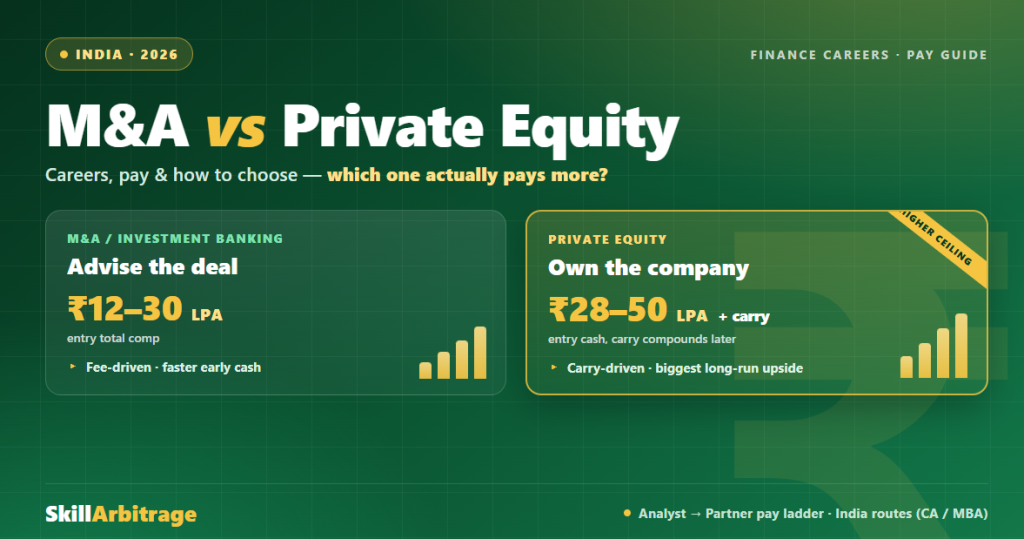
M&A (mergers and acquisitions) is advisory work: bankers advise companies buying or selling businesses and earn fees on the deal. Private equity (PE) is investing: funds buy companies, improve them, and sell for profit. In India, M&A and investment-banking analysts typically start around ₹12 to 30 LPA, while PE’s pay ceiling runs higher over a fund cycle through carried interest.
The rest of this guide splits that headline open. You’ll get two India-specific pay ladders side by side, two entry-route maps (including how to break into PE without a US MBA), a plain-English carry explainer, the hours-and-geography reality, exit options, and a decision framework tuned to your degree and your willingness to relocate. Let’s map the fork.
M&A vs private equity: the core difference (advise vs own)
Ask ten finance students what separates M&A from private equity and most will describe two versions of “high-paying finance job with long hours.” That’s not wrong. It’s just not the distinction that decides your career. The real line is who takes the risk.
In M&A you advise someone else’s transaction and get paid whether or not it works out for them. But in private equity you put a fund’s capital at risk and get paid on how well the bet performs.
Why does this matter so much for the reader? Because the advise-versus-own axis quietly determines everything downstream: the skills you build, the hours you keep, how you’re paid, and which exits open later. Get this one distinction and the rest of the comparison stops being confusing. If you want to see how the underlying transactions are actually structured, the difference between a merger, an amalgamation and a slump sale is worth a look, because the vocabulary shows up on day one of either job.
M&A / investment banking: advising the deal for a fee
M&A, short for mergers and acquisitions, is the business of helping companies buy, sell, or combine with other companies. Investment banks run this as an advisory service. A company that wants to sell a division hires a bank to find buyers, market the asset, negotiate, and shepherd the transaction to close. That’s sell-side advisory; when the bank advises the party doing the buying, it’s buy-side advisory.

The bank’s income is a fee, usually a percentage of deal value, earned when the deal closes. So an M&A banker’s core job is execution: build the models, write the pitch materials, run the diligence process, keep the transaction moving. The practical reality is that you’re paid to be the trusted operator who gets a complicated, high-stakes transaction over the line, on time, without a mistake that blows up the deal.
For an India reader, the important part is that this advisory work happens across a wide range of employers, from global banks with India desks to home-grown investment banks. And the funnel into it is comparatively open, which we’ll map in detail later. The temperament it rewards? Someone who thrives on pace, precision, and being the person the client trusts under pressure.
Private equity: owning the company, improving it, exiting for a return
Private equity is investing, not advising. A PE fund raises capital from institutions and wealthy individuals, buys companies (often using a mix of the fund’s money and debt), works to make those companies more valuable, then sells them a few years later for a profit. The fund keeps a share of that profit. That’s the whole model in one sentence.
What is private equity in the simplest terms? It’s professional company-ownership as an investment strategy. The PE professional’s job isn’t to close someone else’s deal and move on; it’s to decide which companies to buy, at what price, and then to own the outcome for the next three to six years. If the company improves and sells well, the fund and its team win big, and if it doesn’t, that shows up in their pay in a way it never would for a banker.
Here’s what that actually looks like for the reader’s career: judgment over speed. You’re not rewarded primarily for how fast you can execute. You’re rewarded for whether your investment calls turn out to be right. Different instinct, same starting skillset.
Buy-side vs sell-side: what the distinction means for your day and your career
You’ll hear “buy-side” and “sell-side” constantly, and they trip people up. Sell-side broadly means the advisory and dealmaking businesses that sell services and securities, so investment banks doing M&A advisory sit here. Buy-side means the investors who deploy capital: private equity funds, hedge funds, asset managers. M&A/IB is a sell-side career; PE is a buy-side career.
What does the distinction mean for your career, practically? Sell-side work is deal-volume-driven and relationship-driven, so your reputation is built on execution across many transactions. Buy-side work is returns-driven, so your reputation is built on the performance of a smaller number of investments you actually own. One is a wider door with faster feedback; the other is a narrower door with slower, higher-stakes feedback.
And does M&A always feed into PE? Often, but not always, and in India less automatically than the US pipeline suggests. Plenty of people build long, senior careers in M&A without ever moving buy-side, which we’ll return to in the exits section. The pitfall to avoid now is assuming M&A is merely a waiting room for PE: it isn’t.
What an M&A analyst and a PE associate actually do day-to-day
Definitions are tidy. The actual work is messier and far more revealing. If you want to know which track fits you, look at what you’d literally be doing at 9pm on a Tuesday, not at the org chart. So what does a normal week look like on each side?
The honest starting point: at the junior level, the two jobs share more than they differ, because both run on modelling and analysis. The divergence is in what the work is for. An M&A analyst’s output serves a transaction someone else owns, while a PE associate’s output serves an investment their own fund owns. That’s the thread to hold as we go section by section.
A day in M&A: pitch books, models, diligence support, deal execution
An M&A analyst’s day is built around live deals and the pursuit of new ones. A big chunk of early-career time goes into pitch books: the presentation materials a bank uses to win a mandate or advise a client on options. Then there’s the modelling: valuation models, merger models, the numbers that underpin what a company is worth and what a deal should look like. To see how those pieces fit into a real transaction from mandate to close, how an M&A deal actually moves from mandate to close lays out the sequence.
When a deal goes live, the work shifts to execution: supporting due diligence, coordinating with lawyers and accountants, preparing materials for buyers or sellers, and turning the model every time an assumption changes. The defining feature is the live timeline, and those deadlines don’t care about your evening plans. What does an M&A analyst actually do day-to-day? Build, revise, coordinate, and keep the transaction moving without dropping a detail.
For the India reader, much of this execution work now happens from Mumbai, Gurgaon, and increasingly from global-capability centres serving international deals. The task list is real and demanding, and the feedback loop is fast: you know within days whether your work held up under scrutiny.
A day in PE: deal sourcing, LBO modelling, portfolio monitoring, IC work
A PE associate’s day splits across a different set of activities. First, sourcing: finding and evaluating companies the fund might buy, screening opportunities, and building the investment case for the ones worth pursuing. Second, modelling, but with a buy-side accent: the leveraged buyout (LBO) model, which tests whether a target can be bought with debt, improved, and sold for a strong return.
Third, and this is the part outsiders miss, portfolio-company monitoring. Once the fund owns a business, someone tracks its performance, sits in on board discussions, and helps drive the improvements that create the eventual return. Fourth, investment-committee work: preparing the memos and analysis that the fund’s decision-makers use to approve or kill a deal.
What does a PE associate actually do day-to-day? Hunt for deals, pressure-test them, and help steward the companies the fund already owns.
The subtle difference in feel: a banker is measured on transactions completed, while a PE associate is measured on investments that eventually perform. And that slower, ownership-driven rhythm is either the appeal or the frustration, depending on your temperament.
Shared toolkit, different judgment
What skills do M&A and PE have in common? Almost all the technical ones: financial modelling, valuation, reading financial statements, building and defending assumptions. Is financial modelling used in both? Yes, heavily, on both sides, which is why the same early-career skillset opens either door and why a strong modelling and valuation foundation is the shared entry ticket rather than two separate tickets.
What differs is the judgment those skills serve. M&A rewards execution judgment: speed, accuracy, process management, client handling under a deadline. PE rewards investment judgment: is this a good business to own, at this price, with this plan? The mistake we see most often is students obsessing over which track has “harder” technicals; they’re broadly the same, and the instinct is what varies.
This shared foundation has a practical implication for anyone in India planning a route in. Building a genuinely deal-ready modelling and valuation skillset (the kind a structured corporate finance and investment banking programme drills) is the highest-leverage early move, because it qualifies you for both funnels at once instead of forcing an early bet. Fair warning: the toolkit gets you in the door; the judgment is what you develop on the job.
M&A vs PE pay in India: the two-track salary ladder
This is the section most readers scroll straight to, so let’s be honest and specific. Below is a two-track total-compensation ladder for India, level by level, with M&A/IB on one side and private equity on the other. Every band is directional and source-attributed, presented as a range rather than a single number, because that’s how comp actually behaves. And a load-bearing caveat up front: PE pay in India is thinly sourced relative to IB, so treat the PE column as a wider, softer range.
Which grows faster, and which pays more in India? The short answer is that early cash can favour M&A/IB (especially at bulge-bracket India desks), while PE’s ceiling pulls ahead over a full fund cycle because of carried interest, which we explain right after this. Here’s the two-track picture no competitor page currently puts side by side.
| Level | M&A / investment banking (INR LPA, total) | Private equity (INR LPA, total) | What changes at this rung |
|---|---|---|---|
| Entry (analyst) | ~₹12-30 LPA (bulge-bracket India desk higher than domestic/boutique) | ~₹28-50 LPA at top funds; wider spread, thinner data | M&A hires more openly across CA/MBA/CFA routes; PE analyst seats are fewer and pedigree/referral-gated |
| Associate | ~₹30-60 LPA | Higher band than IB associate at top funds; carry may begin to feature | PE work shifts toward investment judgment and portfolio oversight |
| VP / Principal | ~₹60-150 LPA | Cash comparable-to-higher; carry becomes a meaningful share of pay | Carried interest starts to separate the two ceilings |
| MD / Partner | ~₹300-600+ LPA (fee-driven) | Base + large carry on fund exits: highest ceiling over a cycle | PE partner upside is carry-driven and cyclical; IB MD is fee/bonus-driven |
Bands are directional and attributed to quintedge’s 2026 India IB salary data, finxl’s M&A career figures, publicly discussed fund-analyst ranges from Quora threads on Bain, TPG, KKR and Blackstone India, and Bain & Company’s India Private Equity Report for fund-scale context. Read the ranges as ranges. Individual offers vary widely by firm, city, and background.
The M&A / IB pay ladder in India: analyst to MD
The M&A/IB ladder in India runs analyst, associate, vice president, managing director, and the bands widen sharply as you climb. Entry analysts sit around ₹12 to 30 LPA total, with a real premium for a bulge-bracket India desk over a domestic boutique. How much more do global offices pay? Often a meaningful premium at the junior level, which is why the same title pays very differently across two firms.
How does bonus work here? A large slice of IB comp is variable: the base is one thing, but the year-end bonus (tied to the desk’s deal fees and your contribution) can rival or exceed it at senior levels. By the MD rung, pay is fee-driven and can reach ₹300 to 600+ LPA, because an MD’s job is to originate the deals that generate the bank’s fees. As for the typical ladder: analyst builds, associate manages the process, VP runs execution, and MD wins the mandate.
Worth flagging: bankers aren’t the only ones paid on these deals. The legal side runs its own well-compensated track, and if you’re curious how it compares, what M&A lawyers earn in India is a useful reference point for the reader weighing the deal ecosystem as a whole. Back to the two finance tracks, though, because that’s the comparison this ladder is built for.
The PE pay ladder in India: analyst to partner (and why it reads differently)
The PE ladder runs analyst/associate, VP or principal, and partner, and it reads differently from the IB ladder for one structural reason: carry. At entry, top-fund PE cash can sit around ₹28 to 50 LPA, sometimes above the comparable IB band, but with a wider spread and thinner public data. What’s the typical ladder in PE? Associate evaluates and monitors, principal leads deals, partner raises capital and owns the fund’s returns.
Here’s where it gets interesting. The cash bands alone understate PE senior pay, because from the VP/principal level up, carried interest (a share of the fund’s investment profits) becomes a growing part of total compensation. So a PE principal’s cash might look comparable to an IB VP’s, but the carry sitting on top is what eventually pulls the ceiling away. We’ll unpack exactly how that works in the next section.
There’s a forward-looking wrinkle India-specific readers should hear. As India-focused domestic funds scale (ChrysCapital closing India’s largest-ever independent PE fund at roughly $2.2 billion in its Fund X, and Kedaara having set the prior India fundraise record and now managing a multi-billion-dollar book, per publicly reported figures), the carry pools attached to India-based seats grow with them. The practical implication? The PE pay-ceiling advantage becomes more real for professionals who stay in India over the coming cycle, rather than being something you had to leave the country to capture.
A side-by-side INR total-compensation ladder for the two tracks, level by level, so an India reader can see how M&A/IB and private equity pay diverge as the career progresses. Bands are total cash comp (base + bonus), directional and source-attributed; carry (PE) sits on top of the senior PE bands and is what pulls the PE ceiling away over a fund cycle.
| Level | M&A / investment banking (INR LPA, total) | Private equity (INR LPA, total) | What changes at this rung |
|---|---|---|---|
| Rung 1Entry (analyst) | ~₹12–30 LPA (bulge-bracket India desk higher than domestic/boutique) | ~₹28–50 LPA at top funds; wider spread, thinner data | M&A hires more openly across CA/MBA/CFA routes; PE analyst seats are fewer and pedigree/referral-gated |
| Rung 2Associate | ~₹30–60 LPA | Higher band than IB associate at top funds; carry may begin to feature | PE work shifts toward investment judgment and portfolio oversight |
| Rung 3VP / Principal | ~₹60–150 LPA | Cash comparable-to-higher; carry becomes a meaningful share of pay | Carried interest starts to separate the two ceilings |
| Rung 4MD / Partner | ~₹300–600+ LPA (fee-driven) | Base + large carry on fund exits — highest ceiling over a cycle | PE partner upside is carry-driven and cyclical; IB MD is fee/bonus-driven |
Bands are directional and source-attributed (quintedge 2026 / finxl / Quora fund threads / Bain India PE Report). PE India pay is thinly sourced — treat as ranges. Carry sits on top of senior PE comp and is the structural reason PE’s ceiling pulls away over a fund cycle.
Carried interest: why PE’s pay ceiling beats IB over a cycle
If one concept explains why the two pay ladders diverge, it’s carried interest. Most students have heard the word “carry” without ever getting a clean definition, and the vague pages don’t help. So let’s fix that, because it’s the single most important pay concept in this whole comparison, and it’s the reason PE has a higher ceiling than IB.
What carried interest (“carry”) is, in plain terms
Carried interest is the share of a fund’s investment profits that the fund’s professionals keep. The market-standard figure is around 20% of the profits the fund generates for its investors, realised when investments are sold. So if a fund buys companies and later sells them for a large gain, roughly a fifth of that gain (above a hurdle) flows to the team as carry, on top of their salary. For a clear, non-promotional explainer of how carry and fund economics work, the CFA Institute is the authority to read.
The key feature is that carry is tied to outcomes, not activity. A banker earns a fee whether or not the client’s deal ages well, while a PE professional earns carry only if the fund’s investments actually perform, and only when they exit. That’s why carry rewards ownership and judgment rather than execution volume, and why it pays out lumpily, over years, rather than as a predictable annual bonus.
Why carry lifts PE’s ceiling above IB over a fund cycle
At the analyst level, cash comp between the two tracks is close, and sometimes IB even edges ahead. So where does PE’s higher ceiling come from? It’s carry compounding over a fund cycle. A senior PE professional with a meaningful carry allocation, in a fund that performs, can earn multiples of their base pay when investments exit, in a way an IB managing director’s fee-and-bonus structure rarely matches at the very top.
Which has better long-term earning potential, IB or PE? Over a full cycle, and assuming the fund performs, PE holds the higher ceiling precisely because of carry. But notice the conditions in that sentence: carry only pays if the fund does well, and it pays slowly, so the higher ceiling comes with more variance and a longer wait. The practical reality is that PE offers a higher possible top, not a guaranteed one.
Now the honest India caveat, because this is where US-framed pages mislead. Carry pools in Indian funds are younger and smaller than in mature US funds today, simply because India’s PE industry is newer and many domestic funds are still on their earlier fund vintages. That gap is closing, though.
As domestic funds scale and season, the carry attached to India-based roles grows, which widens the real PE earnings upside for professionals who build the career here rather than abroad. The ceiling advantage is becoming more India-accessible over the next cycle, not less.
Hours, lifestyle and geography: the M&A vs PE reality in India
Pay is only half the trade. The other half is what the job costs you in hours, stress, and where you have to live. Which has better work-life balance, M&A or PE? On average, PE is lighter than M&A/IB, but “lighter” is doing a lot of work in that sentence, and the India specifics matter.
M&A / IB hours: the deal-timeline grind
M&A and investment banking is generally the harder lifestyle of the two, and it’s not close at the junior level. How many hours does an M&A analyst work? During live deals, very long ones: late nights and weekend work are routine when a transaction is racing toward a signing or a deadline. The driver is the live timeline, and when a deal is on, the client’s clock (not yours) sets the pace.
It’s not relentless every single week, deal flow ebbs and rises, but the peaks are steep and unpredictable. Is the grind sustainable long-term? For many, the junior years are a deliberately intense apprenticeship they trade for the pay and the exits, not a forever state. The pitfall is going in expecting the senior lifestyle from day one, because the analyst and associate years are the tax you pay upfront.
PE hours: lighter than IB on average, but the pressure is real
How many hours do private equity associates work in India? On average, somewhat fewer than IB analysts, because PE isn’t driven by the same constant deal-execution churn. But (and this is the part that surprises people) the pressure is different, not absent. When a fund is racing to close an acquisition or a portfolio company is underperforming, the hours spike hard.
The deeper difference is the type of pressure. IB pressure is timeline pressure: get it done by the deadline. PE pressure is judgment-and-outcome pressure: you own the investment, so a bad call follows you. Based on what we’ve seen, people who prefer PE’s rhythm usually value ownership over predictability, accepting slower, weightier feedback in exchange for fewer all-nighters.
Which is more prestigious in India? Both carry serious prestige; PE’s smaller seat count gives it a certain scarcity cachet, but M&A at a top desk is no one’s idea of a soft landing.
Geography and culture: Mumbai, Gurgaon, and the referral reality
Do you have to move to Mumbai or Gurgaon for these careers? Largely, yes. India’s high-finance jobs are heavily concentrated in Mumbai (the financial capital) and the Gurgaon/Delhi-NCR belt, with pockets in Bengaluru. If relocation isn’t possible for you, that’s a real constraint to factor in early, not a detail to discover after you’ve committed.
The culture has its own texture. Parts of the market still run a six-day-week reality, and hiring, especially in PE, is notably referral-heavy: who vouches for you can matter as much as your résumé. That’s not a personality flaw of the industry, it’s how a small, trust-driven, high-stakes hiring market behaves everywhere. The practical takeaway for the reader is that networking isn’t optional flavour here; it’s part of the actual entry mechanism, which shapes both of the route maps coming up next.
How to break into M&A from India (the entry-route map)
Now the transactional part: how do you actually get in? M&A/IB has the wider funnel of the two tracks, with several genuine routes rather than one narrow door. Which route fits you depends mostly on the credential you already hold. If you want the deep, step-by-step roadmap for the analyst role specifically, the full M&A analyst path from India is the companion how-to to this comparison; here we map the routes at the level you need to choose between tracks.
The routes into M&A
How to get into investment banking in India? These are the main on-ramps, roughly in order of how commonly they work:
- Target-school MBA (an IIM or ISB) recruiting directly into investment-banking roles through campus placements.
- Chartered accountancy, often paired with the CFA, feeding into a domestic investment bank or a Big-4 deal-advisory practice.
- A bulge-bracket India desk or a global-capability-centre seat executing M&A for international deals from India.
- A boutique or mid-market investment bank analyst role, which can be more accessible early and builds real deal reps.
- CFA plus a serious financial-modelling skill-build, used to lateral in from an adjacent finance role.
- An internship converted into a full-time analyst offer, still one of the cleanest entry paths.
- A referral or networked introduction into a domestic investment bank, which matters more here than most guides admit.
How do you break in from a tier-2 or tier-3 college? Usually through the CA route, a boutique start, or a modelling-plus-networking push, rather than through campus recruiting you don’t have access to. The route is harder, not closed. But the single biggest lever is demonstrable skill (a portfolio of models and a command of valuation) that lets you compete on output rather than pedigree.
The firms that hire M&A talent in India
Which firms hire M&A analysts in India? Two broad camps. The bulge-bracket global banks run India desks and execution teams: Goldman Sachs, JPMorgan, Morgan Stanley, Citi, and Bank of America among them. These desks pay the premium bands and recruit selectively.
The domestic investment banks are the other major employer, and for many India-based candidates they’re the more realistic first door: Kotak Investment Banking, Axis Capital, ICICI Securities, JM Financial, and Avendus. They run serious deal flow, and a strong track record here travels well. There’s a forward tailwind, too: as global banks expand their India-based execution and global-capability-centre footprint, more bulge-bracket M&A seats are being based in India to serve international deals, which is quietly opening a growing entry point into the M&A track without needing to relocate abroad. Investment banking has stayed one of the most rewarding finance career paths for exactly this reason, and why investment banking remains one of the most rewarding finance career paths is worth reading alongside this.
Which degree opens which door: CA vs MBA vs CFA for the M&A track
What degree do you need for M&A in India? There’s no single answer, which is the point. An MBA from a top school is the classic campus-recruiting route into IB. The CA is a powerful India-specific credential (especially into domestic banks and Big-4 deal advisory) that’s often underrated in US-framed guides, while the CFA is a strong differentiator and skill-signal, though rarely a standalone ticket on its own.
The better approach, in our view, is to treat the credential as the door and the skill as the key. A CA who can build a genuinely institutional-grade model competes for seats a CA without that skill can’t touch. Which is why, whatever the degree, the modelling-and-valuation skill-build (the deal-ready toolkit) is the consistent multiplier across every one of these routes.
How to break into private equity in India, including without a US MBA
PE is the harder door, and pretending otherwise does the reader no favours. The seat count is smaller, hiring is more pedigree-and-referral-driven, and the “just do M&A first” pipeline works less reliably in India than in the US. But “harder” isn’t “impossible,” and there’s a real playbook for getting into private equity in India without a US MBA. Let’s map it honestly.
The routes into PE
How to get into private equity in India? These are the genuine routes, with candid odds:
- The pipeline route: a couple of years as an M&A/IB analyst, then a lateral move to a fund. This works, but less automatically in India than in the US.
- Academic pedigree (an IIM A/B/C, ISB, or IIT background) plus referrals, which is how a large share of blue-chip PE seats actually get filled.
- The CA into Big-4 Transaction Advisory into PE route: real, respected, but genuinely an exception rather than a default, so plan for it as a stretch path.
- Management consulting into PE, leaning on the strategy-and-operations skillset funds increasingly value.
- Sector-specialist or operating-partner entry, where deep industry expertise substitutes for the classic finance pedigree, growing with buy-and-build demand.
- CFA plus real deal experience, used as a differentiator that signals both technical depth and commitment.
- Growth equity or venture capital as an adjacent on-ramp, often a more open door that can lead toward buyout PE later.
How do you get into PE without an MBA, or as a CA? Routes 3, 5, 6, and 7 are your realistic lanes: a CA with strong transaction-advisory experience, a sector specialist, or someone building deal reps in growth equity can absolutely reach PE without a US MBA. Do PE firms hire freshers? Rarely straight out of undergrad; most seats want some prior deal or operating experience first.
The firms that hire PE talent in India
Which PE firms hire in India? Again, two camps. The global megafunds run large, active India platforms: Blackstone, KKR, Warburg Pincus, Carlyle, and Bain Capital all deploy serious capital here. These are the most competitive seats in Indian finance, full stop.
The India-focused domestic funds are the other camp, and they’re scaling fast: ChrysCapital, Kedaara Capital, Premji Invest, and Everstone among them. Their growth matters for the reader, because more India-based fund headcount means more India-based PE seats that don’t require leaving the country.
Why India PE recruiting differs from the US (and how competitive it is)
How competitive is PE recruiting in India versus the US? Very, and it’s competitive in a different shape. The US runs a structured, cyclical “on-cycle” recruiting process that pulls analysts from banks on a near-conveyor-belt timeline. India’s process is less structured and more relationship-driven: funds recruit through pedigree filters and referrals as much as through a formal pipeline, and the seat count is smaller relative to the talent pool.
Is PE more selective than M&A in India? Yes, meaningfully. The practical implication is that access matters more here: who knows you, and whether your background clears the pedigree filter, weighs heavily. That’s uncomfortable to say plainly, but the reader deserves the real map rather than the aspirational one.
Here’s the more hopeful second-order shift, though. As buy-and-build and control deals grow (and 2025 saw PE tilt hard toward mid-market, sub-$100 million, operationally intensive deals), funds increasingly need operating-partner and value-creation skills, not just financial engineering. That raises demand for sector specialists, CAs, and operators, which widens the CA-and-CFA-plus-deal-experience route into PE. The “you must leave India or do a US MBA” pressure genuinely eases as domestic-fund headcount grows and operating skill gets valued over pure pedigree.
Whichever track you’re targeting, the deal-ready modelling and valuation skillset (the shared ticket a focused corporate-finance-and-investment-banking skill-build gives you) is what makes you a credible candidate for either funnel.
Exit opportunities from M&A and PE in India
No one spends a whole career as an analyst, so where does each track lead next? Exit options are a genuine part of the decision, and they differ between the two paths. What’s more, the India exit map isn’t identical to the US one, which is where generic pages fall short. Let’s localise it.
Exits after M&A / IB in India
What are the exit options after M&A in India? Broader than most people expect. The classic move is into private equity, but it’s far from the only one. Corporate development (the in-house M&A team at a large company) is a common and lifestyle-friendlier exit, while growth equity and venture capital are increasingly popular, as is an MBA used to reposition into a new track.
There’s also the industry route: moving into a strategy or finance leadership role at a corporate, often at better hours and comparable pay. The reason M&A opens so many doors is the optionality it builds: the execution, modelling, and deal-process skills transfer widely. And that optionality is, in our view, one of M&A/IB’s strongest and most under-discussed selling points for the India reader.
Exits after PE in India
What are the exit options after private equity in India? Fewer in raw count but often more senior in nature. Fund-hopping (moving to another PE fund for a better seat or more carry) is common. So is moving into an operating role at a portfolio company, sometimes as a CFO or strategy lead, which suits people who found they preferred building over investing.
Corporate development, growth equity, venture capital, and an MBA are all on the table too. Not everyone on a deal is a financier, though, and it’s worth the reader knowing that the deal ecosystem has adjacent professional tracks of its own. The legal side, for instance, is a full career in its own right; for anyone weighing that adjacent path, the M&A lawyer career path in India is a solid starting point. And for the non-bulge-bracket and boutique angle on the banking side, investment banking opportunities beyond the biggest firms is worth a look.
Does M&A always lead to PE, or can you stay in M&A long-term?
Does M&A always lead to PE? No, and this is one of the most persistent myths in finance career advice. Plenty of professionals build long, senior, well-paid careers entirely in M&A/IB, rising to VP and MD without ever going buy-side. The “M&A is just a stepping stone” framing is a US-pipeline assumption, and it undersells M&A as a destination in its own right.
Can you stay in M&A long-term in India? Absolutely, and many choose to. The honest answer is that M&A is both a great launchpad and a legitimate lifelong career, depending on what you want. If you love dealmaking, client work, and origination, staying in M&A isn’t settling, it’s a valid endpoint that shouldn’t be mistaken for a failed graduation to PE.
How to choose: M&A vs private equity decision framework for India
Everything so far feeds into one question: which one should you actually pick? Is private equity better than investment banking? There’s no universal answer, only the right answer for your credential, temperament, and constraints. So here’s a decision framework tuned to the India reality rather than the US-grad template, built so you can genuinely run it on yourself.
Choose M&A / IB if…
Choose the M&A/IB track if you want faster, wider access and you thrive on pace. This track fits you if you hold a CA, a non-elite MBA, a CFA, or a B.Com and want the most open set of routes in (rather than betting everything on pedigree). It fits if you’re energised by deal execution, can accept the harder junior hours, and value optionality: M&A opens the widest range of exits, PE included.
Is M&A a good call for a fresher in India? Often yes, precisely because the funnel is wider and the skills you build transfer everywhere. If you’re early, unsure, and want to keep the most doors open, M&A/IB is usually the pragmatic first move. You can always move buy-side later; the reverse is much harder.
Choose PE if…
Choose the private-equity track if you can clear the access filter and you prefer ownership to execution. This fits you if you hold the academic pedigree (IIM A/B/C, ISB, IIT) or a strong referral network, or you have a genuine shot at the CA into Big-4 Transaction Advisory on-ramp. It fits if you’d rather make investment calls and own outcomes than run deal processes for clients.
Is PE worth it over IB in India? If you can get the seat and you have the temperament for slower, higher-stakes, outcome-driven work, the long-run carry-driven ceiling is real, and it’s becoming more India-accessible as domestic funds scale. But be honest with yourself about access. Wanting PE and being able to enter PE are two different things in India, and the framework only works if you separate them.
Decision inputs tuned to India constraints
Run the choice through four India-specific inputs rather than the US-grad checklist. First, the credential you already hold or can realistically get, because it determines which doors are actually open. Second, whether you can relocate to Mumbai or Gurgaon, since geography is a hard constraint here, not a preference.
Third, your risk appetite: PE trades predictability for a higher but lumpier, later-arriving ceiling, and that suits some temperaments and not others. Fourth, your timeline: if you want faster, steadier early cash and wide optionality, M&A/IB leans your way; if you’re optimising a long-run ceiling and can wait for carry to mature, PE edges ahead.
Is private equity a good career in India in 2026? Yes, if you can access it, and the access is slowly widening; M&A is just as good, with a wider door today. And there’s a valid third answer the decision tree allows: build the shared modelling-and-valuation skillset first, then let the stronger route reveal itself once you’re a credible candidate for both.
A decision flow tuned to India constraints — the degree you already hold, whether you can relocate to Mumbai or Gurgaon, your risk appetite, and your timeline — that points a reader toward the M&A/IB track, the PE track, or a shared skill-build first.
IIM A/B/C, ISB, or IIT pedigree (or a strong referral network) → PE is genuinely accessible; also strong for M&A.
CA / CFA / other MBA / B.Com → M&A/IB has the wider set of open routes; PE via CA→Big-4 Transaction Advisory is possible but an exception → proceed to Q2.
Executing deals / fast pace → M&A / investment banking.
Investment judgment / owning the company’s improvement → private equity (build the on-ramp: IB/M&A first, or operating/sector specialism).
Both tracks are open; M&A/IB tends to have the harder hours, PE lighter-but-investor-pressured.
Weigh GCC/offshore M&A execution seats and India-based domestic-fund roles that reduce the ‘must leave India’ pressure.
Long-run ceiling over a fund cycle (carry) matters most → private equity edges ahead once carry matures.
Faster, more predictable early cash and wider optionality → M&A/IB, with PE and many other exits open later.
Not the US-grad framework — this is tuned to India constraints (degree held, Mumbai/Gurgaon relocation, risk appetite, timeline). The shared modelling/valuation toolkit opens either door, so a skill-build first is a valid third answer.
M&A vs private equity at a glance: side-by-side comparison
Before the FAQ, here’s the whole comparison compressed into one scannable frame. If you read nothing else, read this: it’s the M&A-vs-PE decision in a single grid, tuned to the India reader. Which one is this table telling you to pick? Neither, on its own: it’s telling you which questions to weigh.
The full side-by-side
| Dimension | M&A / investment banking | Private equity |
|---|---|---|
| Nature of work | Advise the deal for a fee (sell-side) | Own the company as an investment (buy-side) |
| Core judgment rewarded | Execution: speed, accuracy, process | Investment: is this worth owning, at this price? |
| Entry routes (India) | Wider: CA, MBA, CFA, boutique, GCC, referral | Narrower: pedigree + referral; CA→Big-4-TS as exception |
| Hours / lifestyle | Generally harder; live-deadline grind | Lighter on average; ownership-and-outcome pressure |
| Pay trajectory | Strong early cash; fee/bonus-driven at the top | Higher long-run ceiling via carry over a cycle |
| Exit optionality | Broadest: PE, corp-dev, growth/VC, MBA, industry | Senior but fewer: fund-hop, operating roles, corp-dev |
| India hiring reality | Buoyant, wide funnel, buoyant deal flow | Selective, mid-market-skewed, pedigree-gated |
India market context in one view
How big is each engine right now? In 2025, strategic M&A hit roughly $60.2 billion across 963 deals, up about 41% year on year per the Grant Thornton Bharat Annual Dealtracker, with a small number of billion-dollar deals accounting for a large share of value. A separate tracker, Bain & Company, put India’s 2025 strategic M&A near $113 billion (up about 42% year on year) on its own methodology; the two figures come from different trackers and aren’t the same measure, so they shouldn’t be treated as interchangeable. On the investing side, PE-VC deployment ran roughly $36 to $37 billion across more than 1,500 deals, tilting toward mid-market buy-and-build, per Bain & Company’s India Private Equity Report.
Is India’s PE market growing, and how big is it? It’s grown almost beyond recognition. A decade ago, around 2014, India’s PE-VC market was a nascent, venture-adjacent, small-fund affair, the world the older US-authored India pages described. Today it’s a multi-tens-of-billions asset class with domestic funds closing billion-dollar-plus vehicles.
Is growth equity or VC an alternative to both? Yes, and an increasingly viable one. For readers who want ownership-style investing with a more open door than buyout PE, growth equity and VC are a legitimate third lane that has expanded alongside the buyout market.
Frequently asked questions
Do I need to do investment banking before private equity in India?
No, though it helps. The “IB first, PE second” pipeline is the global default, but India’s version is weaker, so plenty of people reach PE through other doors: pedigree-plus-referral hiring, the CA into Big-4 Transaction Advisory route, consulting, or sector specialism. IB is a strong on-ramp, not a mandatory prerequisite, especially as domestic funds hire more operators.
How much more do global bulge-bracket India offices pay than domestic firms?
At the junior level, global bulge-bracket India desks typically pay a meaningful premium over domestic banks and boutiques, which is why the entry band spans a wide ₹12 to 30 LPA range. The premium narrows in relative terms as you rise, and a strong track record at a domestic bank still travels well. Treat these as ranges; individual offers vary by desk and background.
Which PE firms hire in India and how do they recruit?
Global megafunds (Blackstone, KKR, Warburg Pincus, Carlyle, Bain Capital) and India-focused funds (ChrysCapital, Kedaara, Premji Invest, Everstone) all hire here. Recruiting leans heavily on academic pedigree and referrals rather than a fully structured pipeline, and the seat count is small relative to demand. Access and network matter as much as raw credentials, which is why PE is the more selective of the two tracks.
Should a CA go into M&A or private equity?
For most CAs, M&A/IB is the more accessible first move, because domestic banks and Big-4 deal advisory hire CAs readily. PE is reachable for CAs too, most realistically via the Big-4 Transaction Advisory route, but it’s a stretch path rather than a default. A CA who pairs the qualification with genuinely strong modelling skill competes for seats that a CA without it can’t.
Should an MBA target M&A or PE in India?
It depends on the school. An MBA from an IIM A/B/C or ISB opens both tracks, including blue-chip PE, because those funds recruit on exactly that pedigree. An MBA from a strong-but-non-elite school leans more naturally toward M&A/IB, where campus and lateral routes are wider. Match the target to the door your specific degree actually opens.
How do I get into private equity in India without an MBA?
The realistic routes are the CA into Big-4 Transaction Advisory path, sector-specialist or operating-partner entry (growing with buy-and-build demand), CFA plus real deal experience, and growth equity or VC as an adjacent on-ramp. None is easy, but all are genuine. The common thread is demonstrable deal experience and a strong network, which substitute for the MBA pedigree filter.
Can I get into PE in India as a CA?
Yes, though it’s an exception rather than the norm. The cleanest CA route runs through Big-4 Transaction Advisory, where you build transaction and diligence experience, then lateral to a fund. It’s competitive and referral-sensitive, so treat it as a stretch goal you actively build toward rather than a default outcome. Strong modelling skill and a sector focus meaningfully improve the odds.
Do I need an IIM/ISB degree for private equity in India?
It’s not strictly required, but it’s the single most common filter at blue-chip funds, which hire heavily on IIM A/B/C, ISB, and IIT pedigree. Without it, you’re competing through the narrower CA, operating-partner, or growth-equity lanes, which are real but harder. The pedigree gate is loosening slowly as funds value operating skill, though it still shapes most senior-fund hiring today.
Is a CFA enough to get into PE or M&A in India?
Rarely on its own, but it’s a strong differentiator. The CFA signals technical depth and commitment, and it pairs well with a CA, an MBA, or hands-on deal experience. Think of it as a multiplier rather than a standalone ticket: a CFA plus real modelling ability and some transaction exposure is far more powerful than the charter alone for either track.
What certifications help most for M&A vs PE in India (CFA, CA, MBA)?
For M&A/IB, the CA is a powerful India-specific credential and a top-school MBA is the classic campus route, with the CFA as a strong add-on. For PE, elite-MBA pedigree carries the most weight at blue-chip funds, while the CA-plus-CFA-plus-deal-experience stack is the main non-MBA lane. Across both, demonstrable modelling and valuation skill is the consistent multiplier.
How many hours do private equity associates work in India?
On average, somewhat fewer than IB analysts, because PE isn’t driven by the same constant deal-execution churn. But the hours spike hard when a fund is racing to close an acquisition or a portfolio company is struggling. The pressure is different in kind: less pure timeline pressure, more ownership-and-outcome pressure, since you’re accountable for the investment itself.
How many hours does an M&A analyst work?
During live deals, very long hours are routine, including late nights and weekend work as a transaction races toward a deadline. It isn’t relentless every week, deal flow rises and falls, but the peaks are steep and hard to predict. The junior years are generally the hardest lifestyle in finance, which most analysts treat as a deliberate apprenticeship traded for pay and exits.
What is the realistic starting salary for M&A in India?
Entry-level M&A/IB total compensation typically runs around ₹12 to 30 LPA, with bulge-bracket India desks at the higher end and domestic or boutique banks lower. A meaningful chunk of that is variable bonus tied to deal fees and performance. Treat the band as directional; the actual offer depends heavily on the firm, city, and your background, per quintedge’s 2026 India data and finxl.
What is the realistic starting salary for PE in India?
Entry PE cash at top funds can sit around ₹28 to 50 LPA, sometimes above the comparable IB band, but with a wider spread and thinner public data than IB. Carry generally doesn’t feature at the entry level; it becomes meaningful higher up. Read these as ranges drawn from publicly discussed fund figures (Bain, TPG, KKR, Blackstone India threads), not fixed numbers.
Can I switch from M&A/IB to private equity in India, and when?
Yes, and the classic window is after roughly two years as an analyst, once you have solid deal reps. In India the move is less automatic than the US on-cycle pipeline, so a network and referrals matter a lot. It gets harder the longer you wait, as funds prefer to hire and train junior, so if PE is the goal, move buy-side relatively early.
Which pays more in India, investment banking or private equity?
Early cash can favour IB, especially at bulge-bracket India desks, while PE’s ceiling pulls ahead over a full fund cycle through carried interest. So the real answer is “it depends on the horizon”: IB for steadier, faster early cash; PE for the higher long-run top, if the fund performs and you have the carry allocation. PE’s ceiling is also becoming more India-accessible as domestic funds scale.
Should I choose M&A or PE as a fresher in India?
For most freshers, M&A/IB is the pragmatic first move, because the entry funnel is wider (CA, MBA, CFA, boutique, referral) and the skills transfer everywhere, PE included. PE rarely hires straight out of undergrad, so even PE-focused freshers usually build deal experience first. Keep your options open early; you can move buy-side later far more easily than the reverse.
Is it too late to switch from audit/Big 4 to PE or M&A?
Usually not, especially from Big-4 Transaction Advisory, which is a recognised on-ramp into both M&A and PE. The switch gets harder the more senior and specialised you become in pure audit, so the earlier you pivot toward deal-advisory or transaction work, the smoother it is. Building strong modelling skill and targeting a transaction-adjacent role first makes the move far more credible.
Is private equity in India as lucrative as US private equity?
Not yet at the very top, mainly because carry pools in Indian funds are younger and smaller than in mature US funds, so the biggest carry payouts are still larger in the US. But the gap is closing as India-focused domestic funds scale and season. For a professional building the career in India, the long-run PE upside is becoming meaningfully more accessible over the coming cycle without needing to leave the country.
Disclaimer: This article is for informational and educational purposes only and does not constitute professional, financial, legal, or career advice. Salary figures and market data are directional, drawn from the cited sources, and vary by firm, city, and individual background. Readers should consult a qualified professional before acting on any career, financial, or investment decision.





 Allow notifications