
Some professionals don’t wait for life to fall apart before they make a change. They don’t need a crisis. They simply reach a point where the work they do every day, even if they’re good at it, no longer represents the future they want.
Table of Contents
Story of Saipriya

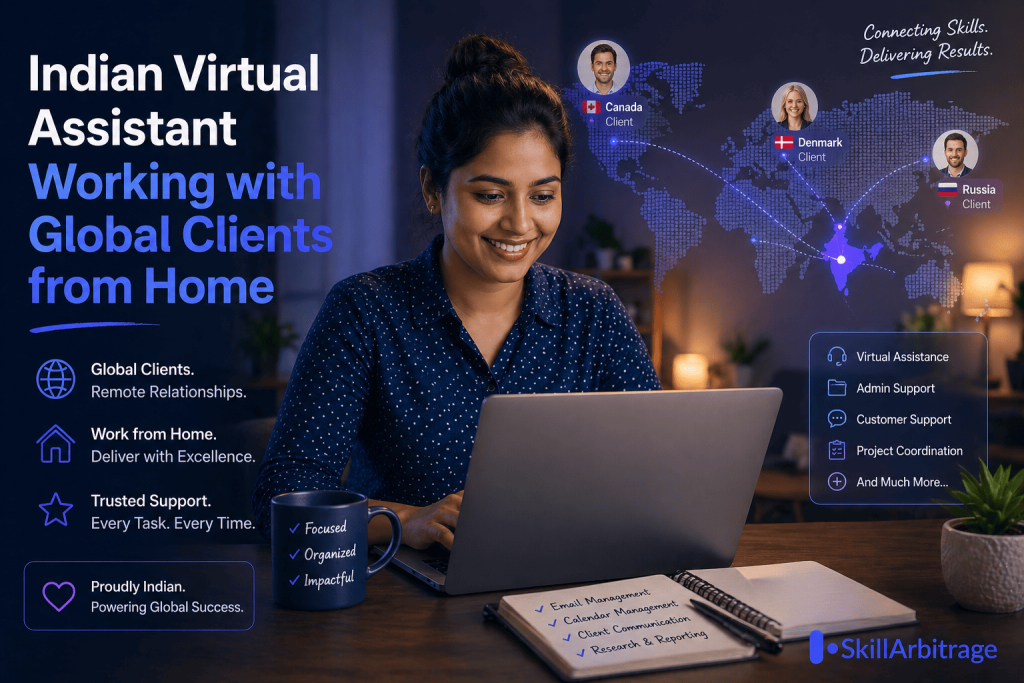
This is the story of Saipriya, an Indian operations manager who turned her hospital and admin experience into a Virtual Assistant career working with global clients. In just two weeks. From her home. In her own time zone. If you’re an operations, support, or admin professional wondering whether your skills still have a future in the AI era, this is the roadmap she followed and the exact playbook you can use too.
Why Indian Operations Pros Are Switching to Virtual Assistant Roles
For many support and operations professionals in India, life slowly becomes a cycle of doing what’s necessary, what’s expected, and what keeps the organisation running.
You become the person everyone trusts to fix issues, coordinate teams, complete tasks, and hold everything together. You do it well so well that sometimes your capability becomes invisible.
But deep inside, there’s a quiet awareness that you’re meant for more. More growth, more challenge, more opportunity than your current routine allows. That’s exactly the realisation pushing thousands of Indian ops pros toward Virtual Assistant careers with international clients.
Saipriya’s Journey From Hospital Ops to Virtual Assistant
Saipriya worked as an Operations Manager at Seva At Home in Gurugram, handling coordination, processes, and the day-to-day functioning of the organisation. She later joined AMPS Healthcare in Hyderabad, preparing reports, supporting hospital operations, and managing backend workflows.
Her career was steady, structured, and full of responsibility. She was known for being reliable and detail-oriented. But even with all of that, something inside her began to feel unsettled.
The Quiet Question That Started Everything
Every day, between office deadlines and personal responsibilities, the same question kept coming up: “Is this how my life will always be?” Wake up, commute, work, commute again, complete household duties, sleep, repeat.
She was hitting a career plateau. And the bigger worries kept circling back:
- What happens to her career once she gets married and needs to devote time to family?
- What if her partner lives in a different city and she has to move?
- What if her skills become irrelevant because most operational tasks are getting automated?
- What if AI replaces the routine work she had spent years mastering?
She knew she was outgrowing the life she had built. She wanted security and progress. A career that wouldn’t collapse the moment she took a break or changed cities.
The Discovery That Reframed Her Career
One evening, while returning from work, she started reading stories of Indian professionals working remotely for global businesses people with backgrounds just like hers. Operations. Support. Admin. Management.
They weren’t coders or designers. They were normal professionals who had learned to use AI to enhance their work, and were now supporting founders and small teams across the world. They were:
- Setting up automated onboarding flows
- Using AI to summarise tickets
- Fixing customer experience problems
- Creating knowledge bases and SOPs
- Building chatbots and voice agents
- Doing sentiment analysis
- Running operations for global founders
None of it sounded like a scam. It sounded like a preview of where the future was headed.
That’s when she came across a three-day live bootcamp on building a career in support and operations using AI.
How AI Is Reshaping Virtual Assistant Careers in 2026
During those three days, Saipriya’s understanding of her own career changed completely.
She realised that ops and customer support functions are changing fast especially after AI developments through 2025. Many entry-level and routine jobs in the space are at real risk of being replaced.

But here’s what she also discovered: AI is creating more new roles than it’s eliminating. Roles that pay 3–5x more. Roles that need human judgment, empathy, and decision-making. The skills global businesses are searching for are exactly the ones an experienced Indian Virtual Assistant can offer if they combine traditional ops experience with modern AI tools.
The AI Skills That Make a High-Earning Virtual Assistant
Saipriya learned how to combine her hospital and admin background with AI capabilities to position herself as a Virtual Assistant global founders would actively want to hire. The skills that mattered most:
- Structuring onboarding documents and SOPs for international teams
- Supporting founders with daily operations and project coordination
- Creating simple designs and presentations
- Managing calendars and inboxes across time zones
- Preparing data, research, and reports in clear, organised formats
- Using AI to summarise customer tickets and chats
- Running sentiment analysis on customer feedback
- Building basic chatbots and voice agents for client businesses
- Setting up automated workflows for repetitive ops tasks
Suddenly, her years of operations experience didn’t look “ordinary” anymore. It looked like a superpower waiting for the right roadmap.
How to Build a Virtual Assistant Portfolio That Wins Clients
Skills alone don’t get you hired. Proof does. Saipriya spent one to two hours every night, after dinner, building her Virtual Assistant profile. Here’s exactly what she did:
- Wrote her experience for an international audience. She translated “operations work at AMPS Healthcare” into outcomes a Canadian or US founder would understand.
- Highlighted her transferable strengths. Hospital ops experience became “managing complex multi-stakeholder workflows.”
- Listed the AI tools she could work with. Even tools she had just started learning.
- Built basic work samples. A sample SOP. A sample onboarding flow. A sample report.
- Wrote simple, clear proposals. No buzzwords. Just what the client wanted to hear.
She started sending a few proposals every day. The first week was silent. No replies. It would have been easy to give up but she remembered one line from the bootcamp: this is a game of consistency, not instant luck.
How to Pitch as a Virtual Assistant to Global Founders
Within two weeks of starting, the silence finally broke. Out of six clients she applied to that week, four invited her for interviews. From her home. In Indian time zone hours.
A few principles made her pitches work:
- She led with the client’s pain, not her resume
- She kept proposals short, under 200 words
- She offered a small free deliverable (a sample SOP or workflow) to prove she could actually do the work
- She positioned herself as an AI-enabled Operations Virtual Assistant, not just a generic VA
- She asked one smart question in every proposal to start a real conversation
One client a company based in Canada put her through a three-round interview. She cleared every round and was offered the role of Operations Virtual Assistant.
What Indian Virtual Assistants Earn From International Clients
Saipriya started by working only three to four hours a day and earned around ₹35,000 per month from her first Canadian client.
The amount wasn’t life-changing. But it signalled something far more important: she had restarted her career on her own terms, and stepped into a space with unlimited upside.
That small beginning changed everything:
- She started receiving inquiries from clients in Denmark, Russia, and other parts of Canada
- Her workload scaled up as she added more clients
- She began earning more than her full-time salary in significantly fewer hours
- She kept full flexibility scaling up when she wanted to, slowing down when life demanded it
Today, she works with multiple international clients from her home, on her schedule, in her time zone.
How to Start Your Virtual Assistant Career in 2 Weeks
If Saipriya’s story resonates, here’s the compressed roadmap she followed:
- Audit your existing skills. List every operational, administrative, or support task you’ve ever owned. This is your raw material.
- Layer on AI capabilities. Learn 3–5 AI tools that 10x your existing skills (chatbots, automation, summarisation, dashboards).
- Reframe your profile for global clients. Translate your Indian-context experience into outcomes international founders care about.
- Build 3 sample deliverables. A sample SOP. A sample onboarding flow. A sample report or workflow.
- Send focused proposals daily. Quality and consistency over volume. A few sharp pitches every day.
- Treat the first 2 weeks as setup. Replies usually start coming in the second week, not the first.
- Position yourself as AI-enabled, not generic. “Operations VA who builds AI workflows” beats “Virtual Assistant” every time.





 Allow notifications