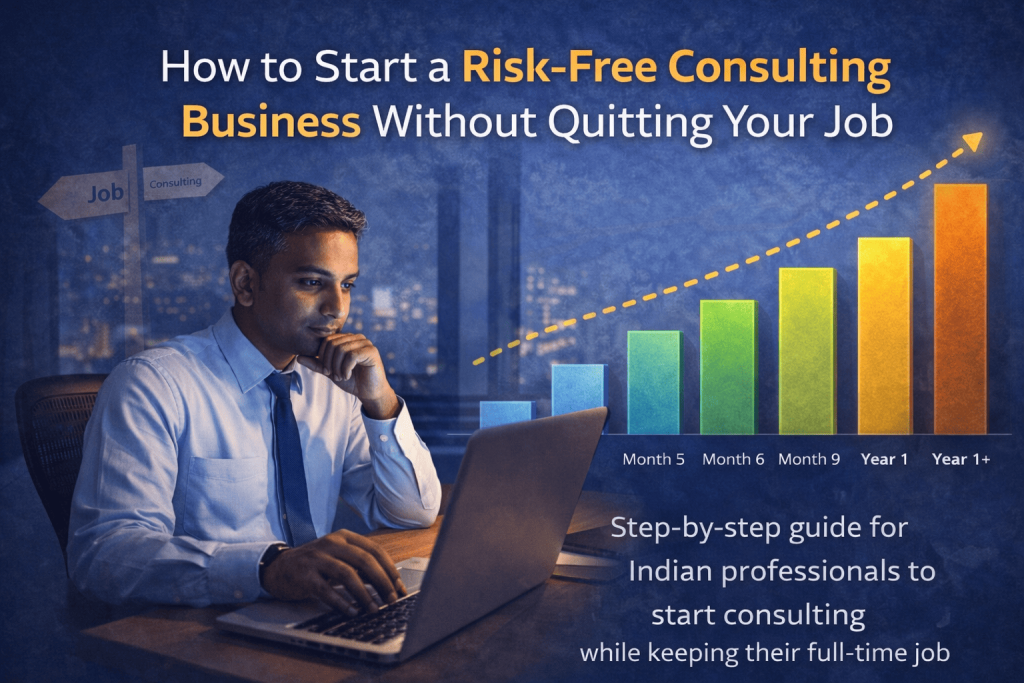

Many professionals dream about starting their own business but hesitate because of one major concern: risk.
Table of Contents
The idea of leaving a stable salary, investing capital, and facing uncertainty stops many experienced professionals from pursuing entrepreneurship. But what if there was a way to start a business without quitting your job, without investing money, and without taking financial risks?
That possibility exists through a risk-free consulting business.
Consulting allows professionals to use their existing expertise to create additional income streams while maintaining job security. Instead of investing money into products or infrastructure, consultants provide knowledge, strategy, and problem-solving to businesses that need expertise.
This guide explains how experienced professionals can build a consulting practice gradually, safely, and sustainably while keeping their full-time job.
What Is a Risk-Free Consulting Business?
A risk-free consulting business is a consulting practice started alongside a full-time job with no financial investment, no loans, and no need to quit employment.
Professionals begin by serving one client after work hours, test their consulting model, and gradually scale to multiple clients while their salary continues to cover living expenses.
This approach removes the biggest risks that usually prevent people from starting businesses.
Why Consulting Is One of the Lowest-Risk Businesses
When most people hear “start a business,” they picture loans, office space, quitting their job, and months of zero income.
Consulting is fundamentally different.
No Capital Required
A consulting business runs on your knowledge, experience, and judgment, not your wallet.
You need:
- A laptop
- Internet connection
- Communication tools
- Your professional expertise
There is no office rent, inventory, or equipment to purchase. Your biggest investment is time, roughly 2–3 hours a day after work.
No Resignation Required
You do not leave your job to start.
Your salary continues every month and covers all your expenses while you build consulting on the side. Your job remains your financial safety net.
No Loans Required
Because there is no capital outlay, there is nothing to borrow.

No EMIs.
No debt.
No pressure to land clients immediately.
You grow your consulting practice at your own pace.
Key Takeaway: The only thing you invest is time, and even that investment improves your professional skills and network.
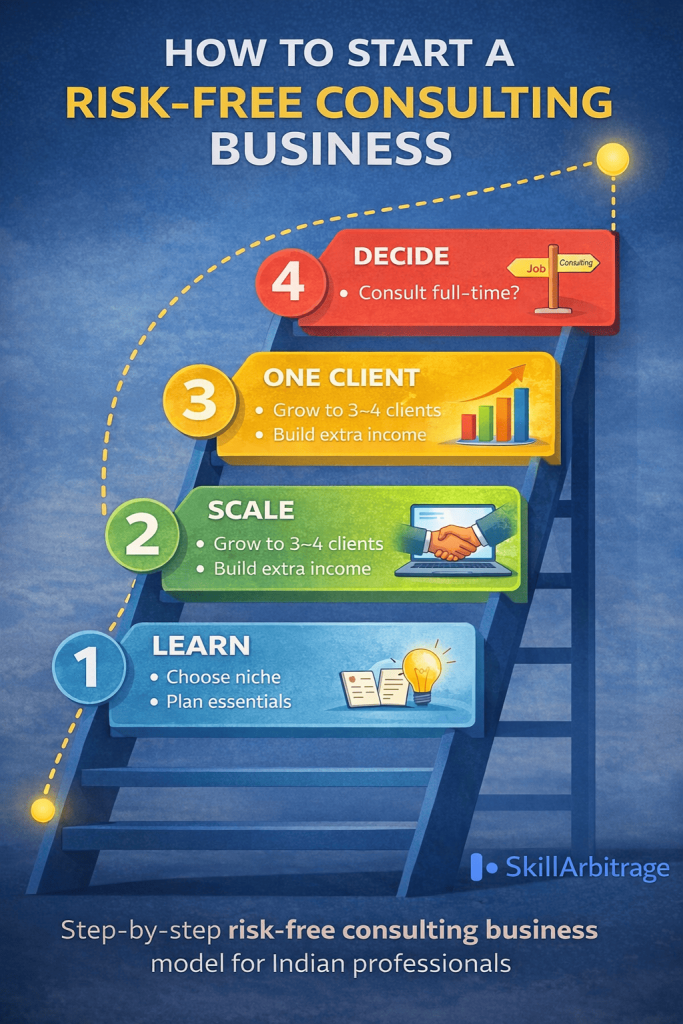
Step-by-Step Guide to Start a Risk-Free Consulting Business
The safest way to start consulting is through a gradual, structured approach.
Step 1 — Identify Your Consulting Niche
Your consulting niche should focus on specific business problems you already know how to solve.
Ask yourself:
- What problems do I regularly solve at work?
- What expertise have I developed over the last 10+ years?
- What projects have I delivered successfully?
Examples of consulting niches include:
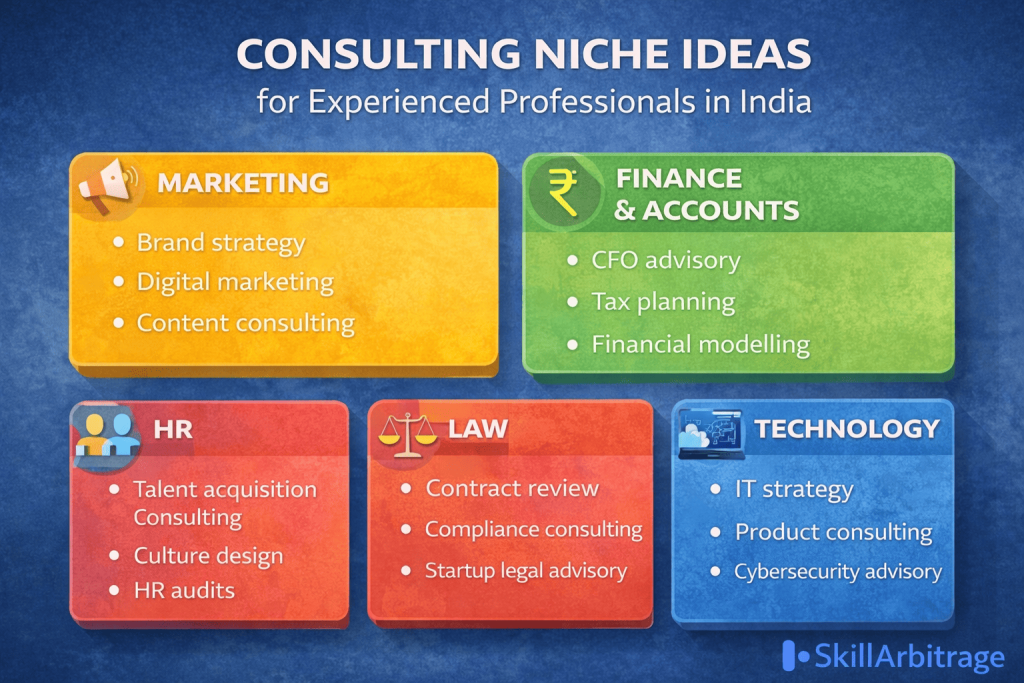
- Marketing strategy consulting
- HR policy and hiring consulting
- Cybersecurity and IT consulting
- Financial planning and tax advisory
- Sales process consulting
- Operations and supply chain optimization
If you have 10–15 years of experience, you already possess valuable expertise — you simply need to package it as consulting services.
Step 2 — Learn the Consulting Foundations
Before approaching your first client, clarify a few fundamentals:
- Your consulting niche
- Your service offerings
- How you will price your services
- How you will deliver results to clients
Consulting does not require reinventing the wheel. Templates and frameworks exist for:
- client proposals
- consulting contracts
- pricing structures
- project delivery systems
Learning these foundations reduces uncertainty when you start working with clients.
Step 3 — Start With Just One Client
The biggest mistake new consultants make is trying to find too many clients at once.
Instead, start with one client only.
Your first client becomes your learning laboratory.
Working with one client helps you discover:
- How productive you are in a 2-hour consulting window
- How well you can balance job responsibilities with consulting work
- How clients communicate and expect deliverables
- How long consulting tasks realistically take
You learn all of this while your salary continues to cover your expenses.
That is the essence of the risk-free consulting model.
Step 4 — Work After Office Hours
Most professionals start consulting by dedicating:
- 2–3 hours in the evening
- A few hours on weekends
Many consultants find they are extremely productive during focused evening sessions because there are fewer distractions.
This schedule allows you to build consulting income without risking financial stability.
Step 5 — Gradually Scale to 3–4 Clients
Once you gain confidence working with your first client, add a second.
Then eventually a third.
Each new client gives you:
- testimonials
- case studies
- improved delivery processes
- stronger confidence
By the time you are serving 3–4 consulting clients, you have created a parallel income stream alongside your salary.
How Much Can You Charge as a Consultant?
Consulting fees depend on your experience and the value you deliver.

Typical starting ranges in India include:
- ₹5,000 – ₹15,000 per consultation session
- ₹25,000 – ₹1,00,000 per consulting project
- ₹50,000 – ₹3,00,000 monthly retainers
International clients often pay 3–5 times higher rates than domestic clients.
The most important principle in consulting pricing is to price based on business impact, not hours worked.
What Do Consulting Clients Actually Receive?
Consulting is not just advice, it produces tangible business outcomes.
Typical consulting deliverables include:
- strategic analysis reports
- operational audits
- implementation roadmaps
- training workshops
- process frameworks
- weekly advisory sessions
Clients hire consultants because they want clear direction and solutions to complex business problems.
How to Get Your First Consulting Client
Most professionals underestimate the power of their existing professional network.
After a decade in your industry, you have likely worked with:
- former colleagues
- vendors
- managers
- clients
- LinkedIn connections
These people already know your expertise.
Use LinkedIn to Demonstrate Expertise
Instead of directly pitching services, start by sharing insights:
- lessons from projects you have completed
- observations about industry challenges
- frameworks you use to solve problems
- trends you are seeing in your field
This positions you as a trusted expert rather than someone selling services.
Have Direct Conversations
Reach out to people in your network who face the types of challenges you solve.
Explain that you are exploring consulting opportunities and ask if they know businesses that might benefit from your expertise.
In many cases, your first consulting client already knows you.
Common Fears About Starting a Consulting Business
Most professionals hesitate to start consulting because of a few common fears.
What if I fail?
If consulting does not work out:
- your job remains intact
- your salary continues
- you have no debt
- your career remains secure
The worst outcome is gaining valuable business experience.
What if I cannot find clients?
Your professional network is usually the first source of consulting opportunities. Demonstrating expertise through LinkedIn and industry conversations often leads to referrals.
What if I do not have time?
Starting with one client helps you understand your real capacity. Most professionals discover they can effectively manage consulting work within 2–3 focused hours per day.
5 Mistakes New Consultants Should Avoid
Many new consultants slow their growth by making avoidable mistakes.
Common pitfalls include:
- Trying to serve too many clients too early
- Underpricing their expertise
- Offering vague services instead of clear outcomes
- Not documenting case studies from early projects
- Waiting too long to activate their professional network
Avoiding these mistakes makes the consulting journey much smoother.
How AI Is Transforming Modern Consulting
Technology has significantly changed the consulting industry.

AI tools now help consultants:
- conduct research faster
- analyze large datasets
- draft reports and presentations
- organize information efficiently
- automate repetitive tasks
This allows individual consultants to operate with the productivity of a small consulting team.
By combining human expertise with AI tools, consultants can deliver faster results and serve multiple clients effectively.
What Professionals Have Built With This Model
This consulting approach is not just theoretical. Many professionals have used the same model to build successful businesses while continuing their jobs.
This is exactly how Abhyuday and Ramanuj built their 600-member companies. They started their consulting journey as a side business with zero capital and zero financial risk while keeping their jobs.

By starting small and gradually building their client base, they eventually grew their consulting operations into companies worth crores.
Their journey demonstrates a powerful principle: consulting businesses often begin with one client, a few hours after work, and the willingness to apply existing expertise in a new way.
For experienced professionals, this approach provides a practical way to test entrepreneurship without sacrificing financial stability.
The Long-Term Advantage of Starting Consulting While Employed
The global consulting industry is worth hundreds of billions of dollars, and independent consultants are one of the fastest-growing segments.
Starting consulting while working full-time offers several advantages:
- financial security
- gradual learning
- reduced pressure
- opportunity to test business ideas
Over time, consulting can evolve into a powerful parallel income stream.
Some professionals continue consulting alongside their careers indefinitely, while others eventually transition into full-time consulting once their client base becomes stable.
Conclusion
Starting a consulting business does not have to involve financial risk, large investments, or quitting your job.
For experienced professionals, consulting offers one of the safest paths to entrepreneurship. By starting with one client, working after hours, and scaling gradually, you can test the consulting model without jeopardizing your financial stability.
Your expertise already exists.
Your professional network already exists.
And the opportunity to turn that expertise into a consulting practice is closer than most professionals realize.
The only remaining step is deciding when to begin.





 Allow notifications