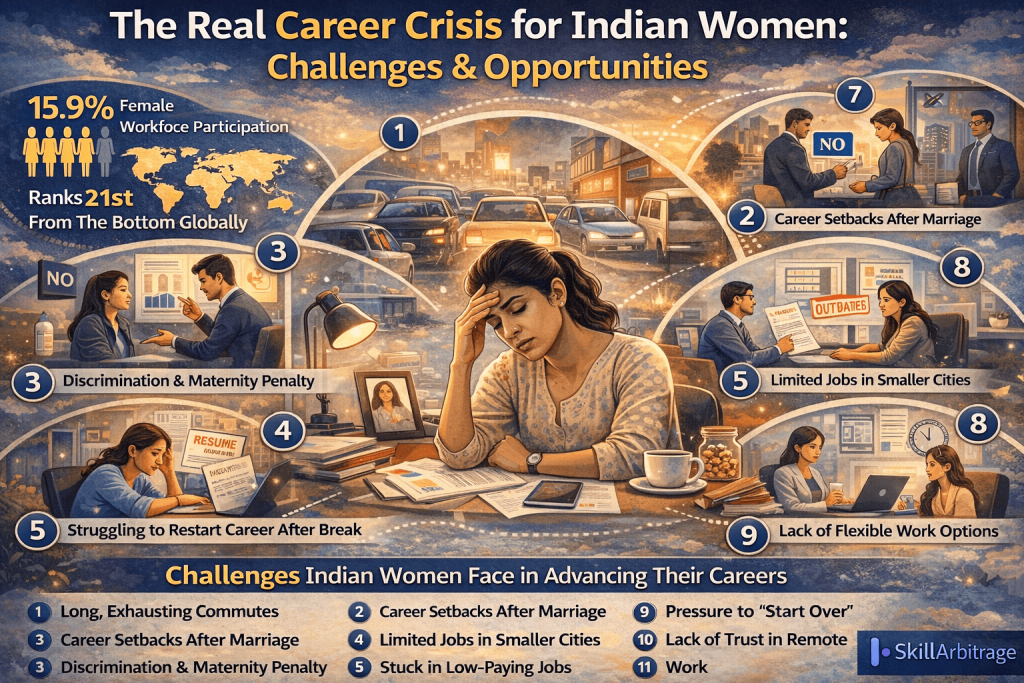

The career crisis faced by Indian women is a growing concern, marked by numerous challenges and limited opportunities for advancement. Did you know that women’s participation in the workforce is very low in India? Merely 15.9% of women are in formal wage employment.
Table of Contents
There are only 21 countries in the world that have worse female labor force participation than India, including countries like Afghanistan, Algeria, Pakistan, and Nepal. Even some of our neighboring countries have better female labor participation in their economy!
The Factors Behind Women’s Struggles in Career Advancement
Despite the rising number of women in education, the gender gap in workforce participation remains huge. Here are some reasons why women in India face significant barriers to entering and staying in the workforce:
1. Long, Exhausting Commutes
- Commuting in big cities can consume hours of a woman’s day, leaving little time for other commitments or career growth.
- These long hours spent traveling contribute to exhaustion that impacts productivity.
2. Career Setbacks After Marriage or Relocation
- After marriage or relocation due to their spouse’s job, many women experience career setbacks.
- The need to prioritize family commitments often leads to women taking a step back professionally.
3. Discrimination Due to Marital Status or Potential for Maternity
- Many women face discrimination during hiring because they are married or might have children soon.
- Employers are sometimes reluctant to hire women because of the assumption that they won’t be as committed or available.
4. The Impossible Choice Between Career Growth and Maternity
- The “maternity penalty” is another major issue. Women are often forced to choose between maternity and career growth.
- This creates a major barrier for women trying to balance career growth and family responsibilities.
5. Limited Job Opportunities in Smaller Cities
- Women living in Tier-2/3 cities often face limited job opportunities.
- Many high-paying jobs are concentrated in big cities, leading women to either relocate or compromise on their career aspirations.
6. Struggling to Restart Careers After a Break
- Women who take career breaks often struggle to restart their careers because their experience is considered outdated or irrelevant.
- Employers may also hesitate to hire women who’ve had career gaps, citing concerns about age or perceived lack of skills.
7. Feeling Like You Have to Choose Between Your Family and Your Ambitions
- Balancing family and professional ambitions is an ongoing challenge. Many women feel like they need to choose between their career and their family.
- This leads to feelings of guilt and pressure from society and family expectations.
8. Stuck in Low-Paying Jobs Despite Having Great Education and Potential
- Many women in India find themselves in low-paying jobs, even though they have great education and untapped potential.
- The lack of growth opportunities leads to frustration as their qualifications are undervalued or ignored.
9. The Lack of Flexible and Remote Work Options
- Traditional workspaces offer little to no flexibility for women to balance both family obligations and career growth.
- Despite having free time and the willingness to work, the lack of remote or flexible work options limits career opportunities for many women.
10. The Pressure to “Start Over” in the Workforce
- Returning to work after a break can feel like starting from scratch.
- Women often face challenges in rebuilding confidence, adjusting to new work cultures, and updating their skills to meet current job requirements.
11. Toxic Work Environments and Lack of Trust in Remote Work
- Many women prefer to continue working remotely, but they are forced back into the office because their employers don’t trust remote work or fear losing control.
- This toxic workplace culture forces women to sacrifice flexibility and work-life balance.
The Crisis of Career Breaks and Reentry Challenges
Career breaks often make it hard for women to return to the workforce. Here are some reasons why:
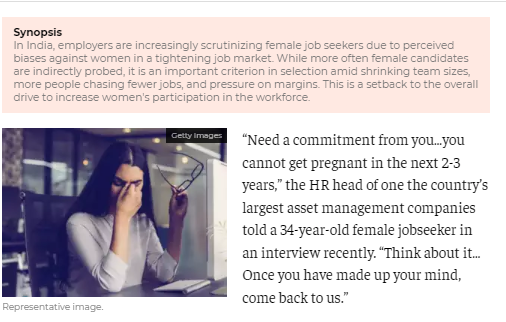
- Outdated skills: Women may not be up-to-date with current job requirements, making it difficult to re-enter their profession.
- Reluctance of employers: Employers are often unwilling to hire women who have been away from the workforce for an extended period due to their age or lack of recent experience.
- Limited local opportunities: Many women in smaller cities face a lack of well-paying local jobs, or they simply don’t have time to commute to work.

Here is a detailed research we conducted on ‘Why is it hard for women to get back to work after a career break?’
Why Remote Work is the Future for Women in India
During the COVID-19 pandemic, millions of companies were forced to adopt remote work almost overnight. What they discovered changed everything:
- Employees were more productive working from home.
- Companies saved money by eliminating the need for office space.
- Work got done just as well, and in some cases, even better.
As a result, 74% of companies now plan to permanently adopt remote work. What was once a temporary solution has now become the new normal.
For small businesses, especially, remote hiring isn’t just an option anymore; it’s how they compete. They can’t afford $5,000/month for local talent, but they can hire skilled professionals from India at $1,000-2,000/month and still get excellent work done.
Companies have realized they can access global talent, save costs, and grow faster. This is why WFH is the future of work.
Why Remote Work Matters for Women in India
- Flexible work hours allow women to balance both family and career commitments.
- Remote work eliminates the time and stress associated with long commutes.
- Women can work from home, manage household responsibilities, and still have a fulfilling career.
How Remote Work Opens Opportunities for Indian Women
Remote work offers opportunities that were previously unavailable for women in India:
- Companies across the globe are eager to hire talented professionals from India at lower salaries than they would pay in Western markets, but still receive excellent work.
- Women now have the freedom to work for international employers without needing to relocate.
Key Insights:
- Global talent demand is on the rise, especially for remote workers.
- Smaller businesses need remote talent to stay competitive but can’t afford high local salaries.

Opportunities for Women in Remote Work
With the increasing demand for remote talent, here are some ways women can tap into this field:
Key Skills for Remote Work:
- Digital marketing
- Content writing
- Data analysis
- Virtual assistance
Platforms to Find Remote Jobs:
- Upwork
- Freelancer
- FlexJobs
- Remote.co
How to Approach Remote Work:
- Build relevant skills: Focus on skills that are in high demand for remote work.
- Leverage online platforms: Use job platforms that specialize in remote work.
- Tailor your resume: Highlight your ability to work independently and manage time effectively.





 Allow notifications