

Curious about the independent director role? Here’s what it really takes, and if it fits your career stage.
Table of Contents
You will discover what happens in actual board meetings, what committees require of you, how much time you need to commit, and what you earn, based on how the role works under Indian corporate law.
The Core Responsibility of an Independent Director
As an independent director, your primary responsibility is to attend meetings of the board and any committees you are appointed to. Your role in those meetings is to ask relevant questions about the company’s governance, keeping in mind the interests of public shareholders.
Think of yourself as the experienced, independent voice in the room, someone who ensures that management decisions are sound and that the interests of all shareholders, especially the public investors, are being protected. You are not there to run the business. You are there to provide oversight, ask the right questions, and bring the perspective that only seasoned professionals can offer.
What Actually Happens in a Board Meeting?
This is where most professionals’ concerns dissolve once they see what board meetings look like in practice.
All board meetings follow a pre-shared agenda. For a listed company, a typical meeting might include:
1. Quarterly Financial Review
The management team presents how the company performed in the last quarter. The MD or CFO walks the board through financial results, revenue trends, profit margins, major expenses, in plain summaries, not complex accounting formats. You can always ask for clarification if something is not clear.
| Key takeaway: You do not need to be a chartered accountant or even have a high degree of financial expertise to contribute meaningfully to financial discussions. |
2. Strategic Business Updates
The CEO or MD presents the company’s plans, new products, market expansions, potential acquisitions. Your job here is to ask fundamental questions about risk and long-term strategy:
- Is this expansion too risky given current market conditions?
- Has the management done adequate market research?
- Can the company genuinely afford this investment?
These are the same questions you have been asking throughout your professional life. The setting just happens to be a boardroom now.
How Often Do Board Meetings Happen?
Under the Companies Act, boards must meet at least four times a year, typically once every quarter. Most companies schedule these well in advance, often a full year ahead, so you can plan your personal schedule around them.
Each meeting usually lasts between 30 minutes to an hour, though important decisions can occasionally extend the discussion. Today, most meetings can be attended virtually, so you can participate from home.
Independent Director Responsibilities in Committee Meetings
Alongside board meetings, you will typically serve on one or two committees where your specific expertise becomes particularly valuable. Each committee is required to meet at least twice a year under SEBI regulations. Here is what each committee involves:
Audit Committee
The Audit Committee reviews the company’s financial statements and internal controls. The external auditors present their findings, and directors ask questions to ensure accuracy and transparency. You do not need to be a finance expert. Common-sense questions, such as “Why did this expense jump so sharply?” or “Are we collecting receivables on time?”, are exactly the kind of oversight the committee exists to provide.
Nomination and Remuneration Committee
This committee oversees appointments of senior executives and their compensation packages. Your role is to help ensure the company attracts strong talent without overcompensating, a balance that requires the kind of business judgment you have accumulated over decades.
CSR Committee
The CSR (Corporate Social Responsibility) Committee oversees how the company fulfils its social obligations. You help decide which causes, NGOs, or community projects receive corporate funding. For professionals who have long wanted to contribute to meaningful causes, this committee offers a direct way to do exactly that.
| SEBI Requirement: All independent directors of a listed company must hold at least one exclusive meeting per year, without management present, to review the performance of the board and its leadership. |
You will also attend the Annual General Meeting (AGM), where shareholders gather. This is a formal event where you sit on the dais while the chairman addresses shareholders and takes their questions.

How Much Time Does the Work of an Independent Director Require?
When you add all meetings together, you are looking at approximately 15 to 20 meetings per year per company. That is fewer than two meetings per month, and for someone who wants meaningful professional engagement without operational responsibilities, it is a very manageable commitment.
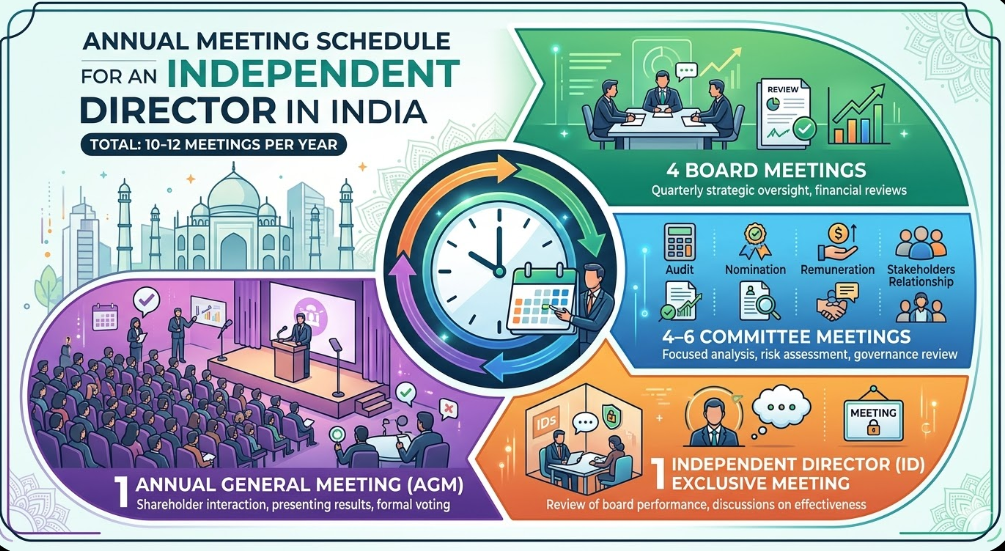
| Quick math: 4 board meetings + 4–6 committee meetings + 1 independent directors’ meeting + 1 AGM = roughly 10–12 formal meetings per year, with occasional additional sittings for larger matters. |
Are Board Papers Difficult to Read?
Board papers do come with terms like ‘related party transactions’ and ‘material subsidiaries’ that can sound unfamiliar at first. But here is what actually happens:
About a week before each meeting, the company secretary sends you board papers. These documents summarise everything you need to know. They include simple executive summaries that highlight key points. If anything is unclear, you simply call the company secretary, they explain regulations in plain language and ensure you have everything you need before walking into the meeting.
During the meeting itself, whether in person or on video conference, the atmosphere is professional and structured, not intimidating. Management presents reports, directors ask questions, discussions happen, and decisions are made by vote. Your vote carries exactly the same weight as every other director’s vote.
What Makes Senior Professionals Uniquely Valuable in This Role?
The experience you have built over decades is not just useful in a boardroom, it is precisely what companies are looking for. Younger professionals can analyse data and present projections. What they often cannot offer is the perspective of someone who has seen business cycles up close, navigated economic downturns, and understands what truly drives long-term value.
When a CEO presents an aggressive growth plan, your lived experience allows you to spot risks that models and spreadsheets might miss. When markets turn volatile, your steady perspective is exactly what the board needs. Companies do not just want compliance, they want wisdom.
What Does an Independent Director Earn?
Independent directors are paid a ‘sitting fee’ or honorarium for attending board meetings. Financially, the role offers excellent compensation for the time invested:
| Company Type | Sitting Fee per Meeting | ~20 Meetings/Year | 3 Boards Combined |
| Smaller / SME Listed | ₹30,000 – ₹50,000 | ₹6L – ₹10L | ₹18L – ₹30L |
| Mid-size Listed | ₹75,000 – ₹1,00,000 | ₹15L – ₹20L | ₹45L – ₹60L |
These are not salaries. You are not an employee, a consultant, or a service provider. You are compensated for the value of your judgment, your experience, and your time, and the amounts reflect the respect the position commands.
Beyond financial reward, the role keeps you professionally relevant without the daily pressures of operations. It is an ideal next chapter for senior professionals who want engagement, impact, and income, without compromise.
Frequently Asked Questions About the Work of an Independent Director
How many meetings does an independent director attend per year?
Typically 15 to 20 meetings per year per company, including board meetings, committee meetings, an independent directors’ exclusive meeting, and the AGM. The Companies Act mandates at least four board meetings annually.
Do I need a finance background to be an independent director?
No. While financial literacy is helpful, especially for the Audit Committee, you do not need to be a CA or finance professional. Management presents simplified summaries, and your role is to ask relevant questions, not to audit the books.
Can independent directors attend board meetings virtually?
Yes. Most companies today, including many SME and technology companies, conduct board meetings via video conference, allowing you to participate from home.
What is the sitting fee for independent directors in India?
Smaller listed companies typically pay INR 30,000 to INR 50,000 per meeting. Larger listed companies often pay INR 1 lakh or more per meeting. If you serve on three boards, your annual earnings from sitting fees can range from INR 18 lakhs to INR 60 lakhs.
What committees are independent directors required to sit on?
The three primary statutory committees are the Audit Committee, the Nomination and Remuneration Committee, and the CSR Committee. Independent directors are usually appointed to one or two of these, each meeting at least twice a year as per SEBI regulations.
Ready to Step into a Boardroom?
The work of an independent director is substantive, respected, and well-compensated, but it is not overwhelming. It is, in many ways, the role you have been quietly preparing for throughout your entire career. The governance questions, the strategic judgments, the stakeholder awareness, all of it draws directly from experience that only senior professionals bring.
Here is a document on: ‘How to prepare for your first board or committee meeting as an independent director’ for your reference’





 Allow notifications

This breakdown of the independent director role really clarifies the practical aspects of what it takes to serve on a board, especially the time commitment and committee involvement. It’s helpful to see how the responsibilities differ from what many people expect, and the emphasis on asking the right questions really highlights the value of having an independent perspective. Thanks for making this so accessible.