
Most professionals seeking Independent Director roles rely on credentials and referrals, a slow and competitive approach. This post unveils a faster, relationship-driven strategy: identifying IPO-worthy companies, connecting them with merchant bankers, and positioning yourself for board-level appointments in just 10 days.
Table of Contents
Why the IPO Route Is the Most Powerful Independent Director Appointment Strategy
Every company filing for an IPO with SEBI is legally required to appoint Independent Directors on its board before listing. That creates a recurring, time-bound demand for qualified professionals, and promoters want people they already trust in those seats.
By positioning yourself as the person who introduced a company to the IPO opportunity in the first place, you become the most natural candidate to recommend for that board seat. You are not cold-applying. You have already delivered value.
There is also a significant financial incentive built into this strategy: a finder’s fee of 1–2% of total funds raised through the IPO. For a company raising even ₹50 crore, that is ₹50 lakh to ₹1 crore, often exceeding an entire year’s salary.
What Makes a Company IPO-Worthy? The SME IPO Eligibility Criteria
Before reaching out to any network, you need to know what you are looking for. The SEBI eligibility criteria for an SME IPO in India are deliberately accessible:
- Minimum net profit of ₹3 crore
- Annual turnover of ₹10 crore or more
- Profitability in at least 2 out of the last 3 financial years
These are not rare companies. Thousands of businesses across India meet these thresholds without realizing they qualify. That gap between eligibility and awareness is exactly where your opportunity lies.
Key Takeaway: You are not looking for unicorns. You are looking for solid, profitable businesses that simply haven’t been introduced to the IPO pathway yet.
How to Find IPO-Worthy Companies, Even Without Being a CA or CS
You do not need to be a Chartered Accountant or Company Secretary to find eligible companies. What matters is building a network with people who already have visibility into business finances.
Tap Into CA and CS Networks
CAs and CS professionals sign annual returns and handle tax filings. They routinely work with companies that match the SME IPO criteria. Your job is not to extract financial data, it is simply to get them to agree to an introductory meeting between you and the promoter.
The value proposition for them is straightforward: a finder’s fee that could easily exceed their annual income from that client relationship.
Bank Managers as a Source
Bank managers extend loans to businesses and often have a clear picture of a company’s financial health. They are another strong network node for identifying companies that meet the turnover and profitability thresholds.
Lawyers, Alumni Networks, and Business Events
Corporate lawyers, deal advisors, and even your own alumni network can surface relevant companies. Industry events, trade associations, and chamber of commerce meetings are all valid sourcing channels.
The common thread: you are looking for connectors who already have financial visibility into businesses, and you are offering them a share of a meaningful outcome.
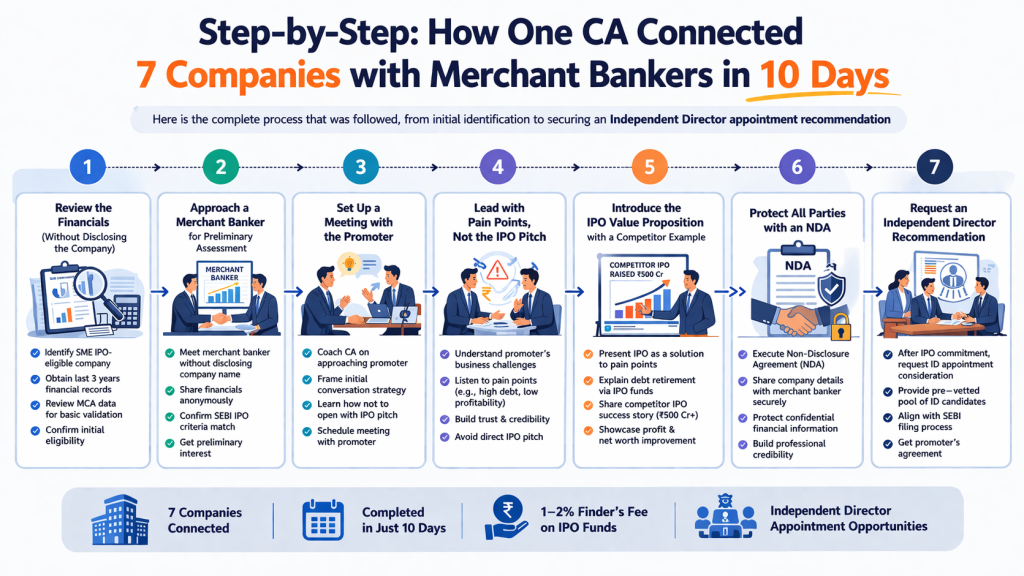
Step-by-Step: How One CA Connected 7 Companies with Merchant Bankers in 10 Days
Here is the complete process that was followed, from initial identification to securing an Independent Director appointment recommendation.
Step 1 : Review the Financials (Without Disclosing the Company)
The CA identified a company in his network that appeared to meet SME IPO criteria and obtained its last three years of financial records for review. Basic financial data is also publicly available on the MCA (Ministry of Corporate Affairs) website for registered companies.
The initial review confirmed eligibility. The next step was to validate this with a merchant banker.

Step 2 : Approach a Merchant Banker for Preliminary Assessment
In the first meeting with the merchant banker, the company’s identity was deliberately not disclosed. The goal was only to confirm interest and assess eligibility in principle.
The merchant banker confirmed that the financials matched SEBI’s IPO criteria and expressed interest in proceeding further.
Step 3 : Set Up a Meeting with the Promoter
With the merchant banker’s interest confirmed, the next step was coaching the CA on how to approach the promoter and frame the initial conversation, specifically, how not to open with an IPO pitch.
Step 4 : Lead with Pain Points, Not the IPO Pitch
This is the most critical step. In the meeting with the promoter, the CA’s first priority was to understand the business challenges the promoter was facing, not to present an opportunity.
The promoter revealed a significant problem: a ₹150 crore loan was substantially reducing profitability through interest payments. This kind of disclosure only happens when there is trust and genuine curiosity, not a sales pitch.
Step 5 : Introduce the IPO Value Proposition with a Competitor Example
Only after understanding the pain point, debt burden cutting into profits, was the IPO idea introduced. The framing was specific and practical:
- An SME or Mainboard IPO could raise funds to retire the debt
- Reduced interest payments would directly improve net profitability
- The promoter’s personal net worth would multiply post-listing
To eliminate hesitation, the CA presented a concrete example: a direct competitor had raised ₹500 crore through an IPO in the past five years and had been thriving since. This comparison, researched in advance, resolved the promoter’s doubts.
Step 6 : Protect All Parties with an NDA
Before sharing any company details with the merchant banker, a Non-Disclosure Agreement (NDA) was executed between the CA and the merchant banker. This protects the promoter’s confidential financial information and establishes the professional credibility of everyone involved.
Step 7 : Request an Independent Director Recommendation
As the final step, after the promoter had committed to proceeding with the IPO, the CA made a straightforward request: that the company consider appointing an Independent Director from a pre-vetted pool of candidates at the time of filing documents with SEBI.
The promoter agreed. The trust built through the entire process made this a natural outcome. The CA had delivered enormous value; recommending a board candidate was a small ask in return.
What Happens When the Company Qualifies for a Mainboard IPO Instead?
In the case above, the company’s financials turned out to be strong enough to qualify for a Mainboard IPO, a significantly larger listing than the SME route. This is not a complication; it is an upgrade. Mainboard IPOs involve larger fund raises, higher finder’s fees, and more prominent board positions.
The same process applies. The key difference is the scale of the outcome.
How This Strategy Leads Directly to Independent Director Appointments
The reason this approach works for Independent Director appointments, beyond the financial incentive, is trust.
Promoters of growing companies are not looking for strangers with impressive résumés on their boards. They are looking for people they already know and respect. When you are the person who introduced them to a transformational financial opportunity, you become exactly that person.
This is why establishing trust with promoters is the single most effective strategy for securing an Independent Director appointment, especially for first-timers with limited board experience.
The same strategy has been replicated to identify 6 additional IPO-worthy companies currently in the pipeline, with Independent Director recommendations pending for those engagements as well.
Frequently Asked Questions
Do I need to be a CA or CS to use this strategy?
No. You need a network that includes people with financial visibility into businesses, CAs, CS professionals, bank managers, or lawyers. Your role is to facilitate introductions, not to audit financials yourself.
How much can I earn as a finder’s fee?
Typically 1–2% of total funds raised through the IPO. For a company raising ₹50 crore, that translates to ₹50 lakh to ₹1 crore.
What is the SME IPO eligibility criteria in India?
SEBI requires a minimum net profit of ₹3 crore, annual turnover of ₹10 crore or more, and profitability in at least 2 of the last 3 financial years.
Where can I access a company’s financials?
Basic financial data for registered companies is publicly available on theMCA (Ministry of Corporate Affairs) website.
What is the role of a merchant banker in an IPO?
A SEBI-registered merchant banker acts as the lead manager for the IPO process, handling due diligence, regulatory filings, pricing, and investor outreach. Introducing an eligible company to a merchant banker is the core of this strategy.
Conclusion
The IPO strategy is one of the most underutilized pathways to securing an Independent Director appointment in India. It works because it leads with genuine value, helping a promoter unlock a transformational financial opportunity, and builds the kind of trust that makes a board recommendation a natural outcome.
You do not need to be a CA, a CS, or a seasoned director to get started. You need a network, a clear understanding of SME IPO eligibility criteria, and a structured approach to connecting promoters with merchant bankers.




 Allow notifications