


A Complete Guide for Senior Professionals Ready to Take Their Career to the Next Level
Table of Contents
You spent three decades climbing the corporate ladder. You earned every title, every promotion, every ounce of respect. And now, as retirement approaches or has already arrived, a quiet question lingers: “Is this it?”
The answer is no. Not even close. For senior professionals and retirees in India, one of the most powerful and underutilised career moves is becoming an independent director on a company’s board. It offers prestige, influence, meaningful work, and compensation, all without the grind of a 9-to-5 job.
In this guide, you will learn exactly what an independent director does, why retired professionals have a unique advantage, what it takes to qualify, and the step-by-step roadmap to land your first board appointment within six months.
The Career Stagnation Trap That Haunts Senior Professionals
More than 90% of senior professionals experience career stagnation in the final decade of their working life. Growth slows, opportunities narrow, and younger competitors start gaining ground. No matter what they try, the next level feels out of reach.
This is what we call the stagnation trap. It does not discriminate; it affects accomplished executives, domain experts, and seasoned consultants alike. The symptoms are familiar:
- Growth plateaued despite decades of experience and expertise.
- Constant pressure to stay relevant as industries evolve rapidly.
- Intensifying competition from younger, digitally native professionals.
- Shrinking opportunities as age increases and retirement nears.
- The lingering regret of unfulfilled ambitions, such as the CEO position that never materialised.
For many, this stagnation spirals into a full-blown professional crisis. Retirement amplifies it further because once you leave your organisation, the title, the network access, and the daily sense of purpose can vanish overnight.
Less than 10% professionals succeed in breaking this stagnation trap.
If age is just a number, then why should 60 put a cap on your career growth?
How to Overcome the Career Crisis as a Retiring Professional
If you’re a retired professional or someone about to retire soon, you’re likely wondering how to avoid the common career crisis that often accompanies this phase. So, what’s the best way to prevent it from happening?
The answer is simple: take your career to the next level.
To truly overcome this transition, you need to position yourself among the highest echelons of leadership. Rub shoulders with top executives, directors, CEOs, investors, and influential bankers who back the most exciting and innovative projects. Build relationships with these power players from a position of influence and responsibility.
This isn’t about working for them. It’s about working with them.
By placing yourself in these strategic circles, you’ll find that bigger roles and exciting opportunities are within reach, enabling you to elevate your career beyond your expectations.
What Is an Independent Director and Why Should You Care?
An independent director is a non-executive member of a company’s board of directors who has no material or pecuniary relationship with the company. Their job is to provide impartial oversight, challenge management decisions, and safeguard the interests of shareholders and stakeholders.
Think of it this way: you are not working for the company. You are sitting with the decision-makers, asking the hard questions, and shaping the direction of the business.

The Legal Mandate Creating Massive Demand
Indian corporate law, specifically the Companies Act 2013, and SEBI’s Listing Obligations and Disclosure Requirements (LODR), mandates the appointment of independent directors for a wide range of companies:
- All listed companies must have at least one-third of their board as independent directors.
- If the chairperson is an executive director (e.g., MD or CEO), at least half of the board must be independent.
- Unlisted public companies with paid-up capital of ₹10 crore or more, turnover of ₹100 crore+, or outstanding loans/debt of ₹50 crore+ must appoint at least two independent directors.
- Companies planning an IPO must have independent directors on their board regardless of their financial thresholds.
There is a significant and growing shortage of qualified independent directors in India. This shortage is your opportunity.
Why Retired Professionals Have a Unique Advantage
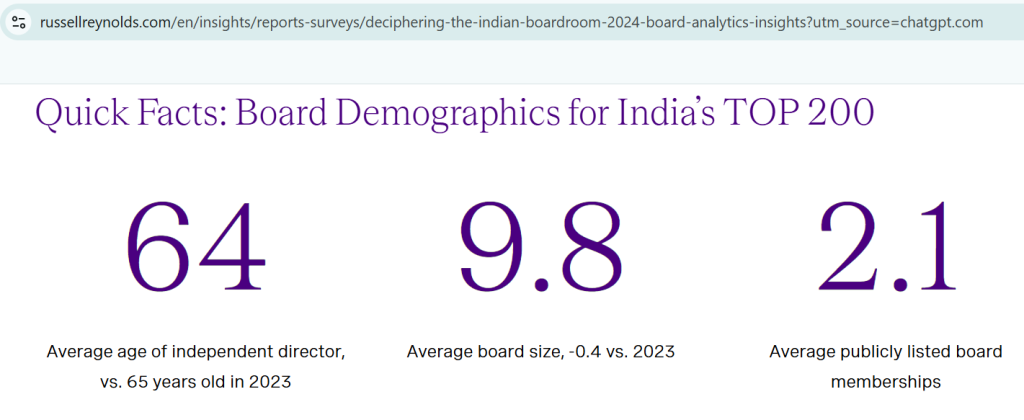
If you are retired or nearing retirement, you might assume the best opportunities are behind you. The data tells a different story entirely.
| Metric | Data Point |
| Average age of independent directors (India’s Top 200 companies) | 64.1 years |
| Average age of directors in NSE-listed companies | 56 years |
| Preferred experience level for board appointments | 30+ years |
The numbers are unequivocal. Companies actively seek professionals with decades of wisdom, industry expertise, and deep networks. Retired professionals can also dedicate more time and focus to their board roles because this is not a side gig; it is a primary engagement.
Key Advantages for Senior and Retired Professionals
- Deep industry knowledge that takes decades to build, something no shortcut can replicate.
- Extensive professional networks spanning industries, sectors, and geographies.
- Availability and focus that working professionals simply cannot match.
- Credibility and gravitas that boards value for governance oversight.
- Cross-functional perspective from having navigated multiple business cycles.
The Benefits of Becoming an Independent Director
Becoming an independent director is not just about extending your career. It is a fundamentally different kind of professional engagement that offers rewards well beyond a pay cheque.
1. Financial Compensation
Independent directors earn sitting fees for each board and committee meeting attended. SEBI-listed companies may also grant stock options and commission-based compensation. For retired professionals, this provides a steady, meaningful income stream without the demands of full-time employment.
2. Prestige and Recognition
A board-level title carries weight. It signals that your expertise is valued at the highest level of corporate decision-making. This recognition extends across your professional network and opens doors to additional opportunities including advisory roles, speaking engagements, and mentoring positions.
3. Networking at the Highest Level
As an independent director, your peers are CEOs, managing directors, promoters, investors, and merchant bankers. You interact with the movers and shakers of the business world from a position of equal standing, not as someone working for them, but as someone sitting with them.
4. Purpose and Continued Relevance
One of the most underappreciated benefits is the sense of purpose. Board work is intellectually demanding and socially rewarding. It keeps you engaged, relevant, and connected long after traditional retirement age.
Your 3-Step Roadmap to Becoming an Independent Director
Fewer than 10% of senior professionals break the stagnation trap. The ones who do follow a deliberate, structured approach.
Step 1: Crack the IICA Independent Director Examination
The Indian Institute of Corporate Affairs (IICA) conducts a mandatory online proficiency self-assessment test for first-time independent directors. Here is what you need to know:
- The exam covers corporate governance, board procedures, the Companies Act, SEBI regulations, financial literacy, and ethical standards.
- It is an open-book, online test that you can take from home.
- You must register on the IICA portal, complete the preparatory modules, and then schedule your exam.
- The pass mark is straightforward, and most well-prepared professionals clear it on their first attempt.
Preparation tip: Focus heavily on the Companies Act, 2013 (especially Sections 149–152 and Schedule IV), SEBI’s LODR Regulations, and case studies on corporate governance failures. Understanding these areas deeply will serve you not just in the exam but in your actual board role.
Step 2: Build a Powerful Personal Brand
Passing the exam makes you eligible. Your personal brand is what makes you appointable. Companies and their nomination committees need to find you, trust you, and believe you will add value.
- Optimise your LinkedIn profile with board-level keywords such as “independent director,” “corporate governance,” and “board advisory.”
- Publish thought leadership articles on governance, industry trends, and strategic management.
- Register on platforms that connect independent directors with companies, such as the IICA databank.
- Seek speaking opportunities at industry forums, conferences, and governance summits.
- Build a concise, compelling board CV that highlights your governance-relevant experience, not your entire career history.
Step 3: Invest in Strategic Networking
Board appointments are, at their core, relationship-driven. Companies appoint people they trust, and trust is built through consistent, visible engagement with the right people.
- Connect with startup founders and promoters who are scaling their businesses and will soon need board-level governance.
- Build relationships with merchant bankers and investment bankers who advise companies on IPO readiness, a process that requires independent director appointments.
- Engage with CXOs and senior leaders in your industry who serve on nomination and governance committees.
- Attend governance-focused events and contribute meaningfully to discussions.
The professionals who land board positions fastest are not necessarily the most qualified on paper. They are the ones who are visible, connected, and trusted.
Frequently Asked Questions About Independent Directors
Can I be an independent director on multiple boards?
Yes. A person can serve as an independent director on a maximum of seven listed companies at any given time. If you are a whole-time director in any listed company, the limit is three listed companies.
Do I need a specific degree or professional qualification?
There is no mandatory degree requirement. The law requires “relevant expertise and experience.” Professionals from finance, law, engineering, operations, HR, marketing, and technology backgrounds are all in demand. The key is demonstrating that your experience adds value to the board’s decision-making.
Is the IICA exam difficult?
The exam is designed to test your understanding of corporate governance fundamentals, not to be a barrier. With structured preparation over 4–6 weeks, most professionals pass comfortably.
How long does it take to get appointed?
With focused effort on the three steps outlined above, many professionals secure their first board appointment within 6–12 months. The timeline depends on your existing network, industry profile, and how actively you pursue the opportunity.
Conclusion: Your Career Is Not Over. It Is Ready to Evolve.
Retirement does not mean the end. For senior professionals in India, becoming an independent director is the most powerful way to break the stagnation trap, regain career momentum, and achieve the recognition you have earned over decades of hard work.
The demand is real. The legal mandate is clear. And the shortage of qualified candidates means the opportunity is wide open.
You have the experience. You have the wisdom. Now it is time to sit at the table you deserve.





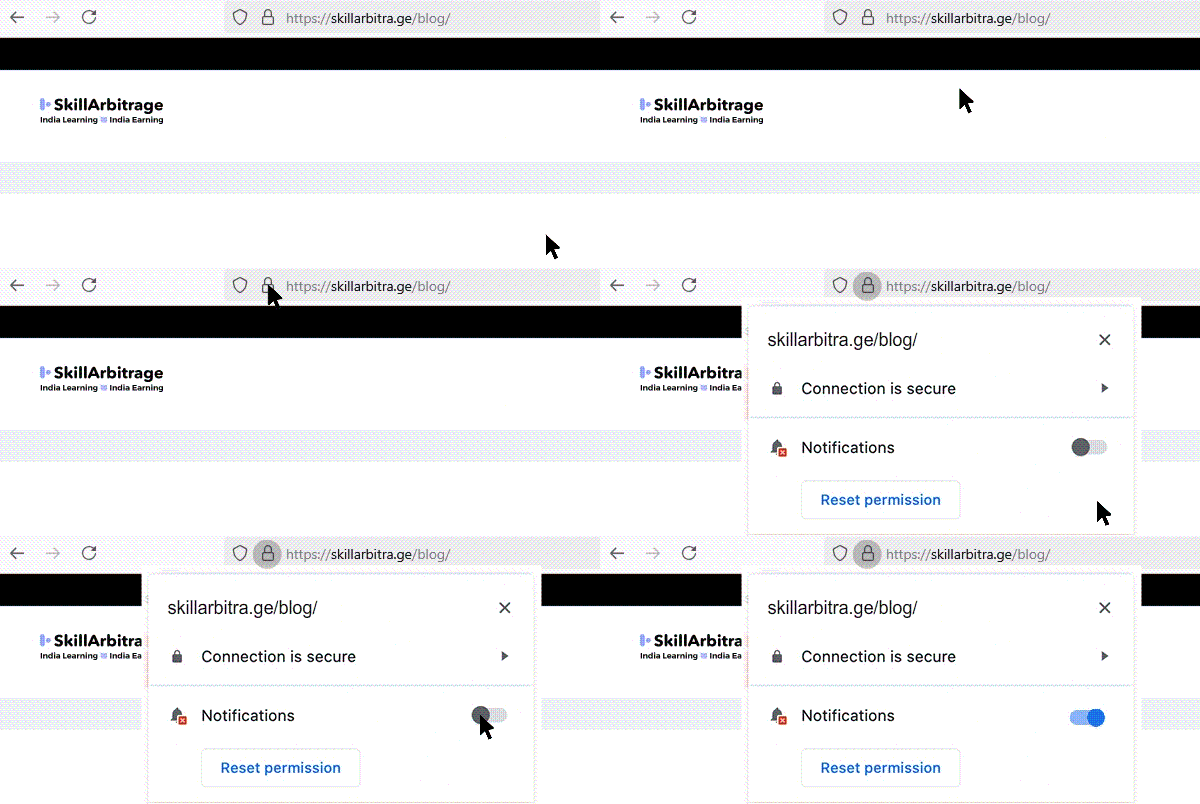
 Allow notifications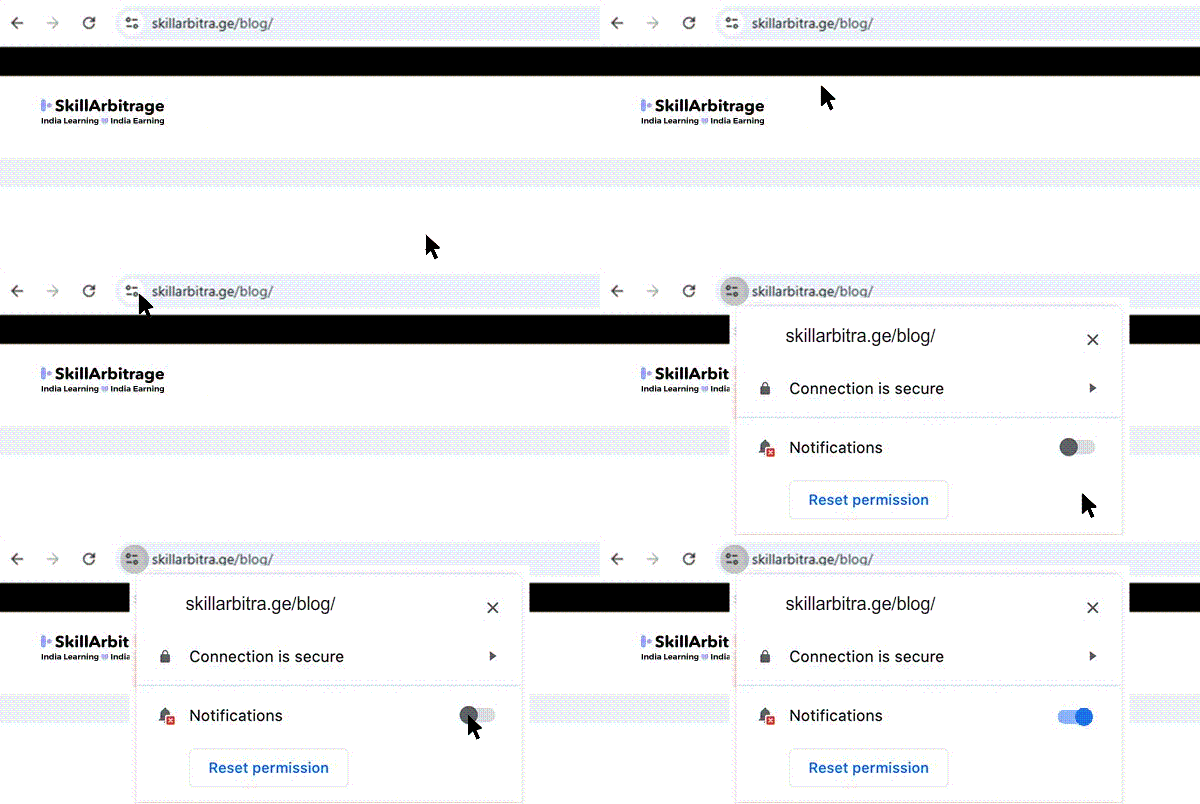
As someone who’s been in corporate leadership for over two decades, I can attest to the fact that the transition to being an independent director isn’t just about staying relevant, it’s about leveraging decades of experience in a way that truly matters. The article does a great job of highlighting how this path offers both purpose and prestige, especially for retirees looking to continue contributing meaningfully. It’s refreshing to see a focus on building personal brand and strategic networking, which are often overlooked but critical for success in this space.